

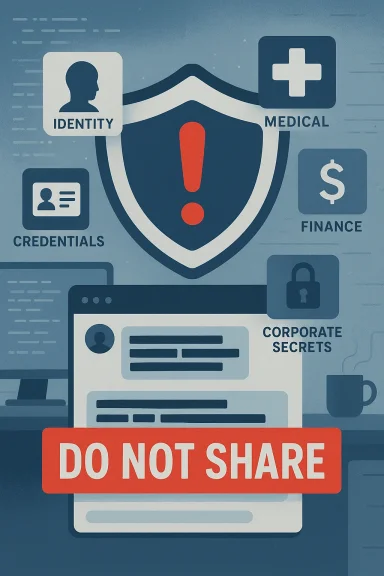
People often treat ChatGPT and its peers like private assistants — but when you type, upload, or speak sensitive material into a chatbot, you may be handing away control of that information in ways most users don’t expect. The short list published by mainstream outlets — identity documents, medical results, bank and investment details, login credentials, and proprietary corporate material — is accurate as a starting point, but the full picture is more complex. This feature unpacks the five categories you should never share with public AI chatbots, explains why those categories are risky, summarizes current vendor policies and legal wrinkles that affect data retention, and gives a practical, step-by-step privacy playbook you can apply today to protect yourself and your organization.
AI chatbots are conversational front-ends to complex cloud systems that may log, review, and retain your inputs for multiple purposes: service delivery, abuse detection, model improvement, and legal discovery. Vendors publish guidance that looks simple — “don’t share sensitive info” — but each provider handles data differently: some use human reviewers, some store reviewed data for years, and some offer enterprise tiers with tighter controls. That means the practical answer to “is this safe to send?” depends on the vendor, the product tier, and recent legal developments.
OpenAI’s public guidance and retention rules make two points clear: users should avoid sending sensitive information in normal conversations, and conversations deleted by users are scheduled for permanent deletion within a retention window (typically 30 days for consumer ChatGPT), though exceptions exist for safety, legal, or security reasons. Those same retention windows and deletion guarantees have been subject to change when courts or investigations require preservation.
Google’s Gemini warns explicitly not to enter “confidential information or any data you wouldn’t want a reviewer to see,” and the Gemini Apps privacy hub confirms human review and retention practices that can keep reviewed content for extended periods unless special settings are used. This dual reality — user controls exist, but certain content may still be reviewed and retained — is the practical reason the blanket advice to “never share” sensitive data remains sound.
Why chatbots are risky for identity data:
Why medical results are risky:
Vendor considerations:
Why this is a hard no:
Why this is especially dangerous:
Google’s Gemini explicitly warns users that conversations may be reviewed by humans and that reviewed content can be retained for up to three years; it also clarifies that even with activity controls disabled, the system may retain conversations for a short window (for example, 72 hours) to provide the service and process feedback. Those retention rules are configurable in some settings, but human-reviewed data is handled separately.
Anthropic, OpenAI, and other companies publicly recommend cautious user behavior — for example, deleting conversations and using stronger account locks — but those recommendations coexist with platform-level logging designed to detect abuse and maintain safety. Third-party reporting has captured vendor spokespeople echoing the “don’t share” guidance.
Protecting privacy around AI is not just about what you don’t say — it’s about changing habits, tools, and organizational policies so that sensitive information never needs to be funneled into systems that can’t guarantee its security. Start with the simple steps above; make them standard operating procedure for yourself and your team.
Source: AOL.com Five things you should never reveal to ChatGPT if you want to protect your privacy
 Background: why “don’t share” is simpler than the reality
AI chatbots are conversational front-ends to complex cloud systems that may log, review, and retain your inputs for multiple purposes: service delivery, abuse detection, model improvement, and legal discovery. Vendors publish guidance that looks simple — “don’t share sensitive info” — but each provider handles data differently: some use human reviewers, some store reviewed data for years, and some offer enterprise tiers with tighter controls. That means the practical answer to “is this safe to send?” depends on the vendor, the product tier, and recent legal developments.OpenAI’s public guidance and retention rules make two points clear: users should avoid sending sensitive information in normal conversations, and conversations deleted by users are scheduled for permanent deletion within a retention window (typically 30 days for consumer ChatGPT), though exceptions exist for safety, legal, or security reasons. Those same retention windows and deletion guarantees have been subject to change when courts or investigations require preservation.
Google’s Gemini warns explicitly not to enter “confidential information or any data you wouldn’t want a reviewer to see,” and the Gemini Apps privacy hub confirms human review and retention practices that can keep reviewed content for extended periods unless special settings are used. This dual reality — user controls exist, but certain content may still be reviewed and retained — is the practical reason the blanket advice to “never share” sensitive data remains sound.
The five categories you should never reveal — and why
1. Identity information: SSNs, IDs, addresses, DOBs, phone numbers
Identity data is a direct path to fraud, account takeover, and identity theft. Social Security numbers, passport and driver’s license numbers, full birthdates, residential addresses, and personal phone numbers are the classic building blocks attackers use to impersonate you, reset accounts, or enroll in services in your name.Why chatbots are risky for identity data:
- Inputs can be logged in vendor systems and appear in datasets used for analysis or human review. Even when vendors strip obvious PII, embedded context can re-identify people.
- Chat histories are not automatically quarantined to your local device; they exist in cloud logs and backups where different retention rules and access controls apply.
2. Medical records and lab results
Medical data is sensitive for two reasons: the personal harm it can cause if leaked (discrimination, insurance consequences, stigma) and the regulatory wrinkle — HIPAA protections apply to covered entities and their business associates, but they typically do not apply to consumer chatbots unless an explicit covered-entity agreement (Business Associate Agreement) exists.Why medical results are risky:
- A chatbot is not a doctor’s office. If you upload lab results or imaging, those images and text can be stored and — depending on settings — may be reviewed by humans or used to improve models. Vendors warn that medical content shared outside protected healthcare channels is not afforded healthcare confidentiality.
- De‑identification isn’t foolproof. Even cropped images, combined with context about dates and rare conditions, can re-identify individuals.
- If you need help interpreting a lab result, remove or redact any personal identifiers and crop images aggressively so only the numerical result or relevant values remain.
- Prefer healthcare-specific tools that are offered under a HIPAA-compliant agreement or that explicitly state they are designed for clinical data handling.
3. Financial accounts and payment data
Bank routing numbers, account numbers, brokerage account IDs, and even detailed transaction histories are high-value data. Disclosure risks include monitoring accounts, social engineering attacks, and outright financial theft.Vendor considerations:
- Inputting raw account numbers into a public chatbot can create logs, backup copies, or exposures through human review. Consumer chatbots are not secure vaults for financial credentials.
- Use official bank channels or encrypted, purpose-built tools when you need to share financial identifiers.
- Never paste full account numbers or copies of checks into chat sessions. If you must discuss a transaction, give the minimum necessary context and remove account digits (use formats like XXXX-1234).
4. Login credentials and authentication secrets
Usernames and passwords, API keys, security tokens, and secret answers are immediate keys to account takeover. Chatbots are not password managers.Why this is a hard no:
- Chatbots may retain prompts and responses; any stored credential becomes an attack vector. The right move is to store passwords only in a dedicated password manager and never in an AI chat.
- Use a secure password manager (ideally one with zero-knowledge encryption).
- If an AI-assisted task requires account access, use OAuth or tokenized connections through vendor-supported integrations where tokens are stored and rotated securely — avoid pasting credentials into chat text.
5. Proprietary corporate information and trade secrets
Internal client data, non-public roadmaps, source code snippets covered by NDAs, or financial projections have legal and competitive stakes. Exposing these to a consumer chatbot can create compliance breaches and intellectual property risks.Why this is especially dangerous:
- Many organizations mistakenly use consumer chatbots to draft emails, summarize internal documents, or rework code. Without enterprise controls, those inputs may be used in model training or read during human review. Vendor enterprise products and private deployments exist to mitigate this, but consumer services are insufficient for sensitive corporate data.
- Never paste client PII, contract text, source code, or proprietary analytics into consumer chatbots. Use an enterprise AI platform with contractually guaranteed data handling, or keep sensitive work on internal tools that never touch public LLM APIs.
Policy and legal context that affects what happens to data
Vendor policies: deletion, temporary chats, and human review
Most mainstream vendors publish explicit guidance telling users to avoid sharing sensitive info, together with deletion and retention windows. OpenAI’s documentation explains that users can delete conversations and that deleted chats are typically scheduled for permanent deletion within 30 days, while Temporary Chats are automatically deleted within 30 days as well. But vendors also note exceptions for safety, legal obligations, and security investigations.Google’s Gemini explicitly warns users that conversations may be reviewed by humans and that reviewed content can be retained for up to three years; it also clarifies that even with activity controls disabled, the system may retain conversations for a short window (for example, 72 hours) to provide the service and process feedback. Those retention rules are configurable in some settings, but human-reviewed data is handled separately.
Anthropic, OpenAI, and other companies publicly recommend cautious user behavior — for example, deleting conversations and using stronger account locks — but those recommendations coexist with platform-level logging designed to detect abuse and maintain safety. Third-party reporting has captured vendor spokespeople echoing the “don’t share” guidance.
Court orders, subpoenas, and legal preservation
Legal processes can override normal deletion policies. In notable instances, court orders have compelled vendors to retain data that would otherwise have been deleted, meaning a promise of “deleted in 30 days” may be superseded by a legal hold. Public reporting has cited rulings that required indefinite preservation of certain logs for litigation and discovery, temporarily changing vendor behavior. That creates a permanent uncertainty for people who assume deletion equals erasure.Product differences: consumer vs enterprise vs on-prem
- Consumer chatbots provide convenience but fewer guarantees.
- Enterprise AI offerings increasingly promise “no training on customer data,” separate isolated instances, contractual data deletion timelines, and compliance options — these are the right choice for organizations handling sensitive data at scale.
- On‑premise or private-hosting options provide the strongest technical separation but carry operational costs and complexity.
Practical privacy playbook: what to do, step by step
Follow this checklist when you use any AI chatbot. Think of it as digital hygiene for the age of generative AI.- Treat public chat windows like public forums.
- Never paste full SSNs, driver’s license numbers, passport numbers, or full bank account and routing numbers. Use tokenized or partial formats (last four digits only) if you must reference an account.
- Use vendor privacy controls and read the retention settings.
- Turn on available “auto-delete” or data retention minimization settings, and understand whether human reviewers might still see content that was “deleted.” For Gemini and ChatGPT, check activity settings and Temporary Chat options.
- Avoid uploading full documents or images containing PII — redact aggressively.
- If you need help with a document (medical result, legal clause), copy only the minimal necessary text and scrub names, dates of birth, and account numbers. When sharing images, crop to exclude metadata and identifying marks.
- Don’t use chat for passwords, API keys, or tokens — use a password manager.
- If an AI integration needs access, prefer OAuth or scoped tokens that can be revoked, not raw username/password pairs.
- For work: use enterprise AI or keep data in internal tools.
- If your company allows AI use, insist on enterprise-grade agreements with data residency, “no training” promises, and contractual retention terms. If those aren’t available, treat consumer chatbots as forbidden for any sensitive work.
- Lock your account: strong passwords + multi‑factor authentication.
- Protect your chatbot account with a unique password and MFA; treat this account like any other high-value login. Use an authenticator app or hardware FIDO key when possible.
- Delete conversations and clear local caches regularly — but don’t assume deletion is absolute.
- Deleting UI history is a good habit, but be aware of vendor retention windows and legal exceptions. When you delete, check whether the vendor provides a deletion confirmation and read the privacy policy’s retention explanation.
- Use isolated accounts for risky experiments.
- If you must try something borderline (e.g., test a data transformation on real-looking data), use a throwaway account tied to a burner email and never link it to your primary accounts.
- Educate co-workers and family.
- The weakest link is often another human. Explain why they shouldn’t paste sensitive receipts, medical scans, or client data into chat windows.
- Audit and export periodically.
- If you want visibility, export your chat history and audit it for PII so you know what you’ve already shared and can clean it up where possible.
Real-world examples and fringe cases to watch for
- Accidental voice activations: Conversational agents may activate by mis-hearing a trigger phrase and log things you never intended to share. Vendor docs warn this can happen and describe short retention windows for such interactions; review settings that govern voice activation.
- Files and screenshots: Files uploaded to chats can be tied to the conversation lifecycle and may survive UI deletion via backups or legal holds. OpenAI’s file retention documentation explicitly ties uploaded files to conversation deletion lifecycles and notes the potential for additional retention for safety/compliance reasons.
- Human reviewers and annotation: Several vendors acknowledge human review for quality and safety, and vendor help pages or support documents disclose that reviewed data may be retained separately. This is a key reason to treat chat windows as potentially visible beyond the model itself.
- Court orders and litigation: If an AI provider is subject to a legal hold tied to litigation, deletion promises can be paused. A highly publicized legal matter forced at least one vendor to preserve chat logs that would otherwise have been deleted, highlighting the limits of deletion promises.
Enterprise and developer advice: when you must use AI with sensitive data
If your job requires feeding sensitive data into AI workflows, don’t use consumer chatbots. Instead, pursue one of these safer paths:- Enterprise offerings with contractual protections: seek vendors that sign off on data handling, limit training on customer content by contract, and provide audit logs and compliance attestations. These typically cost more but are essential for regulated workflows.
- Dedicated private instances or on-prem deployments: these keep model execution and logs inside your network boundary. They require ops capability but give the strongest data control.
- Synthetic or de-identified datasets: when training or testing, use synthetic data or provably de‑identified copies rather than real client data.
- Data minimization pipelines: build pre-processing that strips or tokenizes PII before any request hits an external model.
- Compliance reviews and legal agreements: involve legal and compliance teams early. NDAs, Data Processing Agreements (DPAs), and Business Associate Agreements (for health data) are non-negotiable when sensitive data is involved.
Strengths, shortcomings, and what to expect next
The benefits of conversational AI are clear: speed, creativity, and automation. For routine drafting, brainstorming, and learning, ChatGPT and its peers are powerful and often safe when users avoid sensitive inputs. But the technology’s rapid evolution and legal scrutiny create structural uncertainty:- Strengths:
- Productivity gains and new workflows.
- Increasing vendor transparency around data controls and enterprise features.
- Shortcomings and risks:
- Divergent retention and review policies between vendors create confusion.
- Legal processes can force vendors to retain data contrary to prior deletion promises, creating trust gaps.
- Human review of content is still common, meaning that “private” conversations can be seen by people outside the immediate user/vendor context.
- Better product controls: expect more granular auto-delete, account-scoped retention policies, and clearer opt-outs for model training on user data.
- Regulatory pressure: laws in multiple jurisdictions are coalescing around data minimization and transparency for AI systems, which should push vendors toward stronger user protections.
- Enterprise adoption: as enterprise products mature, organizations will increasingly segregate sensitive workloads to private or contractually guaranteed platforms.
Quick reference: do/don’t cheat sheet
- Do: use a password manager and MFA; redact documents; use enterprise AI for work; enable auto-delete where available; export and audit your history.
- Don’t: paste SSNs, full medical images with identifiers, bank account information, passwords/API keys, or unredacted proprietary documents into consumer chat windows.
Conclusion
The five items the headlines tell you to never reveal — identity documents, medical results, financial accounts, login credentials, and proprietary corporate data — are an accurate top-level checklist for staying safe with ChatGPT and other AI chatbots. But the underlying lesson is broader: in the current environment, convenience and privacy are often in tension. Vendor controls and enterprise options can mitigate risk, but they don’t eliminate it — legal orders, human reviewers, and persistent logs mean deletion is not always erasure. Treat public chatbots as untrusted endpoints when it comes to anything that can be used to harm you, your finances, or your organization, and build workflows that minimize exposure: redact, tokenize, quarantine, and prefer enterprise-grade or on‑prem solutions for anything that matters.Protecting privacy around AI is not just about what you don’t say — it’s about changing habits, tools, and organizational policies so that sensitive information never needs to be funneled into systems that can’t guarantee its security. Start with the simple steps above; make them standard operating procedure for yourself and your team.
Source: AOL.com Five things you should never reveal to ChatGPT if you want to protect your privacy
