

The pendulum that moved much personal and enterprise IT into public clouds is swinging back — not because clouds have failed, but because free, self-hosted Linux server platforms are finally mature enough to make on-premises privacy and control practical for households, small teams, and even some public-sector use cases. As analysts forecast public cloud spending in the high hundreds of billions of dollars for 2024 and beyond, a parallel movement — driven by digital sovereignty, privacy concerns, and rising subscription costs — is making self-hosting and private cloud architectures realistic alternatives for many users.
The macro forces nudging users toward on-premises deployments are clear. Analyst forecasts put global public cloud spend in the mid‑hundreds of billions for 2024, underscoring both the scale of centralized cloud adoption and the rising operational costs organizations face as they consume more managed services and AI capacity. At the same time, regulatory and policy momentum in Europe — from Schrems II rulings on cross‑border data transfers to sovereign-cloud initiatives such as Gaia‑X — has crystallized a demand for architectures that keep data under local control.
But the other side of the equation is pragmatic: the tooling for small-scale servers has improved. Projects that once required a fair amount of Linux know‑how now offer polished web consoles, curated app catalogs, automatic updates, and simplified networking stacks. That lowers the friction for non‑specialists to host email, collaboration suites, chat, and file storage without funneling everything into big‑tech clouds.
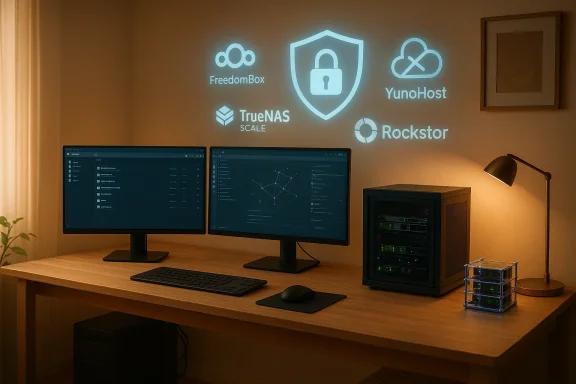
This article examines five free Linux server platforms that have emerged as go‑to options for privacy‑focused self‑hosting: FreedomBox, YunoHost, TrueNAS SCALE, Rockstor, and Zentyal. I summarize what each does best, verify key technical claims, highlight deployment caveats, and give practical guidance for choosing and running them in production‑lite environments.
If you’re considering the leap, start small, validate backups and networking, and treat your on‑premises servers with the same operational rigor you’d expect from a managed service. The privacy and sovereignty gains are real — but they come with responsibilities.
Source: findarticles.com Five Free Linux Servers Challenge Public Cloud
 Background: why self-hosting matters now
The macro forces nudging users toward on-premises deployments are clear. Analyst forecasts put global public cloud spend in the mid‑hundreds of billions for 2024, underscoring both the scale of centralized cloud adoption and the rising operational costs organizations face as they consume more managed services and AI capacity. At the same time, regulatory and policy momentum in Europe — from Schrems II rulings on cross‑border data transfers to sovereign-cloud initiatives such as Gaia‑X — has crystallized a demand for architectures that keep data under local control.But the other side of the equation is pragmatic: the tooling for small-scale servers has improved. Projects that once required a fair amount of Linux know‑how now offer polished web consoles, curated app catalogs, automatic updates, and simplified networking stacks. That lowers the friction for non‑specialists to host email, collaboration suites, chat, and file storage without funneling everything into big‑tech clouds.
This article examines five free Linux server platforms that have emerged as go‑to options for privacy‑focused self‑hosting: FreedomBox, YunoHost, TrueNAS SCALE, Rockstor, and Zentyal. I summarize what each does best, verify key technical claims, highlight deployment caveats, and give practical guidance for choosing and running them in production‑lite environments.
Overview of the five contenders
FreedomBox — a privacy‑first “personal server” experience
FreedomBox began as an idea championed by legal scholar Eben Moglen and has grown into a Debian Pure Blend with a web management console called Plinth. The project’s goal is straightforward: make it easy for non‑experts to run privacy‑focused services on hardware they control.- Key bundled services include Nextcloud (files and collaboration), ejabberd (XMPP chat), Matrix Synapse, Mumble (voice), Janus (WebRTC), and WordPress for publishing. FreedomBox also provides VPN options (OpenVPN and WireGuard) and supports Tor and Privoxy for additional anonymity.
- The project is packaged within Debian and distributes images for popular single‑board computers and modest x86 hardware. Official documentation lists Raspberry Pi 3 and Raspberry Pi 4 among supported targets and shows a broader list of older SBCs; while a Raspberry Pi 2 historically appears in older hardware lists, current recommended builds are focused on Pi 3/4 family and similar arm64 devices.
- FreedomBox runs services as managed packages with a focus on sane defaults: automatic updates, an app marketplace via Plinth, and a firewall interface. The manual shows integrated apps like Matrix, ejabberd, Nextcloud, Janus, Mumble, and standard web app stacks — confirming the platform’s multi‑service ambition.
YunoHost — one‑click apps and unified logins
YunoHost takes a different approach: it’s a Debian‑based distribution that focuses on packaging dozens to hundreds of apps into a single catalog with a friendly web admin portal and single sign‑on via SSOwat.- Out of the box, YunoHost uses Nginx as a reverse proxy, SSOwat for unified authentication, Let’s Encrypt for TLS automation, and Fail2ban plus a host firewall for basic hardening.
- The app catalog includes one‑click deployments for Jitsi Meet, OnlyOffice, Mastodon, GitLab, and many community‑packaged apps. YunoHost also supports a full mail stack (Postfix, Dovecot, Rspamd) for those who want to run their own mail.
- In practice, YunoHost is tailored to households, hobbyist communities, and small teams — projects that value quick installs and an easy portal over raw scalability.
TrueNAS SCALE — ZFS reliability plus containerized apps
When data integrity and reliable snapshots are top priorities, TrueNAS stands out. TrueNAS historically split into CORE (FreeBSD, ZFS) and SCALE (Linux, Debian base). TrueNAS SCALE brings OpenZFS to a Linux stack and layers in container support for apps.- The filesystem engine is OpenZFS, delivering copy‑on‑write snapshots, end‑to‑end checksums that detect bit‑rot, and snapshot replication. These are the principal reasons administrators choose ZFS for backups and critical file stores.
- SCALE adds Linux containers and orchestration features that let you run services like Nextcloud, Jellyfin, or databases alongside your NAS shares. Recent product evolution has focused development on the Linux‑based branch for broader container and Linux app compatibility.
- For home labs and small offices, TrueNAS is a robust NAS platform: SMB/NFS shares, scheduled scrubs, snapshot policies, and optional high‑availability appliances are all part of the ecosystem.
Rockstor — Btrfs simplicity on modest hardware
Rockstor prefers a lighter weight filesystem approach, building on Btrfs and an openSUSE base. It emphasizes a compact administration UI and lower hardware needs than typical ZFS setups.- With Btrfs you still get snapshotting, transparent compression, and integrated RAID features — but with different tradeoffs from ZFS.
- Rockstor exposes “Rock‑ons” (its Docker‑style add‑ons) for running services from the web UI, which accelerates app deployment without deep container orchestration knowledge.
- Community threads and documentation indicate Rockstor 4+ offers ARM64 images and specific support for Raspberry Pi 4, though ARM support is more community‑driven and can require attention to boot and installer quirks.
Zentyal — a Windows‑friendly AD off‑ramp
Zentyal is built on Ubuntu LTS and uses Samba 4 to provide Active Directory–compatible services for organizations looking to move off Windows Server but keep AD semantics.- It supports domain joins, user/group management, file and printer sharing, DNS, DHCP, and optional mail/gateway modules. That makes Zentyal a practical choice for small businesses that must preserve Windows domain workflows while reducing Microsoft licensing exposure.
- Zentyal publishes a free development edition suitable for labs and internal testing; paid subscriptions provide commercial support and features intended for production use.
What these platforms get right (and what they don’t)
Strengths shared across the group
- Sovereignty and privacy: Running services on your hardware keeps data paths local and reduces dependence on third‑party cloud vendors.
- Cost control: For many small deployments, a one‑time hardware purchase plus minimal electricity can be cheaper than recurring SaaS subscriptions — especially when hosting multiple services.
- Mature building blocks: Projects like Nextcloud, Matrix, OpenZFS, and Btrfs are production‑tested; integrating them into curated stacks reduces integration work.
- Community and public sector validation: Major public‑sector projects (for example, the French government’s Matrix‑based Tchap deployment and pilots by EU data authorities to use self‑hosted Nextcloud/Collabora) underscore that self‑hosted stacks can scale beyond hobbyist projects.
Common limitations and risks
- Operational burden: Self‑hosting trades subscription fees for operational responsibility. Backups, security hardening, certificate rotation, and patching fall on the operator.
- Mail deliverability headaches: Hosting SMTP on consumer networks is particularly unforgiving due to IP reputation, RBLs, and complex anti‑spam rules.
- Hardware and network resilience: Home internet connections and SBC storage (microSD) can be single points of failure; invest in redundancy where it matters.
- Scaling limits: While these platforms can support many use cases, they are not drop‑in replacements for enterprise public‑cloud autoscaling and global CDN performance.
- Diverse maturity across architectures: ARM64 support (e.g., Raspberry Pi 4) is increasingly mainstream but sometimes community‑led; expect variation in images and installer robustness between x86 and ARM targets.
Choose the right platform: practical decision guide
Quick decision matrix
- Pick FreedomBox if your primary goal is privacy, a simple remote access story, and a curated set of collaboration apps with strong Debian integration.
- Pick YunoHost when you want the widest one‑click app catalog and a single sign‑on portal for a home, family, or small community.
- Pick TrueNAS SCALE when data integrity, snapshots, and a robust NAS backbone are non‑negotiable.
- Pick Rockstor if you want Btrfs simplicity on modest hardware and a lighter NAS footprint.
- Pick Zentyal if you’re migrating Windows Server AD functionality and need native Samba 4 compatibility.
Baseline operational checklist for any self‑hosted deployment
- Get a domain name and plan for DNS management (including SPF/DKIM/DMARC if you operate mail).
- Ensure reachable networking: either a static public IP or a dynamic DNS service plus proper router port forwarding.
- Enable automatic updates where possible — but test major distribution upgrades in a lab first.
- Use on‑site backup plus off‑site copies (cloud or remote replica) — do not rely on a single disk or single site.
- Add a modest UPS to ride out short power blips and protect filesystem integrity.
- Hardening basics: firewall rules, fail2ban or equivalent intrusion detection, and TLS everywhere (Let’s Encrypt covers most use cases).
- VPN access: start with WireGuard for secure remote connections — it’s modern, performant, and easier to audit than older solutions in most deployments.
Deep dive: operational notes and gotchas
Storage: ZFS vs Btrfs (TrueNAS vs Rockstor)
- ZFS (TrueNAS SCALE): engineered for data integrity. It provides checksums, self‑healing when redundancy exists, and robust snapshot and replication mechanisms. ZFS typically benefits from generous RAM allocation (the oft‑quoted rule of thumb is at least 1 GB of RAM per TB of usable storage for some workloads, though real needs vary) and careful vdev design.
- Btrfs (Rockstor): lighter on memory and simpler to administer in small setups. It supports snapshotting and compression, but historically Btrfs has had nuanced edge cases around RAID‑5/6 and some resync behaviors. Rockstor mitigates complexity via a polished UI and curated features.
Mail: be cautious before committing
Running your own mail server (Postfix/Dovecot/Rspamd with DKIM) can be rewarding but requires attention to DNS, reverse DNS, SPF/DKIM/DMARC, and ongoing monitoring for blacklistings. For many small organizations the hybrid pattern — self‑host mail for internal use, but use a reputable smart host or relay for outbound internet delivery — is the real pragmatic compromise.Real‑world performance: VPNs and WireGuard
- WireGuard has repeatedly shown lower latency and higher throughput than legacy tunnel options in independent benchmarks, and many operators report faster connection establishment and easier configuration. For most home and small‑office remote access needs, WireGuard is the recommended first step.
- That said, VPN performance is affected by tunnel endpoints, ISP peering, and CPU cryptographic offload. Always benchmark actual end‑to‑end throughput in your environment.
App compatibility and federation
- Projects like Matrix and XMPP are deliberately federated to allow cross‑server communication. Governments and large organizations have successfully deployed Matrix at scale (for example, France’s Tchap), which proves federation can work in high‑security environments. However, federation introduces policy and moderation responsibilities — you must decide who you will federate with.
- Some services integrated into curated stacks may require additional components (for example, Janus needs a TURN/Coturn server for robust WebRTC across NATs). Check app‑to‑app dependencies in advance.
Security lifecycle and updates
- Keep a staged update process for major distribution upgrades. Many curated distributions provide automatic security updates for packages, but distribution upgrades (e.g., Debian major versions) can change package availability and break edge apps.
- Test restoration procedures. Backups are only valuable when you can restore them under time constraints.
Cost and value calculus: self‑host vs public cloud
Self‑hosting shifts costs from operational subscription fees to capital expenditures (hardware) and time (administration). Consider the following when doing the math:- Upfront hardware: single‑board computers or a modest NUC can host small services cheaply; a robust TrueNAS or used enterprise chassis will cost more but deliver reliable storage.
- Power and network: continuous power and broadband upload capacity are non‑zero costs. For heavy sync workloads (many users, large media), home ISPs may be a limiting factor.
- Human time: expect a few evenings of setup and recurring maintenance. For small teams, that may be worth it. For larger organizations with compliance needs, factoring in staff or paid support (commercial subscriptions or managed providers) is prudent.
- Hybrid options: keep critical backups off‑site in a small commercial cloud bucket to combine sovereignty with resilience. Many organizations strike a balance: self‑host daily services and use low‑cost cloud storage for air‑gapped recovery.
Legal, compliance, and sovereignty considerations
- The rise of digital sovereignty initiatives in Europe and government adoptions of open‑source stacks demonstrate that self‑hosted solutions can meet institutional security and regulatory requirements — but they must be deployed with the same care as any production system.
- For organizations subject to specific data residency or processing rules, where you host (local racks, legally controlled co‑locations) matters as much as the software choice. Self‑hosting is not a regulatory shortcut; it can help meet obligations only if architecture and contracts align with legal requirements.
- If you handle sensitive personal data, implement documented access controls, encryption at rest and in transit, and an incident response plan.
Cross‑checks and verification of claims
I verified the major trend claims and product details against multiple sources and vendor/project documentation:- Public cloud spending projections from major industry analysts put 2024 public cloud spend in the hundreds of billions (commonly reported figures near $675–679 billion in recent forecasts).
- FreedomBox is a Debian Pure Blend originally conceived by Eben Moglen, and its Debian manual lists the apps and supported SBCs (Matrix Synapse, ejabberd, Janus, Nextcloud, Mumble, OpenVPN/WireGuard, Tor/Privoxy).
- YunoHost’s catalog, SSOwat, and bundled components (Nginx, Let’s Encrypt, Fail2ban) are confirmed by project documentation and community reports.
- TrueNAS SCALE’s OpenZFS foundations and container/VM features are part of the product trajectory that moved the project toward a Debian‑based Linux core and richer container support.
- Rockstor uses Btrfs and has community ARM64 images for Pi4, though ARM builds are more community‑driven and can require extra care.
- Zentyal’s Ubuntu LTS base and Samba 4 usage for Active Directory compatibility are longstanding parts of its positioning.
Practical starter checklist (step‑by‑step)
- Define scope: identify the services you need (files, chat, mail, domain join, media).
- Pick the anchor platform (TrueNAS for storage, FreedomBox/YunoHost for apps, Zentyal for AD).
- Procure hardware: choose a small x86 box for more headroom or a Pi4 for lightweight footprints.
- Prepare networking: register a domain, configure dynamic DNS or get a static IP, and set up port forwarding or a reverse proxy.
- Install and test one service at a time; validate backups and restores.
- Harden: enable TLS, fail2ban, and scheduled updates. Document your procedures.
- Monitor: use simple logging and health checks, and schedule weekly checkups for updates and backups.
Conclusion
Public clouds will remain central to modern IT, especially for massive scale and AI workloads. But the surge in capability and polish of free Linux server platforms gives individuals, small teams, and public institutions a credible path to reclaim privacy, avoid vendor lock‑in, and reduce recurring SaaS costs. Whether you choose FreedomBox for a privacy‑first personal hub, YunoHost for app‑catalog convenience, TrueNAS SCALE for rock‑solid storage, Rockstor for Btrfs‑based simplicity, or Zentyal for a Windows‑friendly domain off‑ramp, the important point is this: self‑hosting is no longer a niche hobbyist experiment — it’s a practical alternative when you pair the right platform with disciplined operations.If you’re considering the leap, start small, validate backups and networking, and treat your on‑premises servers with the same operational rigor you’d expect from a managed service. The privacy and sovereignty gains are real — but they come with responsibilities.
Source: findarticles.com Five Free Linux Servers Challenge Public Cloud
