

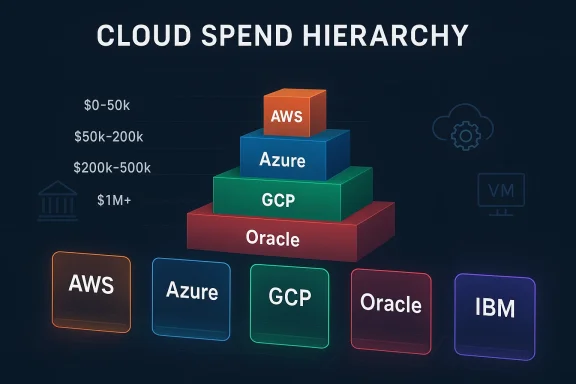
Azure vs. AWS vs. GCP vs. Oracle vs. IBM is no longer just a market-share argument. Flexera’s 2026 State of the Cloud report, as broken down by CRN, shows a clear spending hierarchy in which AWS and Microsoft Azure still dominate the high end of cloud budgets, while Google Cloud tends to cluster lower, and Oracle, IBM, and Alibaba remain much smaller in monthly customer outlays. The message for buyers is blunt: scale still matters, but so does where organizations are in their cloud maturity journey. For vendors, the numbers are a reminder that headline usage share and actual monthly spend are not always the same thing. (crn.com)
Flexera says its 2026 State of the Cloud report surveyed more than 750 executives and professionals in winter 2025, with a majority of respondents based in the Americas and the rest spread across Europe and Asia-Pacific. That matters because the sample is broad enough to show enterprise patterns, but still structured enough to reflect the real-world imbalance in cloud adoption across geographies and organization sizes. The report’s spending tiers also help reveal something cloud marketers often blur: how many customers are truly reaching multi-million-dollar monthly consumption, versus how many are still in modest operational footprints. (crn.com)
The reporting context is equally important. Flexera’s 2026 release frames cloud as shifting from a pure cost-control story to a value story, with FinOps maturity, governance, and business-unit accountability becoming central themes. That shift changes how spending should be interpreted. A customer spending $100,000 per month may be far more strategic and workload-rich than a customer spending less in a bursty test environment, while a higher-spend account may simply be running large legacy estates that are expensive to modernize.
This is also a competitive snapshot of cloud economics, not just cloud adoption. AWS and Azure continue to collect the heaviest spend concentration across the monthly tiers, while GCP shows more skew toward the low end. OCI and IBM Cloud appear to retain pockets of meaningful enterprise use, but the report suggests their customer bases are narrower and more concentrated in smaller spend bands. Alibaba Cloud, meanwhile, remains the smallest footprint in this particular Western- and APAC-leaning survey, especially in the SMB segment. (crn.com)
A useful way to read the report is to separate three lenses: overall customer spend, enterprise spend, and SMB spend. Those categories do not always tell the same story, and that divergence is where the strategic insight lives. AWS and Azure are both deeply embedded across the spectrum, but Azure’s strength in midrange enterprise tiers and AWS’s lead in larger high-spend buckets show how each has carved out a different kind of gravity. (crn.com)
AWS and Azure both show substantial high-end consumption, but AWS appears to hold an edge in the very largest deployments and spend buckets. That suggests a long-running advantage in large-scale enterprise workloads, especially where customers have already committed deeply enough that migration costs become material. Azure, by contrast, looks exceptionally strong in the midrange, which may reflect its close ties to Microsoft’s broader enterprise stack and existing Windows-centric estates. (crn.com)
For buyers, tiering also helps expose concentration risk. If most of a company’s cloud spend sits in one provider’s midrange band, there may be room to optimize via rightsizing, reserved capacity, or workload segmentation. If spending is already high and clustered at the top, the bigger challenge may be governance, architectural simplification, and negotiating leverage. That is a very different procurement problem.
Azure’s profile looks almost as impressive, but in a different shape. The report says Azure leads in the $50,001 to $100,000 and $100,001 to $200,000 enterprise tiers, which points to a broad and sticky installed base. In practical terms, that means Microsoft is exceptionally good at turning enterprise relationships into cloud consumption, especially in organizations already standardized on Microsoft identity, endpoint, productivity, or server technologies. (crn.com)
That difference has implications for partner ecosystems, FinOps tooling, and enterprise negotiation strategy. AWS-heavy customers may focus more on technical optimization at scale, while Azure-heavy customers may spend more time aligning cloud bills to Microsoft license economics and broader enterprise agreements. Either way, the data shows why multi-cloud governance has become a board-level issue rather than just an engineering preference.
In the enterprise split, GCP still has meaningful presence, but it does not match AWS or Azure in the upper brackets. It shows strength in lower spend and smaller VM estates, which is consistent with a platform often associated with data, analytics, developer-led adoption, and targeted cloud-native projects. For organizations that want strategic cloud use without wholesale migration, that can be a perfectly rational posture. (crn.com)
Still, the spending curve matters for competitive momentum. If a cloud provider is winning developer mindshare but not converting it into large production consumption, the long-term economics can lag. In a market where AI, data, and platform services are increasingly expensive, a low-spend footprint can be either a foothold for future growth or a sign that customers are keeping the platform at arm’s length.
This lines up with Oracle’s broader market identity. OCI has often been strongest where customers have a reason to stay close to Oracle databases, enterprise applications, or specialized performance and pricing commitments. In other words, it may not win the widest cloud conversation, but it can win the most economically motivated one. That distinction matters more than it sounds.
The challenge is that cloud infrastructure markets reward scale, ecosystem depth, and default-choice behavior. OCI’s niche can be durable, but only if it continues to prove value in specialized workloads, private connectivity, and database-heavy environments. If it cannot expand beyond those use cases, the cloud growth curve may remain flatter than the hyperscaler leaders.
Alibaba Cloud shows the smallest overall footprint in this particular report, especially in SMB spending. Its profile suggests that, for the sampled respondent base, it is far less embedded than the major Western providers. That could reflect geographic concentration, regulatory realities, market maturity, or customer preference, but the data itself is clear: Alibaba Cloud is not a mainstream SMB cloud spend destination in this survey. (crn.com)
That matters because cloud markets are increasingly driven by platform breadth plus adjacent value. A provider that is not accumulating spend at scale may struggle to create the same flywheel effect in services, partner ecosystems, and customer lock-in. Small does not mean unimportant, but it does often mean the growth path is more constrained.
AWS and Azure both look strong across enterprise and SMB, but AWS has the clearest lead in the smallest monthly spend tier among SMBs, while Azure posts especially strong numbers in the enterprise middle. GCP, meanwhile, shows a comparatively smaller SMB spend profile and more limited high-end enterprise traction. OCI, IBM, and Alibaba all appear much more constrained in SMB usage, which suggests their value propositions are not broadly resonating with smaller companies at the same level. (crn.com)
Enterprises are different because they can spread spend across multiple business units, regions, and application estates. They also have larger modernization backlogs, which can drive bigger bills even when unit economics improve. That is why enterprise data is often the better indicator of long-term platform entrenchment, even if SMB numbers are useful for judging marketplace reach.
Google Cloud trails in the biggest VM deployments and has a higher rate of respondents with no VMs at all, which implies a more selective role in many organizations. IBM Cloud is even more concentrated at the low end, with a large share reporting no VMs whatsoever. Oracle sits somewhere in the middle, but well behind the two hyperscaler leaders. (crn.com)
This also gives a clue about future modernization pressure. VMware migrations, containerization, PaaS adoption, and AI workload integration could all reshape VM counts over time. But for now, the report suggests AWS and Azure remain the deepest infrastructure homes, which is a strong position in a market that still values persistence as much as innovation.
Buyers should read this report as a benchmarking tool rather than a scoreboard. The right question is not “who is spending the most?” but “where does our company sit relative to peers with similar scale, and what does that say about our cloud operating model?” That answer can reveal whether cloud is being used strategically, inherited passively, or optimized aggressively. (crn.com)
Partners aligned with GCP, OCI, IBM, or Alibaba may need more targeted value propositions. They cannot rely on raw platform momentum in the same way as AWS or Azure ecosystems can. Instead, they need to win on specialization: analytics, database adjacency, regulatory fit, hybrid integration, or workload-specific expertise. That is a tougher sell, but also a more defensible one if executed well. (crn.com)
At the same time, AI may distort traditional cloud spend patterns. Workloads tied to model development, inference, and data pipelines can create sudden shifts in consumption, especially for enterprises that were previously stable in their cloud usage. If that happens at scale, the spending map Flexera captured in winter 2025 could become a snapshot of a market that is already moving toward a more expensive and more complicated future.
The most important thing to watch next is whether AWS and Azure extend their lead in the upper enterprise tiers, whether GCP can convert selective adoption into larger-scale consumption, and whether OCI, IBM Cloud, or Alibaba can deepen their niches without being squeezed by hyperscaler momentum. The cloud market is mature, but it is not static, and the next competitive shift may come from economics rather than features. (crn.com)
Source: crn.com Azure Vs. AWS Vs. GCP Vs. Oracle Vs. IBM Client Spending Face-Off: Flexera Report
 Overview
Flexera says its 2026 State of the Cloud report surveyed more than 750 executives and professionals in winter 2025, with a majority of respondents based in the Americas and the rest spread across Europe and Asia-Pacific. That matters because the sample is broad enough to show enterprise patterns, but still structured enough to reflect the real-world imbalance in cloud adoption across geographies and organization sizes. The report’s spending tiers also help reveal something cloud marketers often blur: how many customers are truly reaching multi-million-dollar monthly consumption, versus how many are still in modest operational footprints. (crn.com)The reporting context is equally important. Flexera’s 2026 release frames cloud as shifting from a pure cost-control story to a value story, with FinOps maturity, governance, and business-unit accountability becoming central themes. That shift changes how spending should be interpreted. A customer spending $100,000 per month may be far more strategic and workload-rich than a customer spending less in a bursty test environment, while a higher-spend account may simply be running large legacy estates that are expensive to modernize.
This is also a competitive snapshot of cloud economics, not just cloud adoption. AWS and Azure continue to collect the heaviest spend concentration across the monthly tiers, while GCP shows more skew toward the low end. OCI and IBM Cloud appear to retain pockets of meaningful enterprise use, but the report suggests their customer bases are narrower and more concentrated in smaller spend bands. Alibaba Cloud, meanwhile, remains the smallest footprint in this particular Western- and APAC-leaning survey, especially in the SMB segment. (crn.com)
A useful way to read the report is to separate three lenses: overall customer spend, enterprise spend, and SMB spend. Those categories do not always tell the same story, and that divergence is where the strategic insight lives. AWS and Azure are both deeply embedded across the spectrum, but Azure’s strength in midrange enterprise tiers and AWS’s lead in larger high-spend buckets show how each has carved out a different kind of gravity. (crn.com)
Why Cloud Spend Tiering Matters
Monthly spend tiers may sound like a dry finance exercise, but they are really a proxy for workload depth, architecture complexity, and vendor stickiness. A cloud provider with many low-spend customers can still be a growth engine, but a provider with a larger share of high-spend accounts usually has stronger platform entrenchment and more room for adjacent services. That is why Flexera’s tiered data is so revealing: it hints at where cloud providers are winning the hardest workloads, not just the newest ones. (crn.com)AWS and Azure both show substantial high-end consumption, but AWS appears to hold an edge in the very largest deployments and spend buckets. That suggests a long-running advantage in large-scale enterprise workloads, especially where customers have already committed deeply enough that migration costs become material. Azure, by contrast, looks exceptionally strong in the midrange, which may reflect its close ties to Microsoft’s broader enterprise stack and existing Windows-centric estates. (crn.com)
The strategic meaning of the middle tier
The middle tier matters because it is where many enterprises spend years before they reach hyperscale levels. If a platform dominates the $50,000 to $500,000 range, it can become the default landing zone for operational workloads, then expand upward as application modernization progresses. Azure’s strength there is not a trivial footnote; it is a durable sales advantage. (crn.com)For buyers, tiering also helps expose concentration risk. If most of a company’s cloud spend sits in one provider’s midrange band, there may be room to optimize via rightsizing, reserved capacity, or workload segmentation. If spending is already high and clustered at the top, the bigger challenge may be governance, architectural simplification, and negotiating leverage. That is a very different procurement problem.
- High-tier spend often signals deeper workload entrenchment.
- Mid-tier dominance can indicate broad enterprise adoption.
- Low-tier concentration may mean early-stage, exploratory, or fragmented usage.
- Spend tiers are not the same as customer counts.
- A cloud vendor can be “popular” without being the biggest wallet winner.
AWS and Azure Still Own the Enterprise Conversation
AWS remains the most formidable spend engine in Flexera’s report, particularly when enterprises are the focus. It has the highest concentration of customers in the $200,001 to $500,000 monthly range, and it also posts strong numbers in the upper brackets, including $1 million-plus and $5 million-plus spending. That kind of distribution suggests AWS is still the default for large, mature cloud estates that have already crossed from experimentation into ongoing production scale. (crn.com)Azure’s profile looks almost as impressive, but in a different shape. The report says Azure leads in the $50,001 to $100,000 and $100,001 to $200,000 enterprise tiers, which points to a broad and sticky installed base. In practical terms, that means Microsoft is exceptionally good at turning enterprise relationships into cloud consumption, especially in organizations already standardized on Microsoft identity, endpoint, productivity, or server technologies. (crn.com)
AWS scale versus Azure breadth
The contrast here is subtle but important. AWS seems to win more of the largest, most expensive cloud estates, while Azure wins more of the broad middle where most enterprise customers live. That does not mean either platform is weak in the other’s sweet spot, but it does show how cloud leadership can be defined by different economic shapes. One vendor is strongest where spend gets very large; the other is strongest where spend is widely distributed. (crn.com)That difference has implications for partner ecosystems, FinOps tooling, and enterprise negotiation strategy. AWS-heavy customers may focus more on technical optimization at scale, while Azure-heavy customers may spend more time aligning cloud bills to Microsoft license economics and broader enterprise agreements. Either way, the data shows why multi-cloud governance has become a board-level issue rather than just an engineering preference.
- AWS leads the biggest spend concentrations.
- Azure leads several of the most common enterprise spend bands.
- Both platforms are deeply embedded in enterprise IT.
- The winners are often the vendors already inside the account.
- Negotiation leverage improves when buyers understand tier placement.
Google Cloud Remains a More Moderate Spend Story
Google Cloud Platform’s spend profile is notably different from AWS and Azure. Flexera’s data shows the highest share of GCP users in the lowest spend tier, with a heavy concentration below $50,000 per month and a tapering pattern above that level. That does not mean GCP is unimportant; it means its customer base, in this survey, appears more likely to be earlier in its lifecycle, more selective in deployment scope, or more concentrated in specific workload types. (crn.com)In the enterprise split, GCP still has meaningful presence, but it does not match AWS or Azure in the upper brackets. It shows strength in lower spend and smaller VM estates, which is consistent with a platform often associated with data, analytics, developer-led adoption, and targeted cloud-native projects. For organizations that want strategic cloud use without wholesale migration, that can be a perfectly rational posture. (crn.com)
A platform of selective intensity
The report’s VM data reinforces this impression. GCP has a sizable share of users with no VMs at all, and its larger deployments are less common than AWS or Azure. That suggests the platform is being used with more selectivity, or at least that customers are not yet committing as deeply to broad infrastructure estates. That is not a weakness in every case; for some buyers, it reflects a deliberate architectural choice. (crn.com)Still, the spending curve matters for competitive momentum. If a cloud provider is winning developer mindshare but not converting it into large production consumption, the long-term economics can lag. In a market where AI, data, and platform services are increasingly expensive, a low-spend footprint can be either a foothold for future growth or a sign that customers are keeping the platform at arm’s length.
- GCP skews toward smaller monthly bills.
- Its largest enterprise estates are fewer than AWS and Azure.
- Its footprint may reflect targeted workload adoption.
- Lower spend is not inherently negative, but it can limit revenue expansion.
- VM concentration suggests more selective infrastructure use.
Oracle Cloud Infrastructure Finds a Narrower but Real Enterprise Niche
OCI’s spending profile is more modest than the top three, but it is not negligible. Flexera’s report shows Oracle with a meaningful lower-end base and a thin but visible presence in higher tiers, especially among enterprises. That combination suggests a platform that is often selected for specific workloads rather than used as a broad default across large estates. (crn.com)This lines up with Oracle’s broader market identity. OCI has often been strongest where customers have a reason to stay close to Oracle databases, enterprise applications, or specialized performance and pricing commitments. In other words, it may not win the widest cloud conversation, but it can win the most economically motivated one. That distinction matters more than it sounds.
Oracle’s selective advantage
The report suggests OCI has a smaller SMB footprint than AWS, Azure, or GCP, and a relatively limited share of very high-spend accounts. Yet its enterprise presence is not absent; instead, it is concentrated. That can be a useful position if Oracle is successfully using cloud to anchor existing software relationships and make infrastructure one part of a larger platform story. (crn.com)The challenge is that cloud infrastructure markets reward scale, ecosystem depth, and default-choice behavior. OCI’s niche can be durable, but only if it continues to prove value in specialized workloads, private connectivity, and database-heavy environments. If it cannot expand beyond those use cases, the cloud growth curve may remain flatter than the hyperscaler leaders.
- OCI has a real enterprise niche.
- Its strength is more targeted than universal.
- Existing Oracle relationships likely matter a lot.
- The platform appears narrower in SMB adoption.
- Expansion beyond Oracle-centric workloads remains the key challenge.
IBM Cloud and Alibaba Cloud Face a More Limited Footprint
IBM Cloud’s data in the report is concentrated at the lower end, with a relatively modest share of enterprises and SMBs spending meaningfully at higher levels. That does not mean IBM Cloud lacks relevance; it means its cloud business sits within a different strategic context than the hyperscalers. IBM’s broader enterprise software, consulting, and hybrid cloud positioning likely matters more than raw infrastructure volume alone. (crn.com)Alibaba Cloud shows the smallest overall footprint in this particular report, especially in SMB spending. Its profile suggests that, for the sampled respondent base, it is far less embedded than the major Western providers. That could reflect geographic concentration, regulatory realities, market maturity, or customer preference, but the data itself is clear: Alibaba Cloud is not a mainstream SMB cloud spend destination in this survey. (crn.com)
The meaning of a smaller cloud
A smaller footprint does not automatically equal strategic irrelevance. IBM may still exert influence through hybrid environments, managed services, and software integration, while Alibaba may remain powerful within certain regional or regulatory markets. But from a pure monthly spending perspective, both appear to sit well behind AWS and Azure, with Google Cloud also ahead in most of the tiers that matter for broad adoption. (crn.com)That matters because cloud markets are increasingly driven by platform breadth plus adjacent value. A provider that is not accumulating spend at scale may struggle to create the same flywheel effect in services, partner ecosystems, and customer lock-in. Small does not mean unimportant, but it does often mean the growth path is more constrained.
- IBM Cloud remains concentrated at the low end.
- Alibaba Cloud has the smallest SMB footprint in the report.
- Regional and sector-specific strength may still exist.
- Pure cloud spend share is only one part of the story.
- Scale remains a major advantage in the cloud business.
Enterprise Versus SMB: Two Different Markets in One Report
One of the most valuable things in the Flexera data is the split between enterprise and SMB behavior. These are not just two customer categories; they are two different economic engines. Enterprises buy cloud as a governance, modernization, and resilience platform, while SMBs often buy it as a cost-efficient enabler for immediate application needs. That is why the same provider can look dominant in one segment and merely adequate in another. (crn.com)AWS and Azure both look strong across enterprise and SMB, but AWS has the clearest lead in the smallest monthly spend tier among SMBs, while Azure posts especially strong numbers in the enterprise middle. GCP, meanwhile, shows a comparatively smaller SMB spend profile and more limited high-end enterprise traction. OCI, IBM, and Alibaba all appear much more constrained in SMB usage, which suggests their value propositions are not broadly resonating with smaller companies at the same level. (crn.com)
Why SMBs spend differently
SMBs tend to be more cautious, more price-sensitive, and more likely to keep cloud deployment footprints narrow. That means the platform that wins SMBs is often the one that is easiest to adopt, simplest to govern, and most familiar to generalist IT teams. In that context, AWS and Azure benefit from brand recognition and ecosystem breadth, while niche platforms may be harder to justify unless there is a very specific workload reason. (crn.com)Enterprises are different because they can spread spend across multiple business units, regions, and application estates. They also have larger modernization backlogs, which can drive bigger bills even when unit economics improve. That is why enterprise data is often the better indicator of long-term platform entrenchment, even if SMB numbers are useful for judging marketplace reach.
- Enterprises and SMBs behave like separate markets.
- AWS and Azure are strong in both.
- GCP is healthier in selective use cases than in broad SMB depth.
- OCI, IBM, and Alibaba have more limited SMB traction.
- Platform simplicity matters more to smaller buyers.
VM Footprints Reveal Maturity, Not Just Budget
Flexera’s VM data adds another layer to the spending story. AWS and Azure support much larger and more mature VM estates than their competitors, which is exactly what you would expect from the market leaders. The fact that a meaningful share of respondents report 101 to 1,000 instances on both platforms suggests that these clouds are serving as operational backbones, not just testbeds. (crn.com)Google Cloud trails in the biggest VM deployments and has a higher rate of respondents with no VMs at all, which implies a more selective role in many organizations. IBM Cloud is even more concentrated at the low end, with a large share reporting no VMs whatsoever. Oracle sits somewhere in the middle, but well behind the two hyperscaler leaders. (crn.com)
Infrastructure depth as a proxy for lock-in
Large VM estates are important because they usually reflect more than raw consumption. They point to operational dependencies, migration complexity, and the need for governance at scale. Once an organization has hundreds or thousands of instances in one cloud, moving is expensive in technical and organizational terms, which is why the VM distribution matters almost as much as the spending tiers. (crn.com)This also gives a clue about future modernization pressure. VMware migrations, containerization, PaaS adoption, and AI workload integration could all reshape VM counts over time. But for now, the report suggests AWS and Azure remain the deepest infrastructure homes, which is a strong position in a market that still values persistence as much as innovation.
- VM count is a maturity signal.
- AWS and Azure host the deepest estates.
- GCP looks more selective in infrastructure use.
- IBM Cloud has a large no-VM cohort.
- Migration complexity tends to rise with footprint depth.
What the Data Means for Buyers
For cloud customers, the headline is not simply that AWS and Azure are larger. It is that cloud bills are increasingly a measure of organizational behavior, not just technical architecture. If a company is spending heavily in midrange tiers, it may be running a broad portfolio of production apps; if it is spending modestly but has strong governance, it may be extracting more value per dollar than a larger rival. Spend alone is not efficiency.Buyers should read this report as a benchmarking tool rather than a scoreboard. The right question is not “who is spending the most?” but “where does our company sit relative to peers with similar scale, and what does that say about our cloud operating model?” That answer can reveal whether cloud is being used strategically, inherited passively, or optimized aggressively. (crn.com)
Practical buyer takeaways
A cloud team can use this kind of data to sharpen budget reviews, vendor negotiations, and workload placement decisions. It also helps explain why one platform may feel more expensive than another even when nominal compute prices look similar. Usage pattern beats list price far more often than vendors want to admit.- Benchmark your cloud mix against peers, not just against plans.
- Look for abnormal concentration in one spending tier.
- Use spend tiers to target optimization conversations.
- Separate exploratory cloud use from production dependency.
- Treat migration decisions as financial and operational decisions.
What the Data Means for Vendors and Partners
For vendors and channel partners, the report is a reminder that the cloud market is now a contest over where spend lands, not just whether customers are “in the cloud.” AWS and Azure continue to command the most strategic consumption, which means ecosystem partners that can help optimize, secure, and govern those environments have the richest opportunity set. That is especially true as Flexera’s 2026 messaging emphasizes FinOps maturity and business value.Partners aligned with GCP, OCI, IBM, or Alibaba may need more targeted value propositions. They cannot rely on raw platform momentum in the same way as AWS or Azure ecosystems can. Instead, they need to win on specialization: analytics, database adjacency, regulatory fit, hybrid integration, or workload-specific expertise. That is a tougher sell, but also a more defensible one if executed well. (crn.com)
Ecosystem consequences
The strongest cloud platforms do not only attract customers; they attract tooling, consulting, security, and migration talent. That creates a reinforcing loop that makes the leaders even more valuable to enterprise buyers. Smaller ecosystems can still thrive, but they must provide a sharper reason to exist, especially when buyers are under pressure to show measurable ROI from cloud investments.- AWS and Azure remain the richest ecosystems.
- Specialist vendors need sharper differentiation.
- Cloud governance tools are increasingly strategic.
- Consulting and managed services stay important.
- Value creation is replacing cost reduction as the pitch.
Strengths and Opportunities
Flexera’s 2026 report is useful because it goes beyond simplistic “cloud market share” rhetoric and shows how real money is actually distributed across customer segments. It highlights the durability of AWS and Azure, the selective rise of GCP, and the narrower roles of OCI, IBM Cloud, and Alibaba Cloud. That makes it a strong signal for both strategic planning and practical budget governance. (crn.com)- Clear benchmarking value for enterprises comparing their cloud posture to peers.
- Strong visibility into spend tiers that reveal maturity and workload depth.
- Useful enterprise/SMB split that shows different buying behaviors.
- Helpful VM footprint context for understanding infrastructure entrenchment.
- Evidence of FinOps relevance as cloud spending becomes more scrutinized.
- Insight into partner opportunities around optimization and governance.
- A more nuanced picture than market-share charts alone provide.
Risks and Concerns
The biggest risk in interpreting this report is overreading spend as success or failure. A lower-spend cloud account may be highly strategic, tightly governed, and critical to a specific business outcome, while a larger account may simply reflect legacy inefficiency or slow modernization. Numbers without context can mislead, especially in cloud economics.- Spending tiers can hide workload quality and business value.
- Survey data may not fully reflect regional or sector-specific realities.
- One report cannot capture every enterprise cloud pattern.
- Vendor-specific strengths can be obscured by broad averages.
- Cloud migration risk rises when spend is concentrated but unmanaged.
- SMB results may differ sharply from enterprise behavior.
- AI-driven cost growth could change the picture quickly.
Looking Ahead
The next phase of cloud competition will likely be shaped less by basic adoption and more by value extraction, AI workload economics, and governance discipline. Flexera’s broader 2026 messaging already points in that direction, describing a cloud market where organizations care increasingly about business outcomes, not just technical deployment. That means the providers that win the next round will be the ones that help customers make cloud more measurable, less wasteful, and easier to justify to finance leaders.At the same time, AI may distort traditional cloud spend patterns. Workloads tied to model development, inference, and data pipelines can create sudden shifts in consumption, especially for enterprises that were previously stable in their cloud usage. If that happens at scale, the spending map Flexera captured in winter 2025 could become a snapshot of a market that is already moving toward a more expensive and more complicated future.
The most important thing to watch next is whether AWS and Azure extend their lead in the upper enterprise tiers, whether GCP can convert selective adoption into larger-scale consumption, and whether OCI, IBM Cloud, or Alibaba can deepen their niches without being squeezed by hyperscaler momentum. The cloud market is mature, but it is not static, and the next competitive shift may come from economics rather than features. (crn.com)
- AI spending pressure could reshape cloud budgets quickly.
- FinOps maturity will keep rising as a board-level concern.
- AWS and Azure likely remain the default enterprise leaders.
- GCP’s challenge is conversion from selective use to deeper spend.
- OCI, IBM, and Alibaba must defend niche advantages carefully.
Source: crn.com Azure Vs. AWS Vs. GCP Vs. Oracle Vs. IBM Client Spending Face-Off: Flexera Report
Last edited:
