

Florida Crystals Corporation’s expanded agreement with Celonis marks a decisive step in marrying process intelligence with enterprise AI, setting the sugar producer on a path from tactical process improvement to an enterprise-wide AI orchestration strategy that touches finance, procurement, supply chain, and plant maintenance.
Florida Crystals Corporation (FCC), a large integrated cane sugar producer with extensive agricultural and milling operations in South Florida, has deepened its relationship with Celonis so the latter becomes FCC’s enterprise platform for AI, automation, and digital transformation. The expanded deal formalizes Celonis as the backbone for process intelligence across FCC’s Finance, Procurement and Inbound Supply Chain teams and establishes a co‑created Asset Reliability application focused on improving Overall Equipment Effectiveness (OEE), asset utilization and availability. The program also names Celonis the engine for FCC’s AI Lighthouse initiative, which prioritizes use cases such as intelligent invoice processing, predictive maintenance, and automated order management. The announcement and customer case claims that Celonis helped unlock “millions in working capital” during earlier phases of the engagement. This move is consistent with a broader enterprise pattern: vendors are layering process mining and process intelligence on top of transactional systems and then using that unified context to power AI agents, copilots and orchestration across Microsoft and other ecosystems. Celonis has been explicit about integrating with Microsoft platforms such as Teams, Power Platform and Microsoft Copilot Studio, enabling process-aware agents and in‑context action triggers.
Strengths of the program include a pragmatic lighthouse strategy, integration into collaboration tools, and the focus on asset reliability where outcomes map directly to revenue and cost. The most significant risks lie in governance, portability and the operational complexity of predictive maintenance at scale. Quantities such as the precise dollar amount of “working capital unlocked” remain undisclosed in public materials and should be treated as directional indicators rather than audited figures. For enterprises planning similar moves, the recommended path is clear: start with process discovery, run tightly scoped pilots with measurable KPIs, bake governance and observability into every agent, and plan for the long tail of operational costs and portability. Done right, process intelligence can transform how work flows—and crucially, how AI drives measurable business outcomes.
Source: Business Wire https://www.businesswire.com/news/h...ower-Enterprise-AI-with-Process-Intelligence/
 Background / Overview
Florida Crystals Corporation (FCC), a large integrated cane sugar producer with extensive agricultural and milling operations in South Florida, has deepened its relationship with Celonis so the latter becomes FCC’s enterprise platform for AI, automation, and digital transformation. The expanded deal formalizes Celonis as the backbone for process intelligence across FCC’s Finance, Procurement and Inbound Supply Chain teams and establishes a co‑created Asset Reliability application focused on improving Overall Equipment Effectiveness (OEE), asset utilization and availability. The program also names Celonis the engine for FCC’s AI Lighthouse initiative, which prioritizes use cases such as intelligent invoice processing, predictive maintenance, and automated order management. The announcement and customer case claims that Celonis helped unlock “millions in working capital” during earlier phases of the engagement. This move is consistent with a broader enterprise pattern: vendors are layering process mining and process intelligence on top of transactional systems and then using that unified context to power AI agents, copilots and orchestration across Microsoft and other ecosystems. Celonis has been explicit about integrating with Microsoft platforms such as Teams, Power Platform and Microsoft Copilot Studio, enabling process-aware agents and in‑context action triggers. Why this matters: Process Intelligence as the new data fabric for enterprise AI
The problem most enterprises face
Large operational enterprises run on many systems—ERP, MES, CRM, WMS—and human work across those systems creates handoffs, delays and hidden costs. Traditional BI and reports are retrospective; they tell leaders what happened, not why or how to fix it in real time. This structural gap is precisely what Celonis’ Process Intelligence platform aims to fill: create a living digital twin of how work actually flows and bind that insight to automation and decisioning.What process intelligence contributes
- Visibility into end‑to‑end flows across source systems, exposing bottlenecks and root causes rather than surface symptoms.
- Contextualized data: harmonizing master data and transactional events into a process graph that AI agents can reason over.
- Actionability: not just detection, but event-driven remediation using orchestration and automation engines.
- Governance scaffolding for agentic AI: traceable inputs, decision logs and operational KPIs that enable audit and rollback.
What FCC gains: concrete capabilities and early outcomes
Orchestration across systems, teams and technologies
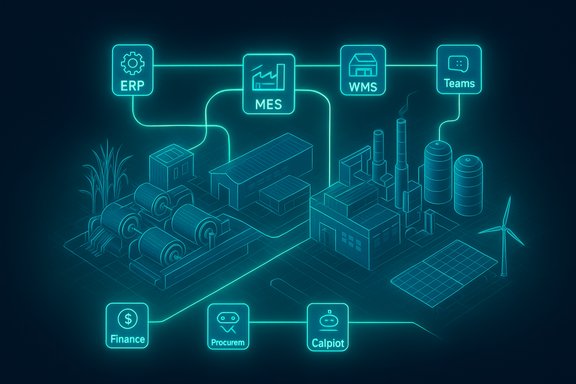
The expanded agreement positions Celonis to orchestrate how work flows across FCC’s systems and teams. That spans:- Continuous monitoring of process adherence and exceptions.
- Automated remediation triggers and workflows (e.g., routing a late invoice for expedited review).
- Embedding intelligence in collaboration tools (Teams) so operational actors see process context where they already work.
Process Intelligence surfaced in Microsoft Teams and via Copilot agents
Celonis has invested in Process Copilots and APIs that surface process-aware assistants into external channels such as Microsoft Teams and Microsoft Copilot Studio. For an operational workforce, this means actionable alerts and guided recommendations inside the chat/collaboration fabric rather than forcing users into a separate analytics console. FCC’s program explicitly calls out these in-context deployments as a way to accelerate time-to-action.Asset Reliability and OEE—plant‑floor to finance linkage
A notable, high-impact piece of the expanded agreement is a co‑created Asset Reliability application that targets Overall Equipment Effectiveness (OEE), availability and utilization. Celonis already offers Plant Maintenance solutions and marketplace apps (e.g., Plant Maintenance Navigator built with Marcadus) that combine process mining with maintenance workflows, inventory and purchasing data to identify root causes of downtime. For FCC—whose business includes two sugar mills, a refinery and a large renewable power plant—improving asset uptime directly translates into recovered throughput and lower per‑unit cost.AI Lighthouse: a pragmatic staging ground for enterprise AI
FCC’s AI Lighthouse program is described as a collection of prioritized use cases that will be staged as pilots and then scaled. Early pilots include:- Intelligent invoice processing (AP automation).
- Predictive maintenance (plant equipment health).
- Automated order management (supply chain remediation).
This “lighthouse” model is a pragmatic way to de‑risk enterprise AI: run measurable pilots, prove ROI, harden governance, then scale. It’s the recommended pattern for AI adoption across industries and matches vendor best practices.
Verifying the claims: what’s documented and what needs caution
Verified claims
- Celonis offers Process Copilots and APIs that enable surfacing process intelligence into Microsoft Teams and external systems; these capabilities were emphasized in Celonis documentation and product release notes.
- Celonis maintains a formal partnership and integration story with Microsoft—covering Power Platform, Teams, Copilot Studio and Microsoft Fabric—designed to let customers embed process intelligence into Microsoft workflows and agents.
- Celonis sells plant‑maintenance and asset‑reliability apps (including the Plant Maintenance Navigator) and partners with specialist consultancies for plant maintenance implementations; these provide the product foundations for FCC’s OEE effort.
- FCC has publicly described measurable finance outcomes (opening the S/4HANA migration case and AP transformation) and stated that Celonis helped unlock “millions in working capital.” The Celonis customer story on Florida Crystals corroborates that phrase while not disclosing a precise numeric breakdown. The exact dollar amount remains undisclosed publicly.
Claims that require caution or are partially verifiable
- “Celonis will serve as the company’s enterprise platform for AI, automation, and digital transformation.” This is a contractual/strategic claim reported in the announcement. It is verifiable as FCC’s stated intent; however, whether Celonis will become the single enterprise platform for all AI at FCC (versus a principal partner) depends on future technical and procurement choices, and cannot be independently verified from public materials. Treat this as a vendor‑stated strategic commitment rather than immutable architecture.
- “Unlocked millions in working capital.” Public case materials reference “millions” in working capital unlocked, but do not provide granular audited figures or a time series. Therefore the magnitude (single‑digit millions vs. tens of millions) is not independently verifiable from available public sources. Readers should treat the phrase as directional evidence of success rather than an audited financial statement.
Strengths of the FCC–Celonis approach
1. A data‑centric, process‑first foundation for AI
Starting with process intelligence addresses one of the biggest failure modes for enterprise AI: poor retrieval and inconsistent master data. Celonis’ process graph approach harmonizes transactional context so AI agents have reliable inputs—an essential precursor to trustworthy automation. This reduces the “stovepipe” problem where different agents use different, conflicting data views.2. Practical staging via an AI Lighthouse program
The AI Lighthouse approach—prioritized, measurable pilots with governance and scale plans—reduces risk, focuses investment and creates reusable patterns. Pilots like intelligent invoice processing typically yield rapid ROI and act as learning labs for operationalizing model governance, observability and human‑in‑the‑loop controls.3. Integration into tools people already use
Surface-level integration into Microsoft Teams and the ability to bootstrap agents into Microsoft Copilot Studio reduce friction and accelerate adoption because workers get insights and actions where they already collaborate. This improves decision velocity and the odds that recommendations translate into executed outcomes.4. Direct linkage between operational and financial KPIs
By tying plant maintenance (OEE, downtime) to procurement and accounts payable flows, FCC can close the loop between root‑cause fixes and balance‑sheet impacts. That cross‑functional linkage is where most process intelligence programs deliver sustainable, measurable value.Risks and open questions
Data and model governance
Embedding AI into operational decision loops raises governance questions that require explicit answers:- How are prompts, data retrieval inputs and model outputs logged and audited?
- What guardrails exist to prevent unauthorized automated actions (e.g., auto‑approving large invoices)?
- How will model drift and data schema changes be observed and remediated?
Vendor lock‑in and portability
Moving process intelligence, agent orchestration and long‑running event rules into one vendor’s platform simplifies operations but creates concentration risk. If Celonis becomes a central runtime for process discovery, orchestration and agents, extracting those capabilities or switching vendors later will be expensive. Contracts should explicitly address data portability, export formats for process graphs, and transition support.Operationalizing predictive maintenance
Predictive maintenance projects often face integration complexity: telemetry ingestion, mapping OT identities to corporate IAM, establishing thresholds, and calibrating false positives. Celonis’ Plant Maintenance apps and partner solutions lower the lift, but the success of FCC’s OEE program will depend on sensor coverage, data fidelity and the ability to tune interventions so they don’t generate alert fatigue.Cost and capacity management for agentic AI
Agentic AI and Copilot consumption add variable costs—compute, token consumption, orchestration cycles. Organizations often underestimate these operating costs during pilot phases. Expect to see separate FinOps disciplines for agent lifecycle and prompt‑cost management as pilots scale.The “black box” problem and human oversight
Automations that change orders, shift inventory or schedule maintenance have real impact on safety, quality and regulatory compliance. Firms must maintain clear human‑in‑the‑loop gates for high‑risk decisions and preserve audit trails. This is particularly important in food and agricultural processing, where quality and traceability are tightly regulated.Practical checklist for enterprises considering a similar path
- Clean and canonicalize master data before launching agentic AI pilots.
- Scope lighthouse pilots tightly; set measurable KPIs such as days‑sales‑outstanding (DSO) reduction, AP cycle time, or percentage OEE uplift.
- Define governance artifacts up front: prompt logs, decision provenance, SLA for automated actions, and incident runbooks.
- Validate integration and portability: request exportable process graphs and APIs to extract rules, datasets and historical audit logs.
- Run an observability program for models: monitor drift, precision/recall on classifications, and intervention outcomes.
- Build a FinOps model for agent consumption: estimate compute and token costs before scaling to dozens of agents.
- Maintain human approval thresholds for high‑risk transactions and keep fallback manual processes well documented.
The strategic implications for the market
Florida Crystals’ public announcement is a clear example of how process intelligence is evolving from a diagnostics tool to a strategic data fabric for enterprise AI. Vendors and customers will increasingly expect:- Process‑aware agents that can operate across ERP, SCM and OT boundaries.
- Closer embedded partnerships between process mining vendors and hyperscale cloud platforms (notably Microsoft), because seamless agent lifecycle and governance require tight platform integration.
- Industry‑specific packaged applications (plant maintenance, order orchestration) that combine best practices, connectors and governance blueprints to reduce time to value.
Conclusion
Florida Crystals’ expanded agreement with Celonis is a textbook case of how large, operational enterprises are applying process intelligence as the foundation for enterprise AI. The approach addresses critical adoption blockers—contextual data, actionability and observability—by turning a living digital twin of operational flows into the input fabric for copilots, agents and automation.Strengths of the program include a pragmatic lighthouse strategy, integration into collaboration tools, and the focus on asset reliability where outcomes map directly to revenue and cost. The most significant risks lie in governance, portability and the operational complexity of predictive maintenance at scale. Quantities such as the precise dollar amount of “working capital unlocked” remain undisclosed in public materials and should be treated as directional indicators rather than audited figures. For enterprises planning similar moves, the recommended path is clear: start with process discovery, run tightly scoped pilots with measurable KPIs, bake governance and observability into every agent, and plan for the long tail of operational costs and portability. Done right, process intelligence can transform how work flows—and crucially, how AI drives measurable business outcomes.
Source: Business Wire https://www.businesswire.com/news/h...ower-Enterprise-AI-with-Process-Intelligence/
