

Form 6 is the legal gateway for any Indian citizen to join the electoral roll: a short, declaration-driven application used for first-time registration or when changing constituency that combines simple online tooling with a verification process that still relies heavily on local electoral officers.
India’s voter registration system has moved decisively online over the last decade, with the National Voters’ Services Portal (NVSP), the Voter Helpline app and state Chief Electoral Officer (CEO) websites handling millions of Form 6 submissions every year. The shift has lowered friction for new voters, sped up intake, and introduced real-time status tracking — but it has also exposed structural gaps in verification, data governance and citizen awareness. The Election Commission of India (ECI) continues to run periodic revisions of electoral rolls (including high-profile Special Intensive Revisions or SIRs), and those exercises routinely push large cohorts of citizens to either re-register or file claims via Form 6 when their names are missing from draft rolls. These mass revisions have amplified the stakes of digital registration: small errors or ambiguous documentation can lead to deletion from rolls or long delays before an eligible voter can cast a ballot.
Source: ET Now https://www.etnownews.com/news/form...line-to-become-a-new-voter-article-153405433/
 Background: why Form 6 matters now
India’s voter registration system has moved decisively online over the last decade, with the National Voters’ Services Portal (NVSP), the Voter Helpline app and state Chief Electoral Officer (CEO) websites handling millions of Form 6 submissions every year. The shift has lowered friction for new voters, sped up intake, and introduced real-time status tracking — but it has also exposed structural gaps in verification, data governance and citizen awareness. The Election Commission of India (ECI) continues to run periodic revisions of electoral rolls (including high-profile Special Intensive Revisions or SIRs), and those exercises routinely push large cohorts of citizens to either re-register or file claims via Form 6 when their names are missing from draft rolls. These mass revisions have amplified the stakes of digital registration: small errors or ambiguous documentation can lead to deletion from rolls or long delays before an eligible voter can cast a ballot. Overview: What is Form 6 and who should use it?
- Form 6 is the official application for inclusion of a name in the electoral roll under the Registration of Electors Rules, 1960.
- It is intended for:
- First-time voters who have turned 18 on or before the qualifying date for a roll revision.
- Electors who have changed residence and need inclusion in the roll of another constituency (subject to rules about duplicate registration).
- The form collects personal details, ordinary residence, relative details, date of birth/age and a declaration of citizenship and non-duplication. Documentary evidence is required for age and residence; citizenship is accepted on declaration rather than documentary proof in routine Form 6 filings.
The legal anchor: Registration of Electors Rules, 1960
Form 6 and its processing are not an administrative invention — they are prescribed by statute and subordinate rules. The Registration of Electors Rules, 1960 provide the format of Form 6, the qualifying dates for electoral roll compilation, and the obligation to attach documentary proofs for age and residence in most cases. That statutory basis means Form 6 cannot be rewritten by policy whims alone; changes require procedural updates and clear public communication.How to apply online: the practical seven-step walkthrough
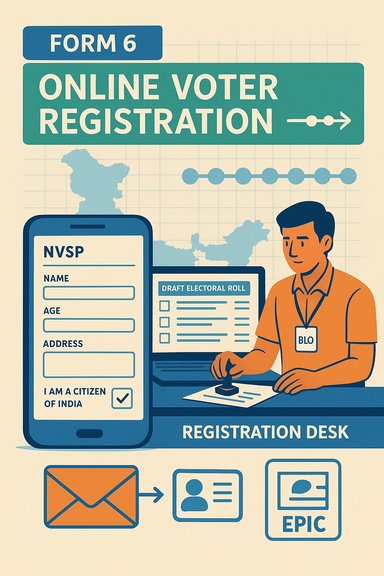
The online flow on the NVSP and ECI portals has been standardized into a short sequence. Multiple authoritative guides and national newspapers condense the process into seven clear steps — the same seven steps widely quoted in consumer and news coverage. Follow these steps as written below and keep copies of every acknowledgment/OTP you receive.- Visit the National Voters’ Services Portal (NVSP) or the Voter Helpline App and choose the option to apply for new registration.
- Click ‘Sign-up’ or register with your mobile number and email; verify through OTP to create an NVSP account.
- Log in using your mobile number and password; you may be required to verify again by OTP.
- Under the ‘Forms’ section, select Fill Form 6 (apply for inclusion in electoral roll).
- Complete Form 6 with accurate details: state, district, constituency, full name, relative’s name, contact details, Aadhaar (optional but often used), gender, date of birth, address and the declaration about citizenship and non-duplication.
- Upload the required documents for proof of age and proof of residence (and a passport-sized photo where requested).
- Preview carefully, submit the form, and note the reference number / acknowledgment for tracking. Use the NVSP tracking page or the app to monitor status until the Elector’s Photo Identity Card (EPIC) is issued or the application is processed.
Documents you will be asked for — and the tricky role of Aadhaar
Normally Form 6 requires:- One document proving age (passport, birth certificate, class X mark-sheet, Aadhaar in many states).
- One document proving ordinary residence (ration card, utility bill, Aadhaar, passport, bank passbook, etc..
- A passport-sized photograph, and an attestation/declaration where applicable.
What happens after you submit Form 6?
After submission, the application routes to the Electoral Registration Officer (ERO) and Booth Level Officer (BLO) of the relevant constituency for local verification. Typical downstream steps include:- Local verification (BLO visits or calls to confirm residence).
- Acceptance into the draft roll (the applicant’s entry may appear in the draft electoral roll published during revisions).
- Opportunity period for claims and objections (Form 7, Form 8 for corrections).
- Final publication of the roll and issuance of EPIC (physical voter ID) or e-EPIC where available.
Recent operational change: faster EPIC delivery
In mid-2025 the ECI announced a technology and process upgrade to reduce the lead time for EPIC delivery and provide end-to-end tracking by integrating with Department of Posts APIs. Media coverage around that upgrade reported a target delivery window of 15 days from the issuance stage, backed by SMS alerts at each milestone. The objective is clear: shorten the wait, increase transparency, and give electors a digital trail for their application. This is operationally significant for first-time voters and those re-registering during mass revisions.Strengths: what the online Form 6 ecosystem gets right
- Convenience and scale: Online Form 6 removes geographic friction and long lines at booths, enabling millions of first-time registrations without in-person visits.
- Traceability: NVSP’s account system, reference numbers, and SMS/portal tracking create an auditable application trail that citizens can use to chase delays.
- Reduced paperwork: Digital uploads cut a layer of manual handling and the risk of physical loss.
- Integration with delivery: The EPIC delivery improvements promise better closure for successful applications and fewer queries to ERO/BLOs.
Risks and weaknesses: where the system is fragile
- Documentation vs. citizenship gap
- Because Form 6 relies on a citizenship declaration rather than mandatory documentary proof of nationality, critics say non-citizens can slip into rolls if verification is weak. SIRs and legal challenges have repeatedly highlighted this vulnerability. The ECI’s practice of accepting Aadhaar for identity/age/residence but excluding it as citizenship proof in certain verification contexts is a policy patch, not a structural fix.
- Digital divide and accessibility
- Online filing favors smartphone and internet users; elderly, marginalised or digitally unskilled citizens still rely on BLOs and camps, where coordination can be inconsistent. Voter camps during mass revisions have documented coordination failures and redirected applicants, producing frustration and drop-off.
- Data governance and Aadhaar linkage risks
- The use of Aadhaar for age/residence introduces questions about storage, purpose limitation and potential mission creep. Best practice in identity systems recommends minimizing retention of sensitive identifiers and using tokenized or ephemeral verification rather than long-term storage of Aadhaar numbers. Current public materials and portal flows do not always make the retention policy explicit to applicants.
- Duplicate registration and legal exposure
- Indian law makes it an offence to be registered in more than one constituency. Duplicate online filings (by mistake or design) can result in cancellations or legal complications; applicants must ensure they are not already on the roll elsewhere before applying. The statutory declaration in Form 6 is thus both a shield and a legal risk for careless applicants.
- Local verification bottlenecks
- The final decision often depends on a BLO’s verification, a resource-constrained function prone to delay and human error. Large-volume SIRs can overload local officers and create backlogs or mis-classifications that affect electors’ ability to vote.
Case studies and recent examples: the SIR effect
Recent Special Intensive Revisions (SIRs) in states such as Bihar and West Bengal have created intense periods where thousands to millions of citizens were either removed from draft rolls or needed to file Form 6 to make claims for inclusion. These events expose the system’s tension: while mass clean-ups are necessary for accuracy, they generate confusion and political controversy when verification falls short or is perceived to be uneven. The uptick in Form 6 filings during these periods is both a proof of digital accessibility and an alarm bell for operational strain on ERO/BLO workflows.Practical advice for applicants: apply smart to avoid delays
- Use your own mobile number and email to create the NVSP account and retain the OTP/acknowledgement SMS.
- Keep scanned copies of one age proof and one address proof ready; Aadhaar is commonly accepted for both but check state CEO pages for local nuances.
- Before applying, verify that your name is not already listed in any constituency — duplicate registration is illegal and will complicate processing.
- If possible, upload high-quality photos and scanned documents; blurred or partial uploads are the leading cause of rejection/deferral.
- Track the application using the NVSP reference number; if status stalls beyond published SLAs, escalate to the ERO and use the Voter Helpline (1950) or your CEO’s contact channels.
Technical and policy recommendations for the ECI and administrators
- Minimize retention of raw Aadhaar
- Adopt tokenization or hash-based ephemeral verification to confirm identity without storing Aadhaar numbers in plain text. This reduces privacy and breach risk while preserving verification utility.
- Publish clear data-retention and consent statements
- The portal should show, before upload, exactly how long documents will be retained, who can access them, and how they will be disposed or archived.
- Strengthen BOT/automation for duplicate detection
- Introduce robust server-side duplicate-checking that flags potential dual registrations and prompts applicant confirmation before submission — reducing legal exposure and administrative clean-up.
- Expand BLO capacity and digital tooling
- Equip BLOs with mobile apps that present verified Applicant dashboards, photographic evidence and a standardized checklist to shorten on-site verification times and reduce subjectivity.
- Audit rolls proactively with third-party verification
- Periodic independent audits (random-sample cross-checking) can surface systemic errors before they become politically contentious during SIRs.
- Transparent appeals and reasoned notifications
- When names are excluded from draft rolls, provide a mechanism to inform impacted persons (via SMS/portal) with a reason code and clear remedial actions to reduce confusion and panic.
Where the debates remain unresolved
- Citizenship verification vs. inclusivity: Requiring documentary proof of nationality could reduce non-citizen inclusions but also raise barriers for genuine citizens with weak documentation, such as migrants or marginalized communities. The balance between accurate rolls and inclusive access remains the central policy dilemma.
- Aadhaar’s role: Aadhaar solves friction but is not a legal marker of citizenship. Using Aadhaar for convenience while excluding it for citizenship checks creates an operational ambiguity that courts, policymakers and civic groups continue to challenge.
- Digital-only assumptions: Relying on online filing as the dominant route risks excluding populations without broadband access; hybrid offline support remains essential in practice.
Quick checklist: what to have when you start Form 6 online
- Mobile number and email for NVSP account (OTP-enabled)
- One age proof document (passport, birth certificate, class X certificate, Aadhaar)
- One address proof (Aadhaar, passport, utility bill, ration card, bank passbook)
- Passport-style photograph (digital)
- Clear scan or photo of documents, correctly oriented and legible
- Time to follow up with the BLO if the portal requests local verification
Final assessment: convenience won, but the system must guard the gate
The online Form 6 process represents a real step forward for voter enrolment in India: it scales access, reduces transaction friction and creates an auditable trail that citizens can use to follow their application. Recent upgrades to EPIC generation and postal integration are sensible improvements that will reduce uncertainty about card delivery. However, speed and convenience cannot substitute for robust verification, transparent data governance and a resilient offline safety net. The dual realities—Aadhaar as a practical enabler but not citizenship proof, and the legal reliance on a declaratory Form 6—create a system that is functionally adequate in normal times but vulnerable during large-scale revisions or politically sensitive audits. Persistent issues around duplicate registration, local verification quality and data privacy demand focused technical and procedural fixes. For prospective registrants, the best posture is simple: prepare good documents, follow the seven-step online flow, keep your acknowledgment number safe, and engage quickly with the ERO/BLO when local verification is requested. For administrators, the imperative is equally plain: keep improving the digital tooling while hardening privacy, auditability and local verification capacity so that the digital roll-up of India’s electorate remains both inclusive and credible.Source: ET Now https://www.etnownews.com/news/form...line-to-become-a-new-voter-article-153405433/

