

FORTÉ’s announcement that it will participate at Integrated Systems Europe (ISE) 2026 in Barcelona signals more than a routine trade‑show appearance — it’s a strategic move to foreground the company’s scaled collaboration offerings, its FORTÉ Velocity™ deployment model, and a tight partnership with GPA that will put Microsoft Places and Copilot adoption strategies front and center during the show. The company confirmed booth activities, demonstrations, and a slate of sessions featuring Microsoft product leads and FORTÉ executives, timed to coincide with ISE’s Feb. 3–6 schedule at Fira de Barcelona.
ISE is the industry’s flagship gathering for professional audiovisual (ProAV) and systems‑integration suppliers, integrators, and enterprise buyers, and the 2026 edition is explicitly positioned as a convergence point for edge AI, platform certification, and next‑generation display technologies. Analysts and preview coverage argue that the show will spotlight devices and systems that embed intelligence at the endpoint — bringing inference, sensor fusion, and device‑level automation into meeting rooms and shared spaces. Those themes establish the context for why FORTÉ’s presence, and its emphasis on scalable room deployments, matters to IT leaders and integrators heading to Barcelona.
ISE 2026 runs February 3–6 at Fira de Barcelona Gran Via, with opening times across the four days and a broad content program that includes newly highlighted topics such as a Cybersecurity Summit and expanded zones for smart buildings and digital signage. Attendance figures and exhibitor lists indicate this remains the single largest ProAV trade exhibition, making it a practical place for vendors like FORTÉ to demonstrate repeatable, enterprise‑scale solutions.
Key in‑booth sessions include:
That license expansion also coincides with Microsoft’s rework of the Teams Shared Space licensing for administrative space management (renamed and rebalanced to manage multiple desks under single license units), plus extended Teams town‑hall and webinar capacity changes. Taken together, the moves indicate Microsoft’s intent to bake workplace coordination and scaled events more directly into the mainstream Microsoft 365 experience.
That said, the positive story comes with important caveats: licensing expansions (like Microsoft’s Places change) indeed lower a key cost hurdle, but they do not eliminate the non‑trivial tasks of governance, device lifecycle management, firmware and model patching, or cross‑platform interoperability. The work of turning ISE demonstrations into dependable, secure, and maintainable outcomes will fall squarely to IT and integration teams — and those teams should use the show to extract measurable proof points, service guarantees, and multi‑year support commitments before signing enterprise contracts.
Forté’s ISE 2026 program is built to capitalize on a market moment: platform features are being unlocked at the license level, hardware is becoming smarter at the edge, and integrators who can marry repeatable deployment models with strong governance will capture the lion’s share of enterprise rollouts. Visit Stand 2P700, attend the GPA Global Lounge sessions, and demand the operational proof points that separate a show‑floor demo from a scalable enterprise solution.
Conclusion
ISE 2026 will be a practical litmus test for whether the industry can turn the promise of the AI‑powered workplace into durable, secure operational practices. FORTÉ’s activities at the show — its Velocity demonstrations, Microsoft‑led sessions, and GPA collaboration — position the company to be part of that transition, but the real winners will be buyers who extract measurable pilots, ironclad SLAs, and clear governance plans out of the noise on the show floor.
Source: Business Wire https://www.businesswire.com/news/home/20260129100474/en/FORT-to-Attend-ISE-2026-in-Barcelona/
 Background / Overview
ISE is the industry’s flagship gathering for professional audiovisual (ProAV) and systems‑integration suppliers, integrators, and enterprise buyers, and the 2026 edition is explicitly positioned as a convergence point for edge AI, platform certification, and next‑generation display technologies. Analysts and preview coverage argue that the show will spotlight devices and systems that embed intelligence at the endpoint — bringing inference, sensor fusion, and device‑level automation into meeting rooms and shared spaces. Those themes establish the context for why FORTÉ’s presence, and its emphasis on scalable room deployments, matters to IT leaders and integrators heading to Barcelona. ISE 2026 runs February 3–6 at Fira de Barcelona Gran Via, with opening times across the four days and a broad content program that includes newly highlighted topics such as a Cybersecurity Summit and expanded zones for smart buildings and digital signage. Attendance figures and exhibitor lists indicate this remains the single largest ProAV trade exhibition, making it a practical place for vendors like FORTÉ to demonstrate repeatable, enterprise‑scale solutions.
What FORTÉ Is Bringing to Barcelona
The headline: collaboration, demos, and partner sessions
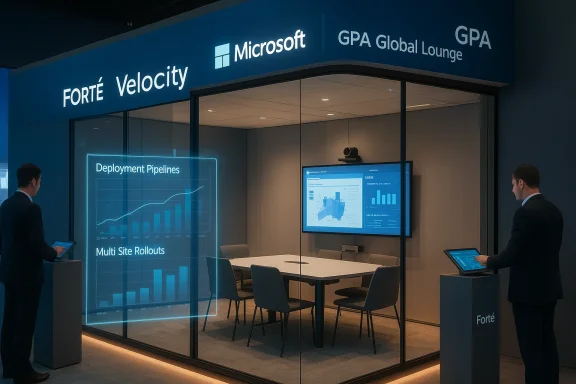
FORTÉ’s press release and public booth listing outline a tight program of activity at the STIM | GPA Stand 2P700 in Hall 2, additional meetings and presentations in the GPA Global Lounge (Europa Suite outside Hall 2), and scheduled FORTÉ Velocity™ demonstrations in room E47‑48. The company will present subject‑matter sessions focused on Microsoft Places and Microsoft Copilot, and it has highlighted executive speakers including Jason Moulden (Vice President, Intelligent Workplace at FORTÉ) and external Microsoft representatives such as Brennan McReynolds, Product Strategy Lead for Microsoft Places.Key in‑booth sessions include:
- Wednesday, Feb. 4, 2:00 p.m. — “From Deployment to Impact: Practical Insights on Microsoft Places.”
- Wednesday, Feb. 4, 11:00 a.m. — “The AI‑Powered Workplace: Copilot Strategies That Move the Needle.”
- Thursday, Feb. 5, 10:00 a.m. — “The Human Side of Hybrid: Change Management for Microsoft Places.”
What Velocity™ means in practice
FORTÉ markets Velocity as a pre‑engineered, factory‑to‑field meeting‑room solution intended to accelerate deployments, standardize configurations, and reduce risk for multi‑site rollouts. The value proposition is operational predictability: repeatable systems, staging and QA in logistics centers, and packaged deliverables that dramatically shorten installation and commissioning timelines. That pre‑engineered model is particularly relevant for enterprise buyers looking to scale Teams‑centric room deployments or hybrid‑work experiences across many sites.Why Microsoft Places and Licensing Changes Matter
What Microsoft has changed (and when)
Microsoft has recently announced a licensing shift that broadens access to Microsoft Places functionality to a wider set of Microsoft 365 and Teams licenses — specifically, to licenses that include access to calendar features in Outlook and Teams (examples listed by Microsoft include Microsoft 365 E3/E5, Business Basic/Standard/Premium, Outlook 365 E1/E3/E5, Exchange Online and applicable Teams SKUs). Microsoft’s published guidance describes the expansion of Places Finder and Places Explorer capabilities and indicates the changes will take effect on April 1, 2026. This licensing update is consequential because it moves some end‑user functionality out of premium paywalls and into a more widely held license footprint.What Places does and why wider access matters
Microsoft Places is a workplace coordination service that adds spatial context to calendars, room and desk booking, and maps-based exploration of office spaces. The Places Finder and Places Explorer experiences give users richer context (floorplans, images, technology availability) than classic Room Finder, enabling better decision‑making for hybrid days and fewer wasted trips to unavailable spaces. By making these end‑user features available to standard calendar‑enabled licenses, Microsoft reduces the per‑user cost barrier for wide adoption — a practical enabler for customers that want to standardize space booking and analytics across a global estate.That license expansion also coincides with Microsoft’s rework of the Teams Shared Space licensing for administrative space management (renamed and rebalanced to manage multiple desks under single license units), plus extended Teams town‑hall and webinar capacity changes. Taken together, the moves indicate Microsoft’s intent to bake workplace coordination and scaled events more directly into the mainstream Microsoft 365 experience.
The Strategic Case: Why FORTÉ’s ISE Presence Is Timely
- Scaling room rollouts: FORTÉ’s Velocity model directly addresses the implementation friction that enterprises face when trying to deploy Teams/Copilot/Places capabilities at scale—especially when a new license expansion suddenly makes more features available to more users. Having a productized deployment pipeline reduces variability and shortens time‑to‑value.
- Partnership leverage: Collaborating with GPA and co‑presenting with Microsoft product leads lets FORTÉ tell a unified story: product capability (Microsoft Places, Copilot), deployment model (Velocity), and global services (GPA alliance reach). That narrative is persuasive for multinational buyers who need consistent, repeatable rollouts across regions.
- Live proof points: Demonstrations at ISE give integrators and IT buyers the chance to evaluate not just UI features but operational processes — device provisioning, device management, and the lifecycle services that underpin enterprise deployments. FORTÉ is packaging those operational stories as a differentiator.
Critical Analysis: Strengths, Risks and the Unsaid
Strengths and notable positives
- Practical scalability: Velocity’s standardized hardware and logistics model is a clear operational advantage for enterprises running 100s of rooms. Repeatability reduces installation errors and simplifies support.
- Lower barrier to adoption: Microsoft’s licensing change removes a cost obstacle for many organizations, making Places features available to a broader user base and therefore improving the ROI calculus for space‑management projects. FORTÉ’s timing to showcase integration patterns is smart.
- Market alignment: ISE 2026’s theme — AI at the edge, certified endpoints and new display tech — favors vendors who can demonstrate integrated solutions across hardware, cloud and services. FORTÉ’s combination of services + certified hardware + Microsoft ecosystem messaging fits that market rhythm.
Risks, blind spots, and operational caveats
- Governance and data residency: Expanding Places access to many license types increases who can use the tool — but it does not automatically solve where the underlying data (maps, check‑ins, transcripts, analytics) is stored and how retention is enforced. Enterprises must validate data‑flow models, retention controls, and Purview/Entra‑based RBAC restrictions before broad rollouts. Microsoft’s administrative controls exist, but they require governance and policy work that is often underestimated.
- Device and firmware management: As ProAV moves to edge AI and firmware‑dependent features (auto‑framing, on‑device noise suppression, local inference), the long‑tail maintenance burden grows. Buyers should insist on firmware‑update SLAs, rollback capabilities and long model‑support windows when selecting suppliers for room hubs and cameras. Without these guarantees, eye‑catching demos can become maintenance headaches.
- Interoperability and vendor lock‑in: Certification programs (for example, Microsoft Device Ecosystem Program variants) make procurement easier but can constrain multi‑platform flexibility. If your environment must support a mix of Teams, Zoom and Google endpoints, a certified Teams‑first stack may simplify operations but limit options. Integrators should design mediation layers or accept tradeoffs explicitly.
- Supply‑chain and cost volatility: Advanced displays (micro‑LED) and AI accelerators are subject to component lead times and price pressure. Large video walls or AI‑heavy hubs may face prolonged lead times that must be reflected in procurement and project schedules.
Flags and unverifiable claims
- Marketing claims about “removing one of the biggest barriers to enterprise adoption” — quoted from FORTÉ’s Jason Moulden — read as a persuasive interpretation tied to Microsoft’s license change. That characterization should be treated as vendor perspective rather than an objectively measured outcome. IT buyers should validate incremental adoption metrics in pilots rather than relying solely on licensing changes as proof of ROI.
How IT Leaders and Integrators Should Approach ISE (Practical Playbook)
ISE’s show floor and FORTÉ’s sessions are valuable, but turn demonstrations into repeatable outcomes with a disciplined approach.- Pilot before you scale. Choose representative rooms (small, medium, large) and pilot Places + Copilot workflows to validate assumptions. Measure occupancy changes, booking accuracy, and end‑user satisfaction. Demand instrumented results from vendors.
- Lock down governance and retention. Use Entra and Exchange RBAC patterns to control who can edit Places directories and who can access exports or analytics. Make explicit where transcripts, usage metrics and telemetry are stored.
- Negotiate SLAs that cover firmware and model updates. Get rollback procedures, guaranteed support windows (three years is a practical floor suggested by analysts), and spare‑parts commitments for displays and hubs. Ask for documented calibration and measurement procedures for any large display claims.
- Require proof of certification and reference deployments. If a vendor claims MDEP, Teams certification, or compatibility with Places, insist on documented rollouts at scale and API integration examples.
- Define an operational center of excellence. Centralize device management, telemetry ingestion, security monitoring and procurement cadence to treat AV endpoints as first‑class IT assets rather than one‑off project boxes.
What to Watch at FORTÉ’s Booth and GPA Events
- FORTÉ Velocity live demos (room E47‑48) — evaluate not just the UI but the delivery chain: staging, labeling, packing lists, and install time expectations. Measure actual install numbers against vendor claims.
- Microsoft Places sessions — ask concrete questions about data retention, Graph API examples for Places Directory automation, and tenant admin workflows. Brennan McReynolds’ participation is an opportunity to probe roadmap priorities for Places.
- Copilot adoption strategies — during the “AI‑Powered Workplace: Copilot Strategies That Move the Needle” session, request examples that show measurable productivity wins and clear admin controls (Copilot defaults, transcription settings, and retention). Microsoft’s admin changes to Copilot meeting defaults underscore the importance of governance.
- Sustainability and operational sessions in the GPA Global Lounge — these sessions can surface lifecycle and energy implications for large displays and device fleets; factor those into TCO calculations.
Wider Market Signals that Reinforce the Move
ISE 2026’s editorial and analyst previews repeatedly highlight three industry forces that underpin FORTÉ’s messaging: (1) AI moving onto devices (edge inference), (2) ecosystem certification and consolidated platform experiences (Teams, Zoom, Google), and (3) display innovation (micro‑LED, e‑paper) — all of which pressure integrators and IT teams to think in terms of lifecycle, security and supply‑chain risk as much as feature lists. Those same previews recommend asking vendors for independent measurements, firmware SLAs and realistic lead‑time commitments before committing to large deployments.Bottom Line and Verdict
FORTÉ’s presence at ISE 2026 is a purposeful move to convert product marketing into operational credibility. The combination of FORTÉ Velocity deployments, sessions with Microsoft product leads, and GPA partnership positioning gives the company a credible narrative for enterprises seeking faster, more standardized rollouts of hybrid‑work technologies.That said, the positive story comes with important caveats: licensing expansions (like Microsoft’s Places change) indeed lower a key cost hurdle, but they do not eliminate the non‑trivial tasks of governance, device lifecycle management, firmware and model patching, or cross‑platform interoperability. The work of turning ISE demonstrations into dependable, secure, and maintainable outcomes will fall squarely to IT and integration teams — and those teams should use the show to extract measurable proof points, service guarantees, and multi‑year support commitments before signing enterprise contracts.
Quick Checklist: Questions to Ask FORTÉ, GPA and Microsoft at ISE
- Can you produce instrumented pilot results (occupancy delta, booking accuracy, ROI for the first 6 months)?
- What is the firmware and AI‑model support policy for devices in Velocity bundles? Are rollbacks and emergency patches included?
- Where are Places and Copilot artifacts (transcripts, analytics) stored, and what admin controls exist for retention and discoverability?
- Provide reference customers with similar scale and geography who used Places + Velocity for global rollouts.
- Supply documented SLAs for spare parts, calibration, and display servicing for micro‑LED or large dvLED claims.
Forté’s ISE 2026 program is built to capitalize on a market moment: platform features are being unlocked at the license level, hardware is becoming smarter at the edge, and integrators who can marry repeatable deployment models with strong governance will capture the lion’s share of enterprise rollouts. Visit Stand 2P700, attend the GPA Global Lounge sessions, and demand the operational proof points that separate a show‑floor demo from a scalable enterprise solution.
Conclusion
ISE 2026 will be a practical litmus test for whether the industry can turn the promise of the AI‑powered workplace into durable, secure operational practices. FORTÉ’s activities at the show — its Velocity demonstrations, Microsoft‑led sessions, and GPA collaboration — position the company to be part of that transition, but the real winners will be buyers who extract measurable pilots, ironclad SLAs, and clear governance plans out of the noise on the show floor.
Source: Business Wire https://www.businesswire.com/news/home/20260129100474/en/FORT-to-Attend-ISE-2026-in-Barcelona/
