

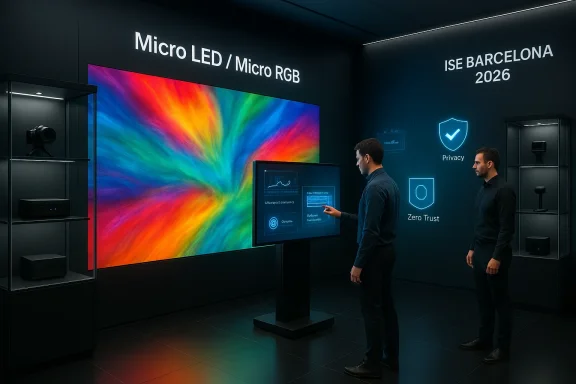
Integrated Systems Europe (ISE) Barcelona 2026 is shaping up to be the year professional AV (ProAV) stops being “just a screen and a projector” and starts to function as a distributed intelligence layer for buildings, meetings, retail and public spaces—driven by a convergence of edge AI, micro‑LED and Micro RGB display advances, platform-level collaboration, and a renewed focus on cybersecurity and serviceability.
Background
ISE Barcelona (February 3–6, 2026) has been framed by analysts and vendors as a cross‑discipline showcase where ProAV vendors will present not only incremental product upgrades but system‑level shifts: on‑device inference, certified collaboration stacks, and next‑generation display panels that promise new form factors and interactive capabilities. Omdia’s preview explicitly highlights this three‑way convergence—AI shifting onto hardware, collaboration ecosystems consolidating around certified devices and programs, and display innovation (e‑paper, micro‑LED/Micro RGB) redefining what “a screen” can be.These are not isolated trends. Vendors are positioning displays and room systems as both content surfaces and computational endpoints: sensors (visual, voice, environmental) feed local models running on NPUs/accelerators inside cameras, speakers and displays, delivering low‑latency features like auto‑framing, noise suppression, personalized signage and adaptive room content without persistent cloud uploads. This hardware‑first AI story will be visible across showrooms and vendor booths, with many demonstrations intended to prove the case for privacy‑sensitive, latency‑critical AV capabilities.
AI‑driven audio and video: from cloud magic to edge muscle
What’s changing
The dominant narrative for ProAV at ISE 2026 is that AI is moving from a software‑only, cloud‑centric model to purpose‑built hardware and firmware. Cameras, microphones and displays will increasingly embed multimodal sensors and local inference engines (NPUs/TPUs/DSPs), enabling real‑time features such as:- Auto‑framing and dynamic participant tracking
- Advanced noise suppression and voice enhancement
- Context‑aware content switching and personalized signage
- On‑device transcription, summarization and meeting assistance (with on‑device fallbacks)
Why this matters for IT and integrators
Edge AI changes procurement, operations and risk models. Devices now require:- Long‑term firmware support and model update paths
- Patch management and over‑the‑air (OTA) rollback procedures
- Device attestation, secure boot and telemetry controls
- Clear documentation about what is processed on device vs. what is uploaded to cloud services
Converged unified communications: ecosystems, certifications and the MDEP effect
Integrated room solutions and certification momentum
The major collaboration platforms—Microsoft Teams, Zoom, and Google Meet—are deepening hardware partnerships and certification programs, creating an expectation of consistent, plug‑and‑play room experiences from huddle rooms to boardrooms.Key trends highlighted for ISE include:
- Integrated room solutions: scalable, out‑of‑the‑box setups emphasizing zero‑touch provisioning, proactive device management and predictive analytics.
- Microsoft’s Devices Ecosystem Program (MDEP): a focal point for Android‑based Teams Rooms integrations that promise easier deployment and security controls.
- Platform AI tools: in‑meeting assistants (Copilot, Zoom AI, Gemini) providing transcription, action‑item extraction and summaries—often tied into downstream workflow automation.
Practical implications
- Certified bundles reduce deployment complexity but increase vendor dependence: management tools, updates and analytics often assume a single platform.
- Integrators must demand proof of certification for scale deployments and validate APIs and device management tooling before large rollouts.
- Security controls and data governance become the differentiator for enterprises: where meeting transcripts live, retention policies and admin controls must be clearly documented.
Edge AI in action: examples and evaluation criteria
Real‑world capabilities to expect
When AI moves to devices, the headline features become functional realities that integrators must validate:- Auto‑framing and speaker tracking: local computer vision models identify active speakers and recompose video in real time.
- Noise suppression and voice isolation: edge DSP/AI reduces room noise and boosts intelligibility without cloud processing.
- Personalized room views and adaptive content: displays that change content based on occupancy, meeting role or environmental signals.
How to evaluate vendor claims on the show floor
Ask for measured, repeatable evidence:- Request latency numbers and whether the features run fully on device or need cloud fallback.
- Test privacy behavior: can inference be forced to stay local? Are transcripts retained or exported?
- Demand device‑management demos showing bulk provisioning, firmware rollback, and alerting.
- Compare noise suppression and auto‑framing under real acoustic/lighting conditions rather than staged content.
Emerging display technologies: micro‑LED, Micro RGB, and e‑paper
Micro‑LED and Micro RGB: the new spatial interface
Micro‑LED and Micro RGB are the display headlines on the ProAV roadmap. Analysts frame micro‑LED as a systems challenge—integrating chip fabrication, driver electronics, optics and intelligent algorithms—to produce immersive, transparent and even three‑dimensional panels. However, the manufacturing realities remain the gating factor: pixel pitches for practical commercial panels are expected to remain above ~0.3 mm for the near term, constraining near‑field viewing applications and keeping costs high.At CES 2026, vendors demonstrated what the near future might look like: large Micro RGB panels and hybrid architectures that place microscopic RGB emitters in backlight planes, enabling higher color volume at sustained brightness while avoiding the tiled economics of pure micro‑LED walls. These demos illustrate possible ProAV applications—transparent displays, immersive galleries and massive corporate canvases—but they also underscore installation complexity, calibration needs and higher service demands.
The Micro RGB case study (Samsung and others)
Samsung’s large‑format Micro RGB exhibits were prominent examples: gallery‑scale panels with sub‑100 µm emitter claims, AI image engines, and VDE‑verified wide gamut statements. These products position Micro RGB as a hybrid path toward high color volume without full self‑emissive microLED tiling. But vendors have been explicit: many of these displays were staged as halo or concept units, with pricing and retail availability often unclear. Independent lab verification—measuring color volume at realistic APLs, halo/bloom behavior and long‑term calibration drift—remains essential before fleet deployment.E‑paper: low power and eye comfort—limited by size and outdoor readiness
E‑paper is resurging for signage use cases that prioritize energy efficiency and readability. Current color e‑paper modules top out around 31.5 inches for indoor and semi‑outdoor applications; production yields and refresh behavior still limit large‑format outdoor adoption. Vendors continue to iterate on multi‑color Spectra stacks and front‑lighting, but for now e‑paper is practical primarily for indoor digital posters, price tags and low‑power information displays rather than for full sunlight outdoor walls.Cybersecurity, privacy and operational maintenance
AV is now an IT problem
As AV devices adopt inference and networked management, responsibility shifts squarely into IT and security teams. ISE 2026 programming and analyst commentary place cybersecurity front and center: device attestation, zero‑trust networking for endpoints, firmware‑update SLAs and audit logging are no longer optional. Vendors must disclose telemetry flows, provide options for on‑device processing, and commit to robust patch management.Data governance and platform AI
Platform AI agents (Microsoft Copilot in Teams, Zoom AI Companion, Google Gemini) unlock productivity but also create governance complexity:- Where are meeting transcripts stored?
- Who can query generated meeting intelligence?
- How are models audited for bias and accuracy?
- Are features regionally restricted or dependent on cloud services?
Supply chain and serviceability: the hidden cost of innovation
Advanced displays and edge AI hardware require components that are also in demand for datacenter AI—semiconductors, memory and specialized sensors. Industry reporting from late 2025 and early 2026 flagged price volatility and constrained supply in these commodity markets, which creates longer lead times and higher total cost of ownership for micro‑LED walls and AI‑heavy room hubs. Omdia recommends factoring component risk into procurement schedules, negotiating firmware and service SLAs (three years is a practical floor suggested), and including contingency allowances for delayed shipments.Technical serviceability must be part of procurement conversations: warranty scope for LED modules, panel replacement terms, calibration services (3D LUTs, professional modes) and independent measurement support should all be contractually documented before purchase.
Buyer’s checklist: practical steps before, during and after ISE
Use the following checklist to convert showfloor excitement into defensible procurement decisions.- Require independent instrumented measurements for display claims: delta‑E, color volume at real‑world APLs, halo/bloom testing and sustained HDR luminance.
- Verify certifications and references for collaboration bundles (MDEP, Teams Rooms, Zoom Rooms, Google Meet Rooms). Ask for deployment references at a similar scale.
- Insist on documentation for where audio/video data is processed and stored; require on‑device fallbacks for sensitive deployments.
- Negotiate firmware‑update SLAs with rollback capabilities and a minimum three‑year support commitment for AI models and security patches.
- Factor supply‑chain contingency into timelines and budgets for micro‑LED and AI accelerators; plan for lead times and spare inventory for critical projects.
- Test integrations in pilot deployments before enterprise‑wide rollouts—validate device management, provisioning, monitoring APIs and telemetry ingestion.
What to watch for at ISE Barcelona 2026
- Booths showing MDEP certified Android Teams Rooms devices and multi‑platform wireless room systems; look for proofs of scale and security validation.
- Edge AI showcases that combine NPUs/accelerators with clear device‑management stories; verify the firmware update path and model patching capabilities.
- Micro‑LED and Micro RGB installations demonstrating color volume and immersive form factors; request lab measurements and long‑term service plans rather than pure spectacle.
- E‑paper signage product launches around the 31.5‑inch bracket for low‑power indoor signage; test refresh behavior under your content mix.
- Sessions and the Cybersecurity Summit focused on AV over IP security, zero‑trust and device attestation—these will be essential for IT leaders.
Strengths, opportunities and notable risks
Strengths and business opportunities
- Improved privacy and latency: on‑device inference reduces cloud dependence and improves responsiveness for meeting experiences and interactive signage.
- New UX possibilities: transparent, interactive and spatial displays can deliver immersive experiences for retail, events and corporate spaces.
- Platform productivity gains: integrated Copilot/AI features can generate post‑meeting artifacts and searchable knowledge, boosting organizational efficiency when governed properly.
Key risks and friction points
- Interoperability and vendor lock‑in: certified stacks simplify deployment but limit cross‑platform flexibility; true multi‑platform unity is still elusive.
- Measurement and marketing claims: gamut and pixel‑pitch claims require independent lab validation; treat manufacturer specs as directional until verified.
- Supply‑chain and component risk: competition for AI accelerators and memory can extend lead times and increase costs—factor this into schedules and budgets.
- Operational overhead: AI‑enabled devices add security, maintenance and lifecycle considerations that move AV projects into IT governance territory.
A measured roadmap for integrators and IT leaders
If you’re responsible for specifying or managing AV in 2026, adopt a phased, measurable approach:- Phase 1 — Pilot and validate: select a small set of rooms and a representative micro‑display or wall to trial edge AI features and display claims; instrument tests and measure outcomes.
- Phase 2 — Lock down governance: finalize data handling policies, retention rules for transcripts, and firmware update processes before wider deployment.
- Phase 3 — Scale with service: negotiate multi‑year SLAs that include calibration, spare parts and firmware/model patch guarantees; include lead‑time buffers in procurement planning.
Conclusion
ISE Barcelona 2026 promises to be a transitional show for ProAV—where edge AI, platform consolidation, and display innovation meet in practical vendor demonstrations. The potential is real: more intelligent meeting rooms, energy‑efficient signage and immersive, interactive canvases that reframe how spaces communicate. Yet the path to meaningful, scalable deployments is guarded by measurable concerns: interoperability, independent verification of display claims, component supply volatility, and the organizational shift required to treat AV as first‑class IT infrastructure. Omdia’s analysis is clear—vendors must move beyond spectacle to provide reproducible performance, transparent governance and long‑term serviceability if these new capabilities are to become widespread.For integrators and IT teams attending ISE, the imperative is straightforward: ask for measurements, insist on certification and SLAs, pilot before you scale, and treat the show floor as the start of a due‑diligence conversation—not the finish line.
Source: Communications Today AI and Micro-LED innovation shape professional AV at ISE Barcelona | Communications Today
