

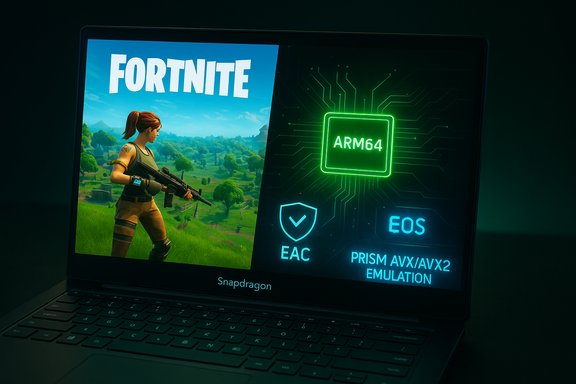
Fortnite is now launching on Windows on Arm machines — not through a cloud stream or quirky workaround, but as a playable native client after Epic updated its Easy Anti‑Cheat/Epic Online Services tooling and Microsoft's Prism emulator expanded what it can emulate for x64 titles.
Windows on Arm has been promising longer battery life, always‑on connectivity, and on‑device AI, but gaming was the conspicuous gap in that story. Two technical barriers stood between Snapdragon‑powered Copilot+ laptops and the mainstream PC gaming library: kernel‑mode anti‑cheat drivers (which previously could not be translated or emulated safely) and the widespread use of modern x86 vector instruction sets such as AVX/AVX2 in games and engines. Over the past year those barriers have seen coordinated industry workarounds: Epic Games has moved Easy Anti‑Cheat support toward Arm, Microsoft has expanded Prism (the Windows on Arm emulator) to expose emulated x64 CPU features, and community testing now shows Fortnite starting on Arm devices after the v38.00 update and recent Windows cumulative patches. This article walks through what changed, why it matters for gaming on Arm, how it performs in the real world today, and the risks and limitations that still make Arm a cautious choice for serious gamers.
The immediate future looks constructive: Prism opens doors for a wide class of apps and games, Epic’s SDK update lowers developer friction for multiplayer titles, and upcoming Snapdragon X family silicon promises better raw performance. The next crucial steps are (1) publishers shipping Arm‑native builds where performance matters, (2) additional anti‑cheat vendors porting their kernel components, and (3) OEMs and Qualcomm delivering consistent driver and firmware updates so the real‑world experience matches the promise.
Windows on Arm is no longer an empty promise for gamers — it’s a platform in motion. The progress is tangible, but pragmatic testing and expectation management remain essential as the ecosystem completes the final mile from “it runs” to “it runs like you expect.”
Source: Windows Latest Windows on Arm looks ready for gaming, as Fortnite finally runs
 Background / Overview
Windows on Arm has been promising longer battery life, always‑on connectivity, and on‑device AI, but gaming was the conspicuous gap in that story. Two technical barriers stood between Snapdragon‑powered Copilot+ laptops and the mainstream PC gaming library: kernel‑mode anti‑cheat drivers (which previously could not be translated or emulated safely) and the widespread use of modern x86 vector instruction sets such as AVX/AVX2 in games and engines. Over the past year those barriers have seen coordinated industry workarounds: Epic Games has moved Easy Anti‑Cheat support toward Arm, Microsoft has expanded Prism (the Windows on Arm emulator) to expose emulated x64 CPU features, and community testing now shows Fortnite starting on Arm devices after the v38.00 update and recent Windows cumulative patches. This article walks through what changed, why it matters for gaming on Arm, how it performs in the real world today, and the risks and limitations that still make Arm a cautious choice for serious gamers.What changed: Epic, Easy Anti‑Cheat, and Fortnite
Epic’s EOS/EAC move: the technical pivot
Epic announced plans to bring Windows‑on‑Snapdragon support to Epic Online Services' anti‑cheat layer and to make Fortnite available on Snapdragon devices, and later rolled ARM support into the EOS SDK so developers could adopt the same tooling. That effort specifically targeted Easy Anti‑Cheat (EAC) — the kernel‑level protection that blocks many online titles when it’s missing or incompatible. The upshot: games that depend on EAC can now be updated by their publishers to work on Arm Windows devices when developers adopt the new EOS SDK.Fortnite v38.00 and an undocumented SDK bump
Fortnite’s v38.00 release (rolled out around November 1, 2025) contained an undocumented SDK change that effectively refreshed the embedded EOS/EAC client to a build that supports ARM64 on Windows. Community reporting and hands‑on tests — first flagged by Windows‑focused outlets and validated by players attempting to launch Fortnite on Snapdragon X‑series laptops — show that the game now launches instead of being blocked by an “ARM64 not supported” anti‑cheat error. Epic’s developer pages confirm the EOS SDK update path for enabling ARM support, and Fortnite’s v38.00 release is the packaging moment when the new EOS client appears in the wild for that title. The official Fortnite patch notes focus on gameplay and features, not the embedded middleware versions, so the SDK bump remains an unsung but material change.Why this matters
Anti‑cheat is a gatekeeper for competitive and many popular live‑service titles. Until kernel‑mode EAC (or equivalent anti‑cheat drivers) were available on Arm, players on Windows on Arm were routinely blocked from matchmade multiplayer. With EAC (via the EOS SDK) supporting Arm64, publishers can deliver multiplayer-capable builds that run legitimately on Snapdragon laptops — a prerequisite for bringing mainstream titles such as Fortnite into the platform’s usable catalog. The change does not magically convert every game overnight, but it removes a top‑level procedural blocker that has kept many titles off the platform for years.Microsoft’s Prism update: AVX, AVX2 and emulation improvements
What Prism now does
Microsoft’s Prism emulator — the just‑in‑time translation layer Windows uses to run x86/x64 binaries on Arm — received a meaningful capability expansion in a recent cumulative update (distributed as KB5066835 in mid‑October 2025). The update causes Prism to advertise and emulate certain x86‑64 CPU extensions to emulated x64 apps, notably AVX and AVX2 as well as related instruction sets (BMI, FMA, F16C). That lets many 64‑bit applications that previously refused to start because they detected no AVX support now proceed to run, albeit under software emulation. Microsoft’s support pages list the cumulative releases, while independent reporting and community tests tie the user‑visible emulator behavior to Prism’s expanded virtual CPU feature set.Practical effect on games and apps
AVX and AVX2 are widely used in game engines and multimedia libraries for parallel floating‑point math and SIMD‑accelerated workloads. Historically, their absence on Arm was a show‑stopper for many titles; with Prism emulating those instructions and advertising them to x64 applications, far more titles will now at least start and initialize critical codepaths. This is not a performance magic trick — emulated vector instructions still cost CPU cycles — but it removes an important “won’t launch” class of compatibility failures and increases the practical software library for Arm laptops.Deployment nuances and a cautionary note
Microsoft exposed Prism’s newer emulated CPU features behind per‑executable compatibility toggles in Windows, and the change was rolled out through normal cumulative update channels. However, KB5066835 also shipped a troublesome regression that affected USB input in the Windows Recovery Environment (WinRE) on some devices — a reminder that system‑level changes carry risk and that administrators should stage and test widely before broad rollout. Microsoft issued out‑of‑band fixes to address that regression. These operational risks matter for users and organizations considering rapid adoption of new cumulative updates on mission‑critical hardware.Hands‑on impressions and community reports
Real gameplay: early hands‑on impressions
Community testers and early hands‑on reports show Fortnite launching and running on Snapdragon X‑series laptops after the v38.00 update and the October Prism changes. Reported behavior varies by SoC and settings:- At default “Performance” settings with v‑sync enabled, testers reported a locked 60 FPS with minimal hitching on many runs, though first‑match texture streaming caused occasional stutters.
- Some community posts show very high frame rates on higher‑end X Elite hardware (reports range from locked 60 up to 120+ FPS with settings tuned down), while lower‑end X Plus variants are more modest. Battery‑and‑thermals influence sustained performance.
What users can expect in the wild
- Playable, not parity‑perfect: Expect a playable Fortnite on Snapdragon X devices for casual and light competitive play, but do not assume parity with high‑end x86 gaming laptops or consoles.
- Texture streaming and open‑world hitches: Early matches show occasional streaming stalls as the engine loads textures; this is consistent with lower memory bandwidth or emulation overhead for certain loader code paths.
- GPU driver and OS maturity matter: The GPU driver stack on Arm is still catching up in feature completeness and performance tuning compared with long‑serving Intel/NVIDIA/AMD drivers on x86. Driver updates will materially affect frame pacing and stability.
- Anti‑cheat parity unlocks multiplayer: EAC support removes the previous block that caused matches to refuse launch; however, other anti‑cheat systems used by different publishers (Riot Vanguard, FaceIt, et al. still lack Arm ports and remain wildcards.
The anti‑cheat landscape: progress and outstanding gaps
EAC’s arrival is necessary but not sufficient
Easy Anti‑Cheat moving to ARM64 is a major, publicly visible victory — it solves the single biggest blocker for a swath of multiplayer titles that already rely on Epic’s tooling. But the ecosystem is fragmented: many popular competitive games use different kernel‑level anti‑cheat systems (Riot Vanguard for Valorant/League of Legends, Valve anti‑cheat variants, FaceIt, etc.. Each vendor must decide to support ARM64 and ship kernel drivers or validated user‑mode arrangements. Until major vendors coordinate similar moves, some competitive titles will remain locked for Arm users.Security and attack surface considerations
Kernel‑mode anti‑cheat drivers are sensitive pieces of code that run with high privileges. Porting them to a different architecture requires rigorous security validation, regression testing, and vendor trust. In practice, that means porting anti‑cheat drivers may lag developer interest or be blocked by business priorities. Even when ports arrive, platform vendors and publishers must ensure they do not introduce regressions or new vulnerabilities. Users should treat new anti‑cheat ports with the same scrutiny as any major system‑level driver push.Performance reality: emulation costs, thermals, and the road ahead
Emulation is slow but acceptable for many workloads
Prism’s AVX/AVX2 emulation closes the “won’t run” gap but cannot eliminate the raw cost of translating wide SIMD operations into Arm64 sequences. For CPU‑heavy simulation, physics, or pathfinding code that leans on AVX vectors, emulation imposes measurable overhead. Games that are GPU‑bound or that structure their workloads to avoid AVX hotspots will fare better. Testers repeatedly note that GPU‑heavy titles can be playable with lowered settings, while CPU‑heavy titles will show larger performance differences versus native x86.Thermal headroom and OEM design matter more than headline SoC numbers
Arm SoC design trades power efficiency for different thermal envelopes than typical x86 laptop silicon. OEM cooling solutions, power profiles, and throttling strategies heavily determine sustained frame rates. Two Snapdragon X Elite laptops with the same SoC can exhibit different real‑world gaming performance based on chassis design. Choosing an Arm laptop with a larger thermal budget will generally yield better sustained gaming performance.The future: Snapdragon X2 and native ports
Qualcomm’s Snapdragon X2 family targets higher single‑core performance, more GPU throughput, and larger NPUs — silicon designed to narrow the performance gap for PC workloads. Native Arm game builds (compiled for Arm64) will always outpace emulation; as more studios ship Arm‑native binaries, performance and battery tradeoffs will improve for gaming. The hardware roadmap plus middleware updates (anti‑cheat, shader compilers, runtime libraries) is what will transform Arm gaming from “possible” to “competitive.”Risks, regressions, and operational guidance
System‑update risk: Prism shipped with a WinRE regression
The October cumulative that expanded Prism (KB5066835) also included a regression that disabled USB input in WinRE for some devices. Microsoft issued an out‑of‑band fix, but the episode is a clear reminder: system‑level compatibility work can break recovery paths or other rare code paths. Enterprises and cautious users should:- Stage the October cumulative in a test ring before broad deployment.
- Create verified external recovery media before applying the update on USB‑only systems.
- Monitor Microsoft’s release health pages for out‑of‑band fixes and known issue rollbacks.
Unverified claims and the need for validation
Some headlines and community posts credited specific games or performance numbers that later proved optimistic or dependent on insider builds. When vendor changelogs don't list a middleware version, community sleuthing is often how the change is discovered. Treat any single‑device or single‑build benchmark as anecdotal until multiple independent reviews reproduce the result. Where a claim cannot be found in official patch notes or vendor blogs, flag it as community‑observed and subject to later confirmation.What this means for different users
Casual players and productivity users
If you want a thin, long‑life laptop that can also run occasional matches of Fortnite and other popular games, a Copilot+ Arm device is now a much more versatile choice than before. Expect multi‑day battery life for productivity and the ability to drop into light gaming sessions when you need a break. The convenience tradeoff is a possible loss in raw frame rate, less headroom for high‑end competitive play, and more reliance on driver maturity.Competitive and hardcore gamers
Competitive gamers should remain cautious. While Fortnite is playable in many reports, players who chase maximum frame rates, minimum latency, and predictable frame pacing will still prefer high‑performance x86 systems or dedicated consoles today. Also, until every major anti‑cheat vendor ships a robust Arm64 kernel client and publishers offer Arm‑native builds, some competitive titles will remain blocked or inferior under emulation.IT and enterprise
Enterprises evaluating Arm for fleet refreshes should prioritize application and driver compatibility testing. Prism's AVX emulation expands compatibility for many line‑of‑business apps, but kernel‑mode security clients, EDR tooling, and specialized device drivers remain potential blockers. Pilot programs and staged rollouts are essential.Practical checklist: how to verify and try Fortnite on an Arm laptop today
- Ensure Windows 11 is up to date (post‑KB5066835 cumulative and any out‑of‑band patches).
- Install Fortnite and allow the Easy Anti‑Cheat installer to run (the EOS/EAC client is required). Epic’s support pages still emphasize EAC as mandatory.
- If a title refuses to launch, check the per‑executable Prism compatibility option: Properties > Compatibility > Windows Arm compatibility and toggle “Show newer emulated CPU features” to allow Prism to expose AVX/AVX2.
- Tune graphics settings: start in “Performance” rendering mode, enable v‑sync to stabilize frame pacing on early systems, and lower texture streaming budgets if you experience stutter. Community testers reported the smoothest starts at these settings.
- Keep drivers current — GPU drivers and firmware updates from OEMs can materially change the experience. Monitor vendor release notes and the Windows Update Catalog for driver rollouts.
Conclusion — measured optimism, not a fanfare
The combination of Epic’s EOS/EAC ARM64 support and Microsoft’s Prism emulator updates is the clearest evidence yet that Windows on Arm is transitioning from a niche productivity play into a platform where mainstream gaming can live — at least in many practical cases. Fortnite’s appearance on Arm‑powered laptops is both symbolic and functional: it proves the path is real and that industry coordination can remove the anti‑cheat and instruction‑set blockers that once made Arm unfit for modern multiplayer titles. That said, the story is not finished. Emulation overheads, driver maturity, anti‑cheat vendor coverage beyond Epic, and OEM thermal choices still make Arm a tradeoff rather than a wholesale replacement for x86 gaming hardware. For users who prize battery life and portability and who want gaming as a valuable secondary capability, Arm laptops are suddenly much more compelling. For competitive players and heavy content creators demanding absolute performance parity, x86 remains the safer choice today.The immediate future looks constructive: Prism opens doors for a wide class of apps and games, Epic’s SDK update lowers developer friction for multiplayer titles, and upcoming Snapdragon X family silicon promises better raw performance. The next crucial steps are (1) publishers shipping Arm‑native builds where performance matters, (2) additional anti‑cheat vendors porting their kernel components, and (3) OEMs and Qualcomm delivering consistent driver and firmware updates so the real‑world experience matches the promise.
Windows on Arm is no longer an empty promise for gamers — it’s a platform in motion. The progress is tangible, but pragmatic testing and expectation management remain essential as the ecosystem completes the final mile from “it runs” to “it runs like you expect.”
Source: Windows Latest Windows on Arm looks ready for gaming, as Fortnite finally runs
