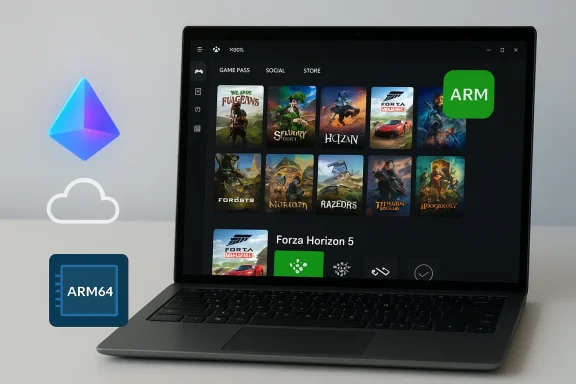
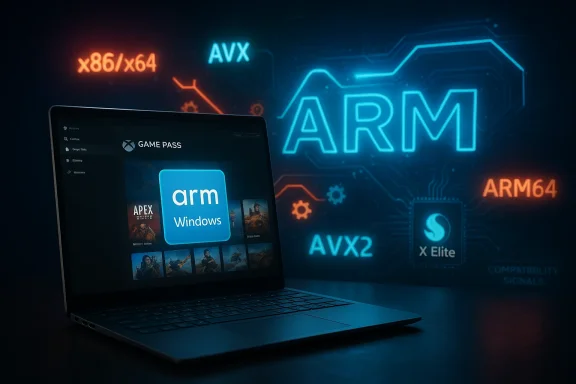
Microsoft’s move to bring the official Xbox app to Arm-based Windows 11 machines is the clearest sign yet that the company intends to make Windows on Arm a first-class gaming platform — not merely a power-efficient curiosity — but the reality for players will be shaped as much by emulator limits, driver maturity, and publisher buy-in as by Microsoft’s engineering push. According to the Tbreak report provided to us, the Xbox app update now lets Arm Windows 11 devices access a substantial portion of the PC Game Pass library — the article claims “more than 85%” of titles are now compatible — while Prism’s expanded emulation and newly supported anti-cheat stacks remove several long-standing blockers for local play. osoft’s investment in Windows on Arm gaming has accelerated across multiple fronts: emulator improvements in Prism to widen x64 compatibility, driver and GPU tooling updates from Qualcomm, a retooled Xbox PC app that supports Arm64 downloads, and coordination with anti-cheat vendors to restore multiplayer parity. These changes are the product of cross-team work — Windows platform engineers, Xbox team members, silicon partners, and third-party middleware vendors — and they’re being rolled out incrementally through Insider channels and cumulative Windows updates. Microsoft’s platform blog frames the work as an explicit Prism upgrade that expands emulation to additional x86 instruction-set extensions, enabling more apps and games to run on Arm devices. This is a structural shift in the Windows-on-Arm story. Historically, Arm devices were limited to cloud streaming for many modern PC games or were restricted to titles with native Arm64 builds. That changed as Microsoft and partners attacked the three core roadblocks: instruction-set incompatibility (particularly AVX/AVX2), GPU driver agility, and kernel-mode anti‑cheat compatibility. The net result is a platform that can run more games locally, stream the rest via Xbox Cloud Gaming, and — importantly — offer multiplayer in cases where anti-cheat vendors provide Arm support. Independent reporting and platform posts have documented these coordinated changes.
The engineering fixes are real and material, but so are the caveats: emulation incurs overhead, driver maturity varies, publishers must ship native builds for the best results, and anti-cheat coverage is still mid-rollout. The Tbreak report’s 85% compatibility claim captures the spirit of large-scale progress but should be treated as a reporter claim pending official verification.
In sum, Microsoft and its partners have delivered an important set of engineering changes that transform the Windows-on-Arm gaming narrative: the Xbox app’s new Arm-friendly behavior, Prism’s broader emulation, and improved anti‑cheat support together remove several of the most visible barriers to play. The result is not immediate parity with high-end x86 gaming rigs, but it is a clear, verifiable pivot toward a useful, playable, and increasingly mainstream Arm gaming experience.
Source: Tbreak Media Xbox App on Arm Windows 11 unlocks Game Pass | tbreak
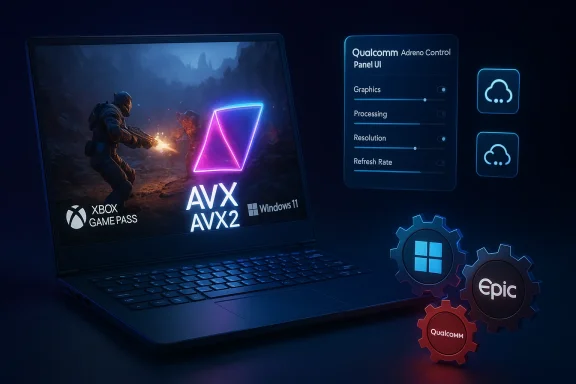 What changed — the technical essentials
Prism: AVX and AVX2 emulation
- Microsoft updated Prism — the x86/x64→Arm64 translation layer — to advertise and translate a larger set of x86-64 instructions, including AVX, AVX2, and related extensions (BMI, FMA, F16C).
- This lets many 64‑bit Windows games that previously aborted on startup because of CPU feature checks now proceed under emulation. Prism’s change is available on Windows 11 builds (24H2 and later) and is enabled by default for x64 apps; 32‑bit legacy launchers remain an edge case.
Xbox app: local downloads and Game Pass integration
- The Xbox PC app on Arm now supports local installation for many supported Game Pass titles, moving Arm devices beyond cloud-only play where publishers provide compatible builds or where improved emulation suffices. The change initially landed for Insiders and is expanding outward.
- For titles that still aren’t running natively, the Xbox app still embeds Xbox Cloud Gaming as a fallback so players can stream unsupported games on demand (Game Pass Ultimate required for cloud streaming).
Anti-cheat: Epic / EAC and other stacks
- Anti-cheat systems were the thorniest problem for multiplayer titles on Arm because many anti-cheat vendors supply kernel‑mode components that were historically x64-only.
- Epic (Easy Anti‑Cheat) and other anti-cheat vendors have worked with Microsoft and Qualcomm to produce Arm-friendly components. That coordination has allowed marquee multiplayer titles, most notably Fortnite in early proofs, to return to Windows-on-Arm multiplayer.
GPU drivers, Qualcomm Control Panel, and delivery cadence
- Qualcomm introduced a Snapdragon (Adreno) Control Panel and an updatable driver model for Snapdragon X-series Windows devices, allowing per-game profiles and faster driver delivery outside sluggish OEM update channels. This mirrors the driver distribution model on x86 systems and reduces time-to-fix for rendering bugs.
- Qualcomm claims targeted fixes and optimizations for large numbers of titles and has signaled a more frequent driver cadence — a necessary piece of the puzzle for consistent game performance on integrated Adreno GPUs.
The headlines and what’s verifiable
- Microsoft’s official platform posts and vendor briefings confirm Prism’s expanded emulation, including AVX/Aons, and note that the updates are rolling out on Windows 11 24H2+ devices. This is a confirmed engineering change.
- Reputable outlets (The Verge, Windows Central, Tom’s Hardware) corroborate that the Xbox app can now permit local downloads on Arm devices (initially via Insiders) and that anti-cheat support (including Easy Anti‑Cheat) has been extended to some Arm platforms, enabling titles like Fortnite to run multiplayer.
- The claim that “more than 85% of the PC Game Pass catalogue is now compatible with these devices” appears in the Tbreak summary provided, but that specific percentage is not published in Microsoft’s public Prism or Xbox blogs and is not corroborated by an official Microsoft statement we can find at this time. Treat the 85% figure as a reporter-sourced claim pending confirmation from Microsoft or publisher-level compatibility lists.
What this means for players — practical takeaways
- If you own an Arm-based Windows 11 laptop or handheld (Snapdragon X series or similar), you should see improved compatibility for 64‑bit PC games. Many titles that previously refused to launch due to AVX checks can now start under Prism emulation. Update Windows 11 to the latest 24H2/25H2 cumulative updates to pick up the Prism improvements.
- The Xbox app rollout increases the odds you can download and play a Game Pass title locally. For unsupported titles, Xbox Cloud Gaming remains a practical fallback — useful when you have a reliable high-speed connection. Note: cloud streaming requires Game Pass Ultimate; local installs require the PC Game Pass or Game Pass Ultimate subscription for access to the Game Pass library.
- Expect variance by title. GPU‑bound games (where the workload depends more on the GPU than CPU SIMD) will generally fare better on Arm devices than CPU-bound sims that stress AVX emulation. Emulation buys you compatibility first; full parity with native x86 performance should not be assumed.
- Anti‑cheat compatibility is a moving target. Titles that rely on anti‑cheat stacks that have been ported to Arm (or validated for Arm) will work in multiplayer; others will remain blocked until vendors ship compatible drivers. Verify anti‑cheat status for the specific games you care about before assuming online play is available.
Strengths: why this is a legitimate platform advance
- Coordination across the stack. This isn’t a single fix; Microsoft, Qualcomm, and anti-cheat vendors coordinated OS-level emulation, driver updates, and middleware support. That cross-stack approach dramatically increases the chance of durable improvements, because fixes at only one layer historically produced brittle results.
- Real usability improvements. Local installs reduce latency vs. cloud-only gaming and allow modern PC features — shader pre-caching, local mod support (where permitted), save synchronization — to function normally.
- Faster driver cadence. Qualcomm’s Control Panel and updatable Adreno drivers mean issues can be patched quickly instead of waiting for OEM firmware cycles. That reduces friction and shortens the time between a game patch and a platform fix.
- Anti-cheat unblock is strategic and necessary. Multiplayer titles are often the most visible gap ing EAC and similar stacks working on Arm removes a critical barrier to mainstream adoption by social and competitive players.
Risks, limitations, and unanswered questions
- Emulation overhead and performance delta. Prism’s AVX/AVX2 support is translation/emulation, not native execution. Emulated SIMD introduces CPU overhead; CPU-bound workloads will remain slower than on equivalent x86 silicon. This is compatibility-first engineering, not a magic performance equalizer.
- Publisher participation matters. Local download support is necessary but not sufficient: publishers must ship Arm64 builds to deliver truly native performance. Many studios will treat Arm builds as lower priority until the install base and quality of experience justify the work.
- Incomplete anti-cheat coverage. While Easy Anti‑Cheat porting is a major milestone, other stacks (BattlEye, Riot Vanguard, proprietary systems) will arrive on staggered timetables. For competitive players, this means validating each title’s anti-cheat support separately.
- Thermals and battery life trade-offs. Emulation consumes CPU cycles and can spike power draw. Thin Arm laptops and handhelds prioritize efficiency; sustained performance under heavy emulation may be thermally limited, affecting long sessions and battery life.
- Fragmentation and QA burden. Per-title driver fixes are powerful, but they increase the potential for regressions elsewhere. A faster driver cadence demands robust QA across configurations. Users who chase bleeding-edge fixes (Insider builds, experimental drivers) should expect occasional instability.
- Unverified numeric claims. The “85% of the PC Game Pass catalog” figure reported in the Tbreak summary is a meaningful headline but lacks direct confirmation from Microsoft at the time of writing. Treat it with caution until Microsoft or Xbox publishes a validated compatibility matrix or an official percentage.
How to try this today (step-by-step)
- Update Windows 11 to the latest cumulative updates (24H2/25H2 channel recommended). Prism improvements are distributed via Windows servicing lines.
- Update the Xbox PC app through the Microsoft Store — the Arm-capable app and Arm64 download behavior are being rolled out there (Insiders may see features earlier).
- If you own a Snapdragon X-series device, install the Snapdragon (Adreno) Control Panel and check for driver updates; these can deliver per‑title fixes faster than OEM channels.
- For titles that fail to start, try the Arm emulation compatibility toggles in the app’s Compatibility settings (Windows on Arm provides per-executable emulation controls including an option to hide newer emulated CPU features). This can help troubleshoot regressions.
- For multiplayer games, check anti-cheat vendor pages or publisher compatibility notes before assuming online play is supported; Epic/EAC progress is promising but not universal.
Verdict: measured optimism, not instant parity
The arrival of the Xbox app on Arm Windows 11 with broader local-install support, Prism’s expanded AVX/AVX2 emulation, and increasing anti-cheat coverage are collectively the most consequential steps yet toward making Windows on Arm a practical gaming tier. For casual players, mobile-focused gamers, or those who prize battery life and portability, the platform is now much more viable than it was a year ago. For competitive gamers and those who demand absolute maximum frame rates and thermal headroom, x86 with discrete GPUs will remain the superior choice.The engineering fixes are real and material, but so are the caveats: emulation incurs overhead, driver maturity varies, publishers must ship native builds for the best results, and anti-cheat coverage is still mid-rollout. The Tbreak report’s 85% compatibility claim captures the spirit of large-scale progress but should be treated as a reporter claim pending official verification.
What to watch next
- Official Microsoft or Xbox compatibility dashboards that quantify Game Pass titles confirmed compatible on Arm hardware (this would settle percentage claims).
- Broader anti-cheat rollouts from BattlEye, Riot, and other vendors.
- Qualcomm’s driver cadence and any day‑0 UGD (updatable graphics driver) guarantees for new Snapdragon X2-class devices.
- Publisher adoption of Arm64 builds for major engines (Unreal, Unity, bespoke engines) and distribution of precompiled shader databases via Advanced Shader Delivery.
In sum, Microsoft and its partners have delivered an important set of engineering changes that transform the Windows-on-Arm gaming narrative: the Xbox app’s new Arm-friendly behavior, Prism’s broader emulation, and improved anti‑cheat support together remove several of the most visible barriers to play. The result is not immediate parity with high-end x86 gaming rigs, but it is a clear, verifiable pivot toward a useful, playable, and increasingly mainstream Arm gaming experience.
Source: Tbreak Media Xbox App on Arm Windows 11 unlocks Game Pass | tbreak