

When Qualcomm and Microsoft set out to make Windows 11 on Arm actually matter for mainstream users, most observers expected incremental gains: better battery life, a few niche apps working, and some polished PR. Instead, a coordinated engineering push—centered on the Prism x64-to-Arm emulator, updated Adreno drivers and a user-facing Snapdragon Control Panel, and anti‑cheat vendor work—has turned “gaming on Arm” from an academic curiosity into a practical, if still imperfect, reality for many players. The result is one of the clearest platform shifts in the Windows ecosystem in years: Windows 11 on Arm is no longer just about efficiency and AI; it’s about running real PC games, locally, with multiplayer support.
For most of the last decade, Windows on Arm lived in a trade‑off: long battery life and thin, cool designs versus patchy app compatibility. That trade‑off mainly came from three hard technical barriers:
Important caveats:
Why it matters:
The ecosystem response included:
For whom this is now compelling:
Windows on Arm’s gaming frontier was won in the engineering trenches, not onstage: thoughtful emulation improvements, modern driver channels, and middleware collaboration produced the kind of cross‑stack uplift that moves a platform from “maybe someday” to “works today for many.” The journey is far from over, but the map has changed—and that matters for everyone who cares about portability, battery life, and the open Windows gaming ecosystem.
Source: Thurrott.com Windows 11 on Arm + Snapdragon X: Gaming, the Final Frontier
 Background / Overview
For most of the last decade, Windows on Arm lived in a trade‑off: long battery life and thin, cool designs versus patchy app compatibility. That trade‑off mainly came from three hard technical barriers:- x64 binaries and game engines frequently depend on SIMD extensions such as AVX and AVX2, which Arm silicon does not provide natively.
- GPU driver delivery for Adreno on Windows historically followed a mobile‑style cadence tied to OEM and Windows Update, slowing fixes and per‑title optimizations.
- Kernel‑level anti‑cheat systems were tied to x86 architectures, and without Arm-native clients many multiplayer titles refused to launch or were blocked from matchmade servers.
What changed, technically — a deep dive
Prism emulator: AVX and AVX2 emulation
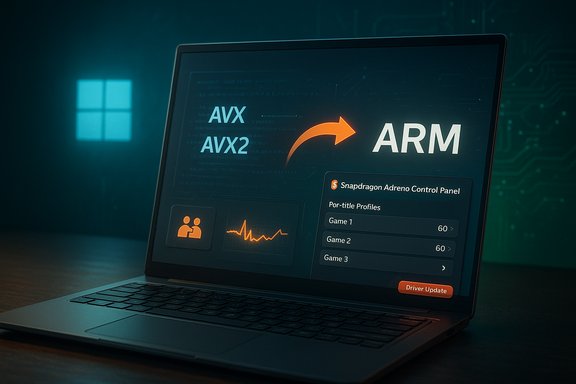
The single most consequential software change is Prism’s expanded emulation of x64 CPU features. Where Windows on Arm once advertised a subset of x86 capabilities and prompted many games to exit early, Prism now exposes and emulates AVX/AVX2 (plus BMI, FMA, F16C and related extensions) to 64‑bit x64 applications. That means binaries that previously failed CPU checks now initialize and proceed under translation. In practice this turns many “won’t run” failures into performance‑bound tests.Important caveats:
- The emulation targets 64‑bit x64 applications only; 32‑bit helpers and mixed bitness checks can still fail.
- Emulated AVX/AVX2 is a compatibility win, not a raw performance win—translation consumes CPU cycles, and heavy SIMD workloads may run slower than on native x86 silicon.
- Power and thermal constraints on thin Arm laptops magnify the performance tax: translated code can drive higher CPU and power usage, reducing sustained frequencies in thermally constrained designs.
Snapdragon Control Panel and updatable Adreno drivers
Qualcomm shipped a dedicated Snapdragon (Adreno) Control Panel for Snapdragon X‑series systems that delivers the standard PC‑grade GPU controls gamers expect: per‑title profiles, framerate caps, performance vs. quality presets, and a direct path to download updated Adreno drivers outside OEM/Windows Update cycles. This is a structural change.Why it matters:
- Updatable graphics drivers (UGD) let Qualcomm respond to patches and ship game‑specific fixes on a cadence comparable to NVIDIA/AMD on x86.
- Per‑game profiles and rollback options give players practical troubleshooting tools that were missing on early Arm machines.
Anti‑cheat and multiplayer: unblocking online play
Anti‑cheat systems were the most stubborn blocker for Arm gaming. Kernel‑mode anti‑cheat clients and middleware were historically x86 focused, and their absence effectively blocked competitive multiplayer in many mainstream games.The ecosystem response included:
- Epic (via Easy Anti‑Cheat and Epic Online Services) and other anti‑cheat vendors shipping Arm‑aware clients or SDK changes so titles can validate and join matchmade services on Arm.
- Publisher updates embedding Arm‑aware anti‑cheat clients in game patches (Fortnite is the early, high‑profile example).
- Platform and OS integration work to ensure anti‑cheat clients interoperate with Windows security features like Secure Boot and VBS.
Gaming performance: real‑world behavior and testing
How games run today
Three practical outcomes describe the current state:- Many x64 titles that previously refused to launch now start and are playable under Prism emulation.
- Titles that rely heavily on CPU SIMD math may exhibit higher CPU utilization and lower sustained framerates than equivalent x86 systems.
- GPU-bound titles scale better: when a game is limited by GPU work (shaders, textures), Snapdragon X’s integrated Adreno GPU can deliver competitive experiences for the platform class—especially at modest resolutions and with modern upscalers enabled.
The role of Advanced Shader Delivery, OS upscaling, and AI
Microsoft’s platform work extends beyond emulation and drivers. Features like Advanced Shader Delivery reduce shader compilation stutter, while OS‑level upscalers (Auto Super Resolution) and NPU‑assisted denoisers can meaningfully increase perceived performance on systems with on‑chip AI accelerators. These features smooth the user experience and reduce the impact of hardware differences at the frame‑time level. However, their effectiveness depends on game support, driver maturity, and per‑title tuning.Handhelds and thermals: the unique constraints
Arm‑based handhelds and ultraportables deliver different tradeoffs than clamshell x86 gaming laptops. Smaller thermal envelopes and more aggressive power limits mean peak bursts are possible, but sustained heavy workloads are often throttled. For many users—casual players, travelers, or those valuing battery life—the trade is acceptable. Competitive esports players seeking absolute frame counts and minimal latency will still prefer high‑end x86 laptops with discrete GPUs.Strengths — why this matters
- Compatibility floor raised: Prism’s AVX/AVX2 emulation turns “won’t launch” failures into solvable performance problems for many AAA and indie titles. That’s the difference between a platform experiment and a platform people can actually use.
- Faster driver cadence: Qualcomm’s Control Panel and downloadable Adreno drivers close a long‑standing operational gap and enable timely, per‑title fixes.
- Multiplayer unblocked: Anti‑cheat vendor updates allow a class of titles to participate in matchmade online services on Arm, unlocking their full feature set.
- Better UX tools: Per‑game profiles, framerate caps, and driver rollback reduce the friction and troubleshooting overhead that early adopters faced.
- Platform momentum: Microsoft, Qualcomm, Epic, and other ecosystem players coordinated across OS, driver, anti‑cheat and storefronts—this is the key to sustained progress, not an isolated optimization.
Risks and limitations — what still holds back parity
- Emulation overhead vs. native x86 performance: Translating AVX heavy code will never match native x86 throughput within the same thermal and power envelope. Expect variable frame rates and higher CPU utilization in CPU‑bound scenes.
- Driver regression risk: Faster driver cadence is a double‑edged sword—while fixes reach users quicker, the chance of regressions also rises. OEM validation and robust QA remain essential.
- Incomplete anti‑cheat coverage: Although major vendors are shipping Arm clients, the anti‑cheat landscape is fragmented. Some titles remain blocked until vendors and publishers update their builds.
- Hardware variability: Not all Snapdragon X SKUs and OEM builds are equivalent—thermals, clocking, and OEM power profiles create meaningful experience variance across laptops and handhelds. Engineering sample demos cannot be generalized to every retail configuration.
- Vendor claims need independent benchmarking: Statements about “100+ games optimized” or top‑end framerate demos require verification across independent testbeds to be meaningful at scale. Treat such claims as directional until corroborated.
Practical guidance — how to get the best experience today
- Keep Windows 11 up to date so your device receives Prism updates and the latest OS-level fixes.
- Install the latest Adreno driver provided via the Snapdragon Control Panel or OEM portal; use the Control Panel to create per‑game profiles and roll back drivers if a regression appears.
- For multiplayer titles, verify the anti‑cheat client version and logs; if a game refuses to start with an anti‑cheat error, check for a game or platform patch that includes the Arm‑aware anti‑cheat client.
- Begin testing titles at modest resolutions and use OS or in‑game upscaling; many Snapdragon‑class laptops perform best at lower native resolutions with high‑quality upscalers enabled.
- Treat performance claims conservatively; measure using your own hardware and settings, and avoid applying experimental cumulative updates on machines where recoverability is critical. Back up before major updates.
Developer and publisher implications
- Add ARM64 build targets where feasible and adopt cross‑platform middleware that supports Arm‑native anti‑cheat or EOS/EAC integrations.
- Test on Snapdragon X silicon early in your QA pipeline to capture architectural differences in threading, power behavior, and shader compilation.
- Use Advanced Shader Delivery and pre‑compiled shader pipelines to reduce first‑run stutter on Arm systems.
- Consider offering ARM64 downloads via the Xbox/Windows storefront to reduce reliance on emulation and maximize performance for users who choose Arm hardware.
Where this goes next — what to watch
- Driver cadence and stability: Watch whether Qualcomm sustains a pragmatic release cadence that balances speed with quality across OEM variants. The long‑term experience depends on maintaining low‑regression, targeted driver updates.
- Anti‑cheat completeness: Monitor which major multiplayer titles remain blocked and the timeline for their anti‑cheat vendors to ship Arm clients. Full parity requires that last mile.
- Snapdragon roadmap: New X‑series revisions (Snapdragon X2 and successors) promising higher clocks and GPU slices will raise the performance floor and make smoother parity more plausible. Hardware improvements will amplify software work.
- Independent benchmarking and reviews: Expect thorough, cross‑lab tests over the next 6–12 months that will clarify which titles are genuinely competitive on Arm and which remain compromised by emulation overhead. Vendor demos will be supplanted by broad empirical data.
Verdict — measured optimism
The engineering story here matters: by aligning emulator capability (Prism), driver delivery (Snapdragon Control Panel and UGD), and middleware support (anti‑cheat SDKs), Windows on Arm crossed a threshold from “interesting” to “practical” for a broad set of gaming scenarios. That’s not hyperbole: coordinated stack improvements are the exact prescription needed to fix platform gaps that persist across years of incremental tweaks.For whom this is now compelling:
- Casual players who value battery life and portability, and who play popular titles at moderate settings.
- Notebook buyers who want the occasional triple‑A experience without a bulky discrete‑GPU laptop.
- Developers and QA teams who must validate cross‑architecture behavior on Arm hardware.
- Competitive esports players chasing absolute frame rates and minimal latency.
- Users who demand universal, out‑of‑the‑box parity for every modern title today.
Windows on Arm’s gaming frontier was won in the engineering trenches, not onstage: thoughtful emulation improvements, modern driver channels, and middleware collaboration produced the kind of cross‑stack uplift that moves a platform from “maybe someday” to “works today for many.” The journey is far from over, but the map has changed—and that matters for everyone who cares about portability, battery life, and the open Windows gaming ecosystem.
Source: Thurrott.com Windows 11 on Arm + Snapdragon X: Gaming, the Final Frontier
