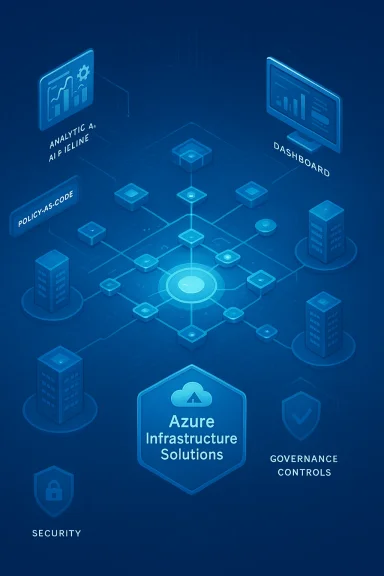
Fortude’s announcement that it has earned the Microsoft Azure Infrastructure Solutions designation marks a clear inflection point in the company’s Microsoft partnership story — one that broadens its enterprise-cloud credentials beyond data and application innovation and places the firm squarely into the foundational layer of Azure adoption: resilient, secure, and scalable infrastructure design and operations.
Fortude, a global digital solutions provider with offices across North America, Europe, and Asia-Pacific, has been steadily accumulating Microsoft recognitions over recent years. The company previously highlighted achievements in Data & AI, Digital & App Innovation, and most recently the Analytics on Microsoft Azure specialization, framing a progressive expansion from analytics and AI into full-stack cloud services. Fortude says the new Infrastructure designation will allow it to deliver integrated Azure lifecycles: from secure foundations to analytics, AI adoption, and modern app innovation.
Microsoft’s Solutions Partner program — introduced to replace the older Gold/Silver competency model — groups partner capabilities into solution-area designations (for example: Digital & App Innovation, Data & AI, Infrastructure). These designations are intended to make it easier for customers to identify partners with demonstrated technical skill, skilling commitments, and customer success in specific Azure solution areas. The Infrastructure designation specifically recognizes partners that can design, deploy, and manage Azure environments to meet enterprise requirements.
For customers, this matters because infrastructure design decisions are long-lived and costly to unwind. A poorly planned landing zone or governance model can create security gaps, sprawl, or spiralling cost inefficiencies. A partner recognized by Microsoft for Infrastructure should have demonstrable methods and customer success to mitigate those risks.
Advantages for customers engaging a partner with this combined profile include:
Security posture monitoring (for example, Microsoft Defender for Cloud secure-score recommendations) and integration of security controls into CI/CD pipelines and infrastructure-as-code are practical differentiators for partners who can shift security left. The Infrastructure designation strongly implies familiarity with these patterns, but customers should still validate capabilities — especially for regulated workloads.
That said, designations are a starting point, not a substitute for rigorous procurement and technical validation. Enterprise buyers should leverage the designation as part of a structured evaluation — asking for landing zone artifacts, staff certifications, and operational commitments — to ensure the partner’s claimed capabilities align with the organization’s risk profile and long-term cloud strategy. Fortude’s growing set of recognitions positions it well to deliver integrated Azure transformations; success will depend on the company’s ability to translate program-level credentials into repeatable, demonstrable customer outcomes.
Source: GlobeNewswire Fortude further strengthens Microsoft cloud capabilities with Azure Infrastructure Solutions Designation
 Background
Fortude, a global digital solutions provider with offices across North America, Europe, and Asia-Pacific, has been steadily accumulating Microsoft recognitions over recent years. The company previously highlighted achievements in Data & AI, Digital & App Innovation, and most recently the Analytics on Microsoft Azure specialization, framing a progressive expansion from analytics and AI into full-stack cloud services. Fortude says the new Infrastructure designation will allow it to deliver integrated Azure lifecycles: from secure foundations to analytics, AI adoption, and modern app innovation.Microsoft’s Solutions Partner program — introduced to replace the older Gold/Silver competency model — groups partner capabilities into solution-area designations (for example: Digital & App Innovation, Data & AI, Infrastructure). These designations are intended to make it easier for customers to identify partners with demonstrated technical skill, skilling commitments, and customer success in specific Azure solution areas. The Infrastructure designation specifically recognizes partners that can design, deploy, and manage Azure environments to meet enterprise requirements.
Why the Infrastructure designation matters
It’s about the cloud foundation, not just lift-and-shift
The Infrastructure Solutions designation is designed to validate a partner’s ability to build enterprise-grade landing zones, connectivity and networking, identity and security baselines, governance, and operational tooling — the platform that enables workloads (apps, data, AI) to run securely and scalably in Azure. In Microsoft’s parlance this aligns closely with the Cloud Adoption Framework guidance and Azure landing zone design areas: identity, connectivity, management, and monitoring are core to any durable Azure estate.For customers, this matters because infrastructure design decisions are long-lived and costly to unwind. A poorly planned landing zone or governance model can create security gaps, sprawl, or spiralling cost inefficiencies. A partner recognized by Microsoft for Infrastructure should have demonstrable methods and customer success to mitigate those risks.
The designation blends technical performance, skilling, and customer success
Microsoft’s solutions partner model does not rely on a single metric. Attainment typically combines:- Technical skilling and certifications for engineers and architects,
- Azure Consumed Revenue (ACR) or evidentiary deployment/performance metrics for certain solution areas, and
- Customer references or audits validating real-world projects.
What Fortude’s designation likely certifies (and what it doesn’t)
Capabilities the designation signals
By earning the Infrastructure Solutions designation, Fortude signals capabilities in several concrete areas:- Design and deployment of enterprise-scale landing zones, including subscription and management group architectures, network topologies (hub-and-spoke, Virtual WAN), and hybrid connectivity via ExpressRoute/VPN.
- Identity and access architecture, leveraging Microsoft Entra (Azure AD) patterns and enterprise synchronization strategies.
- Governance and compliance foundations, such as policy baselines, tagging and billing strategy, and subscription vending/automation for consistent provisioning.
- Operational tooling and observability, including Azure Monitor, baseline alerts, incident playbooks, and runbooks to enable operational excellence.
- Security posture management, often tied into Defender for Cloud recommendations and secure-score improvements incorporated into landing zone designs.
What the designation does not guarantee
It’s important to be precise: the Infrastructure designation is not an absolute guarantee of every capability under the sun. It validates a partner’s experience and ability to deliver in the Infrastructure solution area, but does not by itself:- Ensure deep expertise in every niche Azure service (specializations and audits remain relevant for areas like SAP on Azure, Azure VMware Solutions, or Azure Virtual Desktop).
- Replace customer diligence: buyers still need to vet references, SLAs, and specific domain expertise (industry compliance, sovereign clouds, or specialized workloads).
Fortude’s partner journey: how Infrastructure complements Data & AI and Analytics
Fortude’s trajectory — from data analytics to app innovation and now infrastructure — follows a logical pattern that buyers often appreciate: deliver insights and apps, then own the platform those apps run on. This integrated stack reduces friction between data engineers, app developers, and cloud operations teams, and it supports end-to-end responsibility for performance, security, and cost.Advantages for customers engaging a partner with this combined profile include:
- A single vendor relationship for platform, analytics, and application lifecycle.
- Reduced integration risk between data platforms (e.g., Data Lake, Synapse, Databricks) and underlying infrastructure (networking, identity, governance).
- Potentially faster time-to-value because architectural tradeoffs are made with both application and infra needs in mind.
Technical implications for enterprise customers
Landing zones, governance and cloud economics
Enterprises migrating or modernizing on Azure must get three foundational elements right: a well-architected landing zone, a governance model that enforces policy and security controls, and a cost management strategy that prevents runaway spend.- The Azure landing zone is the platform blueprint that controls subscription topology, network design, identity, and shared services. Microsoft’s Cloud Adoption Framework and landing zone guidance provide prescriptions for these design areas; partners awarded the Infrastructure designation should have implemented these patterns at scale.
- Governance and policy — tagging strategy, naming conventions, guardrails via Azure Policy — are key to operationalizing cloud while meeting compliance obligations.
- Cost governance must be baked into architecture and operations. Tools like Azure Cost Management, reservations, and tagging-enabled chargeback are part of delivering a sustainable environment. Robust partners will provide both technical and organizational change guidance to make cost discipline operational.
Security posture and identity modernization
Identity is the new perimeter. Enterprise-scale Azure architectures hinge on modern identity patterns — Microsoft Entra ID (Azure AD), conditional access, managed identities, and secure identity synchronization or migration from on-prem directories. Landing zones should anticipate identity as a first-class design area.Security posture monitoring (for example, Microsoft Defender for Cloud secure-score recommendations) and integration of security controls into CI/CD pipelines and infrastructure-as-code are practical differentiators for partners who can shift security left. The Infrastructure designation strongly implies familiarity with these patterns, but customers should still validate capabilities — especially for regulated workloads.
Observability and operational excellence
Operational readiness isn’t optional: metrics, logs, alerts, runbooks, and automation for routine operations separate successful long-term operations from reactive firefighting. Azure Monitor and Log Analytics, integrated with incident response processes, are core tools here. Partners with Infrastructure skills must demonstrate not just initial deployment competence but operationalization — the ongoing management of an Azure estate.Commercial and market implications
Benefits to partners and customers
Microsoft’s Solutions Partner model bundles benefits that can include Azure credits, technical enablement, early product access, and marketplace positioning. For partners, these incentives help accelerate capability development and lower the cost of internal sandboxes and proof-of-concept work. For customers, partner benefits can translate into lower-cost assessments, pilots, or migrations. Industry coverage of the partner program also highlights perks like Azure credits and Visual Studio subscriptions tied to certain designations. Buyers should ask how a partner intends to transfer any tangible benefits to the customer engagement.The ACR and skilling vectors: what partners must sustain
Attaining and maintaining a Solutions Partner designation typically requires continuous skilling and, for many partners, meeting Azure Consumed Revenue (ACR) or deployment thresholds. Microsoft defines SMB and Enterprise paths with different signals and thresholds; partners must therefore continually invest in certified staff and measurable customer outcomes to retain their status and access to benefits. This has two effects:- Positive: Customers gain a partner motivated to stay current on Azure capabilities and to deliver measurable cloud consumption and success.
- Risk: Partners may face pressure to maintain revenue thresholds and certifications; customers should ensure incentives align with project needs rather than partner program targets.
Fortude’s positioning: strengths and potential risks
Strengths
- End-to-end Azure stack capability. Fortude’s combination of Data & AI, Analytics specialization, Digital & App Innovation, and now Infrastructure designation creates a contiguous service offering across platform, data, AI, and apps. This reduces vendor handoffs and integration friction for customers that prefer a single accountable partner.
- Global footprint and industry experience. Fortude’s multi-region presence (US, Canada, UK, Netherlands, Sri Lanka, India, Singapore, and Australia) helps enterprises with global operations or region-specific compliance needs access regional delivery teams.
- Demonstrable skilling and audit success. The Analytics specialization required a Microsoft-commissioned audit; that same rigor in Infrastructure attestation suggests repeatable processes and quality control across engagements.
Potential risks and caveats
- Designation is necessary but not sufficient. A Microsoft designation signals capability, but it does not replace detailed RFP evaluation, technical due diligence, and reference checks. Customers should request architecture reviews, runbooks, SLAs, and post-deployment support plans before awarding large programs.
- Overlap and vendor lock-in. As with any partner that positions itself around a single cloud provider, there is a commercial and technical lock-in risk to consider. Organizations must weigh the benefits of deep Azure specialization against multi-cloud diversification strategies where relevant.
- Sustaining skills and revenue metrics. Solutions Partner designations demand ongoing investments in certifications and customer outcomes. If a partner prioritizes program metrics over long-term customer fit, project outcomes could suffer. Customers should probe how the partner balances program attainment with customer-centric engineering practices.
How customers should evaluate designation claims in procurement
When a vendor cites a Solutions Partner designation, procurement teams and technical evaluators should use a targeted checklist to translate that label into operational confidence.- Ask for specific customer references tied to the infrastructure outcomes claimed — landing zone deployments, migrations, or multi-region connectivity projects.
- Request architecture blueprints or a reference landing zone that demonstrates subscription, networking, identity, and governance patterns.
- Verify staff certifications and availability (AZ-305, Azure Administrator Associate, Azure Solutions Architect Expert, or other role-specific certs as required for Infrastructure pathways).
- Clarify ongoing operational model and SLAs — who provides second-line support, escalation paths, and post-migration optimization services?
- Understand commercial incentives and credit usage — will Azure credits or pilot support be passed through to the customer, or used only for partner development?
Broader market context: why partners are doubling down on infrastructure
Two market dynamics explain why companies like Fortude are expanding into infrastructure design and management.- Cloud modernization has matured beyond lift-and-shift. Early cloud programs focused on migration velocity; modern programs demand resilient platform engineering, cost governance, and secure identity models. Partners that can both migrate and operate are more valuable.
- AI and analytics workloads amplify platform needs. Data and AI workloads have specific infrastructure patterns (large-scale storage, compute orchestration, network egress considerations, and governance for sensitive data). Partners that can bridge infra and data disciplines can better optimize performance and cost for these workloads. Fortude’s sequence — analytics → data & AI → infrastructure — mirrors a logical industry pattern.
Recommendations for enterprise buyers and Fortude
For enterprise buyers
- Treat the Solutions Partner designation as a shortlist filter, not the final procurement decision. Use the checklist above to validate the partner’s fit.
- Insist on concrete artifacts: landing zone templates, security baselines, migration runbooks, cost-management playbooks, and operational runbooks.
- Require a pilot or discovery phase with explicit success criteria tied to governance, cost baseline, and operational readiness.
For Fortude
- Translate the designation into tangible, customer-facing assets: pre-packaged landing zone accelerators, industry-focused compliance templates, and published case studies or architecture references.
- Ensure transparent use of any partner incentives or credits so procurement teams see direct customer value.
- Keep investing in cross-domain skilling (infra + data + security) so the multi-discipline promise remains credible and sustainable.
Conclusion
Fortude’s attainment of the Microsoft Azure Infrastructure Solutions designation is a meaningful development for the company and its customers. It validates a capability that sits at the heart of modern cloud adoption: building resilient, secure, and governed infrastructure foundations that enable analytics, AI, and modern applications to thrive.That said, designations are a starting point, not a substitute for rigorous procurement and technical validation. Enterprise buyers should leverage the designation as part of a structured evaluation — asking for landing zone artifacts, staff certifications, and operational commitments — to ensure the partner’s claimed capabilities align with the organization’s risk profile and long-term cloud strategy. Fortude’s growing set of recognitions positions it well to deliver integrated Azure transformations; success will depend on the company’s ability to translate program-level credentials into repeatable, demonstrable customer outcomes.
Source: GlobeNewswire Fortude further strengthens Microsoft cloud capabilities with Azure Infrastructure Solutions Designation