

France’s purchase of Bull from Atos is more than a simple corporate carve-out. It is a deliberate act of industrial policy, aimed at keeping a strategically sensitive high-performance computing, AI, and quantum capability inside the French state’s orbit at a moment when Europe is trying to reassert control over critical digital infrastructure. The deal, reportedly worth €404 million, closes a long chapter in which Atos struggled to stabilize its balance sheet while deciding which assets were essential to its future and which were essential to France’s sovereignty.
What makes this transaction notable is not only the price, but the perimeter. Bull now stands as the renamed and more tightly defined advanced-computing business formerly embedded in Eviden, with the French state becoming sole shareholder. That means France has secured direct influence over the company that builds systems used in defense-adjacent and nuclear-sensitive environments, while also preserving a domestic champion in Europe’s most demanding computing segment.
The story begins well before the final signature. Atos had been under intense financial pressure for years, forcing the group into a broad restructuring and a series of asset reviews that brought the future of its advanced-computing unit into question. In late 2024, the French state first floated a non-binding offer to acquire the business, then refined the scope in 2025 as Vision AI was separated from the package and excluded from the final sale perimeter.
That sequence matters because it shows how the state’s goal was never just to buy revenue. It wanted the parts of Atos that touch sovereign compute, public-sector supercomputing, and sensitive workloads where foreign ownership could complicate procurement, export control, or strategic autonomy. Bull’s footprint in defense and nuclear modeling made it especially valuable in that respect, and the company’s hardware and software stack gave France more than a logo: it gave France a platform.
The transaction also reflects a broader European pattern. Governments increasingly view compute infrastructure as a strategic asset, much like energy, telecoms, or semiconductors. The more AI, simulation, climate modeling, and defense planning depend on large-scale compute, the more pressure there is to keep the underlying supply chain under national or allied control.
For Atos, the sale is both an exit and a lifeline. The company has been rebuilding after a brutal stretch marked by declining revenue and the need for a multiyear recovery plan. Selling Bull reduces debt pressure and simplifies the portfolio, even if it also means surrendering one of the most strategically valuable parts of the group.
The company’s estimated €700 million revenue base in fiscal 2025 makes it substantial enough to matter, but the real value lies in what it designs and delivers. Bull’s portfolio spans HPC, quantum, and business computing with AI, which means it sits at the intersection of research, defense, and industrial workloads. In a market where many vendors specialize in one layer only, that end-to-end capability is rare and politically valuable.
The company also offers a vertically integrated capability that Europe has often struggled to retain. It designs, builds, and deploys hardware and software in-house, which reduces dependence on non-European suppliers at a time when geopolitical friction is reshaping the global technology stack. That kind of integration is rare, and it is precisely why governments are willing to pay for it.
That is why the French government’s willingness to buy Bull at a valuation lower than earlier discussions is understandable. The state was not shopping for a generic software asset. It was securing a strategic lever, and strategic levers are rarely priced like ordinary commercial transactions.
The broader picture is that the French state and Atos gradually narrowed the scope toward the most strategically important “advanced computing” operations. Those include HPC, Quantum, and Business Computing & Artificial Intelligence, while the excluded Vision AI activities were moved elsewhere in Eviden’s structure. This is a cleaner industrial configuration, but also a reminder that “Bull” now represents a carefully curated asset base rather than the entire former advanced-computing empire.
The final closing gives the French state sole ownership, which is important because partial control would not fully solve the sovereignty question. A minority stake can influence governance, but sole shareholding gives the government the cleanest possible answer to national-security concerns, procurement complexity, and long-term strategic planning.
The lesson for other governments is that strategic acquisitions do not need to maximize commercial breadth to be effective. They need to maximize control over the capabilities that matter under stress, and Bull sits squarely in that category.
That convergence is one reason the European supercomputing ecosystem has leaned so heavily on Eviden and Bull-derived platforms. JUPITER, Europe’s first exascale supercomputer, is based on Eviden’s BullSequana XH3000 architecture, and Alice Recoque is being positioned as the next major European exascale system hosted in France. Those projects are not just engineering headlines; they are a vote of confidence in the underlying platform.
This is also why the state may have been unwilling to let Bull disperse into a broader private-market reshuffle. Once a compute stack is broken into fragments, the integration costs rise and the strategic story weakens. Bull’s value is partly that it keeps the stack coherent.
That split matters because it helps explain why the company can survive as a sovereign asset even if its commercial growth is uneven. The public sector may not be its only customer, but it is the customer whose priorities justify the ownership structure. That is the key point.
This is why the French government framed the acquisition in terms of technological sovereignty. If a country wants to preserve control over critical simulations, secure infrastructure, and dual-use compute platforms, it has to control more than software licenses. It has to control the company that designs the machine room itself.
The choice also reflects the broader reality that high-end compute is now a form of strategic infrastructure. If you can model, simulate, and optimize critical systems faster than your adversary, you gain a real advantage. That makes Bull more than a vendor; it becomes part of the state’s defensive architecture.
The irony is that Europe has celebrated its supercomputing progress while still relying on fragile industrial structures. By securing Bull, France is trying to turn a fragile success story into a durable one. That is not trivial in a market where engineering excellence does not always translate into corporate stability.
The factory also reinforces the “made in Europe” narrative that policymakers increasingly want to promote. When a supercomputer is designed, assembled, and supported locally, governments can argue with more confidence that they are not outsourcing the core of their digital nervous system. That argument is especially persuasive in defense and scientific computing.
That is one reason Europe’s HPC ambitions have increasingly converged around a smaller number of specialist vendors. They are difficult to replace, and once the industrial base disappears, rebuilding it is slow and expensive. The French state is effectively paying to prevent that loss.
That is a subtle but important shift. The market is no longer asking which vendor can build the fastest machine alone; it is asking which vendor can build the fastest machine that Europe can actually trust to keep.
That is important because Atos has spent much of the last several years in damage-control mode. Restructuring, disposals, and strategic refocusing have all been part of the effort to restore credibility with markets, customers, and employees. In that context, selling Bull is painful but rational.
Still, the alternative may have been worse. If Atos had been forced into a more disorderly sale later, the business could have been fragmented or sold to a buyer with less strategic alignment with France. In that sense, the state’s purchase is also a rescue of Atos’s own industrial legacy.
The broader European question is whether this model can be replicated. If the answer is yes, the continent may be able to build a more coherent industrial base for frontier computing. If the answer is no, France’s move may stand as a singular national exception rather than the beginning of a wider trend.
Source: Techzine Global French government acquires Bull from Atos for €404 million
What makes this transaction notable is not only the price, but the perimeter. Bull now stands as the renamed and more tightly defined advanced-computing business formerly embedded in Eviden, with the French state becoming sole shareholder. That means France has secured direct influence over the company that builds systems used in defense-adjacent and nuclear-sensitive environments, while also preserving a domestic champion in Europe’s most demanding computing segment.
 Overview
The story begins well before the final signature. Atos had been under intense financial pressure for years, forcing the group into a broad restructuring and a series of asset reviews that brought the future of its advanced-computing unit into question. In late 2024, the French state first floated a non-binding offer to acquire the business, then refined the scope in 2025 as Vision AI was separated from the package and excluded from the final sale perimeter.That sequence matters because it shows how the state’s goal was never just to buy revenue. It wanted the parts of Atos that touch sovereign compute, public-sector supercomputing, and sensitive workloads where foreign ownership could complicate procurement, export control, or strategic autonomy. Bull’s footprint in defense and nuclear modeling made it especially valuable in that respect, and the company’s hardware and software stack gave France more than a logo: it gave France a platform.
The transaction also reflects a broader European pattern. Governments increasingly view compute infrastructure as a strategic asset, much like energy, telecoms, or semiconductors. The more AI, simulation, climate modeling, and defense planning depend on large-scale compute, the more pressure there is to keep the underlying supply chain under national or allied control.
For Atos, the sale is both an exit and a lifeline. The company has been rebuilding after a brutal stretch marked by declining revenue and the need for a multiyear recovery plan. Selling Bull reduces debt pressure and simplifies the portfolio, even if it also means surrendering one of the most strategically valuable parts of the group.
Why Bull Matters So Much
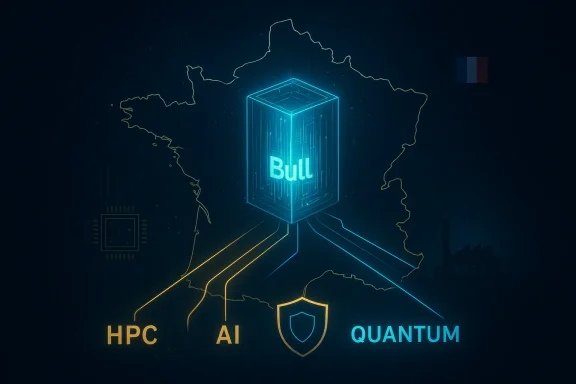
Bull is not a legacy name in the nostalgic sense; it is a legacy name in the industrial sense. The brand has long been associated with French and European computing sovereignty, and its revival as an independent advanced-computing identity signals that the state is trying to preserve more than a business line. It is preserving institutional memory, engineering depth, and a domestic supply chain for systems that cannot easily be replaced.The company’s estimated €700 million revenue base in fiscal 2025 makes it substantial enough to matter, but the real value lies in what it designs and delivers. Bull’s portfolio spans HPC, quantum, and business computing with AI, which means it sits at the intersection of research, defense, and industrial workloads. In a market where many vendors specialize in one layer only, that end-to-end capability is rare and politically valuable.
Strategic Functions Beyond Revenue
Bull’s importance is magnified by the tasks its systems support. Supercomputers built by the company are used for modeling highly sensitive national-security scenarios, including work tied to nuclear facilities and defense planning. That places the business in a category where state ownership is not merely symbolic; it is operationally consequential.The company also offers a vertically integrated capability that Europe has often struggled to retain. It designs, builds, and deploys hardware and software in-house, which reduces dependence on non-European suppliers at a time when geopolitical friction is reshaping the global technology stack. That kind of integration is rare, and it is precisely why governments are willing to pay for it.
- Bull gives France control over a critical compute stack.
- The business supports defense, nuclear, and public-sector workloads.
- It provides a European alternative in a market often dominated by U.S. or Asian platforms.
- It keeps specialized HPC engineering talent inside France.
- It aligns with the state’s broader digital sovereignty agenda.
Why Sovereignty Beats Scale Here
In ordinary IT markets, size often wins. In sovereign computing, trust and jurisdiction matter just as much as throughput or margin. A state owner can prioritize continuity, supply-chain resilience, and security clearances in ways that a commercially constrained private owner may not.That is why the French government’s willingness to buy Bull at a valuation lower than earlier discussions is understandable. The state was not shopping for a generic software asset. It was securing a strategic lever, and strategic levers are rarely priced like ordinary commercial transactions.
The Deal Structure and What Changed
The final purchase price of €404 million landed slightly below the earlier €410 million figure discussed when Vision AI was already being carved out of the deal. That change highlights a common feature of state-backed transactions: the perimeter is often adjusted to reflect strategic priorities rather than purely financial logic.The broader picture is that the French state and Atos gradually narrowed the scope toward the most strategically important “advanced computing” operations. Those include HPC, Quantum, and Business Computing & Artificial Intelligence, while the excluded Vision AI activities were moved elsewhere in Eviden’s structure. This is a cleaner industrial configuration, but also a reminder that “Bull” now represents a carefully curated asset base rather than the entire former advanced-computing empire.
From Negotiation to Closing
Atos first disclosed a non-binding offer in November 2024, then moved toward a confirmatory offer in June 2025, with the share purchase agreement signed in late July 2025. That timeline suggests a relatively deliberate, politically supervised process rather than a fast commercial auction. In sovereign deals, that tends to be the norm rather than the exception.The final closing gives the French state sole ownership, which is important because partial control would not fully solve the sovereignty question. A minority stake can influence governance, but sole shareholding gives the government the cleanest possible answer to national-security concerns, procurement complexity, and long-term strategic planning.
- Initial offer: €500 million EV, potentially €625 million with earn-outs.
- Confirmatory offer: €410 million EV, with Vision AI excluded.
- Final completed sale: €404 million.
- Ownership outcome: the French state becomes sole shareholder.
Why the Price Moved
The reduction from earlier figures likely reflects a tighter asset perimeter and the removal of Vision AI, which Atos said contributed materially to the operating margin of the previously considered scope. In other words, the buyer paid less because it bought less, but it bought the part that mattered most to sovereignty. That tradeoff is very French in the best sense: pragmatic, selective, and state-led.The lesson for other governments is that strategic acquisitions do not need to maximize commercial breadth to be effective. They need to maximize control over the capabilities that matter under stress, and Bull sits squarely in that category.
HPC, AI, and Quantum Under One Roof
One of Bull’s biggest strengths is the way it bundles HPC, AI, and quantum under a single strategic umbrella. In practical terms, that means the company can address workloads that increasingly overlap rather than live in separate silos. Scientific modeling, industrial simulation, and AI training now share hardware assumptions, software orchestration, and energy constraints.That convergence is one reason the European supercomputing ecosystem has leaned so heavily on Eviden and Bull-derived platforms. JUPITER, Europe’s first exascale supercomputer, is based on Eviden’s BullSequana XH3000 architecture, and Alice Recoque is being positioned as the next major European exascale system hosted in France. Those projects are not just engineering headlines; they are a vote of confidence in the underlying platform.
Why the Convergence Matters
HPC alone is no longer enough. AI workloads are reshaping procurement decisions, and quantum research is pulling future architectures toward hybrid environments that blend classical and emerging compute models. A vendor that can span all three has a better chance of staying relevant as customer needs evolve.This is also why the state may have been unwilling to let Bull disperse into a broader private-market reshuffle. Once a compute stack is broken into fragments, the integration costs rise and the strategic story weakens. Bull’s value is partly that it keeps the stack coherent.
- HPC anchors the business today.
- AI adds demand growth and commercial relevance.
- Quantum gives the company a future-facing research narrative.
- Combined, they strengthen France’s sovereign infrastructure story.
Enterprise Versus State Use Cases
For enterprises, Bull’s value lies in access to high-end simulation, research compute, and increasingly AI-ready infrastructure without leaving European jurisdiction. For the state, the value is different: continuity, security, and control. The same hardware can serve both worlds, but the procurement logic behind each is distinct.That split matters because it helps explain why the company can survive as a sovereign asset even if its commercial growth is uneven. The public sector may not be its only customer, but it is the customer whose priorities justify the ownership structure. That is the key point.
The Nuclear and Defense Dimension
Bull’s strategic importance becomes clearer when you look at the workloads it supports. The company’s supercomputing systems are used in environments tied to France’s nuclear defense capabilities, which raises the stakes well above ordinary enterprise IT. In that context, ownership, supply chain, and governance become inseparable from national security.This is why the French government framed the acquisition in terms of technological sovereignty. If a country wants to preserve control over critical simulations, secure infrastructure, and dual-use compute platforms, it has to control more than software licenses. It has to control the company that designs the machine room itself.
Security, Clearance, and Continuity
Sensitive defense-adjacent systems require long-term continuity. They also require trust relationships with public agencies that are difficult to replicate after ownership changes, especially if those changes pull the company into a more fragmented multinational structure. State ownership reduces that uncertainty, even if it does not eliminate all operational risk.The choice also reflects the broader reality that high-end compute is now a form of strategic infrastructure. If you can model, simulate, and optimize critical systems faster than your adversary, you gain a real advantage. That makes Bull more than a vendor; it becomes part of the state’s defensive architecture.
- Defense workloads demand trusted governance.
- Nuclear-related modeling heightens the need for domestic control.
- Ownership can simplify security clearances and long-term support.
- Sovereign compute is increasingly treated like critical infrastructure.
Europe’s Quiet Dependency Problem
Bull’s prominence also exposes a broader European issue: the continent still depends heavily on a small number of firms for frontier compute systems. If one of those firms falters financially, the consequences ripple through public procurement, research schedules, and defense planning. The French state’s intervention is therefore both national and continental in its implications.The irony is that Europe has celebrated its supercomputing progress while still relying on fragile industrial structures. By securing Bull, France is trying to turn a fragile success story into a durable one. That is not trivial in a market where engineering excellence does not always translate into corporate stability.
The Angers Factory and the Industrial Base
One of Bull’s most tangible assets is its supercomputer factory in Angers, which is often mentioned because it turns abstract sovereignty language into steel, racks, and production lines. Having a European manufacturing site for high-end compute equipment is not just a nice-to-have. It gives France and its partners an industrial foothold in a sector where supply chains can become geopolitical choke points.The factory also reinforces the “made in Europe” narrative that policymakers increasingly want to promote. When a supercomputer is designed, assembled, and supported locally, governments can argue with more confidence that they are not outsourcing the core of their digital nervous system. That argument is especially persuasive in defense and scientific computing.
Why Manufacturing Still Matters
In cloud-era IT, manufacturing sometimes feels secondary. In supercomputing, it is not. The hardware footprint is large, the integration is complex, and the ability to control assembly and maintenance can be as important as software innovation.That is one reason Europe’s HPC ambitions have increasingly converged around a smaller number of specialist vendors. They are difficult to replace, and once the industrial base disappears, rebuilding it is slow and expensive. The French state is effectively paying to prevent that loss.
- Angers gives Bull a physical industrial anchor.
- Local production supports sovereign supply chains.
- Manufacturing capability strengthens public procurement credibility.
- The factory is a symbol of Europe’s attempt to retain frontier hardware expertise.
The Competitive Implication
For rivals, especially global hyperscale and hardware vendors, Bull’s continued independence means Europe will still have a domestic reference point for sovereign supercomputing. That may not eliminate competition, but it changes the terms of competition. Vendors will increasingly have to compete not only on price and performance, but also on political fit and jurisdictional comfort.That is a subtle but important shift. The market is no longer asking which vendor can build the fastest machine alone; it is asking which vendor can build the fastest machine that Europe can actually trust to keep.
What This Means for Atos
For Atos, the deal removes a strategic asset but relieves a financial burden. The company’s 2025 performance still showed pressure, including an organic revenue decline, while management pushed ahead with its Genesis recovery plan. Cash from the sale helps reduce debt and supports the group’s attempt to refocus on a more sustainable core.That is important because Atos has spent much of the last several years in damage-control mode. Restructuring, disposals, and strategic refocusing have all been part of the effort to restore credibility with markets, customers, and employees. In that context, selling Bull is painful but rational.
Financial Relief, Strategic Tradeoff
The question is whether Atos can now simplify enough to stabilize without giving up too much future upside. Bull was one of the few parts of the group with a strong sovereignty story and a visible role in Europe’s compute future. Letting it go may improve the balance sheet, but it also reduces exposure to one of the fastest-growing strategic technology categories.Still, the alternative may have been worse. If Atos had been forced into a more disorderly sale later, the business could have been fragmented or sold to a buyer with less strategic alignment with France. In that sense, the state’s purchase is also a rescue of Atos’s own industrial legacy.
- Atos gains liquidity and debt relief.
- It loses a marquee asset with strong strategic relevance.
- Genesis can now proceed with a cleaner portfolio.
- The sale reduces the risk of a disorderly breakup later.
A Hard but Understandable Decision
From an investor’s perspective, the sale may look like a concession. From a national-policy perspective, it looks like triage with intent. Not every valuable asset belongs in a turnaround plan, and not every cash-generating business should be held if it serves a larger sovereign purpose elsewhere. That distinction matters.Strengths and Opportunities
The transaction gives France a rare chance to align ownership, strategy, and industrial policy around a genuinely strategic compute platform. It also preserves a vendor base that can support Europe’s push into exascale computing, AI factories, and sensitive public-sector workloads.- Sovereign control over a critical advanced-computing supplier.
- Continuity for defense and nuclear-related workloads.
- Better alignment with Europe’s AI factory and exascale initiatives.
- Protection of specialized engineering jobs and know-how.
- More predictable governance for long-cycle public contracts.
- Potential to deepen cooperation with EU and national research programs.
- A stronger platform for linking HPC, AI, and quantum roadmaps.
Risks and Concerns
State ownership solves one problem while creating others. A sovereign asset can become insulated, slower-moving, or politically overburdened if governance is not disciplined. The challenge will be to preserve commercial agility without turning Bull into a symbolic project with weak market responsiveness.- Risk of bureaucratic drift under state ownership.
- Potential tension between commercial goals and sovereign priorities.
- Need for continued investment in R&D and manufacturing.
- Exposure to procurement cycles that may be politically driven.
- Risk that Europe’s compute market remains too small to scale efficiently.
- Possible talent retention issues if the company becomes overly state-centric.
- Dependence on a narrow set of major public contracts.
Looking Ahead
The next phase will be about execution, not symbolism. France has secured the asset, but it now has to ensure the business remains technically competitive, financially healthy, and relevant to both government and enterprise customers. The best outcome would be a Bull that is visibly sovereign without becoming inward-looking.The broader European question is whether this model can be replicated. If the answer is yes, the continent may be able to build a more coherent industrial base for frontier computing. If the answer is no, France’s move may stand as a singular national exception rather than the beginning of a wider trend.
- Watch for integration of Bull’s governance under state ownership.
- Track investment in the Angers manufacturing base.
- Monitor future awards tied to Alice Recoque and other EuroHPC systems.
- Follow whether Bull expands its AI and quantum pipeline.
- Observe whether Atos uses the sale proceeds to accelerate its own recovery.
- Pay attention to whether France treats Bull as a protected champion or a growth platform.
Source: Techzine Global French government acquires Bull from Atos for €404 million
Last edited:
