

France’s latest digital sovereignty push is more than a symbolic swipe at Microsoft: it is a concrete plan to move government workstations off Windows and onto Linux, alongside a broader shift toward sovereign collaboration tools. The official French digital directorate says ministries must now prepare their own plans to reduce extra-European dependencies, and that the state is already moving some of its biggest public-sector bodies onto LaSuite, its open-source productivity stack. If fully executed, this could become one of the largest public-sector desktop migrations in Europe, and perhaps one of the most consequential in the long slow history of Linux adoption.
For years, public-sector IT leaders have talked about digital sovereignty as a strategic goal, but in many places it remained an abstract slogan. France is now turning that language into procurement, architecture, and migration roadmaps. The state’s digital directorate, the DINUM, has said that the evolution of the workstation will include a move away from Windows toward Linux, while each ministry and operator will be required to formalize a plan covering desktops, collaboration tools, antivirus, databases, virtualization, networking, and related dependencies.
That matters because desktop operating systems are not just software choices. They are the control point for everything else: identity, security policy, document formats, endpoint management, and application compatibility. When a government uses a mainstream proprietary platform across hundreds of thousands or millions of endpoints, it inherits licensing costs, upgrade cycles, vendor constraints, and geopolitical exposure. France’s move suggests it sees those risks as large enough to justify a structural break.
The timing is also important. France has already been building an alternative internal ecosystem around LaSuite, an open-source, sovereign workplace platform operated by the state’s digital directorate. Public materials describe it as an open-source workspace for civil servants, hosted in France and designed to reduce dependence on external contracts. The fact that the Cnam, the national health insurance body, is also joining that ecosystem shows this is not an isolated experiment but part of a larger administrative pattern.
There is a broader European context too. Denmark has moved to replace Microsoft software in part of its public administration, Schleswig-Holstein has been working through its own Linux and LibreOffice transition, and open-source procurement is increasingly being framed as a resilience policy rather than a cost-cutting exercise. France is now bringing a much larger scale to that conversation, and scale changes the political meaning of the decision. A pilot is a technical test; a ministry-wide roadmap is a governance choice.
France is instead making the case that software dependence itself is a strategic vulnerability. That includes pricing power, update control, cloud coupling, and data jurisdiction. It also includes the risk that one vendor’s product roadmap can shape the behavior of an entire public administration.
In practice, that means the government is likely trying to avoid a classic failure mode of public IT modernization: replacing the front-end logo while leaving the underlying dependence untouched. If the state can shift the desktop, the office suite, and the collaboration layer together, it has a much better chance of making the change stick.
It would also force the state to confront a long list of operational questions:
That is why France’s emphasis on LaSuite is so important. It shows the government understands that desktop migration and productivity-suite migration must be synchronized. Otherwise, the organization ends up with a new operating system but the same vendor gravity pulling from the other direction.
The point is to create a workplace environment whose legal and operational center of gravity remains within French control. That matters for sensitive public data, but it also matters for long-term procurement power. Once an administration relies on an internal platform, the state can influence roadmap priorities instead of merely buying seats from a supplier.
A deployment of that size tells us two things. First, the French state is willing to use high-volume operational agencies as proving grounds for sovereign tooling. Second, LaSuite is no longer being treated as an experimental side project. It is becoming part of the state’s production stack.
That is why public migration projects succeed or fail on ecosystem maturity. If the state does not invest in packaging, compatibility testing, training, and help-desk readiness, the rollout can become a morale problem as much as a technical one. A sovereign strategy only works if end users can still do their jobs efficiently.
It can also reduce the friction of cross-agency collaboration. When one ministry, one state agency, and one contractor all depend on the same proprietary suite, document workflows tend to harden around whatever that vendor supports best. Open formats make procurement more competitive, which is exactly what sovereignty-minded governments want.
But security is not just about the kernel. It is about configuration management, identity, training, endpoint monitoring, and incident response. A poorly administered Linux estate can be less secure than a well-administered Windows fleet, so the success of France’s move will depend on execution more than ideology.
That normalization is powerful. Once one administration demonstrates that a migration is politically survivable, other governments can cite it as precedent. And once several governments do it, vendors lose the ability to dismiss the idea as fringe activism.
That means the decision could create demand for local integrators, packaging specialists, desktop management firms, and open-source service providers. In other words, this is not only a public-policy story; it is an industrial-policy story. That is exactly why the French government is framing it as a sovereignty initiative.
A sovereign stack can still use global open-source projects, international standards, and mixed vendor ecosystems. The difference is that the state wants control over the terms of dependence. That is a much more realistic objective than technological autarky, and it is why the policy is politically durable.
The lesson from the Gendarmerie is not that migration is easy. It is that migration is operationally possible when leadership, support, and standards align. That is exactly the kind of precedent the current French government can now invoke.
Modern governments are no longer just buying software licenses. They are buying policy outcomes, data control, and operational continuity. That shift makes Linux and open-source alternatives more attractive than they once were, even if they are still more demanding to run.
France’s announcement suggests a new definition of modernity in government IT: not “everyone uses the same proprietary platform,” but “everyone uses a platform the state can control, inspect, and evolve.” That is a subtle but profound change in public-administration philosophy.
The company can respond with cloud integrations, security features, sovereign-cloud messaging, and local compliance assurances. But the underlying problem remains: once a customer begins to value autonomy above convenience, the default lock-in story gets weaker. That matters across the public sector and the regulated enterprise market.
That includes endpoint management, document compatibility, remote support, application packaging, and policy enforcement. These are the areas where open-source ecosystems still need to keep improving if they want to win mainstream administrative users. France’s project could become a catalyst for that investment.
That is why execution quality will matter so much. Governments rarely get credit for choosing the “right” architecture unless the user experience is also good. In public IT, success is almost always invisible; failure is always obvious.
That legitimacy matters in IT purchasing. Many organizations are not really choosing between technologies; they are choosing between levels of perceived risk. When a government validates a platform, it lowers the psychological barrier for everyone else.
It could also influence training and certification pathways. If public-sector demand rises for Linux administration, LibreOffice support, and sovereign cloud operation, educational institutions will respond. That creates a talent pipeline that reinforces the ecosystem.
Still, the symbolic effect is real. People notice when governments stop treating Microsoft software as inevitable. Even if they do not switch themselves, they start seeing alternatives as credible.
The Cnam deployment will also be a bellwether. If one of France’s major public institutions can adopt LaSuite successfully at scale, it will prove that the sovereign stack is not just a policy slogan but a working operational platform. That would give other agencies something concrete to copy rather than merely admire.
What to watch next:
Source: CyberShack France abandons Microsoft Windows for Linux on more than 2.5 million workstations - CyberShack
 Overview
For years, public-sector IT leaders have talked about digital sovereignty as a strategic goal, but in many places it remained an abstract slogan. France is now turning that language into procurement, architecture, and migration roadmaps. The state’s digital directorate, the DINUM, has said that the evolution of the workstation will include a move away from Windows toward Linux, while each ministry and operator will be required to formalize a plan covering desktops, collaboration tools, antivirus, databases, virtualization, networking, and related dependencies.That matters because desktop operating systems are not just software choices. They are the control point for everything else: identity, security policy, document formats, endpoint management, and application compatibility. When a government uses a mainstream proprietary platform across hundreds of thousands or millions of endpoints, it inherits licensing costs, upgrade cycles, vendor constraints, and geopolitical exposure. France’s move suggests it sees those risks as large enough to justify a structural break.
The timing is also important. France has already been building an alternative internal ecosystem around LaSuite, an open-source, sovereign workplace platform operated by the state’s digital directorate. Public materials describe it as an open-source workspace for civil servants, hosted in France and designed to reduce dependence on external contracts. The fact that the Cnam, the national health insurance body, is also joining that ecosystem shows this is not an isolated experiment but part of a larger administrative pattern.
There is a broader European context too. Denmark has moved to replace Microsoft software in part of its public administration, Schleswig-Holstein has been working through its own Linux and LibreOffice transition, and open-source procurement is increasingly being framed as a resilience policy rather than a cost-cutting exercise. France is now bringing a much larger scale to that conversation, and scale changes the political meaning of the decision. A pilot is a technical test; a ministry-wide roadmap is a governance choice.
What France Actually Announced
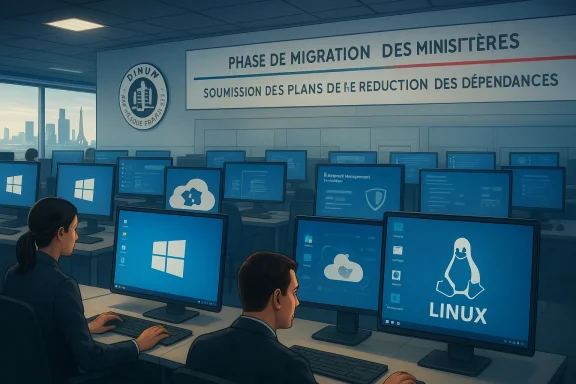
The key point is that France’s announcement is not merely about swapping one desktop operating system for another. The DINUM has explicitly said the state is leaving Windows in favor of Linux-based workstations, and that ministries must submit reduction plans for extra-European dependencies. That wording is deliberate. It ties desktop migration to a broader anti-lock-in strategy rather than a standalone IT refresh.The state is treating software as sovereignty
The language coming out of Paris is unusually direct. Officials say the state can no longer simply observe its dependence on American tools; it must reduce it. That is a very different framing from the older “open source is cheaper” argument, which often collapsed under the weight of migration costs, training, and compatibility work.France is instead making the case that software dependence itself is a strategic vulnerability. That includes pricing power, update control, cloud coupling, and data jurisdiction. It also includes the risk that one vendor’s product roadmap can shape the behavior of an entire public administration.
The migration is tied to a broader dependency map
The DINUM has said that each ministry and operator must produce a plan that covers multiple layers of the stack, not just desktop operating systems. That is significant because it suggests the state is thinking in system terms, not in product terms. A Linux desktop without compatible identity services, collaboration software, document workflows, endpoint security, and support processes would be little more than a branding exercise.In practice, that means the government is likely trying to avoid a classic failure mode of public IT modernization: replacing the front-end logo while leaving the underlying dependence untouched. If the state can shift the desktop, the office suite, and the collaboration layer together, it has a much better chance of making the change stick.
The scale changes the stakes
The claim circulating in the technology press is that the move could affect more than 2.5 million workstations across the French public sector. That figure is not the same thing as a completed project, but it gives a sense of the scope involved. Even a partial migration at that scale would influence procurement, support vendors, and application developers across France.It would also force the state to confront a long list of operational questions:
- Which agencies can move first?
- Which legacy applications remain Windows-only?
- Which users need exceptions?
- Which hardware fleets are ready for Linux?
- Which support teams can handle the transition?
LaSuite as the Other Half of the Story
A Linux desktop migration alone would not be enough to free a government from Microsoft dependence. The more interesting part is that France is also building LaSuite, a sovereign, open-source alternative for collaboration and office work. Official materials describe it as an “open” and “sovereign” workspace for state employees, with tools including messaging, video, documents, and spreadsheet-like functionality.Why the office suite matters as much as the operating system
For most civil servants, the real daily dependency is not Windows itself but the document and collaboration layer sitting on top of it. Email, calendars, files, video calls, real-time document editing, and document exchange are where lock-in becomes visible. If users still need Microsoft 365 or related services, then a Linux desktop only shifts the pressure point.That is why France’s emphasis on LaSuite is so important. It shows the government understands that desktop migration and productivity-suite migration must be synchronized. Otherwise, the organization ends up with a new operating system but the same vendor gravity pulling from the other direction.
LaSuite is designed around open-source and French hosting
Official LaSuite documentation says the platform is operated by the DINUM using open-source building blocks, with data stored and processed in France under clearly defined jurisdiction. It also emphasizes SecNumCloud hosting for some services, which is central to the French model of trusted cloud infrastructure. That architecture is not just a technical preference; it is a policy statement.The point is to create a workplace environment whose legal and operational center of gravity remains within French control. That matters for sensitive public data, but it also matters for long-term procurement power. Once an administration relies on an internal platform, the state can influence roadmap priorities instead of merely buying seats from a supplier.
The Cnam deployment is a real-world stress test
France’s national health insurance body, the Cnam, has announced a move to deploy LaSuite for its 80,000 agents. That is a meaningful test because health administration is not a toy use case. It involves scale, deadlines, document sharing, and information sensitivity.A deployment of that size tells us two things. First, the French state is willing to use high-volume operational agencies as proving grounds for sovereign tooling. Second, LaSuite is no longer being treated as an experimental side project. It is becoming part of the state’s production stack.
- LaSuite is not a cosmetic rebrand
- It is part of an operating model
- It is linked to hosted, sovereign infrastructure
- It is being validated in large public institutions
Why Linux Makes Sense for Government
Linux keeps appearing in these stories because it solves several problems at once. It is open source, highly customizable, widely deployed in infrastructure, and not controlled by a single foreign vendor. For a government concerned with resilience and autonomy, that combination is compelling.Desktop Linux is still harder than server Linux
There is an important caveat here: enterprise Linux on the desktop is not the same as Linux on the server. Government desktops face specialized workflows, aging line-of-business applications, peripherals, digital signatures, and user support complexity. Those are real friction points, and they explain why desktop Linux adoption has historically been slow outside niches.That is why public migration projects succeed or fail on ecosystem maturity. If the state does not invest in packaging, compatibility testing, training, and help-desk readiness, the rollout can become a morale problem as much as a technical one. A sovereign strategy only works if end users can still do their jobs efficiently.
Open formats reduce hidden dependence
One of the quiet advantages of Linux migrations is that they often force governments to adopt more open document and data practices. That means fewer format surprises, fewer opaque feature dependencies, and less risk that a workflow only works inside one proprietary ecosystem. In the long run, this can improve archival durability and interoperability.It can also reduce the friction of cross-agency collaboration. When one ministry, one state agency, and one contractor all depend on the same proprietary suite, document workflows tend to harden around whatever that vendor supports best. Open formats make procurement more competitive, which is exactly what sovereignty-minded governments want.
The security argument is persuasive, but incomplete
Linux is often perceived as more controllable from a security standpoint, especially when combined with sovereign hosting and centralized policy. That perception is not baseless. Governments can audit more, patch more deliberately, and reduce some forms of vendor-driven exposure.But security is not just about the kernel. It is about configuration management, identity, training, endpoint monitoring, and incident response. A poorly administered Linux estate can be less secure than a well-administered Windows fleet, so the success of France’s move will depend on execution more than ideology.
The European Sovereignty Trend
France is not acting in a vacuum. Across Europe, governments have grown more comfortable using software policy as a lever for geopolitical and industrial autonomy. The language is shifting from “open source is nice” to “foreign dependence is risky.”Denmark and Schleswig-Holstein showed the path
Denmark’s Ministry of Digital Affairs has already moved away from Microsoft software in parts of government, and Schleswig-Holstein has been one of the most visible German examples of a public-sector open-source transition. These projects matter not because they are identical to France’s plan, but because they normalized the idea that public institutions can rethink the Microsoft stack.That normalization is powerful. Once one administration demonstrates that a migration is politically survivable, other governments can cite it as precedent. And once several governments do it, vendors lose the ability to dismiss the idea as fringe activism.
France is the scale amplifier
What makes France different is size. Even partial changes in a country with such a large and complex public sector can influence the European market for support services, integration work, and open-source tooling. French procurement has enough weight to shape vendor roadmaps.That means the decision could create demand for local integrators, packaging specialists, desktop management firms, and open-source service providers. In other words, this is not only a public-policy story; it is an industrial-policy story. That is exactly why the French government is framing it as a sovereignty initiative.
Europe is trying to create alternatives, not isolation
This point is easy to misunderstand. The goal is not necessarily to shut out U.S. technology completely. Rather, it is to avoid situations where critical public functions depend on products or pricing decisions outside Europe’s control. That distinction matters.A sovereign stack can still use global open-source projects, international standards, and mixed vendor ecosystems. The difference is that the state wants control over the terms of dependence. That is a much more realistic objective than technological autarky, and it is why the policy is politically durable.
- Europe is moving from theory to procurement
- France is adding scale to a growing pattern
- The goal is leverage, not isolation
- Open source is becoming statecraft
Historical Context: France Has Been Here Before
France’s current move should not be mistaken for a sudden conversion. The country has a long history of public-sector open-source use, including the Gendarmerie Nationale’s well-known Linux lineage. That history matters because it means France is not starting from zero, even if the current scale is much larger.The Gendarmerie proved migration was possible
France’s national gendarmerie has long been cited as an early adopter of Linux-based desktops and open-source tools. That experience is important because it demonstrated that a large, disciplined public organization could migrate away from standard proprietary desktop assumptions. It also showed that support models could be adapted for law-enforcement and field operations.The lesson from the Gendarmerie is not that migration is easy. It is that migration is operationally possible when leadership, support, and standards align. That is exactly the kind of precedent the current French government can now invoke.
Public procurement has changed since the 2000s
Two decades ago, moving government workstations away from Windows would have looked like a rebellion. Today, it looks more like a strategic procurement decision shaped by cloud concentration, cybersecurity concerns, and geopolitical tension. The context has changed dramatically.Modern governments are no longer just buying software licenses. They are buying policy outcomes, data control, and operational continuity. That shift makes Linux and open-source alternatives more attractive than they once were, even if they are still more demanding to run.
The shift is also cultural
There is a cultural element to all this. Public-sector IT has traditionally prized standardization, and Windows was the default standard for a generation. But standardization itself can now be a liability if it creates single-vendor dependency across entire states.France’s announcement suggests a new definition of modernity in government IT: not “everyone uses the same proprietary platform,” but “everyone uses a platform the state can control, inspect, and evolve.” That is a subtle but profound change in public-administration philosophy.
Enterprise Impact: What This Means for Microsoft and Rivals
For Microsoft, the immediate impact is less about lost revenue from one country and more about the precedent. Governments are among the most visible enterprise customers, and when they change direction publicly, they signal to everyone else that vendor dependence is a strategic discussion, not just a procurement detail.Microsoft faces a narrative challenge
Microsoft is not losing relevance overnight. But it is being forced into a conversation it would rather avoid: what happens when customers treat its stack as a dependency to be reduced rather than a platform to be expanded? That is a subtle but serious shift in enterprise perception.The company can respond with cloud integrations, security features, sovereign-cloud messaging, and local compliance assurances. But the underlying problem remains: once a customer begins to value autonomy above convenience, the default lock-in story gets weaker. That matters across the public sector and the regulated enterprise market.
Linux and open-source vendors get a new opportunity set
A large-scale French migration would create opportunities for distributions, support providers, identity vendors, migration consultants, and training partners. More importantly, it would create demand for tools that make open source feel like a mature enterprise environment rather than a hobbyist platform.That includes endpoint management, document compatibility, remote support, application packaging, and policy enforcement. These are the areas where open-source ecosystems still need to keep improving if they want to win mainstream administrative users. France’s project could become a catalyst for that investment.
The real competition is on integration
The battle is not Linux versus Windows in the abstract. It is integrated sovereign stack versus integrated proprietary stack. If France can deliver a coherent experience that matches user expectations, then the market will notice. If it cannot, the effort will be remembered as politically ambitious but operationally awkward.That is why execution quality will matter so much. Governments rarely get credit for choosing the “right” architecture unless the user experience is also good. In public IT, success is almost always invisible; failure is always obvious.
- The precedent may matter more than one contract
- Integration is the real battleground
- Support ecosystems will expand if the migration succeeds
- Vendor narratives will shift toward autonomy and control
Consumer and Cultural Effects
Even though this is a government story, it has cultural spillover. When a major state moves toward Linux and open-source software, it changes public perceptions of what counts as mainstream. That has knock-on effects for individuals, schools, charities, and smaller businesses that watch public-sector decisions for cues.Public legitimacy matters
Linux has long fought the perception that it is a niche platform for enthusiasts. When major institutions adopt it at scale, that perception begins to weaken. The technology becomes less “alternative” and more “officially viable.”That legitimacy matters in IT purchasing. Many organizations are not really choosing between technologies; they are choosing between levels of perceived risk. When a government validates a platform, it lowers the psychological barrier for everyone else.
It may indirectly boost open standards at home
A French transition could accelerate awareness of open document formats, open collaboration tools, and locally hosted services. Those ideas often spread from government to universities, then to mid-market companies, and eventually to consumers. This is how policy reshapes markets over time.It could also influence training and certification pathways. If public-sector demand rises for Linux administration, LibreOffice support, and sovereign cloud operation, educational institutions will respond. That creates a talent pipeline that reinforces the ecosystem.
But consumer adoption is a different game
It would be a mistake to assume a public-sector migration automatically turns into mass consumer desktop adoption. Consumers are more tolerant of proprietary ecosystems that bundle convenience, hardware integration, and consumer services. They also face fewer compliance requirements and less legacy application baggage.Still, the symbolic effect is real. People notice when governments stop treating Microsoft software as inevitable. Even if they do not switch themselves, they start seeing alternatives as credible.
Strengths and Opportunities
France’s strategy has several clear strengths, and they are not limited to symbolism. The move aligns procurement, infrastructure, and policy, which gives the program more chance of surviving political cycles than a simple software swap would. It also creates room for the state to build domestic capability around support, hosting, and integration.- Reduced vendor lock-in across core public-sector workflows
- Greater control over data jurisdiction and hosting choices
- Improved negotiating leverage with global software suppliers
- A stronger domestic open-source ecosystem for support and services
- More durable document interoperability through open formats
- Potential cost predictability over the long term
- Better alignment with European digital sovereignty goals
Risks and Concerns
The downside is just as real. Large desktop migrations are notoriously difficult, and governments have many of the hardest constraints: legacy applications, procurement rules, aging hardware, diverse user groups, and intense scrutiny. A sovereign strategy can also become politically overloaded if it is sold as a cure-all rather than a managed transition.- Application compatibility problems for legacy Windows-only software
- User resistance if the change is poorly explained or rushed
- Training overhead for staff and help-desk teams
- Fragmentation risk if ministries adopt incompatible local variations
- Security complexity if endpoint management is inconsistent
- Budget pressure from migration, support, and retraining costs
- Political backlash if early disruptions are highly visible
Looking Ahead
The most important thing to watch now is whether France turns its announcement into a staggered but measurable migration plan. The DINUM has already said ministries must submit their own dependency-reduction plans, and that means the next phase will be about governance, milestones, and exceptions. If the first ministries move cleanly, the political case will strengthen quickly.The Cnam deployment will also be a bellwether. If one of France’s major public institutions can adopt LaSuite successfully at scale, it will prove that the sovereign stack is not just a policy slogan but a working operational platform. That would give other agencies something concrete to copy rather than merely admire.
What to watch next:
- ministry-by-ministry migration schedules
- the handling of legacy Windows applications
- the rollout pace of LaSuite and related tools
- training and support capacity across agencies
- procurement changes for endpoint and collaboration software
- any public metrics on productivity, cost, or user satisfaction
- whether France’s approach influences EU-level policy discussions
Source: CyberShack France abandons Microsoft Windows for Linux on more than 2.5 million workstations - CyberShack
Last edited:
