

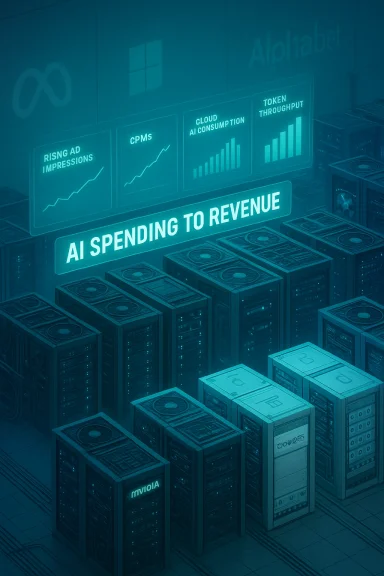
Big Tech’s AI spending splurge is no longer empty spectacle: the last two reporting cycles show real revenue flowing from generative models, cloud consumption, and AI-powered ads — but the path from massive capex to durable profits is complex, company‑specific, and full of execution risks investors must weigh carefully. overview
The headline story of 2025–2026 is simple: Alphabet, Microsoft and Meta have moved from experimentation to productization. All three have announced wildly elevated capital‑expenditure plans to build GPU/TPU‑dense datacenters and custom silicon, and all three now point to concrete revenue lines that tie directly to AI usage. That shift — from promise to receipts — is what separates this cycle from the earlier “metaverse” era where spend outpaced monetisation signals.
Yet the business models differ. Meta about squeezing more yield from attention through a rebuilt, AI‑first ad stack. Microsoft’s playbook is enterprise‑first: sell cloud compute, developer tools, and seat‑based Copilots. Alphabet occupies both poles: planet‑scale consumer distribution and an increasingly enterprise‑grade cloud and silicon business. The economicscs that determine who wins hinge on unit economics — price per ad impression, price per token or inference, and utilization of expensive accelerator capacity.
Meta: the AI advertising machine
Rebuilding owing the receipts
Meta has been explicit: it has rebuilt ad ranking, targeting and measurement around large models and unified AI systems, and management says those systems are driving real revenue. In Q3 2025 Meta reported consolidated revenue of $51.24 billion, with Family of Apps ad revenue the clear engine of growth. Ad impressions rose 14% and average price per ad increased 10% in the quarter — a rare combination of volume and yield expansion. Company materials and post‑earnings coverage also describe an AI‑powered ad engine running at roughly a $60 billion annualized pace. Those numbers matter because they show monetization is not hypothetical: impressions are growing and the platform is capturing more revenue per ad. For an ad‑first business, that proof point is the clearest path from capex to cash flow — if the ad ecosystem remains healthy and AI‑driven recommendations keep users engaged.How Meta makes the numbers add up
- AI‑driven ranking and personalization: fewer bad placements, better conversions, stronger advertiser ROI.
- Consolidation of ranking models: fewer, large models simplify operations and improve conversion per impression.
- Expanded ad load and better pricing: the company shows both more served ads and rising CPMs.
Risks and watch points for investors
- Cannibalization risk — if AI answers reduce the number of monetizable impressions (a “zero‑click” problem), per‑user ad dollars could compress.
- Capex utilization — Meta is building large private fleets; if internal demand slows, the company lacks a mature external cloud channel to sell excess cycles.
- Regulatory and privacy headwinds — changes in ad‑targeting rules, privacy defaults, or antitrust remedies could materially alter advertising metrics to watch: ad impressions and CPM trends, AI feature attach‑rates inside core surfaces (Reels, Feed, Stories), and sequential capex vs utilisation disclosures in future quarters.
Microsoft: the enterprise AI platform
Enterprise distribution and the seat + consumption model
Microsoft’s narrative is built on enterprise relationships. The company reported a strong start to fiscal 2026 with total revenue of $77.7 billion for the quarter ending September 30, 2025, and Azure and other cloud services posting roughly 40% year‑over‑year growth in that quarter. Microsoft positions Azure as the “infrastructure layer of choice” for enterprise AI, and it pairs consumption economics (compute hours, inference) with seat‑based monetization via Copilot offerings. Two metrics stand out in the Microsoft story and help explain investor interest:- GitHub Copilot — now reported at more than 26 million users, providing clear developer adoption signals.
- Copilot seat penetration inside enterprises — Microsoft says M365 Copilot is used by a large fraction of the Fortune 500 (management commentary cites very high penetration), creating a recurring‑revenue base that is sticky and lower churn than pure cloud consumption alone.
Strategic moves: diversify model partnerships and lock in demand
Microsoft’s recent strategic moves show two things: (1) the company is broadening its model partnerships beyond any single provider, and (2) it is making large compute commitments and investments to secure enterprise demand. Public reporting in late 2025 documents new multi‑party arrangements in which Microsoft is participating in investments alongside others to ensure access to multiple model providers and compute flows. One widely reported structure features combined investments by Microsoft and Nvidia in Anthropic, with Anthropic committing to substantial Azure compute purchases. Public figures reported by major outlets indicate Microsoft’s investment in Anthropic was up to $5 billion while Nvidia’s pledge was up to $10 billion; aggregate headlines circulated numbers that differ from some secondary reports, so precise tails on “up to” amounts should be read from corporate filings. This diversification reduces single‑partner dependence and reinforces Azure as a consumption destination. Important correction and caution: some summaries circulating in the market have rounded or combined those commitments in ways that overstate Microsoft’s standalone cash commitment (for example, claims of Microsoft investing up to $15 billion alongside Nvidia are inconsistent with the principal public filings and reporting that list a smaller Microsoft pledge). Treat aggregate investment figures carefully and consult the companies’ definitive disclosures for exact terms.Risks and watch points for investors
- Capex-to‑return timing: Microsoft reported record capex (quarterly figures near ~$35 billion in late‑2025 reporting windows), which compresses near‑term free cash flow even as it supports future revenue growth. Watch depreciation and operating margin trends.
- Pricing and commoditisation risk: if models commoditise, raw compute pricing could erode margins — Microsoft’s advantage becomes its enterprise integrations, not just raw compute.
- Regulatory and contractual complexity: large, long‑dated model deals can create antitrust attention and long tail contractual obligations.
Alphabet (Google): the infrastructure and distribution powerhouse
Scale of usage and the token economi has the rare combination of a dominant ad engine and a rising enterprise cloud business. Management reported Google Cloud revenue in Q3 2025 of roughly $15.2 billion with mid‑30% growth, and they highlighted an enormous surge in model throughput. CEO commentary and investor decks disclosed that Google’s model fleet processed over 1.3 quadrillion tokens per month, roughly a 20x increase year‑over‑year, and that API throughput figures measure in billions of tokens per minute. Those usage figures are compelling because they signal genuine production workloads rather than pilot projects.
Why itokens matter: tokens are the unit of model compute; higher token volumes mean more inference and therefore more billable cloud consumption when enterprise customers run models, as well as more data for product improvement. Alphabet’s argument is that owning the stack — models (Gemini), accelerators (TPUs), cloud tooling (Vertex AI), and massive distribution (Search, YouTube, Android) — allows it to monetise both consumer and enterprise AI flows.The TPU play and Anthropic’s TPU commitment
Alphabet’s custom accelerators are . The company unveiled its seventh‑generation TPU (Ironwood) and announced multi‑year arrangements enabling third parties to run on that silicon. A high‑profile deal with Anthropic gives that startup access to up to one million TPUs — a commitment widely reported across financial and trade press and described as delivering over a gigawatt of compute by 2026. That agreement is an explicit sign that Google is shifting TPUs from internal cost advantage to monetisable capacity. This deal changes the shape of the market: cloud buyers now have a choice between Nvidia GPU fleets, Amazon Trainium, and Google TPUs — and the competition will increasingly be fought on price‑performance per‑inference and data‑center power economics, not just model architecture.Risks and watch points for investors
- Zero‑click risk for search: if generative AI reduces click volumes on Search without new monetisation formats, ad revenue could be pressured — the “AI that answers without sending traffic” problem. This is the central product‑level downside that Alphabet must solve.
- Capex conversion risk: Alphabet’s elevated capex guidance requires conversion of capacity into cloud and product revenue; failure to convert backlog into billed revenue would pressure margins.
- Token accounting nuance: raw token counts are powerful indicators of load, but they mix light consumer tokens (short queries) and heavy reasoning tokens (long contexts, multimodal workloads). Unit economics per token can vary widely by workload.
Comparing the efits from falling inference costs?
A common investor worry is that falling inference costs (the “DeepSeek” effect) will destroy vendor economics. The reality is more nuanced.- Lower per‑inference cost can expand addressable demand: cheaper inference encourages enterprises to productise more AI features (agents, summary services, automated workflows), which expands consumption even if per‑unit price falls.
- Value shifts toward integration and data: as models become more commoditised, the companies that own distribution, identity, data, or deep vertical integrations (Microsoft’s seat+Copilot economics, Alphabet’s search/commercial intent, Meta’s attention graph) retain pricing power.
- Infrastructure vendors and capitally leveraged hyperscalers still capture a near‑term benefit from volume growth even if unit prices decline; long‑term margins depend on mix — raw compute vs managed services vs high‑value seats/subscriptions.
The infrastructure economy: chips, power and utilisation
AI monetization is inseparable from hardware economics. Three structural elements determine winners:- Chip cost and performance (Nvidia GPUs vs Google TPUs vs Trainium).
- Power and data‑center capacity (gigawatts of power, siting and grid access).
- Software stack and developer productivity (tooling, SDKs, pricing transparency).
Practical watchlist — the metrics that separate hype from execution
For any investor or IT leader trying to judge which company is actually monetising AI, these operational KPIs matter most:- Ad engines (Meta and Alphabet): impression counts, average price per ad (CPM), and new AI‑native ad formats that can be charged at premium rates.
- Cloud and enterprise (Microsoft and Alphabet): dollar growth in AI consumption, gross margins on cloud, and backlog / RPO conversion cadence.
- Seat monetisation (Microsoft): Copilot seat conversion rates, ARPU for Copilot products, and total Copilot MAUs.
- Token economics (Google): tokens processed per month, per‑token pricing tiers, and distribution between light consumer and heavy enterprise reasoning workloads.
- Capacity utilisation (all): capex run rate vs reported utilisation; named deals that fill capacity (>$100M+ deals) and third‑party TPU/GPU contract wins.
- Regulatory signals: antitrust or privacy rulings that change default placements or cross‑product data flows.
Where the story is still uncertain — flagged claims and cautionary notes
- Investment tallies across ecosystem partners are often reported inconsistently. For example, several pieces circulated a combined Microsoft/Nvient figure that, if read imprecisely, can overstate Microsoft’s cash commitment. Public reporting indicates Microsoft’s pledged amount in an Anthropic arrangement was materially smaller than some aggregated headlines suggested; treat any single headline number without the underlying contract text as provisional.
- Token counts (e.g., Google’s 1.3 quadrillion tokens per month) are real and reported by management, but they mix many workloads and model variants; tokens are a powerful indicator of load, not a single priceable unit. Drill into per‑model pricing, reasoning vs prompt token mixes, and enterprise seat attach rates to infer revenue impact.
- Many capex forecasts and “notably larger” spending plans are forward‑looking guidance. Companies often adjust capex as utilisation crystalises; therefore capex guidance should be watched alongside utilisation and backlog metrics to judge whether the builds are being monetised.
Conclusion — what investors should do next
Big Tech’s AI investments are backed by visible revenue lines today: Meta’s ad uplift, Microsoft’s Azure + Copilot consumption engine, and Alphabet’s combined consumer/enterprise footprint tied to its TPU advantage. But the duration and quality of durable profits depend on execution: converting capex into high‑margin managed services, protecting ad yields from zero‑click disruptions, and maintaining pricing power as models and compute commoditise.For long‑term positioning, focus on three things:
- Evidence of durable monetisation: consistent quarter‑over‑quarter improvements in ARPU, cloud margins, and Copilot attach rates.
- Capex utilisation: is newly announced capacity being filled by named deals or visible consumption growth?
- Regulatory and product risk: are new monetisation formats (sponsored AI answers, premium seats) scaling without regulatory or adoption friction?
Bold evidence exists: Meta’s ad engine is producing measurable yield improvements and an AI‑powered run‑rate; Microsoft’s Azure AI consumption and Copilot seat economics are producing enterprise dollars; Alphabet’s token volumes and TPU deals show capacity and demand at unprecedented scale. Yet each path carries distinct execution risk, and careful, metric‑driven monitoring remains essential before declaring any single winner in the AI monetisation race.
Source: The Smart Investor Beyond the Hype: How Meta, Microsoft and Alphabet Are Monetising AI
