
Nathan Bensch’s conversation on the AI Agent & Copilot Podcast crystallizes a simple but seismic message for Microsoft-centric IT teams: 2025 and beyond is no longer about Copilot demos — it’s about building, governing, and operating agents that actually do work, touch systems of record, and must be managed like production services. enVista’s VP of Microsoft Enterprise Services lays out the practical agenda attendees will see at the AI Agent & Copilot Summit — a program focused on Dataverse MCP servers, Copilot Studio agent design, and governance patterns that stand up under audit and operational pressure. His top-line: everyone’s hearing “agents, agents, agents,” and they want to know how to make them work in the real world.
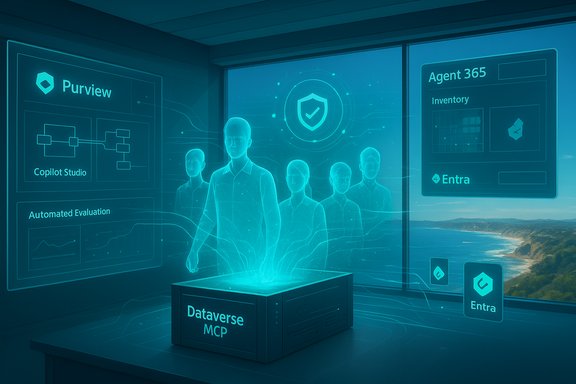
Microsoft’s product direction — highlighted at Ignite 2025 and reinforced across Power Platform, Microsoft 365, and Azure AI investments — has shifted from single-session Copilot assistance to an agent-first architecture: identity-bound agents with lifecycle management, telemetry, and policy controls. That shift is not theoretical; it’s being operationalized via features such as Agent 365 (a tenant control plane), Work IQ / Foundry IQ / Fabric IQ (intelligence and knowledge layers for grounding), Copilot Studio (authoring and validation), and the Dataverse Model Context Protocol (MCP) server for standardized agent-to-app access. These pieces together aim to make agents auditable, discoverable, and safe for enterprise automation.
The AI Agent & Copilot Summit returns March 17–19, 2026 at the Hilton La Jolla Torrey Pines, San Diego — an event designed to move organizations from pilot curiosity to production adoption with actionable sessions, hands-on masterclasses, and intimate peer conversations. The Summit’s 2026 program intentionally favors practical, non-marketing sessions that share the “good, the bad, and the ugly” of real implementations.
Technical verification: Microsoft’s documentation confirms the MCP server exists and can be enabled/disabled in the Power Platform admin center; admins explicitly control which MCP clients can interact with Dataverse. The Power Platform guidance includes step-by-step configuration and a warning that disabling MCP stops MCP-dependent tools and agents. That’s consistent with the hands-on sessions promised at the Summit (e.g., “How to use Model Context Protocol Servers”). Why MCP matters in practice:
Verification and context: Reuters and Microsoft’s own Ignite posts frame Agent 365 as a tenant control plane unveiled at Ignite 2025; Microsoft Learn and the Microsoft Security pages document Entra Agent ID, showing how agents are created with first-class identities, blueprints, and lifecycle policies aimed at large-scale agent governance. These are not mere slogans — there are documented admin flows and conditional-access constructs designed for agents. Key governance mechanics to note:
Source: Cloud Wars AI Agent & Copilot Podcast: enVista’s Nathan Bensch Talks Dataverse, Governance, and Agent Design
 Background / Overview
Microsoft’s product direction — highlighted at Ignite 2025 and reinforced across Power Platform, Microsoft 365, and Azure AI investments — has shifted from single-session Copilot assistance to an agent-first architecture: identity-bound agents with lifecycle management, telemetry, and policy controls. That shift is not theoretical; it’s being operationalized via features such as Agent 365 (a tenant control plane), Work IQ / Foundry IQ / Fabric IQ (intelligence and knowledge layers for grounding), Copilot Studio (authoring and validation), and the Dataverse Model Context Protocol (MCP) server for standardized agent-to-app access. These pieces together aim to make agents auditable, discoverable, and safe for enterprise automation.The AI Agent & Copilot Summit returns March 17–19, 2026 at the Hilton La Jolla Torrey Pines, San Diego — an event designed to move organizations from pilot curiosity to production adoption with actionable sessions, hands-on masterclasses, and intimate peer conversations. The Summit’s 2026 program intentionally favors practical, non-marketing sessions that share the “good, the bad, and the ugly” of real implementations.
What Nathan Bensch Says: Themes That Matter
Agents — the new unit of automation
Bensch emphasizes that the dominant theme for practitioners is agents: multi-step, goal-directed systems that plan, call tools, interact with legacy UI when necessary, and perform write-back into business systems. The question on everyone’s lips is not “what is an agent?” but “how do I deploy and govern fleets of them safely?” His program guidance promises deep technical dives into agent design, security, and Dataverse integrations — sessions that aim to connect strategy with execution rather than repackage vendor marketing.Practical sessions, not product theater
The Summit’s call for papers exploded from roughly 160 submissions in the prior year to more than 500, giving organizers the luxury to prioritize practical sessions: real-world case studies, failure modes, and concrete playbooks for scaling agents. Expect masterclasses on Copilot Studio, Dataverse grounding, validation stations, and admin telemetry that show how to transition pilots into reliable services.Where strategy meets execution
Bensch frames the audience as mostly between early pilots and mid-stage Copilot integration. That translates into content for architects and IT leaders who must stitch governance, Dataverse integration, and legacy-system access (the “computer use” / hosted browser capability) into a coherent operational model. Intimate sessions and networking (even golf and pickleball at Torrey Pines) are designed to create the candid conversations necessary to close the loop between “we need a strategy” and “we shipped an agent that saved time and stayed compliant.”Dataverse, MCP Server, and Grounding Agents
A central, recurring technical theme is the Dataverse Model Context Protocol (MCP) server as the standard bridge between agents and tenant data. Dataverse-as-MCP exposes a defined set of operations — list_tables, read_query, create_record, update_record — allowing agents to interact with application logic and data in a tenant-aware, auditable way. This reduces bespoke glue-code, standardizes tooling, and helps ensure agents operate against governed data rather than ad-hoc sources.Technical verification: Microsoft’s documentation confirms the MCP server exists and can be enabled/disabled in the Power Platform admin center; admins explicitly control which MCP clients can interact with Dataverse. The Power Platform guidance includes step-by-step configuration and a warning that disabling MCP stops MCP-dependent tools and agents. That’s consistent with the hands-on sessions promised at the Summit (e.g., “How to use Model Context Protocol Servers”). Why MCP matters in practice:
- It provides a standardized, auditable tool interface for agents to access records and schema.
- It preserves tenant-aware semantics so agents can be grounded to the right business entities (orders, incidents, ledgers).
- It enables admin gating (PPAC-managed configuration) so organizations can restrict which clients or models can call MCP endpoints.
Governance: Agent 365, Entra Agent ID, and Observability
Agent proliferation without centralized governance is the core operational risk of agentic automation. Microsoft’s answer is an integrated governance stack: Agent 365 for discovery, lifecycle, and quarantine; Microsoft Entra Agent ID for identity-first control; and integrations with Purview/Sentinel for compliance, telemetry, and forensic logging. Practically, this means agents are treated like service principals or applications — discovered, permissioned, monitored, and, if necessary, isolated.Verification and context: Reuters and Microsoft’s own Ignite posts frame Agent 365 as a tenant control plane unveiled at Ignite 2025; Microsoft Learn and the Microsoft Security pages document Entra Agent ID, showing how agents are created with first-class identities, blueprints, and lifecycle policies aimed at large-scale agent governance. These are not mere slogans — there are documented admin flows and conditional-access constructs designed for agents. Key governance mechanics to note:
- Entra Agent ID enables sponsor tracking, blueprint-based provisioning, and token issuance that can be constrained for least-privilege access.
- Agent 365 surfaces inventory, usage telemetry, and kill-switch APIs to quarantine misbehaving agents.
- Purview + Sentinel integration brings agent telemetry under the enterprise compliance and SIEM posture so prompts, responses, and action logs are retained and auditable for policy or regulatory needs.
Agent Design, Copilot Studio, and Validation
Bensch and the Summit programming committee stress that Copilot Studio has matured from a prototyping surface to a production-capable authoring and runtime environment. Copilot Studio now includes:- Agent authoring flows and templates
- Automated agent evaluations (CI-style regression checks)
- Validation stations for human-in-the-loop gates
- Computer use / hosted browser capabilities so agents can interact with legacy web UIs in a sandboxed way when no API exists.
- Use Dataverse as the canonical state store for agent grounding and audit trails.
- Embed deterministic flows (Power Automate) for orchestration while reserving LLM reasoning for planning and extraction.
- Version-agent behavior, run tests in staging tenants, and require human approval for high-risk write-backs.
Where the Summit Program Adds Value: Real Adoption, Not Hype
Bensch’s programming direction intentionally prioritizes sessions that help practitioners move beyond proof-of-concept to measurable adoption:- Deep technical masterclasses (Azure AI Foundry, MCP servers, Dataverse tuning).
- Security and legal panels on policy design and compliance (enVista’s prior sessions show partners pairing security and legal perspectives).
- Breakouts on legacy integration, cost/control models for Copilot credits, and TCO scenarios for finance and cloud teams.
Notable Strengths of the Current Platform Direction
- Enterprise grounding: Dataverse + Microsoft Graph + Purview provides a consistent, tenant-scoped substrate that reduces hallucination risk when agents act on sensitive business data.
- Identity-first governance: Entra Agent ID and Agent 365 make agents visible and manageable using familiar IAM controls, which aligns agent governance with existing security processes.
- Authoring + validation: Copilot Studio’s move toward built-in testing and validation is a crucial step toward treating agents like software artifacts with CI/CD and QA discipline.
- Operational observability: Integrations with Purview, Sentinel, and the Power Platform admin center give security and compliance teams the telemetry needed to audit agent actions and contain incidents.
Key Risks and How Summit Sessions Address Them
- Hallucinations and grounding failures
- Risk: Agents generating plausible but incorrect actions.
- Mitigation: RAG patterns grounded to Dataverse/Foundry, validation stations, and staged monitor-only pilots. Summit sessions focus on data classification and verification patterns.
- Agent sprawl and privileged automation
- Risk: Thousands of ungoverned agents with excessive permissions.
- Mitigation: Entra Agent ID blueprints, Agent 365 inventory, and enforcement of least-privilege via conditional access and access reviews. Summit workshops show how to structure sponsor, owner, and lifecycle policies.
- Data leakage and compliance gaps
- Risk: Agents accessing or exfiltrating regulated data via connectors or “computer use.”
- Mitigation: Purview labeling, DLP rules, and SIEM integration; run red-team prompt-injection tests and integrate agent logs into forensic workflows. Sessions on security and legal design address policy alignment and incident playbooks.
- Cost and license unpredictability
- Risk: Copilot/agent consumption can cause runaway cloud and credit costs.
- Mitigation: Environment-level caps, Copilot credit metering, and TCO modeling; finance-oriented Summit tracks cover budgeting and chargeback patterns.
Practical Playbook: Steps to Move from Pilot to Production
- Inventory existing automations, bots, and scripts; map them to candidate agent use cases.
- Define an Agent Governance Policy: owners, sponsor, retention rules, human-in-the-loop thresholds.
- Enable Dataverse MCP in a staging environment and validate MCP client configurations and permissions.
- Build a small, monitor-only fleet of read-only agents to validate telemetry, agent identity creation, and Purview logging.
- Implement CoE processes: templates, testing suites in Copilot Studio, agent version control, and release gating.
- Add cost controls: Copilot credit budgets, environment caps, and monthly consumption dashboards.
- Run red-team prompt-injection and exfiltration tests; connect agent logs to Sentinel and Purview for forensic readiness.
Session Highlights to Watch at AI Agent & Copilot Summit 2026
- Masterclass — “Building Agents in Azure AI Foundry”: hands-on agent orchestration and multi-agent choreography patterns.
- Workshop — “How to use Model Context Protocol Servers”: configuration, authoring tools, and PPAC gating for MCP clients.
- Security Track — “AI and Security, Legal Challenges & Policy Considerations”: legal alignment and incident response templates (enVista’s prior sessions pair security and legal perspectives).
Where Claims Require Caution
- Forecasts like “1.3 billion agents by 2028” are vendor-cited projections used to emphasize scale and urgency. Treat such numbers as planning signals, not guarantees. Independent verification of such magnitude is challenging; they should inform readiness planning rather than procurement decisions.
- Several product features are rolling out via staged preview channels (Frontier, Insider, public preview). Organizations should validate regional availability and licensing implications before designing critical workflows around preview features. Summit sessions and Microsoft documentation routinely note preview/GA timelines and gating details.
Final Assessment — Strengths, Gaps, and What IT Leaders Should Do Next
The platform and partner ecosystem are converging on a credible operational model for agentic AI: grounding (Dataverse + Graph + Fabric), identity & governance (Entra Agent ID + Agent 365), and authoring + validation (Copilot Studio + validation stations). That stack addresses the three biggest enterprise friction points — correctness, control, and operationalization — and Summit programming (guided by practitioners like Nathan Bensch) will make those patterns accessible to attendees. However, the pathway from capability to value demands disciplined engineering, security rigor, and financial governance. Without those, agent projects risk becoming either compliance headaches or expensive curiosities. Practical steps for leaders:- Treat agents as production services: register, sponsor, monitor, and budget them.
- Start small with guarded read-only pilots and instrument everything.
- Build a cross-functional CoE (IT, Security, Legal, Finance, LOB) to steward scaling.
- Use the Summit’s workshops and masterclasses to capture templates and test them against your data readiness and compliance requirements.
Conclusion
Nathan Bensch’s message — amplified by Microsoft’s product roadmap and partner experiences — is clear: agents are no longer an R&D novelty. They are an operational construct that will reshape how work gets done across Office, Dynamics, and line-of-business systems. The difference between stumbling and winning will be the operational muscle built around Dataverse grounding, identity-first governance (Entra Agent ID), validated authoring (Copilot Studio) and rigorous cost/compliance controls. The AI Agent & Copilot Summit (March 17–19, 2026, Hilton La Jolla Torrey Pines) promises a concentrated, practical program for IT leaders who need to convert those architectural primitives into working, auditable automation that delivers measurable business outcomes.Source: Cloud Wars AI Agent & Copilot Podcast: enVista’s Nathan Bensch Talks Dataverse, Governance, and Agent Design
