

From Hype to Habit: What Comscore’s 2025 AI Intelligence Report Actually Shows (and What It Means)
By WindowsForum newsroom — December 9, 2025
Executive summary
- Comscore’s new “AI Intelligence Report” is not an anecdote; it’s a measurement play: a person-based, panel-backed attempt to quantify how generative AI is moving from novelty to a routine part of consumers’ decision journeys.
- Key headlines: AI assistants now reach a large share of desktop and mobile audiences, AI is appearing inside search results at scale, and AI is materially influencing purchase decisions (notably travel/hotel bookings).
- The details matter more than the headlines. The report — available from Comscore by request — highlights new measurement challenges and strategic choices for publishers, advertisers, platforms and product teams trying to navigate an AI-first consumer path.
Comscore’s press release for the report pulls a short list of figures that, together, argue AI’s shift from experiment to embedded utility:
- AI assistant tools reached roughly 36% of desktop users and 24% of mobile users in 2025. That’s not “some users tried an app once” — it’s a population-level reach statistic indicating routine exposure across device categories.
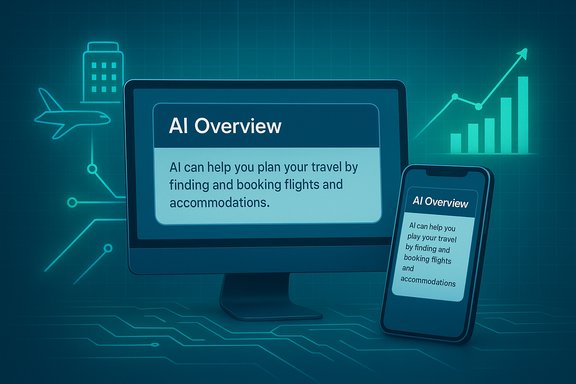
- More than 30% of desktop searches on Google now surface an “AI Overview” (Google’s AI-generated summary), up from 23% in April 2025. That is a tectonic move for search UX: it replaces the classic “ten blue links” interaction with a single synthesized response in a growing number of queries.
- In travel specifically, Comscore finds that nearly 63% of hotel bookers visited an AI platform in the 90 days before booking — and ~7% did so within minutes of the transaction — implying AI is often part of the late-stage decision process. That’s a practical business signal: AI is not just discovery; it’s feeding final choices.
- ChatGPT remains a leader among assistants, but the ecosystem is competitive: Google’s Gemini, Microsoft Copilot and other offerings are all part of the mix. Comscore highlights multi-device usage and demographic expansion (usage growth across age brackets), and it reports an explosion in AI-related social engagement (reported as ~64M social engagements in 2025).
1) Search is becoming an answer engine, not a link index
When an AI Overview or single-response card is the first thing users see, the mechanics of discovery change: users can accept a synthesized answer and never click through to a publisher site, or they can use that answer as a short path to a transaction. That changes (a) traffic funnels for publishers, (b) how marketers measure incrementality, and (c) what “rank” even means when the interface privileges a synthesized output over a ranked list. Comscore’s measurement of AI appearing in >30% of desktop queries is the clearest industry signal yet that search UX is materially different. Practical takeaways:
- Publishers: expect fewer organic pageviews from informational queries unless publishers are explicitly surfaced by AI (citation/knowledge sources) or they invest in formats the AI system ingests (structured data, APIs, verified content feeds).
- Marketers: recalibrate attribution models. If an assistant influenced a booking minutes before transaction, last-click models undercount AI’s role. Comscore’s hotel-booker stat is an early quantification of that problem.
Comscore reports distinct desktop and mobile reach numbers; it also emphasizes that users integrate assistants across touchpoints. For product planners this matters because measurement and design must accommodate cross-device state and continuity: a user that begins planning a trip on an assistant on mobile and finishes booking on desktop is an increasingly common path. Comscore’s person-based approach (panel + device coverage) is designed to capture those journeys, which cookie-based methods can miss. 3) AI is already part of buying decisions in specific verticals — travel is the canary
Travel is the clearest example in Comscore’s highlights. The study’s 63% figure for hotel bookers who visited an AI platform within 90 days of booking tells product, commercial and revenue teams two things: AI is being used for trip planning at scale, and the timing often overlaps with purchase intent. That should make travel marketers and metasearch/OTA platforms rethink where and how they place offers and how they measure performance. What the report doesn’t (yet) prove — and what to watch for
- Which AI claims reflect “adoption” vs “deep engagement”? Reach numbers are useful, but they don’t distinguish a quick query from sustained use. Comscore’s reach stats show scale but not session depth; product teams should treat them as a directional input, not the final UX truth.
- Citations and source quality. Several industry observers have raised concerns about which domains AI responses cite — and how those signals can be gamed. Some reporting on the Comscore findings (and commentators who’ve viewed the underlying material) point to heavy representation of domains like YouTube, Wikipedia and Reddit in AI outputs; if those domains are indeed the frequent provenance of AI responses, manipulatability becomes a risk. Note: the press release’s headline metrics don’t itemize a ranked list of domains; that finer-grain evidence is likely in the full presentation/report PDF Comscore provides on request. Readers should treat domain-mix claims as meaningful but subject to verification. (See the “where I couldn’t independently verify” note below.
- Measurement gaps remain. Comscore’s approach is person-based paneling — a powerful complement to server-side logs — but it is not a single silver bullet. Panels have sampling tradeoffs and Comscore’s classification will matter a great deal in how “AI usage” is defined. Expect healthy methodological scrutiny in the months ahead.
1) Map assistant exposure into funnel models
- Identify queries your content answers that would plausibly trigger an AI Overview or assistant answer. Prioritize content that can be verified and cited by assistant models (structured data, authoritative guides, clear schemas).
- If publishers want to remain visible to agents and assistants, public APIs or packaged knowledge graphs that provide verifiable signals (dates, authorship, canonical content blocks) will be increasingly valuable.
- Short-term fix: extend lookback windows and instrument “assisted by AI” tags in tracking where possible.
- Medium-term: experiment with person-based identification and cross-device stitching (respecting privacy controls) so you can measure assisted conversions that begin in an assistant and finish on your domain.
- If AI-generated answers are built on a concentrated set of domains, as some observers contend, the risk of gaming increases. Publishers and platforms should invest in authenticity signals (signed data, provenance metadata, trust frameworks) that make content harder to spoof.
- Media planning assumptions are shifting. If assistants are discovery points and can directly drive bookings (Comscore’s hotel stat), paid media that merely drives clicks to a landing page may miss an upstream role that assistants are playing. Advertisers need to test: does being present in an assistant citation set move conversions differently than classical display or search buys? Comscore’s measurements are the first systemic input to that question at scale.
Comscore’s release calls out ChatGPT, Gemini and Copilot as major players and notes ChatGPT’s continued leadership in certain measures while other assistants gain share. That’s an important nuance: while ChatGPT may still have a dominant position in some usage metrics, the landscape is competitive and platform integration (Google Search + Gemini; Microsoft Copilot across Windows/Edge/Office) could shift discovery share quickly. For product leaders, that means any strategy that assumes a single “winner” is risky; instead, plan for multi-platform awareness and prepare to serve as a trustworthy source for several agent families. The trust problem: provenance, manipulation, and the “single answer” UX
Comscore highlights that AI-synthesized answers are already common in search; the practical problem for the ecosystem is provenance and manipulation. If an AI Overview credibly and consistently cites a set of domains, operators will try to optimize for those signals. That can be beneficial (trusted authoritative domains rise) or harmful (gaming, misinformation, spam strategies). The stakes are high because, as Comscore quantifies, assistants are influencing decisions near the point of purchase. Companies responsible for content quality — publishers, platforms, and advertisers — need clear authentication and provenance standards fast. Methodology & caveats (what Comscore says about how they measured)
Comscore’s release emphasizes that the findings are based on a person-based panel spanning desktop and mobile and a category-level classification of AI tools and features. That’s important because:
- Person-based measurements can stitch cross-device journeys.
- Classification rules determine what “AI usage” means (a fully AI-native app vs a site with an AI feature may be treated differently).
- The full dataset and presentation are gated behind a request form on Comscore’s site (the download requires a form fill). That means independent researchers will rely on Comscore’s published highlights or get access to the underlying deck to validate deeper claims.
- TVREV’s reporting and other independent commentary highlight that a relatively small set of domains (YouTube, Wikipedia, Reddit) show up frequently as citations in AI-overview style responses. Comscore’s public press release emphasizes concentrated domains in some of its analyses, but the specific domain-ranking detail and the exact share each domain contributes is not enumerated in the press release itself. The full report / presentation (available from Comscore after registration) is likely where that domain-level data lives. Until that presentation is publicly posted in full, the specific claim about the dominance of YouTube/Wikipedia/Reddit is best treated as a reasonable interpretation that should be verified by looking at Comscore’s slide deck or the raw tables.
- For software product owners: AI assistants change the way users ask questions of your product. Be explicit about how your product can be queried, what your canonical responses are, and how to deliver structured, machine-readable outputs (APIs, JSON-LD, OpenAPI docs).
- For platform engineering: expect higher and more varied traffic patterns. Agents may hit APIs or crawl different endpoints. Design for bursty calls, and consider rate limits, authentication, and signed responses to prove provenance.
- For security and ops: a world where assistants cite third-party content opens new vectors for fraud and misinformation. Invest in integrity checks, provenance metadata, and monitoring for unusual citation spikes that may indicate manipulation attempts.
- For measurement and analytics teams: complement traditional models with person-level signals where privacy-compliant stitching is possible. Comscore’s work shows why panel-based, person-centric measurement is valuable in this era.
Comscore’s 2025 AI Intelligence Report supplies the industry with a crucial early measurement baseline: assistants have reach, AI is visible in search at scale, and AI is already influencing purchase behavior in verticals like travel. Those are not speculative changes — they are measurable shifts that should change planning and product priorities in 2026. If you want to dig deeper
- Read Comscore’s press summary and request the full presentation/deck from Comscore’s AI Intelligence Report landing page. Comscore is gating the full deck behind a request form, but the press release contains the report’s headline metrics.
- Treat commentary that lists specific cited domains (YouTube, Wikipedia, Reddit) as interpretations until you can inspect Comscore’s slide deck or tables; those details live in the downloadable presentation.
- Inventory your top informational pages and add machine-readable metadata (structured data, canonical signals).
- Test whether your content is surfaced by major assistants: ask common queries to ChatGPT, Gemini, Copilot and evaluate whether and how your pages appear.
- Re-run attribution analysis with longer lookback windows and person-based stitching where possible.
- Implement provenance metadata on content that should be trusted (signed attestations, author/updated date, canonical source).
- Contact your measurement partners (Comscore or other panels) to understand how the new assistant/AI signals will be integrated in planning and reporting.
- Comscore press release and report landing page (Comscore’s 2025 AI Intelligence Report). These are the primary sources for the headline metrics cited above.
- Industry reprints/summaries of the Comscore release (GlobeNewswire/Barchart, Quiver) that corroborate and redistribute Comscore’s highlighted stats.
Comscore’s reported numbers represent the first large-scale, third-party attempt to put hard measurement around the question “how are people actually using AI?” That question matters because the answers will determine how billions of dollars of media, product development and platform investment flow in the next several years. For practitioners, the moment is not about hype or panic — it’s about measurement, verification, and design for a user experience where an AI assistant may be both the discoverer and the closer in the conversion funnel. — WindowsForum newsroom
If you’d like, I can:
- Pull the specific slides and tables from Comscore’s presentation (I’ll need to request the deck from Comscore and then summarize any domain-level data or charts that are behind the download form).
- Run a quick test/look at how major assistants respond to a sample set of queries in your vertical (travel, finance, healthcare, etc. and report whether your domains are being cited. Which would you prefer?
Source: TVREV From Hype To Habit: Comscore's New Report Explores How Consumers Really Use AI — TVREV
