

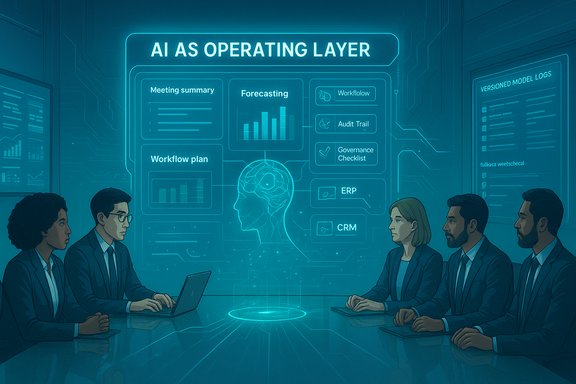
Companies are moving past theoretical debates about artificial intelligence and are embedding it into day‑to‑day operations — but what that looks like in practice is a patchwork of cautious pilots, rapid platform experiments, executive use of copilots, and sharp debates about governance, workforce impact and the reliability of vendor claims.
Background
The conversation about corporate AI has shifted from curiosity to execution. Once dominated by proof‑of‑concepts and marketing demos, AI adoption in many organizations is now an operational effort: measurable pilots, role‑specific training, and layered governance are treated as prerequisites to scale rather than optional extras. This pattern appears across sectors — from finance to retail to software — where companies initially adopt narrow, high‑frequency use cases (meeting summaries, contract drafting, candidate screening) and expand only after establishing monitoring and human‑in‑the‑loop controls.That shift towards operationalization is visible in three converging trends. First, large vendors have embedded copilots and assistant‑like features into mainstream productivity suites, making AI a seat‑based, corporate product rather than an experimental tool. Second, companies labeled as “Frontier firms” are reorganizing around AI as an operating layer — not merely a point solution — and claim outsized returns when AI is woven into core workflows. Third, independent reporting and community analyses repeatedly emphasize the twin imperatives of governance and measurement: without observable outcomes and clear oversight, pilots rarely translate into lasting value.
What companies are actually building and deploying
Copilots, copilots everywhere
Large vendors have made copilots a central commercial product. Enterprises are buying seats, embedding copilots into CRM and ERP workflows, and exposing executives to AI that synthesizes cross‑app context for meeting prep, forecasting and scenario simulation. Many leaders now treat copilots as persistent workflow assistants rather than ad‑hoc utilities. This changes the tempo of decision‑making and creates new expectations for how fast analysis, planning and reporting can be completed.- Typical early use cases include:
- Meeting summaries and action‑item extraction
- Drafting and redlining of legal and marketing copy
- Customer‑support triage and first‑line resolutions
- Demand forecasting and scenario modelling for finance teams
Agentification and multi‑step automation
Companies are moving beyond single‑turn chatbots to agentic systems — multi‑step assistants that plan, act, and coordinate across tools. These agents can run workflows (for example, assemble a project brief, run a data query, and dispatch follow‑up tasks) with human supervisors in the loop. Where agent fleets are deployed, organizations often register and govern them centrally to maintain observability and mitigate runaway automation risk.AI as platform: lifecycle, versioning and observability
High‑maturity organizations treat copilots and agents like platforms: they build lifecycle governance (versioning, audit logs, rollback procedures) and instrument usage with the same operational rigor applied to software releases. This is an important departure from earlier waves of tool adoption where a single team would pilot a bot without enterprise‑level auditing or incident response plans.People‑first deployments and role redesign
Leading companies frame AI adoption as a people transformation before a pure automation exercise. That means redesigning job descriptions to separate tasks suitable for automation (drafting, routine synthesis) from tasks requiring human judgment (negotiation, ethical decisions), creating career ladders for AI‑oversight roles, and rewarding verification and curation as core competencies. Role‑specific microlearning and learning‑in‑the‑flow replace one‑off training events.Who’s winning (and why): the Frontier firm thesis
Some firms — called “Frontier firms” in vendor and analyst narratives — are reported to earn materially higher returns by integrating AI across multiple functions. These organizations embed custom models, agents, and copilots into product and operating layers, rather than treating AI as an add‑on. Vendor‑sponsored studies claim these firms see much higher ROI and faster time‑to‑value, but the numbers often originate in sample frames that favor large, proactive buyers of vendor platforms. Readers should treat such figures as directional and seek independent verification before using them as boardroom evidence.What the claims typically look like:
- Broad cross‑functional adoption (sales, marketing, IT, product, and cybersecurity)
- Custom model or agent investments for domain‑specific tasks
- A focus on measurement: pilots with duration and weekly metrics tracking time‑saved, error rates and business KPIs
Case studies and public examples
Microsoft: Copilot as an operational linchpin
Microsoft’s embedding of Copilot across Microsoft 365 and enterprise offerings is a leading example of vendor‑driven platformization. Internal and public signals — including executive anecdotes about prompt sets used for meeting prep — show the company is not only selling AI but also using it at senior levels. Microsoft’s push is changing expectations inside customer organizations: more seats sold, higher enterprise integration, and a stronger case for treating AI as a baseline workplace capability. That momentum is visible in product telemetry and vendor narratives, but independent measurement of enterprise ROI remains mixed.Klarna: AI avatars and public signaling
Klarna publicly showcased an AI avatar during an earnings presentation and reported widespread internal use of AI. Moves like these are strategic — they demonstrate capability and ambition — but they also raise immediate questions about disclosure, authenticity and customer perception when synthetic spokespeople are used in external communications. Such demonstrations highlight the difference between internal operational use and public‑facing synthetic representation, each of which carries distinct governance and reputational risks.Large consumer and industrial adopters
Vendors and analysts cite examples such as Unilever, which claims scaled AI use cases across supply chain and marketing, and other firms that combine demand forecasting, inventory optimization and customer personalization. These examples are useful to illustrate patterns, but corporate case studies are often selective in metrics and do not replace independent audits of ROI.The hard numbers — claims, caveats and verifiability
A recurring theme in vendor and analyst reports is strong, headline ROI claims: for example, a commonly cited figure is roughly $3.70 returned for every $1 invested in generative AI from commissioned IDC analyses. At the same time, independent researchers warn that many pilots have yet to show measurable profit impact and that vendor‑sponsored studies have sample and framing biases. Decision‑makers should ask for methodologies, samples, and raw data when these numbers are used to justify capital allocations.Key verifiability notes:
- Vendor‑commissioned studies are directional and useful for understanding adoption patterns, but they require independent validation for precise budgeting or investor claims.
- Some academic or independent analyses suggest that a large share of early generative AI pilots have not yet demonstrably improved profits at scale. Treat such findings as a caution against assuming near‑term universal returns.
- Specific corporate numbers (revenue per employee gains, percent of employees using AI daily) may be accurate in their own reporting, but those figures often come without independent audit — flag them and request underlying datasets if you rely on them.
Governance, risk and the people problem
Human‑in‑the‑loop and auditability
Enterprises increasingly require human sign‑offs for high‑risk outputs and instrument audit trails for model decisions. Where agentic systems are deployed, central registries and incident response processes are becoming standard. These controls are necessary to preserve accountability and to meet emerging regulatory expectations in multiple jurisdictions.Bias, fairness and regulatory exposure
AI systems used in hiring, lending, or customer service amplify regulatory risk because they can embed systemic bias into automated decisions. CHROs and legal teams must be involved early to ensure compliance with anti‑discrimination laws and privacy rules. Firms that treat AI as purely a technical project risk large downstream liabilities.Workforce impacts: reskilling, role compression, layoffs
The net labor effect of AI is complex. Some companies emphasize retraining and the creation of AI oversight roles; others have used automation as part of organizational redesign that includes targeted reductions in middle managerial layers. Evidence shows a simultaneous increase in demand for specialist AI talent and pressure on coordination roles that historically handled information routing. This creates both opportunity and social risk.“AI fluency” as career currency
Some large employers have signaled that AI adoption and fluency will factor into performance assessments — effectively making AI skill a component of promotion and review processes. That approach speeds adoption but raises fairness and quality questions if model outputs are used directly in assessments without robust verification.Practical playbook for IT and business leaders
The most consistent recommendation across practitioner reports is to modularize AI adoption: start small, instrument everything, and scale once outcomes and controls are repeatable. Below is a pragmatic step‑by‑step playbook to move from pilot to production responsibly.- Define a tight set of measurable use cases (6–12 week pilots) tied to specific KPIs such as time saved, error reduction, or revenue uplift.
- Build cross‑functional pilot teams that include IT, security, legal, HR and the business owner to align governance and outcomes.
- Treat copilots/agents as platforms: create lifecycle governance, version control, audit logs and rollback plans.
- Instrument observability: log inputs, outputs and confidence metrics; measure performance drift and retraining triggers.
- Design human‑in‑the‑loop thresholds for regulated outputs and high‑impact decisions; require explicit sign‑offs where legal or reputational stakes are high.
- Invest in role‑based learning and career ladders for AI oversight roles; link learning outcomes to promotion and reward systems to preserve pathways.
The upside and the structural risks
Upside: speed, scale and new product surfaces
When executed rigorously, AI can:- Compress time for analysis and planning
- Reduce repetitive toil, freeing employees for higher‑value work
- Unlock new product experiences (personalized assistants, agentic commerce)
- Create operational leverage when models and data become persistent assets
Structural risks: capital intensity, vendor lock‑in and measurement gaps
But the risks are substantial:- Capital intensity: building inference capacity and custom model stacks requires long‑lived commitments in GPUs and datacenter resources, and those costs precede monetization.
- Vendor lock‑in: deep integration with a single vendor’s agent runtime, connectors and memory increases migration costs and strategic fragility.
- Measurement gaps: many pilots remain unproven at scale; vendors’ case studies often lack independent audit. Boards and CFOs should insist on third‑party validation before reclassifying AI investments as revenue‑generating.
What to watch next (signals that matter)
- Scale and maturity of governance: Are organizations creating registries, audit trails and incident response for agents and copilots? Evidence of that indicates movement from pilots to production.
- Independent ROI validation: Are claimed productivity and revenue gains backed by audited, repeatable measurements or only vendor case studies? Request methodologies.
- Talent market dynamics: Is hiring concentrated in small pools of specialist AI talent while middle layers are trimmed? That distribution increases both operational fragility and compensation pressure.
- Public‑facing synthetic use: When firms use avatars, voice clones or synthetic spokespeople externally, watch for regulatory reactions and reputation effects. Disclosure norms will be tested.
Critical analysis — strengths, weaknesses and unanswered questions
The strengths of current corporate AI adoption are palpable. Firms that adopt a disciplined platform approach — with pilots that are measurable, supported by cross‑functional governance and paired with role‑specific training — are plausibly positioned to extract operational value. Executives that treat copilots as decision‑support rather than decision‑maker preserve accountability while benefitting from speed gains.Yet serious weaknesses remain. Many of the most prominent claims about ROI and adoption come from vendor‑sponsored reports or selectively framed case studies. Independent evidence that large swathes of pilots yield sustained profit uplift is still limited; some independent analyses show a wide gap between capital deployment and measured returns. The result is a two‑speed reality: some “Frontier” firms may capture asymmetric returns, while a much larger group risks large infrastructure spending with unclear payback.
Unanswered questions that every leader must confront:
- How will auditors and regulators treat algorithmic recommendations used in finance, HR and governance decisions?
- Which standards for audit trails, provenance and explainability will become contractually required by enterprise customers?
- How will companies balance the competitive need to innovate quickly with the social obligation to retrain affected workers?
Conclusion
The core story is simple but consequential: companies are not merely experimenting with AI anymore — many are redesigning workflows, creating AI platforms, and asking boards to treat generative models and agents as strategic assets. That movement creates genuine opportunities for speed, automation and new products, but it also magnifies governance, measurement and social risks. The right path forward is neither reflexive enthusiasm nor paralytic caution. It is a disciplined, evidence‑driven approach that treats AI as an operational platform: pilot tightly, measure relentlessly, govern transparently, and invest in people as much as in compute. The firms that pair speed with accountability will likely capture disproportionate value; those that chase headlines without controls risk expensive mistakes and regulatory fallout.Source: The Wall Street Journal https://www.wsj.com/articles/what-a...g-with-ai-our-reporters-talk-it-out-a12dd305/
