

Microsoft’s latest playbook for what it calls “Frontier Transformation” lands where many enterprise AI announcements do: at the intersection of engineering, people, and governance — but with a sharper emphasis on starting the work through the people who do the work every day. The vendor brief and executive pieces from Microsoft argue that companies should begin with human ambition, expand agentic AI across functions, and build trust and observability into every layer before they scale. This article breaks down that three-part strategy, validates the biggest claims against public research and independent reporting, surface practical next steps for IT and business leaders, and call out the points where the numbers and promises need careful scrutiny.
Microsoft frames the Frontier concept as a shift from pilot-stage AI to an operating model where every employee is empowered with AI assistants and where multi-agent systems act as workflow co-pilots. The vendor highlights three starter moves for leaders:
Caution: the IDC InfoBrief is sponsored content. The 3x figure is real within the study’s sample and measurement approach, but it’s important to treat vendor‑sponsored survey results as directional evidence rather than an immutable law. The underlying ROI measure depends on survey definitions, the mix of industries sampled, and self-reported outcomes — factors that can bias large averages. The IDC document itself cautions readers about methodology and recommends buyers ask for raw methodology before plugging the multiplier into financial models.
Caution: employee sentiment surveys are useful for mood and engagement signals, but they can conflate correlation and causation. Frontier Firms in the study sample also tend to be larger, digitally mature, and already investing heavily in employee experience — so higher “thriving” scores may reflect a bundle of investments, not AI alone. Treat the metric as an indicator, not proof that agents will automatically raise morale in every context.
Independent analyst coverage and third‑party articles echo the point: security and compliance are the gating constraints for scaling agents across regulated or mission‑critical workflows. The working recommendation from security practitioners is identical to the vendor advice: instrument agent telemetry, register agents as identities, apply least privilege, and require human checkpoints for consequential writes.
Conclusion
AI agents are no longer experimental toys — they are strategic levers that can reshape cycle times, margins, and employee capacity when deployed as an organizational capability. Microsoft’s Frontier prescription — start with people, expand responsibly, and design trust from the outset — is a pragmatic one. The headline ROI and sentiment numbers are directionally promising, but they must be validated in your operations and balanced against security, governance, and cost realities. With pilots that tie directly to measurable business outcomes, a disciplined AgentOps approach, and explicit attention to people and reskilling, organizations can move from vendor narratives to repeatable, auditable value.
Source: Microsoft How to start your Frontier Transformation: 3 strategies to start with people | The Microsoft Cloud Blog
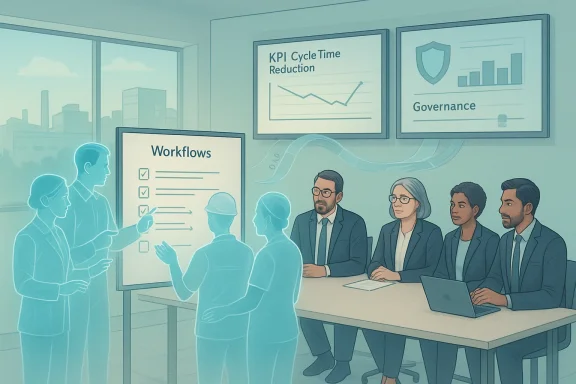 Overview: what Microsoft is asking leaders to do now
Microsoft frames the Frontier concept as a shift from pilot-stage AI to an operating model where every employee is empowered with AI assistants and where multi-agent systems act as workflow co-pilots. The vendor highlights three starter moves for leaders:- Start with employees to amplify ambition — give teams AI tools, training, and permission to redesign workflows, not just a new app.
- Expand adoption across every business function — move AI beyond IT and pockets of experimentation to a multi-function, cross-domain capability.
- Design trust, governance, and integration from day one — put observability, data controls, and human‑in‑the‑loop approval gates at the center of deployments.
Background: the data behind the Frontier claim — what’s solid, what’s directional
The headline: Frontier Firms and the 3x ROI claim
Microsoft cites an IDC InfoBrief (sponsored by Microsoft) that finds Frontier Firms report about three times the ROI from AI investments compared with slow adopters. The underlying IDC survey and summary charts show broad patterns: frontier organizations deploy agents across more business functions, they customize more AI, and their leadership and governance practices differ from laggards. Independent coverage and reproductions of the IDC charts broadly align with Microsoft’s summary — they present the finding as a directional advantage rather than a universal guarantee.Caution: the IDC InfoBrief is sponsored content. The 3x figure is real within the study’s sample and measurement approach, but it’s important to treat vendor‑sponsored survey results as directional evidence rather than an immutable law. The underlying ROI measure depends on survey definitions, the mix of industries sampled, and self-reported outcomes — factors that can bias large averages. The IDC document itself cautions readers about methodology and recommends buyers ask for raw methodology before plugging the multiplier into financial models.
Employee well‑being and “thriving” rates
Microsoft and its Work Trend Index materials report that employees at Frontier Firms are substantially more likely to say their company is “thriving” (figures clustered around the low‑70% range in vendor materials) compared with a much lower global baseline (roughly high‑30% range). This is cited widely in coverage as a sign that a people-first approach can increase morale and perceived meaningful work. Third‑party articles, industry blogs, and regional outlets repeat the statistic and point back to Microsoft research as the origin.Caution: employee sentiment surveys are useful for mood and engagement signals, but they can conflate correlation and causation. Frontier Firms in the study sample also tend to be larger, digitally mature, and already investing heavily in employee experience — so higher “thriving” scores may reflect a bundle of investments, not AI alone. Treat the metric as an indicator, not proof that agents will automatically raise morale in every context.
Security and governance readiness: the hard gap
Microsoft’s 2026 Data Security Index shows a persistent gap: while organizations want to move fast with generative AI and agents, many security controls are still being implemented. The Data Security Index reports roughly 47% of surveyed security leaders have implemented generative‑AI‑specific controls — a meaningful improvement year over year but still short of full readiness. That gap is precisely the reason Microsoft and security teams push for observability, model provenance, and human oversight as foundational requirements, not afterthoughts.Independent analyst coverage and third‑party articles echo the point: security and compliance are the gating constraints for scaling agents across regulated or mission‑critical workflows. The working recommendation from security practitioners is identical to the vendor advice: instrument agent telemetry, register agents as identities, apply least privilege, and require human checkpoints for consequential writes.
Why start with people: the people‑first case for agents
The central insight
The practical difference between successful Frontier implementations and failed pilots is often who shapes the pilot. When the people doing the work — frontline operators, product managers, sales reps, claims handlers — are treated as co‑designers, use cases are grounded, measurable, and rapid to validate. Microsoft frames this as “democratizing intelligence”: giving employees the tools, training, and permission to redesign workflows with AI assistance. That’s not just a slogan; it’s a repeatable operational pattern we see in many case studies.How that plays out in practice
- Workers define the problem in human terms (what slows our cycle time? where do we rework?) rather than in technical terms (need an LLM API).
- Small, time‑boxed pilots are run with measurable KPIs (cycle time, error rate, customer NPS) and a built‑in rollback plan.
- Teams are equipped with templates, a shared agent registry, and a short “playbook” for prompts, testing, and acceptance.
Three practical starter strategies (expanded and operationalized)
Below are three concrete, sequential playbooks you can run in 8–16 week cycles. Each has measurable acceptance criteria and governance checkpoints.1) Start with problem discovery and agent candidate mapping
- Map the top 25 workflows that absorb your people’s time (sales proposals, claims triage, procurement approvals, meeting prep).
- For each workflow, estimate cycle time, frequency, and regulatory sensitivity. Score them by expected ROI, risk, and data readiness.
- Select 3 pilots: one low‑risk/high‑frequency (e.g., meeting summaries), one medium‑risk/high‑value (e.g., invoice reconciliation assistance), and one exploratory cross‑functional workflow (e.g., sales opportunity brief generation).
- Acceptance criteria: measurable KPIs for each pilot (e.g., 20% cycle‑time reduction for invoice triage; 30% fewer rework tickets).
2) Build a “citizen + guardrails” roll‑out model
- Provide a role‑based prompt library and templates that non‑technical employees can use safely.
- Run instructor‑led sandboxes and job‑embedded micro‑learning tied to those pilots.
- Create a corporate agent catalog where each agent has defined permissions, a data lineage tag, and an owner.
- Governance must include registration of agents as identities, short‑lived connector credentials, and SIEM ingestion of agent logs for anomaly detection.
3) Instrument observability and tie outcomes to operating metrics
- Log prompts, outputs, and human approvals for each agent.
- Measure direct business outcomes (time saved, errors prevented, revenue influenced).
- Require provenance for generated assertions (RAG citations, document IDs) when used in decisions or external communications.
- Define runbooks for agent incidents (isolate agent, revoke connector keys, forensic log capture).
Expanding across functions without breaking things
Where to expand next
Frontier Firms in the IDC study reported using AI across an average of seven business functions — customer service, marketing, IT, product, operations, finance, and HR are common early targets. The logic is simple: pick functions where AI reduces repetitive cognitive load and where outcomes are measurable.Examples that have measurable impact
- Mercedes‑Benz used multi‑agent, factory‑facing assistants to diagnose production anomalies and reduced energy in one paint shop by ~20% in scoped deployments. That’s the kind of domain result that signals scaled value when combined with good instrumentation.
- Hospitals that automated scheduling and triage workflows reported large time savings for clinicians, freeing nursing time for care delivery rather than admin tasks — a classic human-centered win that improves both service and staff morale.
Guardrail pattern for cross‑functional scale
- Centralize agent registration and lifecycle controls in a single control plane (Agent registry).
- Route telemetry to a common observability backend and require SLOs/SLA for agent performance.
- Use a tiered access model: self‑service agents for low‑risk tasks; IT‑gated agent provisioning for cross‑system write actions.
Trust, governance, and risk: the design first imperatives
Build trust through transparency and human oversight
People adopt AI when they understand it. That means surfacing provenance, confidence cues, and clear rules for when to escalate to human review. Enterprises should publish simple, role‑specific "what agents can and cannot do" guides and require agents to cite sources for factual claims.Governance mechanics that actually scale
- Register agents as identities and require RBAC and conditional access.
- Enforce least privilege for connectors (agent can read document X, cannot write to finance ledger).
- Mandate logging: prompts, inputs, outputs, timestamps, and the identity of the human approver.
- Use canary and phased rollouts with rollback paths for every agent that performs external writes.
The economics: how to measure real ROI (and avoid vanity metrics)
The common mistake is to measure adoption (number of seats, prompt counts) rather than impact (cycle time, error rates, revenue influence). Use a tight measurement framework:- Define the baseline metric for each pilot (time per case, error rate, cycle time, conversion rate).
- Define acceptance thresholds (e.g., 20% cycle reduction or 15% fewer rework incidents).
- Run controlled pilots with parallel human validation for 8–12 weeks.
- Calculate net benefit (time saved × fully‑loaded labor cost) and compare to infrastructure, AI credits, and governance workloads.
Realistic timeline: pilots to production in 3 phases
- Phase A (0–8 weeks): Discovery, use‑case selection, governance posture agreement, and a 1–2 pilot sandbox. Deliverable: one validated pilot with baseline metrics.
- Phase B (8–20 weeks): Expand pilots, build agent catalog, integrate telemetry into SIEM, publish templates and role‑based training. Deliverable: internal catalog and operational SLOs.
- Phase C (20–52 weeks): Cross‑function scale, multi‑tenant agent governance, continuous improvement loops, cost optimization and model routing. Deliverable: operating model for AgentOps with measurable business KPIs.
Risks and common failure modes (and how to avoid them)
- Risk: treating agents as a point product. If you bolt agents onto brittle data plumbing, you’ll get brittle outcomes. Fix: invest in quality data foundations and a retrieval‑augmented generation (RAG) strategy.
- Risk: measuring vanity metrics. If you celebrate prompt volume but can’t show time saved or decreased error rates, you’ve only built noise. Fix: insist on business KPIs.
- Risk: underestimating operational cost. Agents add governance, telemetry, and incident response burdens that must be funded. Fix: include ongoing governance costs in TCO calculations and use per‑agent budgets and quotas.
- Risk: deskilling or displacement without reskilling. Fix: design job ladders, new role definitions (agent trainers, context engineers), and protect career pathways through focused reskilling programs.
Tools and artifacts to create immediately
- Agent registry template (agent name, owner, scope, data sources, SLOs).
- Pilot acceptance checklist (metrics, security review, human approval gates).
- Prompt library and role‑based training micro‑modules.
- Agent incident playbook (isolate, revoke, forensics, restore).
- Cost control template for AI credits and model routing.
What to ask vendors and partners before you sign
- Can you export agent telemetry to our SIEM? (Auditable logs are non‑negotiable.)
- What model‑use policies and data residency guarantees are contractually enforceable?
- How is model drift detected and how are rollback procedures implemented?
- Can agents be constrained to a retrieval corpus and required to cite sources for any factual output?
- What is the total cost of ownership including governance and telemetry?
Final assessment: should you become a Frontier Firm?
Becoming a Frontier Firm is not a packaging decision; it’s an operating‑model decision. The vendor evidence and independent reporting consistently show two truths:- Organizations that intentionally combine human-centered design, cross‑functional pilots, and rigorous governance capture step changes in operational performance and employee engagement. The IDC‑sponsored study and Microsoft’s Work Trend Index point to a measurable advantage for early, disciplined adopters.
- The path is operationally hard. Security, observability, and ongoing agent management (AgentOps) are real costs and real constraints. Without investments in these areas, pilot gains will not scale.
- Move quickly on low‑risk pilots that the business can measure and own.
- Invest in observability and agent lifecycle management before broad enablement.
- Build role‑based training and change programs so people gain agency rather than fear displacement.
- Validate vendor ROI claims with your own pilots and insist on auditable telemetry exported to your controls plane.
Conclusion
AI agents are no longer experimental toys — they are strategic levers that can reshape cycle times, margins, and employee capacity when deployed as an organizational capability. Microsoft’s Frontier prescription — start with people, expand responsibly, and design trust from the outset — is a pragmatic one. The headline ROI and sentiment numbers are directionally promising, but they must be validated in your operations and balanced against security, governance, and cost realities. With pilots that tie directly to measurable business outcomes, a disciplined AgentOps approach, and explicit attention to people and reskilling, organizations can move from vendor narratives to repeatable, auditable value.
Source: Microsoft How to start your Frontier Transformation: 3 strategies to start with people | The Microsoft Cloud Blog
