

Microsoft’s new retail playbook makes a bold claim: the next frontier of store experience will be run by agentic AI—robots and software agents that sense the environment, reason about priorities, and interact naturally with cused tomers and staff—moving intelligence from dashboards and back offices onto the sales floor itself. view
The business case Microsoft lays out for what it calls Frontier Transformation is straightforward and urgent. Retailers face rising customer expectations, tighter margins, and chronic frontline labor pressure. To bridge the widening gap between what customers expect and what operations can deliver, Microsoft argues that organizations must treat AI as a foundational capability—an operating layer rather than an add‑on. The promised payoff is threefold: Awareness (real‑time sensing), Reasoning (contextual prioritization), and Interaction (natural conversational surfaces).
Microsoft’s enterprise as more than a product release. It’s an operating model: Copilot Studio, Azure AI Foundry (or Foundry/Agent Factory), Dynamics 365 extensions, and managed agent templates combine to give retailers prebuilt agent primitives for discovery, checkout, catalog enrichment, and store operations. The company is positioning these components as building blocks for “agentic commerce,” where agents can act—within governance boundaries—on behalf of staff and customers across channels. This article synthesizes Microsoft’s Frontier Transformation thesis, examines the ADAM beverage robot case Microsoft highlights, checks key claims against independent sources, and outlines practical steps, benefits, and risks for retail and IT teams planning to move from pilot to scale.
Retail is an information‑flow problem writ large: product data, inventory, promotions, customer signals, payment flows and fulfillment must align in real time. Treating AI as a platform—rather than a point solution—changes the game in three ways.
Independent reporting and vendor materials confirm ADAM is a commercially available robot with real deployments. Richtech’s product pages and press releases show ADAM in guest‑facing venues (cafés, stadiums) and list technical specs, capabilities, and real usage milestones (for example, ADAM reportedly served over 16,000 drinks at a Las Vegas flagship location). These materials describe ADAM’s AI features—customer engagement, motion and vision stacks, and integrations with payment or order systems—that align with Microsoft’s example, though they stop short of fully independent verification of the precise Microsoft‑led technical enhancements cited in the announcement.
Microsoft’s retail announcements and templates converge on a few pragmatic primitives that IT teams should evaluate:
The path to durable benefit is iterative and operational, not purely technical. Retail CIOs and store ops leaders should begin with narrowly scoped, measurable pilots (inventory visibility, in‑aisle assistance, conversational checkout for low‑risk SKUs), invest in AgentOps, and treat governance as a first‑order engineering concern. When done with discipline—grounded data, human backstops, privacy safeguards, and payment protections—agentic AI and robotic assistants like ADAM can move stores from reactive to anticipatory operations and deliver measurable improvements in conversion, customer experience and frontline productivity. The retail frontier is no longer an experiment. It is an operational playbook that combines ambient sensing, adaptive reasoning, and natural interaction to reshape the store as an intelligent, service‑oriented experience. Retailers that treat AI as a foundation rather than a feature will define what in‑store commerce looks like for the next decade.
Source: Microsoft Frontier Transformation in retail: How agentic AI robots are redefining store experiences | The Microsoft Cloud Blog
The business case Microsoft lays out for what it calls Frontier Transformation is straightforward and urgent. Retailers face rising customer expectations, tighter margins, and chronic frontline labor pressure. To bridge the widening gap between what customers expect and what operations can deliver, Microsoft argues that organizations must treat AI as a foundational capability—an operating layer rather than an add‑on. The promised payoff is threefold: Awareness (real‑time sensing), Reasoning (contextual prioritization), and Interaction (natural conversational surfaces).
Microsoft’s enterprise as more than a product release. It’s an operating model: Copilot Studio, Azure AI Foundry (or Foundry/Agent Factory), Dynamics 365 extensions, and managed agent templates combine to give retailers prebuilt agent primitives for discovery, checkout, catalog enrichment, and store operations. The company is positioning these components as building blocks for “agentic commerce,” where agents can act—within governance boundaries—on behalf of staff and customers across channels. This article synthesizes Microsoft’s Frontier Transformation thesis, examines the ADAM beverage robot case Microsoft highlights, checks key claims against independent sources, and outlines practical steps, benefits, and risks for retail and IT teams planning to move from pilot to scale.
 Why Frontier Transformation matters for retail
Retail is an information‑flow problem writ large: product data, inventory, promotions, customer signals, payment flows and fulfillment must align in real time. Treating AI as a platform—rather than a point solution—changes the game in three ways.- It replaces batch reporting with ambient awareness: stores can sense foot traffic, shelf availability, and service queues as events, not afterthoughts.
- It transforms decision latency: agents can prioritize staff tasks, trigger replenishment, and escalate exceptions automatically.
- It creates new customer surfaces: conversational agents and in‑aisle voice assistants can convert discovery into purchase without friction.
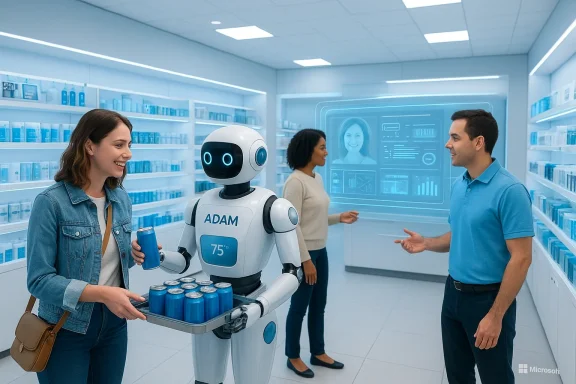
Agentic AI in the field: ADAM the beverage robot
Microsoft’s retail brief usto illustrate Frontier Transformation: Richtech Robotics’ ADAM, a beverage robot reworked with agentic intelligence to be conversational, context aware, and operationally collaborative. The pitch is compelling: ADAM doesn’t just pour drinks—it adjusts recommendations based on weather and promotions, interprets customer modifiers (“less sweet,” “extra ice”), monitors ingredient levels and equipment health, and uses vision models to sustain throughput under high load.Independent reporting and vendor materials confirm ADAM is a commercially available robot with real deployments. Richtech’s product pages and press releases show ADAM in guest‑facing venues (cafés, stadiums) and list technical specs, capabilities, and real usage milestones (for example, ADAM reportedly served over 16,000 drinks at a Las Vegas flagship location). These materials describe ADAM’s AI features—customer engagement, motion and vision stacks, and integrations with payment or order systems—that align with Microsoft’s example, though they stop short of fully independent verification of the precise Microsoft‑led technical enhancements cited in the announcement.
What ADAM demonstrates (and what it doesn’t)
ADAM exemplifies three practical benefits agentic systems can deliver in-store:- Consistent service and speed under high load, which reduces variance and protects brand experience.
- Contextual recommendations that increase average order value by surfacing timely upsells (seasonal menu items, combos).
- Operational alerts that preempt equipment failures or ingredient shortages, reducing downtime.
Microsoft’s retail announcements and templates converge on a few pragmatic primitives that IT teams should evaluate:
- Copilot Checkout: c where customers can discover and complete purchases without leaving the Copilot surface (U.S. rollout partners include PayPal, Shopify, Stripe).
- Brand Agents and Personalized Shopping Templates: prebuilt agent templates trained with brand voice and product catalog to deliver guided discoverCatalog enrichment and store operations templates: automated extraction of product attributes from images and quick answers for frontline staff (inventory, planogram, policies).
- Dynamics 365 Commerce MCP Server and orchestration primitives: exposing catalog, pricing, inventory and fulfillment functions as discoverable, agent‑callable capabilities to enable safer agent actions.
Business benefits: where gains are most likely
Agentic AI is not a silver bullet, but early deployments suggest clear, measurable outcomes when done well:- Operational productivity: agents reduce repetitive tasks for frontline staff, lowering handling times and improving conversion by freeing staff to do higher‑value work. Microsoft and industry pilots report reduced aisle search times and faster issue resolution when store associates.
- Conversion and revenue: relevant recommendations and in‑moment conversational checkout drive conversion; brands that personalize effectively often see higher basket sizes, and studies indicate a substantial majority of consumers prefer personalized offers.
- Inventory and profit protection: fused sensing (ESLs, cameras, POS, RFID) and agentic workflows improve on‑shelf accuracy and reduce stockouts; correcting inventory inaccuracies alone has been associated with a 4–8% uplift in sales in rigorous retailer trials.
- Faster innovation cycles: agents speed up data synthesis across R&D and merchandising teams; consumer goods firms report compressed research timelines using agentic tools for cross‑brand intelligence aggregation.
Risks, friction points, and governance
Agentic systems introduce new operational, legal, and security considerations. Retailers must not confuse pilot novelty with operational readiness.Top risks to plan for
- Operational correctness and financial risk. Agents that make or settle transactions must be provably correct: pricing, tax, promotions, availability and fulfillment flows are complex. Mispriced or misfulfilled orders can cause regulatory, accounting, and customer trust problems.
- Data privacy and consent. In‑store sensors, cameras and personalized assistants process personal data at scale. Compliance with regional laws (e.g., state privacy acts, GDPR where applicable) and consumer disclosure is essential.
- Security and payment integrity. Conversational checkout features require strong payment and identity protections. Emerging industry conversations—such as calls for standards from payments networks and card schemes—underscore that payments partners will want clear protocols for agentic commerce. Recent reporting shows Mastercard engaging on standards for AI commerce to build trust and control.
- Model drift and hallucination. Agents must be grounded in authoritative business data. Unchecked generative behaviors risk incorrect product descriptions, inappropriate recommendations, or procedural errors.
- Operational ownership and AgentOps. Running agents at scale requires new operations disciplines—AgentOps—to monitor agent behavior, rollback faulty actions, and manage human‑in‑the‑loop escalation.
Practical blueprint for retail IT teams
Moving from experimentation to durable benefit will be an engineering and operational program. The following roadmap distills lessons from Microsoft’s guidance and industry pilots.1. Start with a narrowly scoped business outcome
- Pick one high‑impact problem (e.g., empty‑shelf detection in top 50 SKUs).
- Define success metrics up front (lost sales prevented, average time to restock, conversion lift).
- Run a controlled pilot with clear control/test stores.
2. Ground agents in authoritative data (no hallucinations)
- Surface single sources of truth (ERP/OMS/D365 catalog) via secure MCP or API layers.
- Build validation gates that require human approval for financial or legal actions.
3. Use mixed sensing—don’t rely on a single modality
- Combine ESLs, camera vision models, POS events, and staff inputs to increase signal fidelity.
- Keep privacy by design: anonymize, aggregate, and minimize retention of personally identifiable information.
4. Invest in AgentOps and human‑in‑the‑loop workflows
- Operationalize monitoring, rollback, and incident procedures.
- Create rapid feedback loops between store teams and model owners to retrain and refine agents.
5. Negotiate payment and merchant terms carefully
- Validate merchant‑of‑record arrangements, refunds, chargebacks and tax treatment before enabling conversational checkout.
- Verify partner responsibilities (payments providers, gateways) and SLAs for agentic commerce.
Security, privacy and compliance checklist
- Explicit consumer disclosures when an agent collects or uses personal data.
- Access controls and least privilege for agent actions.
- Tamper‑resistant audit trails for every agent decision that affects commerce or inventory.
- Backstop human authorization for high‑risk actions (refunds, promotions overrides, cancellations).
- Payment tokenization and PCI‑compliant flows for conversational checkout.
Strategic implications and competitive dynamics
Two retailer classes will likely emerge over the next 24–36 months:- Foundational adopters (Frontier Firms): those that treat AI as an operating layer across merchandising, store ops, and fulfillment. These retailers will realize compound gains—better availability, more consistent service, measurable conversion lifts—and will be positioned to exploit agentic retail media and instant checkout channels. Microsoft and several large partners are explicitly branding and enabling this pathway with Copilot templates, Foundry, and MCP server artifacts.
- Tool adopters: those that use AI point solutions to improve narrow tasks (chatbots, planogram scanning) but do not integrate agents into the operational fabric. These retailers will get incremental benefit but risk being outpaced on cost, personalization and real‑time responsiveness.
What to watch for in 2026
- Merchant adoption of conversational checkout and the percentage of active catalog merchants in Copilot or equivalent platforms.
- Independent audits looking at real conversion lifts and operational ROI from agentic pilots.
- Regulatory and payments guidance on agentic checkout responsibilities and consumer protection.
- Emergence of AgentOps tooling and best practices—observability, governance and safety will decide which pilots scale.
Balanced assessment: strengths and caveats
vision:** Microsoft’s approach—combining authoring tools (Copilot Studio), orchestration (Foundry/Agent Service), and managed templates—reduces engineering friction for retailers already on Azure and Dynamics stacks.
- Practical templates: Managed agent templates (catalog enrichment, store operations, personalized shopping) accelerate time‑to‑value and standardize behavior across fleets.
- Tangible robotics examples: ADAM shows agentic intelligence can meaningfully extend robotic service experiences in hospitality and retail environments; Richtech’s deployments and milestone statistics indicate the technology is production‑adjacent.
Caveats and risks
- Vendor narratives vs. independent verification: Many headline claims are demonstrated in vendor mapilots. Independent, third‑party audit data on large‑scale conversions and net economic impact is still limited. Treat initial ROI claims as directional until audited.
- Operational complexity: Agents must coordinate across promotion rules, taxes, and fulfillment constraints—areas where small errors produce outsized business risk.
- Ecosystem dependence: Conversational checkout reduces friction but folds merchants, payment platforms and regulators into the transaction path; contractual clarity and standard protocols will be decisive.
Conclusion
Frontier Transformation is a credible and practical reframing of retail modernization: move intelligence to the edge of customer interaction, compose agentic workflows that span sensors and systems, and govern agents so they act reliably on behalf of staff and customers. Microsoft’s templates, Copilot commerce surfaces, and partner ecosystem make this transition approachable for many retailers—especially those already embedded in Microsoft’s cloud ecosystem.The path to durable benefit is iterative and operational, not purely technical. Retail CIOs and store ops leaders should begin with narrowly scoped, measurable pilots (inventory visibility, in‑aisle assistance, conversational checkout for low‑risk SKUs), invest in AgentOps, and treat governance as a first‑order engineering concern. When done with discipline—grounded data, human backstops, privacy safeguards, and payment protections—agentic AI and robotic assistants like ADAM can move stores from reactive to anticipatory operations and deliver measurable improvements in conversion, customer experience and frontline productivity. The retail frontier is no longer an experiment. It is an operational playbook that combines ambient sensing, adaptive reasoning, and natural interaction to reshape the store as an intelligent, service‑oriented experience. Retailers that treat AI as a foundation rather than a feature will define what in‑store commerce looks like for the next decade.
Source: Microsoft Frontier Transformation in retail: How agentic AI robots are redefining store experiences | The Microsoft Cloud Blog
