
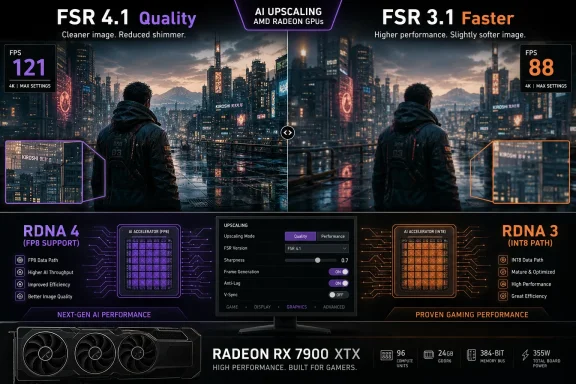
AMD’s FSR 4.1 has now reached Radeon RX 7000-series graphics cards, but early independent testing finds that the newer AI-assisted upscaler can run slower than FSR 3.1 on RDNA 3 hardware while delivering visibly better image quality. That is not a scandal so much as a bill coming due. AMD has broadened access to its newest upscaling stack, but the way it arrives on older silicon exposes the awkward boundary between “supported” and “built for it.” For Radeon owners, the practical question is no longer whether FSR 4.1 works; it is whether its cleaner image is worth the frames it consumes.
For much of the FSR 4 era, the complaint around AMD’s upscaling strategy was simple: the good version was locked to the new cards. FSR began life as a broadly compatible, shader-based answer to Nvidia DLSS, but the move to machine-learning reconstruction changed the bargain. Once the best image quality depended on hardware characteristics, AMD could no longer sell “works almost everywhere” and “looks like the modern AI upscaler” as the same promise.
The arrival of FSR 4.1 on RDNA 3 therefore looked like a course correction. Radeon RX 7000 owners finally get official access to AMD’s more advanced reconstruction model, rather than watching RX 9000-series buyers enjoy the visibly better branch of the technology. On paper, that is exactly what AMD needed to do to reassure customers who bought high-end cards like the Radeon RX 7900 XTX only a few years ago.
But support is not the same as parity. ComputerBase’s new testing, as relayed by Windows Report and other hardware-watchers, suggests that FSR 4.1 on RDNA 3 behaves like a feature backport rather than a free upgrade. The image improves, but performance falls versus FSR 3.1 across multiple RDNA 3 GPUs and multiple games.
That is the part that matters. A single game regression can be a bad implementation. A single GPU regression can be a driver wart. A pattern across the RX 7900 XTX, RX 7800 XT, and RX 7600 points to something more structural: AMD has brought the model over, but RDNA 3 is not executing it with the same efficiency as RDNA 4.
That is a large enough delta to change user behavior. Upscaling is supposed to be the escape hatch when native rendering is too expensive, especially at 4K or with ray tracing enabled. If the newer upscaler claws back a meaningful slice of the performance uplift, it becomes less of a default switch and more of a visual-quality preset.
The midrange and entry-level results are arguably more important. The RX 7800 XT and RX 7600 reportedly showed smaller but still consistent drops, in the rough range of 7 to 9 percent depending on preset. Those are the cards where upscaling is most often used not to gild an already fast frame rate, but to keep a game comfortably above a monitor’s refresh target.
The distinction matters because a flagship can absorb inefficiency more easily. An RX 7900 XTX owner may tolerate losing frames if FSR 4.1 removes shimmer, breakup, or softness in a game that still runs well. An RX 7600 owner using upscaling as the difference between smooth and merely playable is dealing with a harsher tradeoff.
The shape of the regression also undercuts the simplistic reading that “newer upscaler equals faster gaming.” FSR 4.1 is not just another spatial or temporal preset swap. It is a more complex reconstruction path, and on hardware that lacks the ideal arithmetic support, complexity has a price.
That sounds like an implementation detail until you look at the results. AMD’s stated goal appears to be preserving image quality across architectures, even if the underlying math path differs. In plain English, AMD chose to make FSR 4.1 look substantially like FSR 4.1 on RDNA 3, rather than shipping a visibly compromised version just to protect the frame-rate chart.
That is a defensible decision, but it is not a free one. If the model has to be adapted to INT8 execution on RDNA 3, and if that path consumes more of the GPU’s available resources, then the performance penalty is not an accidental blemish. It is the cost of making older silicon behave like newer silicon in a workload it was not primarily designed around.
This is where the phrase AI-powered upscaling stops being marketing vapor and starts being architecture. The industry spent years treating upscalers as driver-era software features that could be swapped around the way anti-aliasing modes once were. The new generation is closer to a co-designed feature: model, driver, game integration, and silicon all determine the result.
That is also why the Radeon RX 9070 XT comparison is so uncomfortable for AMD’s older high-end cards. If a newer RDNA 4 GPU can deliver similar native rendering performance while running FSR 4.1 more efficiently, the upscaler becomes part of the effective generational performance gap. The silicon is not merely drawing frames; it is reconstructing them with different overhead.
FSR 3.1 was a meaningful improvement over earlier FSR versions, but AMD’s upscaling reputation has still lagged Nvidia DLSS in areas like temporal stability, disocclusion handling, fine detail reconstruction, and shimmering. FSR 4 and 4.1 are AMD’s attempt to close that perceptual gap by leaning more heavily into machine-learning reconstruction. If FSR 4.1 looks cleaner in motion, that is not a small achievement.
The problem is that upscaling has always been sold through a performance promise. Users tolerate reconstruction artifacts because the reward is more frames. Once the newer reconstruction path starts competing against the older one not only on image quality but also on overhead, the decision becomes game-by-game and monitor-by-monitor.
That is a mature tradeoff, but it is not the frictionless upgrade many Radeon owners hoped for. AMD has effectively introduced a new axis into the settings menu: FSR 3.1 may be the faster upscaler, while FSR 4.1 may be the prettier one. That sounds familiar to anyone who has balanced native resolution, temporal anti-aliasing, ray tracing, frame generation, and dynamic resolution scaling over the past decade.
The awkward part is branding. A user sees “4.1” and assumes it supersedes “3.1” in every practical way. In reality, FSR 4.1 on RDNA 3 is more like a high-quality rendering option with a measurable compute tax.
Modern GPUs age not only by running out of shader power, memory bandwidth, or VRAM. They age when new rendering techniques start assuming hardware features that older architectures only partially support. Ray tracing already did this. AI reconstruction is now doing it again.
That is especially sensitive for AMD because RDNA 3 was not an ancient platform. The first RX 7000 cards launched in late 2022, and many users bought them under the expectation that AMD’s open and broadly compatible graphics features would age generously. FSR 4.1 arriving on RDNA 3 keeps that promise in one sense, but the performance gap reminds users that broad compatibility can still be second-class compatibility.
The RX 7900 XTX result is also symbolically sharp because it pits AMD’s previous flagship against the logic of its current architecture. If the older flagship can lose more than ten percent against FSR 3.1 while the newer RDNA 4 parts handle FSR 4.1 more gracefully, then AMD has a messaging challenge. The company can say it supports older buyers, but buyers can see that the best experience is still on the newest silicon.
That is not unique to AMD. Nvidia has long tied DLSS features to Tensor Core generations, and frame-generation support has been even more segmented. The difference is that AMD built a great deal of goodwill by being the more open, less restrictive alternative. FSR 4.1 on RDNA 3 proves AMD is trying to preserve that identity, but it also shows the limits of doing so in an AI-heavy rendering stack.
If a game already runs well above the target refresh rate, FSR 4.1 may be the obvious choice. Cleaner edges, reduced shimmer, and better temporal stability can make the whole image feel more native, especially at 1440p and 4K. A player sitting at 90 frames per second on a VRR display may happily spend a few frames for a calmer image.
If a game is already marginal, FSR 3.1 may remain the practical option. That is particularly true on lower-end RDNA 3 hardware, where upscaling is often being used to compensate for GPU limits rather than to polish an already comfortable experience. On those cards, the difference between 58 and 64 frames per second is not academic.
There is also the frame-generation complication. Many users do not experience upscaling in isolation anymore; they stack it with frame generation, latency reduction, ray tracing settings, and driver-level features. A slower base upscaler can affect the perceived smoothness and latency envelope of the entire presentation chain.
This is where AMD’s driver UI and game integrations need to become clearer. Users should not have to read German benchmark tables to understand that FSR 4.1 is a quality-forward choice on RDNA 3. A simple driver note or per-game guidance would go a long way toward preventing the inevitable forum posts asking why the “newer” option reduced performance.
The risk is that “supports FSR 4.1” becomes too vague to describe the player experience. On an RX 9070 XT, that phrase may imply one performance profile. On an RX 7900 XTX, it may imply another. On future RDNA 2 support, it may imply something more constrained still.
Developers can hide some of this through presets, but the market has moved beyond one-size-fits-all graphics settings. Enthusiast players expect granular controls, and PC reviewers will test those controls in combinations that expose every weakness. AMD cannot assume the FSR version number alone will carry the message.
There is also a competitive angle. Nvidia’s DLSS ecosystem is fragmented by hardware generation, but its messaging is often blunt about which features require which RTX cards. AMD’s challenge is harder because it wants to emphasize reach. The more architectures it supports, the more it has to explain that support does not mean identical throughput.
This matters for WindowsForum’s usual audience of sysadmins and IT pros as much as for gamers. Fleet purchases of workstations, lab machines, or gaming-adjacent PCs increasingly involve AI and media workloads alongside games. A GPU feature’s advertised support matrix is no longer enough; the precision path, acceleration hardware, and driver maturity can determine whether that feature is merely available or actually efficient.
But RDNA 2 lacks the dedicated AI acceleration present in later AMD architectures. If RDNA 3 already takes a noticeable hit using an adapted INT8 path, RDNA 2 support may require even more compromise. AMD has already signaled that the older architecture is more challenging, and the new RDNA 3 numbers make that warning feel less like corporate caution and more like technical reality.
The Steam Deck connection is particularly interesting. Valve’s handheld uses an AMD APU derived from RDNA 2-era graphics technology, and handhelds are precisely where upscaling quality and performance efficiency matter most. A better reconstruction algorithm could be transformative on small screens, but only if the overhead does not consume the very performance it is meant to save.
That does not mean RDNA 2 support is doomed. Lower resolutions, handheld display sizes, and carefully tuned presets can change the calculus. A model that is too costly for 4K desktop benchmarking might still prove useful in constrained scenarios if the image-quality gain is large enough.
But AMD should be careful not to oversell. The RDNA 3 launch teaches the lesson now: bringing FSR 4.1 to older hardware is a meaningful engineering achievement, but users will judge it by the frame counter as much as by the screenshot.
That matters because AMD is asking users to trust a more complex stack. FSR 3.1 was already a temporal upscaler with game-side integration requirements. FSR 4.1 adds a more hardware-sensitive machine-learning path and a multi-architecture support story. Every driver stumble makes users more likely to wait, especially if the reward includes lower performance in some modes.
Windows 10 is also not a fringe case yet, despite Microsoft’s long migration push toward Windows 11 and beyond. Gaming PCs have historically lagged enterprise upgrade cycles in some ways and leapt ahead in others; users will upgrade for performance, not for administrative neatness. If a new graphics feature creates OS-specific friction, many players will simply stay with the setting that already works.
This is the difference between a feature launch and a platform transition. AMD is not merely shipping an upscaler. It is moving Radeon users into a world where image reconstruction depends more heavily on machine-learning model behavior and hardware precision formats. That transition needs unusually boring driver reliability to succeed.
The hotfix detail should not overshadow the bigger story, but it belongs in the same frame. FSR 4.1 is arriving across architectures through careful adaptation. That makes each compatibility promise more impressive—and each glitch more consequential.
AI reconstruction complicates that identity. Better upscaling models want specific hardware. Specific hardware encourages segmentation. Segmentation makes old promises sound less convincing.
FSR 4.1 on RDNA 3 is AMD’s attempt to thread the needle. The company is not saying older Radeon buyers are abandoned. It is doing the engineering work to make a modern model run on last-generation cards. That deserves credit, particularly when the easier commercial answer would be to keep the best-looking mode as a reason to buy RX 9000.
Yet the ComputerBase results show that openness has a performance floor. AMD can broaden access, but it cannot rewrite the hardware. If RDNA 3 lacks the ideal path for the model, the driver can adapt, optimize, and improve over time, but it may not erase the gap entirely.
This is the deeper competitive story. Nvidia has accepted, and often exploited, hard feature segmentation. AMD is trying to preserve more continuity across generations. The user-friendly version of that strategy is attractive, but the technical version is messy: more paths, more caveats, more benchmarks that require architectural footnotes.
The second timeline is the reconstruction timeline. If new games increasingly depend on high-quality AI upscaling and reconstruction to make demanding settings playable, then the efficiency of that upscaler becomes part of the card’s usable lifespan. A GPU can be fast enough at native rendering and still feel less modern because the best reconstruction path runs with more overhead.
That does not mean RX 7000 owners should rush to replace their cards. The opposite may be true for many users: FSR 4.1 gives them a better-looking option they did not have before, and FSR 3.1 remains available when performance matters more. Choice is valuable.
But it does mean the next GPU purchase should be evaluated differently. Buyers should look beyond average rasterized frame rates and ask how the card handles the rendering techniques games are actually leaning on. Upscaling, frame generation, ray tracing, ray reconstruction, video encoding, and local AI workloads are no longer side features. They are becoming the shape of the product.
For AMD, this cuts both ways. If RDNA 4 handles FSR 4.1 much more efficiently, that strengthens the argument for the newer architecture even when older cards still look strong in conventional benchmarks. If RDNA 3 can be further optimized, AMD has an opportunity to prove that its cross-generation support is more than a checkbox.
 AMD Wins the Compatibility Argument and Immediately Inherits the Performance One
For much of the FSR 4 era, the complaint around AMD’s upscaling strategy was simple: the good version was locked to the new cards. FSR began life as a broadly compatible, shader-based answer to Nvidia DLSS, but the move to machine-learning reconstruction changed the bargain. Once the best image quality depended on hardware characteristics, AMD could no longer sell “works almost everywhere” and “looks like the modern AI upscaler” as the same promise.The arrival of FSR 4.1 on RDNA 3 therefore looked like a course correction. Radeon RX 7000 owners finally get official access to AMD’s more advanced reconstruction model, rather than watching RX 9000-series buyers enjoy the visibly better branch of the technology. On paper, that is exactly what AMD needed to do to reassure customers who bought high-end cards like the Radeon RX 7900 XTX only a few years ago.
But support is not the same as parity. ComputerBase’s new testing, as relayed by Windows Report and other hardware-watchers, suggests that FSR 4.1 on RDNA 3 behaves like a feature backport rather than a free upgrade. The image improves, but performance falls versus FSR 3.1 across multiple RDNA 3 GPUs and multiple games.
That is the part that matters. A single game regression can be a bad implementation. A single GPU regression can be a driver wart. A pattern across the RX 7900 XTX, RX 7800 XT, and RX 7600 points to something more structural: AMD has brought the model over, but RDNA 3 is not executing it with the same efficiency as RDNA 4.
The Numbers Turn a Nice Driver Update Into a Hard Choice
The headline result is not subtle. On the Radeon RX 7900 XTX, ComputerBase reportedly found FSR 4.1 Quality mode roughly 11 percent slower than FSR 3.1 Quality across its test suite. In Performance mode, the gap widened to around 14.5 percent.That is a large enough delta to change user behavior. Upscaling is supposed to be the escape hatch when native rendering is too expensive, especially at 4K or with ray tracing enabled. If the newer upscaler claws back a meaningful slice of the performance uplift, it becomes less of a default switch and more of a visual-quality preset.
The midrange and entry-level results are arguably more important. The RX 7800 XT and RX 7600 reportedly showed smaller but still consistent drops, in the rough range of 7 to 9 percent depending on preset. Those are the cards where upscaling is most often used not to gild an already fast frame rate, but to keep a game comfortably above a monitor’s refresh target.
The distinction matters because a flagship can absorb inefficiency more easily. An RX 7900 XTX owner may tolerate losing frames if FSR 4.1 removes shimmer, breakup, or softness in a game that still runs well. An RX 7600 owner using upscaling as the difference between smooth and merely playable is dealing with a harsher tradeoff.
The shape of the regression also undercuts the simplistic reading that “newer upscaler equals faster gaming.” FSR 4.1 is not just another spatial or temporal preset swap. It is a more complex reconstruction path, and on hardware that lacks the ideal arithmetic support, complexity has a price.
RDNA 3 Gets the Model, Not the Machine It Wanted
The technical explanation is the most revealing part of the story. RDNA 4 GPUs can run FSR 4.1 using hardware support better suited to AMD’s current machine-learning path, including FP8-oriented acceleration. RDNA 3, by contrast, has to rely on an INT8 version of the model because the architecture lacks the same native FP8 capability.That sounds like an implementation detail until you look at the results. AMD’s stated goal appears to be preserving image quality across architectures, even if the underlying math path differs. In plain English, AMD chose to make FSR 4.1 look substantially like FSR 4.1 on RDNA 3, rather than shipping a visibly compromised version just to protect the frame-rate chart.
That is a defensible decision, but it is not a free one. If the model has to be adapted to INT8 execution on RDNA 3, and if that path consumes more of the GPU’s available resources, then the performance penalty is not an accidental blemish. It is the cost of making older silicon behave like newer silicon in a workload it was not primarily designed around.
This is where the phrase AI-powered upscaling stops being marketing vapor and starts being architecture. The industry spent years treating upscalers as driver-era software features that could be swapped around the way anti-aliasing modes once were. The new generation is closer to a co-designed feature: model, driver, game integration, and silicon all determine the result.
That is also why the Radeon RX 9070 XT comparison is so uncomfortable for AMD’s older high-end cards. If a newer RDNA 4 GPU can deliver similar native rendering performance while running FSR 4.1 more efficiently, the upscaler becomes part of the effective generational performance gap. The silicon is not merely drawing frames; it is reconstructing them with different overhead.
Image Quality Is the Point, but Frame Rate Is the Contract
None of this means FSR 4.1 is a bad update. Quite the opposite: the reason this regression matters is that FSR 4.1 appears to do something users actually want. It improves image quality over FSR 3.1, and in modern games that can be more noticeable than a benchmark table suggests.FSR 3.1 was a meaningful improvement over earlier FSR versions, but AMD’s upscaling reputation has still lagged Nvidia DLSS in areas like temporal stability, disocclusion handling, fine detail reconstruction, and shimmering. FSR 4 and 4.1 are AMD’s attempt to close that perceptual gap by leaning more heavily into machine-learning reconstruction. If FSR 4.1 looks cleaner in motion, that is not a small achievement.
The problem is that upscaling has always been sold through a performance promise. Users tolerate reconstruction artifacts because the reward is more frames. Once the newer reconstruction path starts competing against the older one not only on image quality but also on overhead, the decision becomes game-by-game and monitor-by-monitor.
That is a mature tradeoff, but it is not the frictionless upgrade many Radeon owners hoped for. AMD has effectively introduced a new axis into the settings menu: FSR 3.1 may be the faster upscaler, while FSR 4.1 may be the prettier one. That sounds familiar to anyone who has balanced native resolution, temporal anti-aliasing, ray tracing, frame generation, and dynamic resolution scaling over the past decade.
The awkward part is branding. A user sees “4.1” and assumes it supersedes “3.1” in every practical way. In reality, FSR 4.1 on RDNA 3 is more like a high-quality rendering option with a measurable compute tax.
The RX 7900 XTX Is Now a Case Study in How GPUs Age
The Radeon RX 7900 XTX remains a powerful graphics card. It has ample VRAM, strong rasterization performance, and enough raw throughput to stay relevant in high-resolution gaming. But this FSR 4.1 result illustrates a subtler form of aging than the usual “can it run the latest game?” question.Modern GPUs age not only by running out of shader power, memory bandwidth, or VRAM. They age when new rendering techniques start assuming hardware features that older architectures only partially support. Ray tracing already did this. AI reconstruction is now doing it again.
That is especially sensitive for AMD because RDNA 3 was not an ancient platform. The first RX 7000 cards launched in late 2022, and many users bought them under the expectation that AMD’s open and broadly compatible graphics features would age generously. FSR 4.1 arriving on RDNA 3 keeps that promise in one sense, but the performance gap reminds users that broad compatibility can still be second-class compatibility.
The RX 7900 XTX result is also symbolically sharp because it pits AMD’s previous flagship against the logic of its current architecture. If the older flagship can lose more than ten percent against FSR 3.1 while the newer RDNA 4 parts handle FSR 4.1 more gracefully, then AMD has a messaging challenge. The company can say it supports older buyers, but buyers can see that the best experience is still on the newest silicon.
That is not unique to AMD. Nvidia has long tied DLSS features to Tensor Core generations, and frame-generation support has been even more segmented. The difference is that AMD built a great deal of goodwill by being the more open, less restrictive alternative. FSR 4.1 on RDNA 3 proves AMD is trying to preserve that identity, but it also shows the limits of doing so in an AI-heavy rendering stack.
Windows Gamers Will Treat This Like a Settings Problem, Not a Philosophy Debate
For most Windows gamers, the immediate consequence is simple: benchmark your own games. The ComputerBase numbers are useful because they establish a pattern, but they do not automatically decide the best setting for every title. A 10 percent loss is painful in one game and irrelevant in another.If a game already runs well above the target refresh rate, FSR 4.1 may be the obvious choice. Cleaner edges, reduced shimmer, and better temporal stability can make the whole image feel more native, especially at 1440p and 4K. A player sitting at 90 frames per second on a VRR display may happily spend a few frames for a calmer image.
If a game is already marginal, FSR 3.1 may remain the practical option. That is particularly true on lower-end RDNA 3 hardware, where upscaling is often being used to compensate for GPU limits rather than to polish an already comfortable experience. On those cards, the difference between 58 and 64 frames per second is not academic.
There is also the frame-generation complication. Many users do not experience upscaling in isolation anymore; they stack it with frame generation, latency reduction, ray tracing settings, and driver-level features. A slower base upscaler can affect the perceived smoothness and latency envelope of the entire presentation chain.
This is where AMD’s driver UI and game integrations need to become clearer. Users should not have to read German benchmark tables to understand that FSR 4.1 is a quality-forward choice on RDNA 3. A simple driver note or per-game guidance would go a long way toward preventing the inevitable forum posts asking why the “newer” option reduced performance.
Developers Get Another Upscaler Matrix to Support
Game developers are the quiet third party in this story. Every new upscaling version promises better results, but each also adds another branch of QA complexity. FSR 3.1, FSR 4.1 on RDNA 4, FSR 4.1 on RDNA 3, DLSS, XeSS, native temporal anti-aliasing, dynamic resolution, frame generation, and ray reconstruction-like features all have to coexist in increasingly crowded graphics menus.The risk is that “supports FSR 4.1” becomes too vague to describe the player experience. On an RX 9070 XT, that phrase may imply one performance profile. On an RX 7900 XTX, it may imply another. On future RDNA 2 support, it may imply something more constrained still.
Developers can hide some of this through presets, but the market has moved beyond one-size-fits-all graphics settings. Enthusiast players expect granular controls, and PC reviewers will test those controls in combinations that expose every weakness. AMD cannot assume the FSR version number alone will carry the message.
There is also a competitive angle. Nvidia’s DLSS ecosystem is fragmented by hardware generation, but its messaging is often blunt about which features require which RTX cards. AMD’s challenge is harder because it wants to emphasize reach. The more architectures it supports, the more it has to explain that support does not mean identical throughput.
This matters for WindowsForum’s usual audience of sysadmins and IT pros as much as for gamers. Fleet purchases of workstations, lab machines, or gaming-adjacent PCs increasingly involve AI and media workloads alongside games. A GPU feature’s advertised support matrix is no longer enough; the precision path, acceleration hardware, and driver maturity can determine whether that feature is merely available or actually efficient.
RDNA 2 Is the Real Stress Test Waiting in 2027
The planned RDNA 2 rollout is where AMD’s compatibility promise will face its hardest test. Radeon RX 6000-series cards remain widely used, and the architecture also underpins devices and integrated graphics configurations that still matter in the PC gaming ecosystem. Bringing FSR 4.1 there would be a major goodwill win.But RDNA 2 lacks the dedicated AI acceleration present in later AMD architectures. If RDNA 3 already takes a noticeable hit using an adapted INT8 path, RDNA 2 support may require even more compromise. AMD has already signaled that the older architecture is more challenging, and the new RDNA 3 numbers make that warning feel less like corporate caution and more like technical reality.
The Steam Deck connection is particularly interesting. Valve’s handheld uses an AMD APU derived from RDNA 2-era graphics technology, and handhelds are precisely where upscaling quality and performance efficiency matter most. A better reconstruction algorithm could be transformative on small screens, but only if the overhead does not consume the very performance it is meant to save.
That does not mean RDNA 2 support is doomed. Lower resolutions, handheld display sizes, and carefully tuned presets can change the calculus. A model that is too costly for 4K desktop benchmarking might still prove useful in constrained scenarios if the image-quality gain is large enough.
But AMD should be careful not to oversell. The RDNA 3 launch teaches the lesson now: bringing FSR 4.1 to older hardware is a meaningful engineering achievement, but users will judge it by the frame counter as much as by the screenshot.
The Driver Hotfix Footnote Shows How Fragile the Rollout Still Is
The Windows 10 driver issue reported around the same rollout is a reminder that graphics features do not land in a vacuum. Upscaling support depends on the driver, the game, the operating system, and the user’s update cadence. Even when a hotfix arrives quickly, the perception of fragility can linger.That matters because AMD is asking users to trust a more complex stack. FSR 3.1 was already a temporal upscaler with game-side integration requirements. FSR 4.1 adds a more hardware-sensitive machine-learning path and a multi-architecture support story. Every driver stumble makes users more likely to wait, especially if the reward includes lower performance in some modes.
Windows 10 is also not a fringe case yet, despite Microsoft’s long migration push toward Windows 11 and beyond. Gaming PCs have historically lagged enterprise upgrade cycles in some ways and leapt ahead in others; users will upgrade for performance, not for administrative neatness. If a new graphics feature creates OS-specific friction, many players will simply stay with the setting that already works.
This is the difference between a feature launch and a platform transition. AMD is not merely shipping an upscaler. It is moving Radeon users into a world where image reconstruction depends more heavily on machine-learning model behavior and hardware precision formats. That transition needs unusually boring driver reliability to succeed.
The hotfix detail should not overshadow the bigger story, but it belongs in the same frame. FSR 4.1 is arriving across architectures through careful adaptation. That makes each compatibility promise more impressive—and each glitch more consequential.
AMD’s Openness Now Has to Survive Contact With AI Hardware Reality
The old FSR pitch was elegant because it was democratic. It ran on a wide range of GPUs, including competing hardware, and it gave developers a vendor-neutral-ish way to add upscaling without locking every benefit to one silicon stack. That openness was never perfect, but it made AMD look like the less exclusionary player in a market increasingly shaped by proprietary acceleration blocks.AI reconstruction complicates that identity. Better upscaling models want specific hardware. Specific hardware encourages segmentation. Segmentation makes old promises sound less convincing.
FSR 4.1 on RDNA 3 is AMD’s attempt to thread the needle. The company is not saying older Radeon buyers are abandoned. It is doing the engineering work to make a modern model run on last-generation cards. That deserves credit, particularly when the easier commercial answer would be to keep the best-looking mode as a reason to buy RX 9000.
Yet the ComputerBase results show that openness has a performance floor. AMD can broaden access, but it cannot rewrite the hardware. If RDNA 3 lacks the ideal path for the model, the driver can adapt, optimize, and improve over time, but it may not erase the gap entirely.
This is the deeper competitive story. Nvidia has accepted, and often exploited, hard feature segmentation. AMD is trying to preserve more continuity across generations. The user-friendly version of that strategy is attractive, but the technical version is messy: more paths, more caveats, more benchmarks that require architectural footnotes.
The Sensible Radeon Buyer Now Has Two Upgrade Timelines
The FSR 4.1 numbers create an uncomfortable split in upgrade logic. One timeline is the traditional raster-performance timeline: keep the card until it no longer runs the games you care about at the settings you want. By that standard, many RDNA 3 cards still have plenty of life.The second timeline is the reconstruction timeline. If new games increasingly depend on high-quality AI upscaling and reconstruction to make demanding settings playable, then the efficiency of that upscaler becomes part of the card’s usable lifespan. A GPU can be fast enough at native rendering and still feel less modern because the best reconstruction path runs with more overhead.
That does not mean RX 7000 owners should rush to replace their cards. The opposite may be true for many users: FSR 4.1 gives them a better-looking option they did not have before, and FSR 3.1 remains available when performance matters more. Choice is valuable.
But it does mean the next GPU purchase should be evaluated differently. Buyers should look beyond average rasterized frame rates and ask how the card handles the rendering techniques games are actually leaning on. Upscaling, frame generation, ray tracing, ray reconstruction, video encoding, and local AI workloads are no longer side features. They are becoming the shape of the product.
For AMD, this cuts both ways. If RDNA 4 handles FSR 4.1 much more efficiently, that strengthens the argument for the newer architecture even when older cards still look strong in conventional benchmarks. If RDNA 3 can be further optimized, AMD has an opportunity to prove that its cross-generation support is more than a checkbox.
The Frame Counter Is Now Part of FSR 4.1’s Fine Print
The practical reading for Radeon users is not that FSR 4.1 should be avoided. It is that the update changes the settings conversation from a simple upgrade path into a deliberate tradeoff. AMD has given RDNA 3 owners access to better reconstruction, but the first independent tests suggest that better reconstruction may arrive with a measurable performance toll.- FSR 4.1 is now available on Radeon RX 7000-series RDNA 3 GPUs, extending AMD’s newer AI-assisted upscaling beyond the RX 9000 generation.
- ComputerBase’s testing reportedly found FSR 4.1 slower than FSR 3.1 across several RDNA 3 cards, with the RX 7900 XTX showing the largest drops.
- The performance gap appears tied to architectural differences, because RDNA 3 uses an INT8 model path while RDNA 4 has hardware better suited to AMD’s newer FP8-oriented acceleration.
- The upgrade can still be worthwhile when image quality matters more than maximum frame rate, especially in games where FSR 3.1 artifacts are distracting.
- Lower-end RDNA 3 cards may feel the tradeoff more sharply because upscaling is often needed to reach a playable or smooth target in the first place.
- The planned RDNA 2 rollout in early 2027 will be the tougher test of AMD’s promise to bring modern FSR quality to older Radeon hardware.
References
- Primary source: Windows Report
Published: 2026-06-26T06:20:08.022690
AMD FSR 4.1 Performance Can Be Slower Than FSR 3.1 on RDNA 3, New Test Finds
The latest ComputerBase testing shows AMD FSR 4.1 delivers better visuals but lower performance than FSR 3.1 on Radeon RX 7000 GPUs. windowsreport.com
- Related coverage: pcworld.com
AMD releases FSR 4.1 for older graphics cards earlier than expected | PCWorld
Originally planned for July, AMD's FSR 4.1 upscaling technology for games is now available on some older graphics cards.www.pcworld.com - Related coverage: tomshardware.com
AMD brings official FSR 4.1 support to RX 7000 series GPUs — INT8 model now available in 300+ games, RDNA 3 APUs also getting FSR 4.1 soon | Tom's Hardware
FSR 4.1 for RX 7000 series was expected next month, in July.www.tomshardware.com - Related coverage: videocardz.com
- Related coverage: notebookcheck.com
Nach Community-Kritik: AMD erweitert FSR 4.1 auf GPUs außerhalb von RDNA 4 - Notebookcheck News
AMD wird die Unterstützung für FSR 4.1 über RDNA 4 hinaus ausweiten und das INT8-Upscaling-Modell im Juli 2026 auf RX-7000-GPUs sowie Anfang 2027 auf RX-6000-Grafikkarten bringen. Die Entscheidung folgt auf Kritik an der ursprünglichen Exklusivität, die durch einen Leak ausgelöst wurde, der PSSR... www.notebookcheck.com
- Related coverage: pcgameshardware.de
- Related coverage: pcgamer.com
AMD's next-gen RDNA 5 GPUs not out until late 2027 or even early 2028 according to new report citing graphics card makers at Computex | PC Gamer
In some ways, the later the better.www.pcgamer.com - Related coverage: windowscentral.com
FSR 4 upscaling is now running on unsupported Radeon GPUs | Windows Central
You no longer need an RDNA 4 GPU to run FSR 4 upscaling, if you don't mind some of the performance compromises.www.windowscentral.com