

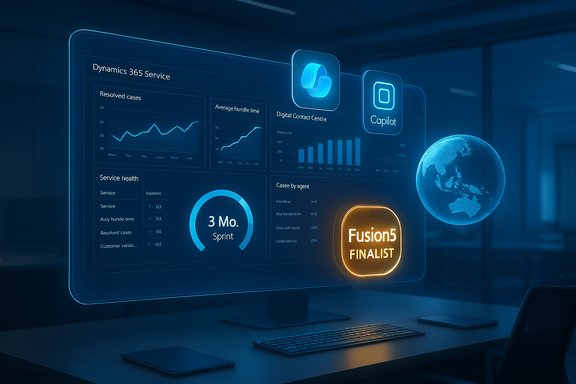
Fusion5’s announcement that it has been named a global finalist for the 2025 Microsoft Dynamics 365 Service Partner of the Year Award positions the Australasian systems integrator among the top four partners in a globally competitive category — a recognition that underscores the company’s Microsoft alignment and its focus on rapid, AI‑driven contact centre transformations.
Microsoft’s Partner of the Year Awards are the industry’s marquee recognition for partners who deliver exceptional solutions on Microsoft Cloud and AI platforms. The 2025 awards cycle drew more than 4,600 nominations from partners worldwide, and winners and finalists were confirmed in advance of Microsoft Ignite. The Dynamics 365 Service category — centered on customer service transformation built on Dynamics 365 Customer Service and the Microsoft Digital Contact Centre stack — attracted entries from major global systems integrators and specialist consultancies. The 2025 Dynamics 365 Service award was ultimately won by TTEC Digital; Microsoft’s official winners page lists TTEC Digital as the category winner and Fusion5 among three global finalists (along with RSM US LLP and EY). That official list is the definitive record for the awards and confirms Fusion5’s finalist status.
Source: ecommercenews.com.au Fusion5 named global finalist for 2025 Dynamics 365 Service award
 Background
Microsoft’s Partner of the Year Awards are the industry’s marquee recognition for partners who deliver exceptional solutions on Microsoft Cloud and AI platforms. The 2025 awards cycle drew more than 4,600 nominations from partners worldwide, and winners and finalists were confirmed in advance of Microsoft Ignite. The Dynamics 365 Service category — centered on customer service transformation built on Dynamics 365 Customer Service and the Microsoft Digital Contact Centre stack — attracted entries from major global systems integrators and specialist consultancies. The 2025 Dynamics 365 Service award was ultimately won by TTEC Digital; Microsoft’s official winners page lists TTEC Digital as the category winner and Fusion5 among three global finalists (along with RSM US LLP and EY). That official list is the definitive record for the awards and confirms Fusion5’s finalist status. What the finalist badge actually means
Being named a Microsoft Partner of the Year finalist is a significant market signal — but it’s a signal with context and limits. Microsoft’s judging looks for demonstrable customer impact, technical innovation on Microsoft platforms, repeatable delivery models, and measurable business outcomes. Finalist status therefore means a partner successfully articulated projects that met those criteria to Microsoft’s reviewers. However, finalist recognition is an evaluative badge, not an operational warranty; procurement teams should treat it as a validated shortlist cue rather than conclusive proof of consistent delivery quality across every customer engagement. Fusion5’s finalist entry highlights these elements: platform alignment (Dynamics 365 Service at the core), AI integration (Microsoft Copilot embedded in service workflows), and delivery speed (the firm claims repeated three‑month Digital Contact Centre rollouts). The company’s own announcement frames the outcome as affirmation of its delivery model and customer outcomes. Those public statements are part of the partner narrative Microsoft evaluates.Overview of the Microsoft Dynamics 365 Service / Digital Contact Centre stack
What Microsoft is packaging as “service” today
Microsoft’s service stack has evolved into a tightly integrated set of capabilities that pair Dynamics 365 Customer Service with omnichannel contact centre features, native voice channels, and embedded generative AI via Copilot and Copilot Studio. Typical implementations combine:- Dynamics 365 Customer Service as the core case and knowledge management system.
- Dynamics 365 Contact Centre / Digital Contact Centre Platform (DCCP) components for omnichannel routing and agent desktop functionality.
- Microsoft Copilot capabilities for agent assist, case summarisation, and customer‑facing conversational experiences.
- Power Platform (Power Apps, Power Automate) for orchestration and lightweight integrations.
- Azure Communication Services and Teams for voice channel connectivity where telephony is required.
How Copilot is typically used in service scenarios
Copilot for Service is routinely embedded at multiple touchpoints:- Self‑service and conversational IVR for containment and deflection.
- Agent assist for summarising conversations, suggesting responses, and surfacing relevant knowledge articles.
- Supervisor and analytics workflows that use generative AI to surface trends and to help triage escalations.
- Knowledge management workflows that rely on retrieval‑augmented generation (RAG) to ground responses in verified content stores and reduce hallucination risk.
Fusion5’s claim set: strengths and what’s verifiable
Fusion5’s public materials and press release make several concrete claims that shaped the award submission:- Fusion5 was named a 2025 global finalist in the Dynamics 365 Service category — an official fact that appears on Microsoft’s winners and finalists list.
- The company asserts a capability to “repeatedly implement Microsoft’s AI‑driven Digital Contact Centre within three months,” positioning rapid deployment as a repeatable go‑to‑market benefit. That timeline is presented as a company performance metric in Fusion5’s announcement.
- Fusion5 highlights platform integration expertise across Microsoft Copilot, Power Apps, and Copilot Studio, and points to prior regional awards and long standing membership in Microsoft’s Business Applications Inner Circle as evidence of deep Microsoft alignment. Fusion5’s site and recent press materials confirm the ANZ Business Applications Partner award and Inner Circle status.
- Microsoft’s winners/finalists page independently confirms Fusion5’s finalist placement, making that the most verifiable claim.
- The “three‑month” delivery cadence is a partner‑stated operational metric. Public case studies from other partners and a Microsoft customer example (Milpark Education) show the Digital Contact Centre can be deployed rapidly in specific contexts, but independent, repeatable evidence proving Fusion5 achieves the same three‑month outcome consistently across multiple customers and comparable scopes was not found in publicly available materials at the time of reporting. That makes the timeline a claim worth validating via named customer references and implementation runbooks during procurement.
Technical analysis — what it takes to deliver “three months” with Dynamics 365 Contact Centre
Delivering a production‑grade contact centre on the Dynamics 365 stack in a compressed window is possible, but it requires specific conditions and trade‑offs:- Preconfigured templates and vertical accelerators. Partners who can assemble templated industry solutions (telecom connectors, IVR flows, knowledge article templates) cut weeks off delivery time.
- Clear scope and minimal customisation. Rapid deliveries typically assume limited bespoke integrations and predefined channel sets (e.g., chat + email, or chat + voice via a supported telephony route).
- Readiness of customer data and identity stores. Fast timelines assume customer CRM records, identity management, and data feeds are well‑structured and accessible.
- Telephony complexity. Voice channels require carrier routing, compliance for call recording, media transcoding, and possibly PSTN interconnects — each can add unpredictable lead times.
- AI governance and security. Embedding Copilot requires model configuration, prompt templates, data‑provenance controls, and PII redaction policies; rushing governance risks creating compliance gaps.
Strengths Fusion5 brings to the table
- Microsoft alignment and pedigree: Fusion5’s Inner Circle recognition, ANZ Business Applications award, and repeated presence in Microsoft partner programs indicate deep specialisation with Microsoft Business Applications and AI‑first tooling. That alignment makes them a predictable collaborator for Dynamics‑centric projects.
- Regional expertise: Fusion5’s presence across Australia and New Zealand and their vertical case work in public sector and education positions them well for customers in ANZ seeking local delivery, compliance understanding, and regional support models.
- Go‑to‑market focus on speed and templates: The company emphasises a “speed‑to‑value” approach using the Microsoft Digital Contact Centre and Copilot-powered flows — a commercial advantage for organisations that prioritise rapid ROI and incremental rollouts.
- Practical AI adoption: Fusion5’s narrative places AI (Copilot) in pragmatic roles — assistive summaries, agent productivity, and guided responses — aligning with industry best practice to phase AI into augments rather than full automation on day one.
Risks, limitations, and governance concerns
- Timelines can be scope‑dependent: The three‑month claim should be scoped. Delivering a minimally integrated contact centre in 90 days is materially different from rolling out a full omnichannel, highly‑customised service platform integrated with core ERP, telephony, and third‑party data providers. Procurement teams should demand named references for comparable scopes.
- AI safety and data governance: Embedding Copilot into agent workflows and customer touchpoints increases risk vectors: prompt leakage, inadvertent disclosure of PII, and model outputs that are not grounded in verified content. Robust governance — prompt libraries, RAG with curated knowledge stores, telemetry and drift detection — is mandatory. These are non‑trivial engineering and operational tasks that can extend timelines and cost.
- Telephony and regulatory complexity: Native voice channels and PSTN interconnects involve telco contracts, recording consent laws, and local regulatory compliance that vary by country. These integrations often extend implementation schedules.
- Observability and operational maturity: Generative AI introduces new observability needs. Partners and customers must instrument model usage, error rates, and feedback loops; without this, production Copilot instances can silently degrade or produce unacceptable behaviour.
- Cost transparency and TCO: Initial platform deployments can show quick wins, but total cost of ownership should include Copilot compute / consumption, Azure services, licensing for Dynamics and Power Platform, telephony costs, and ongoing governance/headcount for AI operations. Rapid deployments should not hide a ballooning TCO.
Due diligence checklist for buyers evaluating finalist partners (practical steps)
- Ask for three named customer references whose project scope, timelines, and post‑go‑live metrics match the partner’s claims (including at least one reference for the claimed “three‑month” delivery).
- Request access to runbooks, templates, and a sample project plan showing the tasks and dependencies that enable rapid delivery.
- Review AI governance artefacts: prompt libraries, RAG design, data retention and deletion policies, PII redaction methods, and model‑output monitoring dashboards.
- Validate telephony integrations: identify which carrier/route will be used, where call recordings will be stored, and compliance controls for each region involved.
- Request a TCO model that separates one‑time implementation costs from recurring Copilot/consumption and telephony charges.
- Require security and privacy evidence: penetration test results, SOC/ISO certifications, and a documented data flow map for personal data.
- Start with a tightly scoped pilot or proof‑of‑value (4–8 weeks) that demonstrates the partner’s delivery velocity and the AI features under a controlled, auditable scope.
Industry context — why Copilot + Dynamics matters now
The 2025 awards cycle emphasised AI‑enabled customer service, reflecting a broader market pivot: organisations are no longer asking whether to use generative AI in service — they are asking how to do so safely and at scale. Microsoft’s emphasis on Copilot, Power Platform integration, and contact centre modernisation shows the vendor is positioning Dynamics 365 as a platform not merely for cases and queues, but for AI‑augmented service experiences that blend self‑service, human agents, and data‑driven insights. Partners who can operationalise that promise — by delivering safe, repeatable rollouts and robust governance — will capture the most value.Final assessment — why the finalist spot matters for Fusion5 and buyers
Fusion5’s placement among the four global finalists in the Dynamics 365 Service category is a meaningful external validation of platform competence and partner maturity; Microsoft’s winners list confirms the claim. For customers in ANZ considering a Dynamics‑centric contact centre modernization, Fusion5’s Microsoft pedigree, regional presence, and messaging around speed and templated delivery make it a strong contender. That strength comes with straightforward caveats: the most commercially valuable claims — especially rapid, three‑month rollouts — require verification through named references, runbooks, and PoVs. AI integration with Copilot introduces governance and operational requirements that must be budgeted and staffed. Telephony and compliance considerations will often determine whether a compressed schedule is realistic for a particular customer.Practical recommendations for enterprise buyers
- Treat the partner finalist badge as a shortlisting filter, not a procurement guarantee.
- Insist on evidence: ask for comparable case studies, customer references, and documented runbooks.
- Budget for governance: allocate separate resources for AI governance, monitoring, and model ops.
- Pilot first: prefer a staged rollout that proves agent assist and self‑service capabilities before wide‑scale adoption.
- Measure outcomes: insist on KPIs tied to resolution time, agent productivity, containment rates, and Copilot error/rollback incidence.
Conclusion
Fusion5’s finalist recognition in the 2025 Microsoft Dynamics 365 Service category confirms the company’s place in Microsoft’s global Business Applications ecosystem and highlights the commercial momentum behind AI‑enabled contact centre modernization. Microsoft’s official awards listings make the finalist status verifiable, and Fusion5’s Inner Circle membership and regional awards add further weight to their profile. At the same time, customers should translate awards into verifiable outcomes: validate rapid‑deployment claims against real project artefacts, demand robust AI governance, and prepare for the operational realities of voice, compliance, and ongoing Copilot costs. With the right procurement discipline, finalists like Fusion5 can be strong partners for organisations that want to adopt Dynamics 365 Contact Centre capabilities and harness Copilot to lift agent productivity and customer experience — but the difference between a successful quick win and a stalled project often comes down to scope control, governance, and measurable evidence.Source: ecommercenews.com.au Fusion5 named global finalist for 2025 Dynamics 365 Service award
