

TTEC Digital’s confirmation as the 2025 Microsoft Dynamics 365 Service Partner of the Year crystallizes a simple market truth: the race to operationalize Copilot and generative AI inside contact centers has moved decisively from pilots to scaled production, and platform-aligned systems integrators are collecting the spoils.
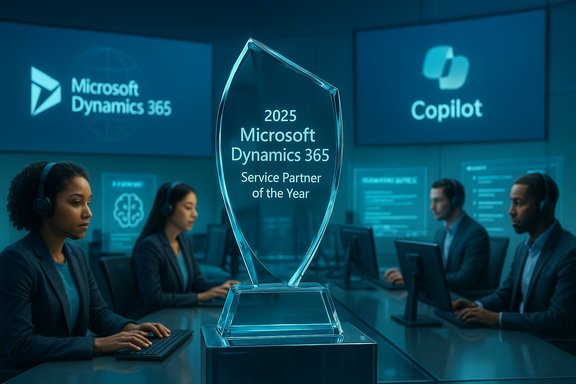
TTEC Holdings announced on November 12, 2025 that its TTEC Digital unit won the 2025 Microsoft Dynamics 365 Service Partner of the Year award, selected from a global field of partners and described as chosen from more than 4,600 nominations. The company framed the recognition as validation of its work building AI-enabled customer experience (CX) solutions that pair Dynamics 365 Customer Service with Microsoft Copilot capabilities. Microsoft’s Partner of the Year Awards are the vendor’s marquee partner recognitions, celebrating contributions across categories such as Azure, Business Applications, Modern Work and Security. Microsoft’s partner communications confirm that the 2025 awards cycle received more than 4,600 nominations from around the world and that winners were announced in the lead-up to Microsoft Ignite (November 18–21, 2025). At the same time, TTEC public materials note that TTEC Digital was named to the 2025/26 Microsoft AI Business Solutions Inner Circle, marking what the company describes as a tenth consecutive Inner Circle selection — a badge partners typically link to privileged roadmap access, co-sell support and prioritized engineering channels. The Inner Circle designation is widely framed by partners as reserved for the top echelon of Microsoft Business Applications partners.
That said, awards accelerate vendor discovery — they do not replace the essential due diligence checks needed before awarding enterprise-scale contracts. Combine the award signal with:
Treat partner awards like a high-quality signal, then require hard evidence. This disciplined approach will separate successful Copilot-driven transformations from costly experiments, and it will ensure that the operational promise of generative AI translates into reliably improved customer experiences.
Source: GlobeNewswire TTEC Digital recognized as the 2025 Microsoft Dynamics 365 Service Partner of the Year
 Background / Overview
TTEC Holdings announced on November 12, 2025 that its TTEC Digital unit won the 2025 Microsoft Dynamics 365 Service Partner of the Year award, selected from a global field of partners and described as chosen from more than 4,600 nominations. The company framed the recognition as validation of its work building AI-enabled customer experience (CX) solutions that pair Dynamics 365 Customer Service with Microsoft Copilot capabilities. Microsoft’s Partner of the Year Awards are the vendor’s marquee partner recognitions, celebrating contributions across categories such as Azure, Business Applications, Modern Work and Security. Microsoft’s partner communications confirm that the 2025 awards cycle received more than 4,600 nominations from around the world and that winners were announced in the lead-up to Microsoft Ignite (November 18–21, 2025). At the same time, TTEC public materials note that TTEC Digital was named to the 2025/26 Microsoft AI Business Solutions Inner Circle, marking what the company describes as a tenth consecutive Inner Circle selection — a badge partners typically link to privileged roadmap access, co-sell support and prioritized engineering channels. The Inner Circle designation is widely framed by partners as reserved for the top echelon of Microsoft Business Applications partners. Why this award matters — the market signal and practical implications
Platform alignment equals business leverage
Large CX systems integrators that combine managed services with deep platform engineering are now the favored route to scale Copilot-driven service modernization. The Dynamics 365 Service category specifically rewards implementations that demonstrate measurable service outcomes — faster case resolution, improved first-contact resolution, better agent productivity and defensible governance for AI outputs. TTEC’s win signals to buyers that the firm’s Dynamics + Copilot playbook passed Microsoft’scompetitive review bar.What customers gain from an award-winning partner
- Faster adoption of Microsoft previews and early feature access through partner channels.
- Stronger co-sell alignment and potential visibility inside Microsoft field sales, which can shorten procurement cycles.
- A single-vendor trajectory for both contact center operations (managed services) and application modernization (Dynamics 365 + Power Platform), reducing integration handoffs.
The technical reality: what Dynamics 365 + Copilot deployments look like in 2025
Core components commonly delivered by partners
- Dynamics 365 Customer Service as the case, knowledge and metadata store.
- Microsoft Copilot (Business Apps / Customer Service Copilot) embedded in the agent desktop for response drafting, conversation summarization and suggested next actions.
- Unified routing and omnichannel ingestion (chat, email, social, voice) often tied to Teams or Azure Communication Services for telephony.
- Power Platform orchestrations (Power Automate/Power Apps) for workflow automation and lightweight integrations.
- Azure-hosted telemetry and observability for performance, drift detection and compliance logging.
Typical AI-enabled features customers will see
- Agent Assist — real-time prompts that draft replies, recommend knowledge articles and propose next-best actions.
- Conversation Summaries — automated case notes and CRM updates derived from call or chat transcripts.
- Automated Knowledge Management — AI-assisted article creation, deduplication and relevance scoring to keep knowledge bases current.
- Intelligent Routing — classification and routing that pairs cases with the right-skill agent using classifier models and business rules.
- Supervisor Intelligence — real-time alerts, coaching suggestions and staffing optimization driven by analytics.
Strengths demonstrated by TTEC’s award submission
- End-to-end capability: TTEC combines experience design, systems integration and managed operations, reducing the friction of cross-vendor handoffs and accelerating time-to-value on complex contact center transformations.
- Copilot functional depth: The firm highlighted deployments that place Copilot at the center of agent and supervisor workflows, aligning with Microsoft’s product priorities for 2025.
- Scale and global delivery: TTEC operates on six continents and markets this scale as an advantage for multinational rollouts requiring consistent compliance and local data controls.
- Repeat recognition: The company’s Inner Circle selection — reported by TTEC — reinforces the narrative of consistent commercial performance inside Microsoft’s ecosystem.
Risks, trade-offs and what procurement teams must validate
Awards and program memberships are valuable signals, but they are not substitutes for operational evidence. The following risks are real and recurring in Dynamics 365 + Copilot projects:1) Hallucination and factual drift
Generative AI can produce plausible but incorrect content when retrieval or grounding is imperfect. Mitigations must be in the architecture (RAG pipelines, document-scoring thresholds, human-in-loop verification). Partners should demonstrate concrete mitigation strategies and red-team results.2) Data residency and compliance
Contact centers often process regulated data. Verify how knowledge artifacts, prompt logs and telemetry are stored, who has access, and whether the deployment meets local residency, encryption and retention requirements. Ask for documented data flows and incident runbooks.3) Consumption and runaway costs
Copilot and Azure AI compute costs can escalate rapidly in high-volume contact centers. Models, context window strategies, caching and prompt engineering discipline are required to control TCO. Require a three-year consumption forecast in the proposal and milestone-based payments tied to adoption.4) Vendor lock-in and portability
Tight coupling to first-party Microsoft primitives, custom Copilot agents and Fabric analytics can impede future platform choices. Negotiate exportability of conversation logs, knowledge artifacts and automation flows in interoperable formats. Require contractual portability guarantees where strategic flexibility matters.5) Operational maturity at scale
Global rollouts need documented runbooks, 24×7 support, regional compliance playbooks and demonstrable SLAs. Inner Circle membership shortens engineering cycles, but does not replace per-region operational evidence. Request named references for comparable-scale programs.A practical buyer’s checklist (contract-ready)
- Request at least three named customer references that match industry and scale; validate claimed KPIs (e.g., reduction in handle time, improvement in FCR, uplift in CSAT).
- Require an AI Governance Dossier that includes model cards, red-team summaries, prompt logs policy and a plan for continuous revalidation of the knowledge corpus.
- Insist on a three-year TCO model that captures peak Copilot usage, indexing and retention costs, Azure OpenAI/Azure AI consumption, and support tiers.
- Demanding export and portability clauses for knowledge artifacts, prompts and conversation logs in standard formats.
- Include milestone-based payments tied to verified adoption metrics (agent usage, case deflection, CSAT improvements).
- Ask for security architecture diagrams, data residency commitments, encryption at rest/in transit, and an incident response runbook.
- Validate the partner’s prioritized engineering escalation pathways and whether Inner Circle access materially shortens remediation SLAs.
- Run a technical PoC that includes hallucination tests, grounding precision tests, and load testing under production-like volumes.
What to believe and what to verify: claims that need scrutiny
- The figure of 4,600+ nominations for the 2025 Partner of the Year program appears in Microsoft’s partner announcement and is corroborated across Microsoft partner channels; this is a reliable program statistic to cite when assessing selectivity.
- TTEC’s claim of tenth consecutive Inner Circle membership is consistent with TTEC’s investor and newsroom archives, which document prior consecutive recognitions; however, Microsoft does not publish a publicly queryable audit trail of the Inner Circle roster or the exact selection metrics, so prospective buyers should treat the “top 1%” framing as partner-provided positioning rather than a third-party audited rank. Request direct confirmation during contract negotiations where program privileges are material to delivery timelines.
- Statements about product roadmaps or direct product influence by Inner Circle partners should be treated cautiously unless the partner cites explicit co-engineered features or joint public announcements. Inner Circle membership confers privileged access and influence channels, but does not imply unilateral control over Microsoft’s product decisions.
Strategic impact on the competitive landscape
For systems integrators and specialist consultancies
Winning Microsoft’s Dynamics 365 Service category creates visible momentum and co-sell leverage — both of which accelerate pipeline growth for large transformation deals. The award reinforces a market reality where platform alignment (Dynamics + Copilot + Azure) is a major differentiator.For enterprises standardizing on Microsoft
An Inner Circle partner with a recognized Dynamics 365 Service win offers a path to shorten pilot-to-production timelines, reduce roadblock friction, and gain prioritized engineering channels. These advantages may be decisive where time-to-value is a strategic objective. However, the strategic trade-off is supplier concentration on Microsoft-first primitives, which should be balanced against long-term portability needs.For neutral or multicloud strategies
Organizations that want multicloud flexibility should explicitly test portability, build clear adapter layers, and demand contractual clauses that protect the customer from vendor-tied lock-in as Copilot and Fabric analytics features proliferate.Implementation playbook: what successful programs actually do
- Start with a narrow, high-value use case (e.g., payment balance inquiries, returns processing) that can demonstrate measurable ROI in 60–90 days.
- Build a hybrid human+AI workflow that keeps a human in the loop for high-risk decisions and automatically escalates ambiguous interactions.
- Invest in knowledge engineering: curate, tag and version knowledge articles; design an ingestion pipeline with quality gates; implement deduplication and summarization tooling.
- Add observability from day one: log prompts, outputs, confidence scores and feedback loops that feed continuous model and prompt tuning.
- Treat Copilot consumption like an operational service: run capacity planning, cost dashboards and throttles to control run-rate.
Verification notes and cautious signals
- Microsoft’s official partner blog confirms the awards program structure and the nominations count, which validates the program-level claims.
- TTEC’s press release and newsroom pages announce both the Partner of the Year award and the Inner Circle membership; these are consistent and independently published across GlobeNewswire, PR Newswire and TTEC’s own channels.
- Independent review: third-party commentary and industry reporting on partner awards often reiterate partner claims; procurement teams should still demand named, auditable evidence for any metric that will be used in contractual acceptance criteria. Where partners cite “top 1%” or numeric streaks, treat those as marketing shorthand unless corroborated by Microsoft partner relations in writing.
Bottom line: how to convert this signal into a sound procurement decision
TTEC Digital’s 2025 Microsoft Dynamics 365 Service Partner of the Year award is a credible market endorsement that highlights technical depth, commercial traction and close Microsoft alignment. For enterprises that are committed to Microsoft as their CX backbone, the award indicates TTEC is a low-friction option capable of converting Copilot and Dynamics 365 investments into operational outcomes.That said, awards accelerate vendor discovery — they do not replace the essential due diligence checks needed before awarding enterprise-scale contracts. Combine the award signal with:
- PoCs that validate grounding and hallucination rates,
- Contractual governance deliverables (model cards, red-team reports),
- Consumption forecasts and milestone payments,
- Named references for comparable-scale programs.
Conclusion
The 2025 Dynamics 365 Service Partner of the Year recognition for TTEC Digital is both a symptom and a driver of a larger market transition: AI-first CX is now a production discipline, not an experimental promise. Partners that can combine Dynamics 365 engineering, Copilot expertise, knowledge engineering and global managed operations are being rewarded — and enterprises that harness those capabilities with rigorous governance and contract discipline will capture the operational gains while minimizing the legal, financial and reputational risks.Treat partner awards like a high-quality signal, then require hard evidence. This disciplined approach will separate successful Copilot-driven transformations from costly experiments, and it will ensure that the operational promise of generative AI translates into reliably improved customer experiences.
Source: GlobeNewswire TTEC Digital recognized as the 2025 Microsoft Dynamics 365 Service Partner of the Year
