

The conversations at Microsoft Security Summit Days make one thing unmistakably clear: future-proofing enterprise security is no longer a checklist—it's a strategic operating model that must knit people, data, identity, tooling, and governance into a single, resilient fabric. Microsoft’s security leaders framed the problem plainly: shrinking budgets and staffing constraints are colliding with ever-higher expectations for resilience, compliance, and digital innovation. The result is a mandate for smarter prioritization—do fewer things better—and for integration and AI to become force multipliers for lean security teams.
Security leaders face three simultaneous pressures: rapidly evolving adversary tactics, a proliferating estate that spans cloud, hybrid, and on‑premises systems, and tighter operational budgets. Industry breach studies and vendor research over the past several years show the same patterns: attackers increasingly exploit vulnerabilities and supply-chain weaknesses; human error remains a major factor in breaches; and detection and containment times, while improving, still measured in months, materially increase breach costs.
At the same time, the security technology landscape has ballooned. Organizations accumulate best-of-breed point products to solve single problems, but those tools often live in silos—each with its own console, telemetry format, and alerting logic. The cumulative effect: telemetry fragmentation, alert fatigue, and slow, manual investigations. Microsoft’s security leadership echoed this diagnosis and made integration—and the intelligent orchestration of data—the central prescription for doing more with less.
Integration reduces friction in three concrete ways:
Elements of an effective classification program:
Core identity controls to prioritize:
Practically, this means:
Key governance controls include:
The pathway to future-proofing is incremental and measurable. Prioritize identity and data first, then invest in integration and AI pilots that reduce manual toil while preserving human oversight. Measure gains transparently, govern models actively, and be prepared to adapt—because adversaries will.
Security leaders who follow this pragmatic, risk-focused approach will be positioned to deliver both business resilience and innovation—even when resources are constrained. The goal is not to buy every new capability, but to orchestrate what you have into a smarter, faster, and more reliable defense.
Source: Microsoft A CISO’s guide to future-proofing security - Microsoft in Business Blogs
 Background: why this matters now
Security leaders face three simultaneous pressures: rapidly evolving adversary tactics, a proliferating estate that spans cloud, hybrid, and on‑premises systems, and tighter operational budgets. Industry breach studies and vendor research over the past several years show the same patterns: attackers increasingly exploit vulnerabilities and supply-chain weaknesses; human error remains a major factor in breaches; and detection and containment times, while improving, still measured in months, materially increase breach costs.At the same time, the security technology landscape has ballooned. Organizations accumulate best-of-breed point products to solve single problems, but those tools often live in silos—each with its own console, telemetry format, and alerting logic. The cumulative effect: telemetry fragmentation, alert fatigue, and slow, manual investigations. Microsoft’s security leadership echoed this diagnosis and made integration—and the intelligent orchestration of data—the central prescription for doing more with less.
Overview: the five pillars of a future-ready CISO strategy
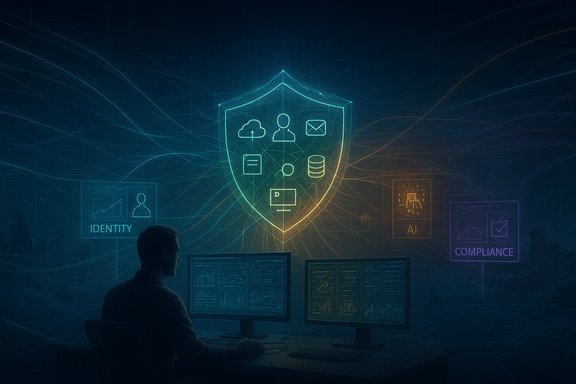
The guidance that emerged from Microsoft’s summit maps cleanly to five practical pillars any CISO can adopt:- Break down silos and integrate telemetry across endpoint, identity, email, cloud workloads, and network.
- Prioritize identity and zero trust as the foundational control plane for modern estates.
- Place data classification and governance at the center so defensive effort maps to business risk.
- Adopt AI and automation conservatively and iteratively to shift from reactive to proactive security.
- Build a security-first culture that makes every employee a participant in risk reduction.
The silo problem: why integration is non-negotiable
The cost of tool sprawl
Point solutions proliferate because they solve immediate, tactical problems. But when each tool emits its own alerts and stores its own telemetry, correlation becomes a full-time job. Security teams spend disproportionate time normalizing and stitching datasets together instead of investigating incidents or hunting proactively.Integration reduces friction in three concrete ways:
- It collapses the mean time to detect and respond by enabling cross-product correlation and automated enrichment.
- It reduces total cost of ownership by consolidating workflows and avoiding duplicate tooling and staffing overhead.
- It improves analyst effectiveness by presenting a single investigation narrative and shared context.
What modern integration looks like
Integration isn’t simply an API connection. The highest-value integrations provide:- Unified identity context so alerts are scoped to user and device trust levels.
- Cross-product correlation that links email, endpoint, cloud, and network events into single incidents.
- Automated playbooks that can triage or remediate low-risk events without human intervention.
- Transparent decisioning—explanations of why an alert is prioritized—so analysts can trust and tune automation.
From reactive to proactive: applying AI thoughtfully
Where AI helps most
AI is not a silver bullet, but when focused on high‑leverage problems it delivers measurable gains:- Alert reduction and prioritization. Machine learning can suppress false positives and surface high-confidence incidents, easing analyst load.
- Behavioral anomaly detection. Models that learn normal patterns for users, devices, and applications can detect subtle deviations that signature-based tools miss.
- Automated triage and enrichment. Natural language models and automation can pull context—configuration data, asset criticality, recent changes—reducing time spent gathering facts.
- Predictive vulnerability and attack-path modeling. AI can help prioritize patching or network segmentation by estimating exploitability and business impact.
Caveats and operational realities
- AI models are only as good as the data feeding them. Fragmented or biased telemetry yields biased outputs.
- Agentic or autonomous behavior must be tightly scoped. Full automation of high‑impact actions without human review increases risk.
- Explainability matters. Analysts must understand why a model recommended a remediation so they can validate and refine it.
- Adversaries also adopt AI. Generative models can be abused to craft highly persuasive phishing and social engineering campaigns, so defensive AI must evolve in lockstep.
Data at the center: know what you’re protecting
Crown-jewels mapping and data classification
You cannot secure what you do not understand. Effective CISOs start with a simple reality: some data is more mission-critical than other data. Data classification and governance programs let security leaders prioritize protections where they matter most, aligning control spend with business risk.Elements of an effective classification program:
- Business-tagged data inventories that map systems and storage locations to data sensitivity.
- Automated classification tools that augment manual tagging with pattern matching and ML.
- Policy-driven enforcement (encryption, DLP, access controls) tied to classification outcomes.
- Continuous discovery for “shadow data” and unsanctioned SaaS applications.
Data protection in an AI era
Generative AI introduces new exfiltration vectors: sensitive inputs typed into third‑party AI tools, or accidental inclusion of sensitive material in prompts or model training sets. Practical mitigations include:- DLP controls that monitor and block sensitive content from being sent to unsanctioned AI apps.
- Enterprise controls around access to AI services, including identity-based gating and telemetry logging.
- Policy and training so employees understand what can and cannot be shared with external AI tools.
Identity and Zero Trust: the new perimeter
Why identity is the primary control plane
With cloud and remote work, the concept of a network perimeter has collapsed. Identity is the new perimeter: controlling who or what can access resources, under what conditions, is central to limiting blast radius when events occur.Core identity controls to prioritize:
- Multifactor authentication (MFA) across all privileged and high-risk accounts.
- Conditional access policies that evaluate device health, geolocation, user risk, and session context.
- Just-in-time and least-privilege role assignments for administrative functions.
- Strong identity hygiene: centralized identity stores, certification, and lifecycle management.
Network segmentation and workload controls
Zero trust extends to devices, networks, applications, and data. Microsegmentation, workload identity, and least-privilege application access reduce lateral movement and limit exposure when an attacker obtains an initial foothold.Practically, this means:
- Segmenting sensitive workloads and applying strict east-west controls.
- Enforcing workload identity (machine identities) with short-lived credentials.
- Requiring authenticated, authorized, and encrypted access for service-to-service calls.
Real-world impact: what success looks like
When organizations get the integration, AI, data, and identity pieces working together, the outcomes are tangible:- Faster, high-confidence detection with fewer false positives.
- Shorter investigation cycles because analysts have a unified incident narrative and automated enrichment.
- Improved resilience: faster containment, more consistent policy enforcement across cloud and on‑premises assets.
- Cost savings through reduction of duplicate tools and improved SOC productivity.
Responsible AI and governance: guardrails that matter
Transparency, explainability, and auditability
AI-driven security systems must be auditable. SOCs should be able to explain why a model recommended a specific priority or action, and to produce logs that an auditor or regulator can review.Key governance controls include:
- Model change control and versioning.
- Explicit logging of model inputs, outputs, and analyst overrides.
- Periodic bias and performance testing against holdout datasets.
- Clear escalation pathways for model-produced recommendations.
Privacy and data residency
AI tools trained on telemetry must respect privacy and regulatory constraints. Organizations must ensure that models and their suppliers adhere to data residency, retention, and processing requirements. Avoid treating model adoption as a purely technical choice—legal and privacy teams need to be in the room.Continuous validation
Models degrade without maintenance. Continuous monitoring of precision, recall, and false-positive rates—and regular retraining on refreshed telemetry—are non‑negotiable. Treat model health like software or patch hygiene: schedule regular reviews and post‑deployment testing.A pragmatic roadmap for CISOs: steps to future-proof security
- Perform a telemetry and tooling audit.
- Catalog all data sources, consoles, and owners. Mark duplication and gaps.
- Map your crown jewels.
- Classify data and map systems that store or process high‑value assets.
- Prioritize identity and zero trust basics.
- Enforce MFA, conditional access, and least-privilege for administrators.
- Consolidate vs. integrate.
- Where consolidation is impossible, build robust integrations and normalized telemetry flows into your SIEM/XDR.
- Pilot AI-assisted workflows in low-risk contexts.
- Start with alert enrichment, triage suggestions, and automated playbooks for low-risk remediation.
- Establish governance and model validation.
- Define KPIs, logging, and review cadences for all AI components.
- Train the organization.
- Deploy role‑based training and continuous phishing simulations to reduce human risk.
- Measure and iterate.
- Track MTTD, MTTR, false-positive rates, and analyst throughput to guide next investments.
Strengths and business value
- Speed and efficiency: Integrated platforms reduce manual stitching and accelerate investigations, which lowers operational costs.
- Risk-focused prioritization: Data‑centric programs ensure scarce resources protect what matters most.
- Augmentation not replacement: AI augments analyst capabilities and reduces routine toil, improving job satisfaction and retention.
- Regulatory resilience: Stronger identity, data governance, and auditability help with compliance and incident reporting obligations.
Risks, trade-offs, and what to watch
- Overreliance on automation: Automating responses without human oversight for high‑impact events increases risk. Maintain human-in-the-loop for critical decisions.
- False confidence from black‑box models: If teams cannot explain a model’s recommendations, they may misapply actions or fail to detect model drift.
- Supply‑chain and third‑party exposure: Consolidation around a single vendor reduces integration work but increases vendor concentration risk. Maintain diversity or contingency plans.
- Shadow AI and data leakage: Employee use of unsanctioned AI apps can exfiltrate sensitive data—DLP and policy enforcement are essential.
- Talent and skills gap: Even as automation reduces routine tasks, SOCs need engineers who can validate models, tune playbooks, and maintain integrations. Workforce planning must include these skill sets.
Practical governance checklist for AI in security
- Require explicit business cases for each AI automation use-case.
- Document model training data scope and retention.
- Maintain an “explainability log” for model decisions used in triage or automated remediation.
- Set thresholds for automatic actions vs. analyst approval.
- Conduct annual adversarial testing of AI components to surface manipulation risks.
- Coordinate with privacy and legal teams on data sharing and third‑party model use.
Final analysis: integration as the multiplier
The conversations with Microsoft’s security leaders reaffirm a central thesis: in an era of constrained budgets and expanding attack surfaces, integration multiplies the value of every existing tool and person on a security team. AI, when governed and applied to clearly defined, high‑leverage problems, shifts organizations from reacting to anticipating threats. But technology alone does not deliver resilience—data classification, identity controls, and a pervasive security culture are the chain that binds capability into outcomes.The pathway to future-proofing is incremental and measurable. Prioritize identity and data first, then invest in integration and AI pilots that reduce manual toil while preserving human oversight. Measure gains transparently, govern models actively, and be prepared to adapt—because adversaries will.
Security leaders who follow this pragmatic, risk-focused approach will be positioned to deliver both business resilience and innovation—even when resources are constrained. The goal is not to buy every new capability, but to orchestrate what you have into a smarter, faster, and more reliable defense.
Source: Microsoft A CISO’s guide to future-proofing security - Microsoft in Business Blogs
