

Samsung’s Galaxy Book6 Pro is arriving at exactly the right moment for Intel. The new laptop is built around Intel Core Ultra Series 3 processors, also known by the code name Panther Lake, and that matters because these chips are more than a routine refresh: they are Intel’s first client SoCs built on 18A and a showcase for the company’s next AI, CPU, and graphics strategy. For buyers, that translates into a machine that is supposed to work as a productivity laptop, a creative tool, and a lightweight gaming system without forcing a compromise on battery life or thermals. In a market where every major PC vendor is racing to define the post-traditional-laptop era, Intel and Samsung are making a very deliberate bet on the idea that one thin-and-light system can credibly do all three.
The modern Windows PC has been under pressure from two directions at once. On one side is the demand for better battery life and quieter operation in ultraportable laptops. On the other is the growing push toward on-device AI, where the NPU is no longer a niche accelerator but a core selling point. Intel’s Core Ultra Series 3 is meant to answer both demands with a single platform, and Samsung’s Galaxy Book6 Pro is one of the clearest examples of that strategy in practice.
What makes this launch notable is not simply that the chip is fast. It is that Intel is trying to redefine what “fast” means in a laptop by balancing CPU performance, NPU acceleration, and integrated graphics in a more even way than older designs typically managed. That balance is especially important in a chassis as slim as the Galaxy Book6 Pro, because thermal and power constraints usually force thin laptops to make trade-offs. Samsung is arguing that those trade-offs are now smaller than before.
Intel’s Series 3 platform also arrives in a very crowded AI PC landscape. Microsoft has spent more than a year pushing the Copilot+ PC category, while Qualcomm has tried to make Arm-based Windows laptops credible for mainstream use, and AMD has been steadily improving its own Ryzen AI lineup. In that context, the Galaxy Book6 Pro is not just a Samsung product; it is a proving ground for whether Intel can reclaim the center of the conversation on premium Windows notebooks.
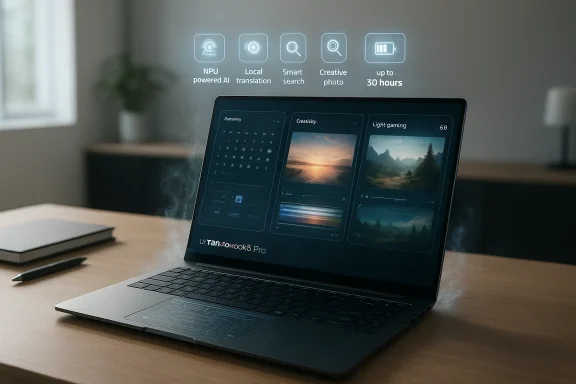
The timing matters as well. Samsung began selling the Galaxy Book6 series in the U.S. on March 11, 2026, with the Pro model starting at $1,599.99. Samsung’s launch materials say the system is powered by Intel Core Ultra Series 3 processors, built on Intel 18A, and offer improved CPU, GPU, and NPU performance, along with up to 30 hours of video playback on the Ultra and Pro models. Those are the kinds of numbers that are designed to turn a spec sheet into a buying argument.
The new platform also reflects the way Windows laptops are evolving. Traditional benchmarks still matter, but so do AI features, battery life, noise levels, and the ability to keep several heavy workloads active at once. Intel is clearly trying to compete on all of those fronts at the same time, which is ambitious, but also necessary.
At the same time, Samsung is using its own hardware tuning to amplify Intel’s silicon gains. The company says the Galaxy Book6 line improves thermal efficiency by about 35% compared with the previous Galaxy Book5 Pro generation. That kind of chassis-level refinement is critical because an efficient chip can still underperform in a poorly cooled body, and a good thermal design can make a strong chip feel even better than the raw spec sheet suggests.
That is not just a convenience story. It is also a privacy and responsiveness story. On-device AI keeps many tasks local, which reduces latency and can limit how much user data needs to travel off the machine. That said, not every AI feature is purely local, and buyers should read the fine print carefully because some creative and generative functions still rely on internet-connected services.
For Samsung, the bigger strategic value is ecosystem consistency. Galaxy AI on a Galaxy Book means the laptop can sit more naturally beside Galaxy phones, tablets, and wearables. That helps Samsung sell a platform, not just a notebook. It also gives the company a way to differentiate a Windows PC beyond display quality and industrial design.
That becomes especially relevant in a laptop like the Galaxy Book6 Pro, which is designed to be thin and portable rather than oversized and thermally forgiving. If the NPU can shoulder AI tasks efficiently, the whole system can feel smoother under load. In other words, the NPU helps preserve the laptop’s responsiveness while the user is doing other things.
That matters to different audiences in different ways. Office users want a laptop that stays quick in Teams, Excel, Outlook, and browser-heavy workflows. Creators want more headroom for Lightroom, Photoshop, and media exports. Gamers want a chip that can keep frame rates respectable in lighter titles without turning the laptop into a small space heater.
Intel’s own launch messaging suggests Series 3 is built to better serve that middle ground. It is not trying to be a desktop replacement in a 16-inch body, and it is not trying to be a minimalist low-power chip either. It is trying to hit the “just enough of everything” sweet spot, which is often where premium Windows laptops win or lose.
The Galaxy Book6 Pro seems designed around exactly that idea. Samsung claims the system’s thermal improvements help it sustain performance more effectively than the prior generation, and that makes the Intel chip more useful in practice. A great CPU in a bad chassis can feel mediocre; a very good CPU in a well-tuned chassis can feel excellent.
Samsung is leaning into that message by shipping a machine that is just 11.9mm thick in the 16-inch Pro configuration, according to its launch materials. A design that slim is far easier to appreciate when the graphics hardware does not require a chunky cooling solution or a battery penalty from a dedicated GPU.
For creators, the appeal is straightforward. A stronger integrated GPU can accelerate photo editing, preview rendering, timeline scrubbing, and export workflows without requiring a heavier workstation. For consumers, it means more room for occasional gaming, smoother media playback, and better general visual performance.
This is where the competitive picture gets interesting. If the integrated GPU is strong enough, it blurs the historical line between premium ultraportables and entry gaming laptops. That creates pressure on rivals to improve their own shared-memory graphics strategies or to accept that many buyers now value balance over specialization.
Samsung claims up to 30 hours of local video playback on the Galaxy Book6 Ultra and Pro models. Real-world workloads will never match that figure, of course, but it still signals that the system is engineered for endurance rather than just peak performance. That matters for travelers, students, and anyone who values leaving the charger behind for a while instead of planning their day around it.
The design philosophy is clear: if Intel supplies the performance and Samsung supplies the cooling, the result can be a laptop that feels more premium than its dimensions suggest. That is especially valuable in the Windows ecosystem, where “thin, light, and fast” has often meant accepting compromises in one of those three areas.
This also helps Samsung differentiate the Pro model from the more expensive Ultra and the lower-cost standard Galaxy Book6. It gives the Pro a clear lane: premium mobility, serious productivity, and respectable creative performance without the bulk of a gaming laptop. In market terms, that is a very attractive middle ground.
That layering is important because it gives the machine more identity. A buyer can see immediate practical use cases: revisit a document, search across content, edit an image, or summarize notes without jumping through as many hoops. The result is a more modern-feeling notebook, especially for users who live inside the Microsoft 365 and Samsung ecosystems.
There is also a strategic subtext here. Intel needs strong OEM partners to make a chip platform feel inevitable. Samsung needs a leading silicon story to keep the Galaxy Book line distinctive. Microsoft needs hardware partners that can demonstrate Copilot+ capabilities convincingly. The Galaxy Book6 Pro ties those agendas together in one high-visibility device.
That enterprise angle could matter a lot. If Intel and Samsung can prove the platform is reliable, performant, and battery-efficient in business use, then the Galaxy Book6 Pro becomes a viable standardization candidate. If not, it remains a premium consumer device with a strong spec sheet but limited corporate reach.
There is also a creative-market angle. Many buyers in photo, video, and design workflows still want a Windows laptop with robust app support and enough graphics capability to avoid carrying a second machine. Series 3 aims directly at that need. It is not trying to be a workstation, but it is trying to be good enough that a workstation is unnecessary for a wide slice of users.
For Samsung, the partnership lets it ship a premium notebook without building all of the performance logic itself. That is smart branding: Samsung can focus on display, industrial design, thermals, and ecosystem integration while Intel handles the platform narrative. In a crowded laptop market, that division of labor can be very effective.
The biggest opportunity is that this hardware stack can appeal to three audiences at once: workers, creators, and casual gamers. That breadth is rare, and if the real-world performance matches the claims, the machine could become a reference point for what a premium Windows laptop should feel like in 2026.
There is also the familiar issue of feature fragmentation. Some AI experiences are local, some are cloud-assisted, and some depend on app support that may evolve slowly over time. Buyers may be confused if they assume all AI features are equally private, equally fast, or equally available across regions and applications.
The next few months will determine whether the Series 3 story translates into sustained momentum. If reviewers find that the chip, thermals, and battery life all hold up in normal use, Intel and Samsung will have a persuasive answer to the current AI PC debate. If not, the machine may still be a very good laptop, but one that falls short of becoming the reference point its makers clearly want.
Source: Windows Central Work, play, create: Why the Intel® Core™ Ultra Series 3 processor should be on everybody's radar
 Overview
The modern Windows PC has been under pressure from two directions at once. On one side is the demand for better battery life and quieter operation in ultraportable laptops. On the other is the growing push toward on-device AI, where the NPU is no longer a niche accelerator but a core selling point. Intel’s Core Ultra Series 3 is meant to answer both demands with a single platform, and Samsung’s Galaxy Book6 Pro is one of the clearest examples of that strategy in practice.What makes this launch notable is not simply that the chip is fast. It is that Intel is trying to redefine what “fast” means in a laptop by balancing CPU performance, NPU acceleration, and integrated graphics in a more even way than older designs typically managed. That balance is especially important in a chassis as slim as the Galaxy Book6 Pro, because thermal and power constraints usually force thin laptops to make trade-offs. Samsung is arguing that those trade-offs are now smaller than before.
Intel’s Series 3 platform also arrives in a very crowded AI PC landscape. Microsoft has spent more than a year pushing the Copilot+ PC category, while Qualcomm has tried to make Arm-based Windows laptops credible for mainstream use, and AMD has been steadily improving its own Ryzen AI lineup. In that context, the Galaxy Book6 Pro is not just a Samsung product; it is a proving ground for whether Intel can reclaim the center of the conversation on premium Windows notebooks.
The timing matters as well. Samsung began selling the Galaxy Book6 series in the U.S. on March 11, 2026, with the Pro model starting at $1,599.99. Samsung’s launch materials say the system is powered by Intel Core Ultra Series 3 processors, built on Intel 18A, and offer improved CPU, GPU, and NPU performance, along with up to 30 hours of video playback on the Ultra and Pro models. Those are the kinds of numbers that are designed to turn a spec sheet into a buying argument.
Why this generation is different
The big story with Panther Lake is that Intel is trying to make the PC feel simultaneously more powerful and less power-hungry. Intel’s own launch material says the Series 3 family is the first AI PC platform built on 18A, and the company has framed it as a major architectural step rather than a routine shrink. That distinction matters because process technology is increasingly tied to the user experience, not just manufacturing bragging rights.The new platform also reflects the way Windows laptops are evolving. Traditional benchmarks still matter, but so do AI features, battery life, noise levels, and the ability to keep several heavy workloads active at once. Intel is clearly trying to compete on all of those fronts at the same time, which is ambitious, but also necessary.
At the same time, Samsung is using its own hardware tuning to amplify Intel’s silicon gains. The company says the Galaxy Book6 line improves thermal efficiency by about 35% compared with the previous Galaxy Book5 Pro generation. That kind of chassis-level refinement is critical because an efficient chip can still underperform in a poorly cooled body, and a good thermal design can make a strong chip feel even better than the raw spec sheet suggests.
The AI angle
The most attention-grabbing part of Intel Core Ultra Series 3 is the NPU. Intel says the top mobile SKUs deliver 50 NPU TOPS, and that figure is central to the broader Copilot+ PC story because AI workloads can be handled locally instead of constantly being pushed to the cloud. In practical terms, that means features like recall-style search, image generation, and contextual assistance can happen faster and with less dependence on network connectivity.What users actually get
For consumers, the appeal of the NPU is not abstract. It shows up in features that reduce friction: smart search, image editing assistance, live translation, and note summarization. Microsoft’s Copilot+ ecosystem includes experiences such as Recall, Cocreator, Live Captions, and other AI-powered tools, while Samsung layers in its own Galaxy AI utilities like AI Select, Note Assist, and Intelligent Search. Together, those tools create a more opinionated workflow that can feel faster than the old “open app, find menu, click tool” pattern.That is not just a convenience story. It is also a privacy and responsiveness story. On-device AI keeps many tasks local, which reduces latency and can limit how much user data needs to travel off the machine. That said, not every AI feature is purely local, and buyers should read the fine print carefully because some creative and generative functions still rely on internet-connected services.
For Samsung, the bigger strategic value is ecosystem consistency. Galaxy AI on a Galaxy Book means the laptop can sit more naturally beside Galaxy phones, tablets, and wearables. That helps Samsung sell a platform, not just a notebook. It also gives the company a way to differentiate a Windows PC beyond display quality and industrial design.
Why the NPU matters in real work
The strongest case for the NPU is not that it replaces the CPU or GPU. It is that it handles the kind of background intelligence that used to compete for precious system resources. A dedicated AI block can process those workloads more efficiently, leaving the rest of the chip free for office work, creative editing, or browser-heavy multitasking.That becomes especially relevant in a laptop like the Galaxy Book6 Pro, which is designed to be thin and portable rather than oversized and thermally forgiving. If the NPU can shoulder AI tasks efficiently, the whole system can feel smoother under load. In other words, the NPU helps preserve the laptop’s responsiveness while the user is doing other things.
- Local AI processing can improve responsiveness.
- Lower system contention helps keep the CPU available for primary tasks.
- Battery life benefits come from offloading work to dedicated silicon.
- Privacy advantages are easier to market when data stays on-device.
- Workflow integration matters more than benchmark theater for many users.
Multitasking and CPU performance
Intel is also using Core Ultra Series 3 to make a more aggressive case for CPU throughput. The company says the flagship mobile chips can deliver up to 60% better multithread performance over the previous generation, while Samsung positions the Galaxy Book6 Pro as a machine built for seamless multitasking. Those claims are important because AI alone does not make a laptop useful if the machine still stumbles when you open too many tabs or export a large project.Hybrid architecture, practical effect
The chip still relies on Intel’s hybrid model, with performance cores and efficient cores sharing the workload. That architecture has matured significantly over the last several generations, and in Series 3 it is presented as a way to intelligently distribute tasks rather than simply chase peak scores. The point is to keep the system fast under load without draining the battery or making the fan noise intrusive.That matters to different audiences in different ways. Office users want a laptop that stays quick in Teams, Excel, Outlook, and browser-heavy workflows. Creators want more headroom for Lightroom, Photoshop, and media exports. Gamers want a chip that can keep frame rates respectable in lighter titles without turning the laptop into a small space heater.
Intel’s own launch messaging suggests Series 3 is built to better serve that middle ground. It is not trying to be a desktop replacement in a 16-inch body, and it is not trying to be a minimalist low-power chip either. It is trying to hit the “just enough of everything” sweet spot, which is often where premium Windows laptops win or lose.
What this means for buyers
For a buyer comparing laptops in 2026, raw CPU charts are only part of the decision. The real question is whether the machine can remain consistently fast across a whole day of mixed use. That means launch-time responsiveness, sustained performance, battery efficiency, and the ability to keep noise levels low all matter just as much as peak turbo numbers.The Galaxy Book6 Pro seems designed around exactly that idea. Samsung claims the system’s thermal improvements help it sustain performance more effectively than the prior generation, and that makes the Intel chip more useful in practice. A great CPU in a bad chassis can feel mediocre; a very good CPU in a well-tuned chassis can feel excellent.
- Office workflows benefit from sustained snappiness.
- Creative tasks benefit from higher sustained clocks.
- Browser multitasking benefits from efficient background task handling.
- Conference calls and productivity apps benefit from cooler, quieter operation.
- Students and mobile professionals benefit from predictable all-day performance.
Graphics and creative work
Intel’s integrated graphics story is the other major headline here. Series 3 mobile chips use a redesigned Arc integrated GPU, and Intel says its top mobile SKUs include up to 12 Xe-cores and much stronger gaming performance than before. Intel has positioned this as a serious leap for systems that do not rely on discrete graphics, which is a big deal in ultrathin laptops where space, weight, and heat are all constrained.The integrated GPU is the real pivot
The important shift is philosophical as much as technical. For years, integrated graphics were treated as the compromise option, good enough for video playback, spreadsheets, and the occasional older game. Intel is now trying to make the integrated GPU a legitimate creative and light-gaming engine, especially when it is paired with a thinner design that cannot comfortably accommodate a discrete GPU.Samsung is leaning into that message by shipping a machine that is just 11.9mm thick in the 16-inch Pro configuration, according to its launch materials. A design that slim is far easier to appreciate when the graphics hardware does not require a chunky cooling solution or a battery penalty from a dedicated GPU.
For creators, the appeal is straightforward. A stronger integrated GPU can accelerate photo editing, preview rendering, timeline scrubbing, and export workflows without requiring a heavier workstation. For consumers, it means more room for occasional gaming, smoother media playback, and better general visual performance.
How it competes with discrete graphics
Intel and Samsung are making an especially bold claim by implying that the highest-end integrated graphics in Series 3 can approach the behavior of entry-level discrete GPUs in some scenarios. That is not the same as replacing a true gaming laptop, and it should not be read that way. But it does matter for the segment of users who want a premium Windows laptop that can do a bit of everything without carrying a power brick or a brick-like chassis.This is where the competitive picture gets interesting. If the integrated GPU is strong enough, it blurs the historical line between premium ultraportables and entry gaming laptops. That creates pressure on rivals to improve their own shared-memory graphics strategies or to accept that many buyers now value balance over specialization.
- Light creative users gain speed without extra bulk.
- Casual gamers get a credible fallback for modern titles.
- Productivity users benefit from faster UI rendering and multimedia handling.
- Thin-and-light designs become more viable without discrete graphics.
- Competing OEMs will need stronger thermal engineering to stay competitive.
Thermals, battery life, and portability
A major reason the Galaxy Book6 Pro matters is that Samsung is pairing Intel’s silicon with a redesigned thermal system. The company says the new machine offers 35% better thermal efficiency than the Galaxy Book5 Pro, and that is the kind of improvement that turns theoretical chip gains into real-world gains. Better thermals usually mean more sustained performance, less fan noise, and fewer performance dips when the laptop is under pressure.Why efficiency is not just about battery charts
Efficiency stories often get reduced to a single battery-life number, but that misses the real user experience. A laptop with strong efficiency can feel more responsive during a long work session, maintain stable clocks during editing, and recover more gracefully from bursts of demand. It also tends to be more pleasant to use on a lap or in a quiet room.Samsung claims up to 30 hours of local video playback on the Galaxy Book6 Ultra and Pro models. Real-world workloads will never match that figure, of course, but it still signals that the system is engineered for endurance rather than just peak performance. That matters for travelers, students, and anyone who values leaving the charger behind for a while instead of planning their day around it.
The design philosophy is clear: if Intel supplies the performance and Samsung supplies the cooling, the result can be a laptop that feels more premium than its dimensions suggest. That is especially valuable in the Windows ecosystem, where “thin, light, and fast” has often meant accepting compromises in one of those three areas.
Mobile-first is the point
The Galaxy Book6 Pro is not trying to be a desktop replacement. It is trying to be the sort of machine you carry everywhere because it does not punish you for doing so. That is why the combination of a lower-power chip, a refined thermal envelope, and integrated AI acceleration is so compelling.This also helps Samsung differentiate the Pro model from the more expensive Ultra and the lower-cost standard Galaxy Book6. It gives the Pro a clear lane: premium mobility, serious productivity, and respectable creative performance without the bulk of a gaming laptop. In market terms, that is a very attractive middle ground.
Windows 11 and Copilot+ PCs
The Series 3 launch lands squarely inside Microsoft’s Copilot+ PC era. Microsoft has defined Copilot+ PCs around NPUs that can deliver more than 40 TOPS, and Intel’s 50 TOPS NPU in Series 3 is designed to fit that conversation comfortably. That makes the Galaxy Book6 Pro part of a broader Windows reset, where AI capabilities are becoming a platform feature rather than a software add-on.Why Microsoft’s ecosystem matters
Windows buyers are increasingly choosing between platform narratives as much as hardware specs. Microsoft is using Copilot+, Recall, Cocreator, and other features to make the PC feel more intelligent. Samsung, in turn, is layering its own Galaxy tools on top to create a more differentiated experience than a plain vanilla Windows laptop.That layering is important because it gives the machine more identity. A buyer can see immediate practical use cases: revisit a document, search across content, edit an image, or summarize notes without jumping through as many hoops. The result is a more modern-feeling notebook, especially for users who live inside the Microsoft 365 and Samsung ecosystems.
There is also a strategic subtext here. Intel needs strong OEM partners to make a chip platform feel inevitable. Samsung needs a leading silicon story to keep the Galaxy Book line distinctive. Microsoft needs hardware partners that can demonstrate Copilot+ capabilities convincingly. The Galaxy Book6 Pro ties those agendas together in one high-visibility device.
Consumer and enterprise implications
For consumers, the pitch is simple: buy one laptop and get a range of AI features that actually feel built in. For enterprises, the story is more complex, because managed environments care about security policy, app compatibility, and fleet consistency as much as novelty. Samsung has already signaled an Enterprise Edition for the Galaxy Book6 line, which suggests it wants to make the same hardware relevant in corporate refresh cycles, not just retail shelves.That enterprise angle could matter a lot. If Intel and Samsung can prove the platform is reliable, performant, and battery-efficient in business use, then the Galaxy Book6 Pro becomes a viable standardization candidate. If not, it remains a premium consumer device with a strong spec sheet but limited corporate reach.
- Consumers get visible AI features and better portability.
- IT departments will focus on manageability and supportability.
- Knowledge workers may value the integrated workflow most of all.
- Ecosystem users benefit from tighter Samsung-Microsoft integration.
- Enterprises will demand proof that AI features can be controlled, audited, and secured.
Competitive positioning
Intel’s Series 3 strategy is clearly meant to answer several rivals at once. Qualcomm has made a strong pitch around Windows on Arm battery life and AI, while AMD has built momentum around Ryzen AI and integrated graphics improvements. Intel is trying to reclaim differentiation by combining manufacturing leadership, CPU strength, NPU power, and better graphics in a single mainstream client platform.Where Intel is pressing hardest
The most obvious pressure point is the premium ultraportable segment. If Intel can deliver similar battery life to Arm-based competitors while retaining broader app compatibility and stronger graphics behavior, then it can argue that x86 still offers the safest all-around answer for many Windows users. That is a powerful pitch, especially for buyers who do not want to think about software compatibility issues.There is also a creative-market angle. Many buyers in photo, video, and design workflows still want a Windows laptop with robust app support and enough graphics capability to avoid carrying a second machine. Series 3 aims directly at that need. It is not trying to be a workstation, but it is trying to be good enough that a workstation is unnecessary for a wide slice of users.
For Samsung, the partnership lets it ship a premium notebook without building all of the performance logic itself. That is smart branding: Samsung can focus on display, industrial design, thermals, and ecosystem integration while Intel handles the platform narrative. In a crowded laptop market, that division of labor can be very effective.
What rivals need to answer
The question competitors now face is not whether they can build a fast laptop. Many already can. The harder question is whether they can build one that feels cohesive across AI, battery, graphics, and thermal behavior. Intel and Samsung are betting that buyers increasingly want that holistic story, not just isolated benchmark wins.- AMD will need to keep pushing integrated graphics and AI acceleration.
- Qualcomm must maintain its battery-life and efficiency edge.
- Microsoft has to ensure Copilot+ features feel genuinely useful.
- PC OEMs will need to match Samsung’s chassis and thermal polish.
- Retail buyers will be comparing experiences, not just core counts.
Strengths and Opportunities
Samsung and Intel have put together a launch that looks unusually well aligned with current PC buying habits. The combination of AI acceleration, strong multitasking, improved graphics, and better thermals gives the Galaxy Book6 Pro a rounded value proposition rather than a one-note gimmick. That matters because the premium notebook market increasingly rewards balance over raw extremes.The biggest opportunity is that this hardware stack can appeal to three audiences at once: workers, creators, and casual gamers. That breadth is rare, and if the real-world performance matches the claims, the machine could become a reference point for what a premium Windows laptop should feel like in 2026.
- Strong on-device AI with a 50 TOPS NPU.
- Better multitasking from a high-core-count hybrid design.
- More capable integrated graphics for creative and casual gaming.
- Improved thermals that should help performance stay consistent.
- Slim, premium industrial design that keeps portability intact.
- Tighter Galaxy ecosystem integration for Samsung users.
- Copilot+ compatibility that strengthens Microsoft platform value.
Risks and Concerns
The biggest risk is that marketing claims may outpace everyday experience. A laptop can have an impressive NPU, strong graphics, and a polished chassis, yet still disappoint if software optimization, driver maturity, or thermal behavior under sustained load does not hold up. Real-world use is always the hard test, not launch-day slides.There is also the familiar issue of feature fragmentation. Some AI experiences are local, some are cloud-assisted, and some depend on app support that may evolve slowly over time. Buyers may be confused if they assume all AI features are equally private, equally fast, or equally available across regions and applications.
- Performance claims may not match sustained workloads.
- AI features may depend on cloud services or app support.
- Pricing starts firmly in premium territory.
- Battery estimates may not reflect mixed real-world use.
- Integrated graphics still won’t replace true gaming GPUs.
- Enterprise adoption will depend on manageability and policy support.
- Competitive responses from AMD, Qualcomm, and others could narrow the gap quickly.
Looking Ahead
The Galaxy Book6 Pro is likely to be remembered less as a single laptop and more as a marker of where the Windows PC market is heading. It shows that Intel now wants its chips evaluated as complete platforms for AI-era computing, not just as CPU upgrades. It also shows that Samsung is willing to build premium notebooks around that thesis rather than chase specification inflation for its own sake.The next few months will determine whether the Series 3 story translates into sustained momentum. If reviewers find that the chip, thermals, and battery life all hold up in normal use, Intel and Samsung will have a persuasive answer to the current AI PC debate. If not, the machine may still be a very good laptop, but one that falls short of becoming the reference point its makers clearly want.
- Independent reviews will test the real battery, noise, and thermal story.
- App optimization will determine how useful the NPU feels day to day.
- Enterprise deployment will show whether this platform scales beyond consumers.
- Competitive pricing will shape whether the Galaxy Book6 Pro feels premium or overpriced.
- Software updates will decide how much value the AI features gain over time.
Source: Windows Central Work, play, create: Why the Intel® Core™ Ultra Series 3 processor should be on everybody's radar
Last edited:
