

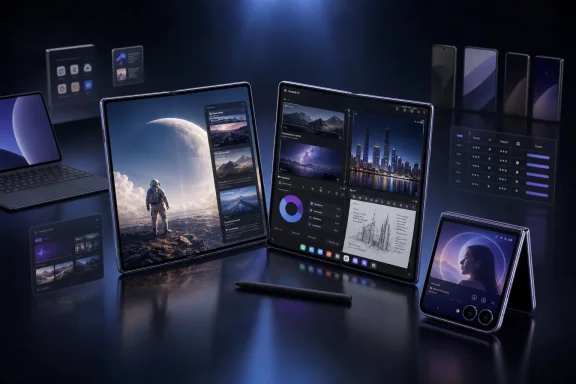
Samsung has turned its foldable strategy inside out with the Galaxy Z Fold8, Galaxy Z Fold8 Ultra, and Galaxy Z Flip8, creating a three-device lineup that no longer treats the book-style Fold as a single all-purpose flagship. Instead, the company is drawing a clear line between an entertainment-oriented wide foldable, a productivity-first Ultra model, and the compact clamshell Flip8 — a move that arrives just as attention increasingly turns toward Apple’s widely anticipated first foldable iPhone.
Pre-orders for the new Galaxy Z series are open now, with general availability beginning August 7 in the United States and other selected markets. Pricing starts at $1,199.99 for the Galaxy Z Flip8, $1,899.99 for the Galaxy Z Fold8, and $2,099.99 for the Galaxy Z Fold8 Ultra.
The most important news is not simply a faster processor, brighter screens, or yet another round of Galaxy AI features. It is Samsung’s decision to redefine what the mainstream Galaxy Z Fold is supposed to be. The Fold8 is no longer the direct continuation of the familiar narrow-and-tall Fold design. That role has effectively moved to the Fold8 Ultra.
For Windows enthusiasts and users who increasingly expect a phone to work like a pocketable PC companion, that distinction matters. Samsung is trying to serve two very different habits: consuming content on a broad canvas and getting serious multitasking work done across a larger, more conventional tablet-like screen.
Samsung’s newest foldable lineup looks straightforward at first glance:
The result is a product that attempts to sit somewhere between a large phone, a portable e-reader, a gaming handheld, and a compact video screen. The Fold8 Ultra, meanwhile, keeps the familiar productivity-focused book-style shape that better resembles a slim folding tablet when opened.
Samsung has therefore avoided making one device compromise equally for everyone. The risk, however, is that the company has created a naming scheme that may initially confuse long-time Fold customers. The Fold8 Ultra is, in practical terms, the natural successor to the traditional Fold experience, while the less expensive Fold8 introduces the more radical redesign.
Its defining characteristic is the display geometry. The outer 5.5-inch display uses a 10:16 aspect ratio, while the inside 7.6-inch display uses a 4:3 aspect ratio. Those numbers may sound technical, but the usability implications are easy to understand.
The Fold8 is designed to address that issue.
When closed, the 10:16 outer screen is intended to feel familiar for scrolling through social platforms, reading messages, checking maps, and watching vertical short-form video. When opened, the 4:3 display creates a broad canvas that is much better suited to:
That is an intelligent response to the reality that not every foldable buyer wants to emulate a mobile office. Plenty of consumers want a phone that opens into a better screen for enjoying content rather than merely organizing it.
It also offers up to 1 TB of storage, which is particularly welcome for a phone positioned around media, photography, games, and downloaded entertainment. Users who capture a lot of high-resolution video or keep large offline libraries will appreciate that option, even if it inevitably raises the final price.
The main display reaches up to 3,000 nits of peak brightness and uses a low-reflection finish alongside Samsung’s Vision Booster technology. Those specifications should be useful outdoors, where a large foldable display can otherwise become difficult to use.
Samsung has also introduced its new Flex Titanium display structure on the Fold8 and Fold8 Ultra. It combines titanium-based materials in the display assembly to support durability, reduce crease visibility, and allow for thinner devices. This is a notable advancement, though it should not be interpreted as a guarantee that the foldable display will be as carefree as conventional flat glass.
This is a meaningful camera setup for an entertainment-first foldable, especially with Samsung’s Nightography and ProVisual processing tools. The Fold8 also adds Dual Recording, allowing users to record with the front and main cameras simultaneously, creating a split view that can be useful for interviews, reaction videos, tutorials, and social media clips.
Still, the Fold8 camera system is a deliberate concession to the product’s price and positioning. Buyers who expect a flagship telephoto camera, 200 MP primary sensor, or the broadest possible creative toolkit will need to move to the Fold8 Ultra.
That makes the Fold8 a more focused device than the name might suggest. It is premium, but it is not Samsung’s ultimate hardware statement.
Its design is more familiar: a 6.5-inch cover display that opens into an 8-inch main display. The result is a much more practical form factor for side-by-side apps, spreadsheet work, document review, large email threads, remote desktop sessions, and multi-window workflows.
At 215 grams and 4.1 mm unfolded, the Fold8 Ultra remains remarkably thin for a device with an 8-inch internal screen. That slimness is a real engineering accomplishment, particularly given the larger battery, upgraded cameras, and improved cooling system.
The 8-inch screen is particularly suited to workflows such as:
The Ultra also adds a 10 MP telephoto camera with 3x optical zoom and up to 30x digital zoom. That makes it more versatile than the standard Fold8 for travel, events, architecture, portraits, and long-distance subjects.
Samsung is also leaning into creator features:
That is a welcome upgrade. An 8-inch foldable screen, a powerful processor, on-device AI processing, and sustained multitasking can drain power quickly. The Fold8 Ultra’s larger battery does not eliminate that reality, but it gives the phone a more fitting power reserve for its premium ambitions.
Samsung rates the Ultra for up to 27 hours of video playback. As always, battery life in real-world use will vary substantially with brightness, 5G connectivity, gaming, camera activity, multi-window work, AI features, and background apps. But the capacity increase is meaningful because it addresses a practical weakness rather than simply adding a benchmark-friendly specification.
The main display is 6.9 inches, and the phone includes a 4,300 mAh battery. Samsung rates it for up to 31 hours of video playback, a claim that reflects the efficiency benefits of its smaller internal display compared with the larger Fold models.
The goal is obvious: reduce the number of times users need to open the phone fully.
That is where a clamshell foldable can make the most sense. A Flip8 owner may want to check transit information, reply quickly, control smart-home devices, look at a calendar reminder, launch a workout, or take a selfie without unfolding the device. Samsung’s software is attempting to make those moments faster and more useful.
The potential downside is that AI suggestions can become clutter rather than convenience. A cover display works best when it is simple, glanceable, and predictable. If Now Brief or Gemini-powered actions become too aggressive, the streamlined appeal of the Flip design could get lost behind another layer of software recommendations.
Samsung has enhanced that experience with:
On larger Fold devices, Now Nudge is designed to surface contextual suggestions and open apps side by side when a task appears to need multitasking. The theory is compelling. A phone that recognizes an upcoming dinner plan and offers to pair messages with a calendar view, for example, could genuinely save steps.
In practice, agentic AI remains a category that deserves scrutiny.
That visibility is important. The more a smartphone anticipates a user’s intent, the more clearly it must explain what it is doing, what data it accessed, and how the user can stop or reverse it.
Samsung’s privacy architecture includes:
The headline lesson is simple: AI convenience does not remove the need for careful configuration. Users should review permissions, cloud-processing settings, linked accounts, and data-sharing options before relying on the newest assistant features.
Apple has not formally announced such a device, so its name, dimensions, display technology, pricing, release timing, and software capabilities remain unconfirmed. Any direct comparison today is therefore premature.
Still, Samsung’s timing is strategic.
By shipping the Galaxy Z Fold8 family in early August, Samsung gives consumers, carriers, retailers, and reviewers a substantial head start before Apple can reshape the mainstream conversation around foldables. It also ensures that Samsung enters the next competitive phase with three distinct answers instead of one.
The Fold8 speaks to the entertainment-first buyer. The Fold8 Ultra targets the power user. The Flip8 serves the compact-phone customer who wants a more expressive and flexible design.
That breadth is Samsung’s strongest defense. Apple may bring enormous marketing power and ecosystem integration to the foldable category, but Samsung already has a mature hardware portfolio, years of hinge and display experience, and a software platform that has been refined around folding screens.
The Galaxy Z Fold8 is the boldest part of the announcement because it rethinks the physical format around media and reading. The Galaxy Z Fold8 Ultra is the most complete hardware package and the clearest choice for multitasking-heavy users. The Galaxy Z Flip8 continues to make the strongest case for foldables as practical everyday phones rather than miniature tablets.
There are still risks. Foldables remain costly, their flexible displays require more care than conventional slabs, software support can vary across apps, and AI features must earn trust through transparency rather than novelty. Samsung’s naming transition also asks customers to understand that the Ultra, not the standard Fold8, is now the spiritual continuation of the established Galaxy Z Fold line.
Even so, Samsung has entered the next phase of the foldable market with a sharper message than before. The Galaxy Z Fold8 lineup is not just a yearly specification refresh. It is a deliberate attempt to define three different reasons to buy a folding phone — before Apple gets the chance to define the category on its own terms.
Pre-orders for the new Galaxy Z series are open now, with general availability beginning August 7 in the United States and other selected markets. Pricing starts at $1,199.99 for the Galaxy Z Flip8, $1,899.99 for the Galaxy Z Fold8, and $2,099.99 for the Galaxy Z Fold8 Ultra.
The most important news is not simply a faster processor, brighter screens, or yet another round of Galaxy AI features. It is Samsung’s decision to redefine what the mainstream Galaxy Z Fold is supposed to be. The Fold8 is no longer the direct continuation of the familiar narrow-and-tall Fold design. That role has effectively moved to the Fold8 Ultra.
For Windows enthusiasts and users who increasingly expect a phone to work like a pocketable PC companion, that distinction matters. Samsung is trying to serve two very different habits: consuming content on a broad canvas and getting serious multitasking work done across a larger, more conventional tablet-like screen.
 Overview: Samsung Splits the Foldable Flagship in Two
Samsung’s newest foldable lineup looks straightforward at first glance:- Galaxy Z Flip8: compact clamshell foldable designed around portability, cover-screen interactions, selfies, and quick AI assistance.
- Galaxy Z Fold8: a newly shaped, lighter book-style foldable optimized for reading, video, gaming, browsing, and social content.
- Galaxy Z Fold8 Ultra: the premium continuation of the established Fold concept, built around large-screen multitasking, high-end cameras, longer battery life, and more aggressive performance hardware.
The result is a product that attempts to sit somewhere between a large phone, a portable e-reader, a gaming handheld, and a compact video screen. The Fold8 Ultra, meanwhile, keeps the familiar productivity-focused book-style shape that better resembles a slim folding tablet when opened.
Samsung has therefore avoided making one device compromise equally for everyone. The risk, however, is that the company has created a naming scheme that may initially confuse long-time Fold customers. The Fold8 Ultra is, in practical terms, the natural successor to the traditional Fold experience, while the less expensive Fold8 introduces the more radical redesign.
Galaxy Z Fold8: A New Shape for Entertainment and Reading
The Galaxy Z Fold8 is the center of Samsung’s new strategy. At 201 grams, it is the lightest Galaxy Z Fold the company has released, and its 4.5 mm unfolded thickness underscores the effort to make a foldable feel less like a specialty device.Its defining characteristic is the display geometry. The outer 5.5-inch display uses a 10:16 aspect ratio, while the inside 7.6-inch display uses a 4:3 aspect ratio. Those numbers may sound technical, but the usability implications are easy to understand.
Why the wider Fold8 design matters
Samsung’s previous Fold-style design emphasized a narrow cover screen and a large internal display designed primarily for multitasking. That can work brilliantly for documents, email, split-screen apps, and desktop-like mobile workflows. It can feel less natural, however, for video, digital magazines, comics, websites, and games that benefit from width.The Fold8 is designed to address that issue.
When closed, the 10:16 outer screen is intended to feel familiar for scrolling through social platforms, reading messages, checking maps, and watching vertical short-form video. When opened, the 4:3 display creates a broad canvas that is much better suited to:
- Watching movies and streaming shows with less of a “tall tablet” feel
- Reading books, articles, PDFs, and magazines
- Viewing web pages with more comfortable text columns
- Playing games with room for on-screen controls
- Editing images or viewing photographs at a useful scale
- Using landscape-oriented media apps without awkward letterboxing
That is an intelligent response to the reality that not every foldable buyer wants to emulate a mobile office. Plenty of consumers want a phone that opens into a better screen for enjoying content rather than merely organizing it.
Hardware built around longer sessions
The Galaxy Z Fold8 uses the Snapdragon 8 Elite Gen 5 for Galaxy processor in the United States, paired with a 4,800 mAh battery. Samsung rates the device for up to 26 hours of video playback under its own test conditions.It also offers up to 1 TB of storage, which is particularly welcome for a phone positioned around media, photography, games, and downloaded entertainment. Users who capture a lot of high-resolution video or keep large offline libraries will appreciate that option, even if it inevitably raises the final price.
The main display reaches up to 3,000 nits of peak brightness and uses a low-reflection finish alongside Samsung’s Vision Booster technology. Those specifications should be useful outdoors, where a large foldable display can otherwise become difficult to use.
Samsung has also introduced its new Flex Titanium display structure on the Fold8 and Fold8 Ultra. It combines titanium-based materials in the display assembly to support durability, reduce crease visibility, and allow for thinner devices. This is a notable advancement, though it should not be interpreted as a guarantee that the foldable display will be as carefree as conventional flat glass.
Cameras: practical, but not Ultra-class
The Fold8 carries a dual 50 MP rear camera system, with 50 MP wide and ultra-wide sensors. Its main camera includes 2x optical-quality zoom, and the device supports up to 10x digital zoom.This is a meaningful camera setup for an entertainment-first foldable, especially with Samsung’s Nightography and ProVisual processing tools. The Fold8 also adds Dual Recording, allowing users to record with the front and main cameras simultaneously, creating a split view that can be useful for interviews, reaction videos, tutorials, and social media clips.
Still, the Fold8 camera system is a deliberate concession to the product’s price and positioning. Buyers who expect a flagship telephoto camera, 200 MP primary sensor, or the broadest possible creative toolkit will need to move to the Fold8 Ultra.
That makes the Fold8 a more focused device than the name might suggest. It is premium, but it is not Samsung’s ultimate hardware statement.
Galaxy Z Fold8 Ultra: The Traditional Fold Becomes the Premium Option
The Galaxy Z Fold8 Ultra is Samsung’s first foldable to carry the Ultra label, but the designation does more than add another tier. It absorbs the role previously held by the mainline Galaxy Z Fold.Its design is more familiar: a 6.5-inch cover display that opens into an 8-inch main display. The result is a much more practical form factor for side-by-side apps, spreadsheet work, document review, large email threads, remote desktop sessions, and multi-window workflows.
At 215 grams and 4.1 mm unfolded, the Fold8 Ultra remains remarkably thin for a device with an 8-inch internal screen. That slimness is a real engineering accomplishment, particularly given the larger battery, upgraded cameras, and improved cooling system.
The better choice for Windows-adjacent productivity
The Fold8 Ultra is the Galaxy foldable that makes the strongest case for users embedded in Windows environments. It is not a Windows phone, and Samsung does not position it as one, but its larger screen and multitasking-focused design make it a better companion for Windows PCs, Microsoft 365 users, cloud workflows, and remote work setups.The 8-inch screen is particularly suited to workflows such as:
- Keeping a Microsoft Teams call open beside notes or a browser
- Reviewing Word files, PDFs, slide decks, and Excel dashboards
- Using web-based admin consoles while messaging colleagues
- Viewing remote desktop sessions with fewer compromises
- Working with Samsung DeX on an external display
- Comparing files, images, spreadsheets, or web pages side by side
- Using AI tools without losing the original source material behind another app
Ultra camera hardware raises the ceiling
The Fold8 Ultra has the far more ambitious camera system. Its 200 MP wide camera supports high-dynamic-range capture in its highest-resolution mode, while a new 50 MP ultra-wide camera is designed to offer better detail for landscape scenes, group shots, interiors, and macro photography.The Ultra also adds a 10 MP telephoto camera with 3x optical zoom and up to 30x digital zoom. That makes it more versatile than the standard Fold8 for travel, events, architecture, portraits, and long-distance subjects.
Samsung is also leaning into creator features:
- 8K video recording
- APV codec support for more flexible editing workflows
- Cine LUT controls for mobile color and tonal adjustments
- Improved low-light capture through updated Nightography processing
- More robust heat management through an expanded graphite cooling structure
Battery and charging: a long-overdue step forward
Battery capacity has long been an area where large foldables had to balance thinness against endurance. The Fold8 Ultra moves to a 5,000 mAh battery, paired with a new dual-path charging architecture and 45W wired fast charging.That is a welcome upgrade. An 8-inch foldable screen, a powerful processor, on-device AI processing, and sustained multitasking can drain power quickly. The Fold8 Ultra’s larger battery does not eliminate that reality, but it gives the phone a more fitting power reserve for its premium ambitions.
Samsung rates the Ultra for up to 27 hours of video playback. As always, battery life in real-world use will vary substantially with brightness, 5G connectivity, gaming, camera activity, multi-window work, AI features, and background apps. But the capacity increase is meaningful because it addresses a practical weakness rather than simply adding a benchmark-friendly specification.
Galaxy Z Flip8: Refining the Pocketable Foldable
The Galaxy Z Flip8 remains Samsung’s most approachable foldable concept, even if a $1,199.99 starting price keeps it firmly in flagship territory. It folds into a compact square, weighs 180 grams, measures 6.1 mm when unfolded, and centers its experience on a 4.1-inch FlexWindow cover display.The main display is 6.9 inches, and the phone includes a 4,300 mAh battery. Samsung rates it for up to 31 hours of video playback, a claim that reflects the efficiency benefits of its smaller internal display compared with the larger Fold models.
FlexWindow becomes more than a notification screen
The cover display is now meant to be an AI-native interface rather than a simple widget panel. Samsung is pushing Now Brief, which provides glanceable information and suggested next actions, alongside access to apps, widgets, controls, health insights, and automation features.The goal is obvious: reduce the number of times users need to open the phone fully.
That is where a clamshell foldable can make the most sense. A Flip8 owner may want to check transit information, reply quickly, control smart-home devices, look at a calendar reminder, launch a workout, or take a selfie without unfolding the device. Samsung’s software is attempting to make those moments faster and more useful.
The potential downside is that AI suggestions can become clutter rather than convenience. A cover display works best when it is simple, glanceable, and predictable. If Now Brief or Gemini-powered actions become too aggressive, the streamlined appeal of the Flip design could get lost behind another layer of software recommendations.
FlexCam still gives Samsung a differentiator
The Flip8 includes a 50 MP main camera with Samsung’s ProVisual Engine, plus a 12 MP ultra-wide camera. Its real advantage is not necessarily raw camera hardware; it is the ability to use the rear cameras for selfies while framing the shot on the cover display.Samsung has enhanced that experience with:
- Hands-free shooting through Flex Mode
- A Camcorder Grip with Zoom Rocker interface
- Cover-screen selfie video
- Mirror View for quick appearance checks
- Real-time preview tools that work with the folded design
Galaxy AI, Gemini, and the Question of Trust
Every device in the Galaxy Z Fold8 lineup is heavily connected to Samsung’s AI strategy. The company is emphasizing Now Nudge, Now Brief, Photo Assist, Gemini Intelligence, app-aware suggestions, and wider controls for how personal data is processed.On larger Fold devices, Now Nudge is designed to surface contextual suggestions and open apps side by side when a task appears to need multitasking. The theory is compelling. A phone that recognizes an upcoming dinner plan and offers to pair messages with a calendar view, for example, could genuinely save steps.
In practice, agentic AI remains a category that deserves scrutiny.
Helpful automation must remain optional automation
Samsung says users can review AI activities in an AI Assistant Activity dashboard within One UI 9. The system is intended to show what automated actions have occurred and link users back to the relevant settings or AI agent.That visibility is important. The more a smartphone anticipates a user’s intent, the more clearly it must explain what it is doing, what data it accessed, and how the user can stop or reverse it.
Samsung’s privacy architecture includes:
- Knox Vault for sensitive information
- Knox Enhanced Encrypted Protection
- On-device processing options for selected AI features
- Controls that let users choose cloud or on-device AI handling in applicable situations
- Privacy Alerts for suspicious or unnecessary background permission requests
- Knox Matrix Trust Chain protections for connected Galaxy devices
The headline lesson is simple: AI convenience does not remove the need for careful configuration. Users should review permissions, cloud-processing settings, linked accounts, and data-sharing options before relying on the newest assistant features.
Apple Competition Is Coming, but Samsung Has the First Move
Samsung’s launch is unavoidably being framed against Apple’s expected entry into foldables. Reports continue to point toward a book-style folding iPhone arriving during Apple’s September hardware season, potentially using a wider “passport” design similar to the philosophy behind the new Galaxy Z Fold8.Apple has not formally announced such a device, so its name, dimensions, display technology, pricing, release timing, and software capabilities remain unconfirmed. Any direct comparison today is therefore premature.
Still, Samsung’s timing is strategic.
By shipping the Galaxy Z Fold8 family in early August, Samsung gives consumers, carriers, retailers, and reviewers a substantial head start before Apple can reshape the mainstream conversation around foldables. It also ensures that Samsung enters the next competitive phase with three distinct answers instead of one.
The Fold8 speaks to the entertainment-first buyer. The Fold8 Ultra targets the power user. The Flip8 serves the compact-phone customer who wants a more expressive and flexible design.
That breadth is Samsung’s strongest defense. Apple may bring enormous marketing power and ecosystem integration to the foldable category, but Samsung already has a mature hardware portfolio, years of hinge and display experience, and a software platform that has been refined around folding screens.
Buying Advice: Which Galaxy Z Fold8 Model Makes Sense?
The most important buying decision is not whether a foldable is impressive. All three new Samsung foldables are ambitious devices. The real question is which physical format matches the way a person actually uses a phone.Choose the Galaxy Z Flip8 if portability comes first
The Flip8 is the best fit for users who want:- A phone that takes less space in a pocket or bag
- Strong selfie and hands-free shooting options
- A useful cover screen for quick tasks
- A compact foldable without the size or cost of a Fold
- A fashion-forward design with practical camera benefits
Choose the Galaxy Z Fold8 for media, games, and reading
The Fold8 is the strongest option for users who want:- A broad screen for video and streaming
- A more natural e-reader and web-reading experience
- A larger canvas for games
- A lighter book-style foldable
- Good flagship cameras without paying for the Ultra tier
- A device that feels different from the traditional narrow Fold formula
Choose the Galaxy Z Fold8 Ultra for work and no-compromise hardware
The Fold8 Ultra is aimed at buyers who want:- The largest display in the new lineup
- A familiar, productivity-oriented Fold form factor
- Better multitasking and multi-window flexibility
- The strongest camera system
- A telephoto lens and 200 MP main sensor
- 45W charging and a larger 5,000 mAh battery
- A foldable that can support demanding workflows alongside a Windows PC
Samsung’s Most Coherent Foldable Lineup Yet
The Galaxy Z Fold8 series represents a more mature kind of foldable strategy. Samsung has stopped pretending that every buyer wants the same compromise. Rather than making one Fold serve as a productivity machine, entertainment device, camera flagship, and lifestyle accessory all at once, it now distributes those priorities across three products.The Galaxy Z Fold8 is the boldest part of the announcement because it rethinks the physical format around media and reading. The Galaxy Z Fold8 Ultra is the most complete hardware package and the clearest choice for multitasking-heavy users. The Galaxy Z Flip8 continues to make the strongest case for foldables as practical everyday phones rather than miniature tablets.
There are still risks. Foldables remain costly, their flexible displays require more care than conventional slabs, software support can vary across apps, and AI features must earn trust through transparency rather than novelty. Samsung’s naming transition also asks customers to understand that the Ultra, not the standard Fold8, is now the spiritual continuation of the established Galaxy Z Fold line.
Even so, Samsung has entered the next phase of the foldable market with a sharper message than before. The Galaxy Z Fold8 lineup is not just a yearly specification refresh. It is a deliberate attempt to define three different reasons to buy a folding phone — before Apple gets the chance to define the category on its own terms.
References
- Primary source: South China Morning Post
Published: 2026-07-24T04:45:06+00:00
Loading…
amp.scmp.com - Independent coverage: South China Morning Post
Published: 2026-07-24T04:45:06+00:00
Loading…
www.scmp.com - Related coverage: tomsguide.com
Loading…
www.tomsguide.com - Related coverage: androidcentral.com
Loading…
www.androidcentral.com - Related coverage: getprice.com.au
Loading…
www.getprice.com.au - Related coverage: macworld.com
Apple iPhone Ultra: Foldable iPhone release date, design, specs & rumors | Macworld
Here's the latest on Apple’s rumored foldable iPhone - aka iPhone Ultra - expected release date, design, display, specs, and price predictions.www.macworld.com