

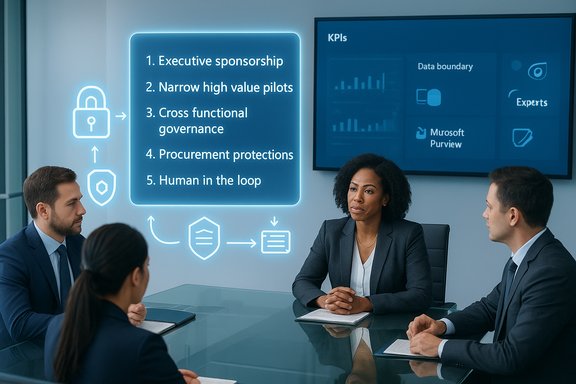
Law360’s five-step playbook for General Counsel to drive generative‑AI experimentation is both a timely wake-up call and a practical blueprint: pair executive sponsorship with measurable targets; start with narrow, high‑value pilots; build cross‑functional governance; insist on ironclad procurement protections; and make human verification the non‑negotiable final gate.
Generative AI has moved from experiments and vendor demos into routine legal tasks—drafting, transcript summarization, precedent extraction and matter triage. That shift brings genuine productivity upside but also real professional risks: hallucinations, inadvertent data exposure, vendor retraining on matter data, and growing regulatory scrutiny. Law360 synthesizes practitioner experience into a five‑step roadmap aimed at legal teams that must square the duty of competence and confidentiality with the pressure to modernize.
This article validates Law360’s practical recommendations against technical realities and regulatory guidance, highlights what works in Windows‑centric environments (Office 365 / Microsoft 365 + Copilot), and surfaces the operational and legal pitfalls GCs must defend against before scaling pilots into production.
Three practical corollaries:
Technical / safety KPIs
Source: Law360 5 Steps For GCs To Drive Generative AI Experimentation - Law360 Pulse
 Background / Overview
Generative AI has moved from experiments and vendor demos into routine legal tasks—drafting, transcript summarization, precedent extraction and matter triage. That shift brings genuine productivity upside but also real professional risks: hallucinations, inadvertent data exposure, vendor retraining on matter data, and growing regulatory scrutiny. Law360 synthesizes practitioner experience into a five‑step roadmap aimed at legal teams that must square the duty of competence and confidentiality with the pressure to modernize.This article validates Law360’s practical recommendations against technical realities and regulatory guidance, highlights what works in Windows‑centric environments (Office 365 / Microsoft 365 + Copilot), and surfaces the operational and legal pitfalls GCs must defend against before scaling pilots into production.
Why GCs must treat AI as a program, not a plugin
AI experimentation fails most often when the organization treats a pilot as the finish line rather than the starting line of operating‑model change. The right mindset reframes AI as a capability that demands process redesign, measurable outcomes, and durable governance—exactly the disciplines legal teams already apply to cybersecurity or eDiscovery programs. Law360’s framework centers on the same principles: measure outcomes, document controls, and lock contractual and technical artifacts into procurement.Three practical corollaries:
- Treat pilot success as evidence for workflow redesign, not license counts.
- Require baseline KPIs (time to first draft, partner review time, error/correction rates) and instrument everything.
- Make human verification mandatory for any outward‑facing or filed product; guidance alone is insufficient without process controls and audit trails.
The Five Steps — distilled and actionable
1) Executive sponsorship + measurable targets
GCs should secure an executive mandate and translate it into specific KPIs and timelines. An executive sponsor removes stovepipes and unlocks procurement and IT resources; measurable targets (e.g., “reduce partner review time on standard memos by 30% in 6 months”) make pilots accountable and auditable. Law360 emphasizes pairing leadership support with tangible metrics.2) Start with narrow, high‑value, low‑risk pilots
Begin with constrained workflows where outputs are easy to verify: transcript summarization, clause extraction, precedent lookup, and first‑draft memos. Use redacted or synthetic datasets in sandboxes and log every prompt/response. These are the classic “safe landing zones” Law360 recommends.3) Build cross‑functional governance
Create a steering group with legal partners, practice leads, security/IT, procurement, KM and senior paralegals. Define role‑based responsibilities (model owner, steward, human verifier) and governance outputs (human‑to‑agent ratios, escalation paths, runbooks). Governance ensures pilots remain auditable and align with ethical duties.4) Insist on procurement and contractual protections
Treat AI vendors as high‑risk suppliers. Minimum contractual items Law360 recommends include:- Exportable, machine‑readable logs (prompts, responses, user IDs, timestamps).
- Explicit no‑retrain clauses or auditable opt‑ins preventing vendor use of matter data for model training.
- Deletion and egress guarantees and robust incident response SLAs.
5) Bake human‑in‑the‑loop verification into workflows
Make human review the default for everything that will be filed, presented to clients, or used in decisioning. Use mandatory checklists, role‑based approvals, and competency gates—don’t rely on informal guidance. The practical emphasis is on process controls and documented sign‑offs, which both preserve professional judgment and create defensible audit trails.Technical controls that matter — Windows & Microsoft 365 special considerations
For law departments embedded in the Microsoft ecosystem, several platform features materially reduce risk when configured correctly.- Tenant grounding and enterprise data boundary: Microsoft’s Copilot for Microsoft 365 processes prompts and responses within the customer’s Microsoft 365 service boundary and documents that organizational data isn’t used to train the base models by default. Admins can manage retention, eDiscovery, and audit policies via Microsoft Purview.
- Conditional Access and MFA: Ensure only authorized identities may access AI features; enforce device posture checks before Copilot or other assistants can access matter data.
- Endpoint DLP and paste‑controls: Prevent accidental copy/paste of confidential matter text into third‑party public endpoints. Endpoint DLP plus sensitivity labels and Purview policies reduce exfiltration risk.
- Centralized logging & observability: Log every model call with user ID, model/version, timestamp and prompt/response content (as permitted), and make those logs exportable for eDiscovery or audits. Law360 calls exportable machine‑readable logs a non‑negotiable procurement ask.
Procurement checklists and contract language GC teams should demand
- Exportable, machine‑readable logs (prompts, responses, user IDs, model version, timestamps).
- Explicit prohibition on using customer data for model training without written opt‑in (“Vendor shall not use Customer Data to train, fine‑tune, or otherwise improve models unless Customer expressly agrees in writing”).
- Deletion guarantees and egress mechanisms enabling the firm to retrieve copies of data and to terminate vendor access.
- Security attestations (current SOC 2 / ISO 27001) and encryption (KMS, private endpoints).
- Incident response SLAs with measurable timelines and breach escalation processes.
Human factors: training, supervision and avoiding deskilling
Law360 stresses training that goes well beyond a 60‑minute demo. A defensible program includes:- Role‑based modules (prompt hygiene, hallucination detection, verification standards, incident reporting).
- Competency demonstrations and micro‑certifications for anyone who will sign off on AI‑assisted legal work.
- Reworked performance metrics that reward quality‑adjusted outcomes rather than raw throughput, to avoid extracting productivity as more billable hours without client benefit.
Regulatory and litigation context — what’s already happening
Courts and regulators are not theoretical pressure points: multiple recent court decisions have sanctioned attorneys for submitting filings containing fabricated AI‑generated citations. Those sanctions show the ethical duty: verify everything generated by AI before submission. Reuters and the Associated Press report several such sanctions and disciplinary referrals, underscoring the real consequences of failing to supervise AI outputs. At the policy level:- The NIST AI Risk Management Framework (AI RMF) is the de facto U.S. guidance for risk‑based AI oversight; it explicitly calls for governance, measurement, logging and human oversight across the AI lifecycle. Use it as a playbook for internal controls.
- The EU AI Act establishes an enforceable, risk‑based regulatory regime imposing documentation, risk assessments, and transparency obligations on many AI deployments—something multinational legal teams must monitor and map into their vendor contracts and audit practices.
What to measure — KPIs that matter
Counting seats or installs is meaningless. Useful metrics include:Technical / safety KPIs
- Number of DLP events tied to AI use.
- Share of AI outputs requiring human correction.
- Verification time per document.
- Prompt/response audit coverage and retention compliance.
- Average partner review time per document (pre/post).
- Turnaround time to first draft.
- Error rate in client deliverables attributable to AI.
- Client satisfaction or NPS for AI‑augmented services and realized cost avoidance.
A practical 90–180 day playbook for GCs
- Weeks 0–4 — Assess & prioritize
- Inventory high‑frequency legal tasks and score by frequency, legal risk and time‑savings potential.
- Run a readiness checklist: identity posture, DLP, connectors and training capacity.
- Weeks 4–12 — Pick pilots & sandbox
- Select 1–3 high‑value, low‑ambiguity workflows. Use redacted/synthetic data, log every prompt/response, define baseline KPIs.
- Concurrent — Secure governance & procurement artifacts
- Establish roles, an AI accountability board, and vendor addenda with no‑retrain and exportable log guarantees. Treat refusal as a red flag.
- Weeks 12–26 — Pilot measurement & verification
- Require human sign‑offs for any external use. Instrument telemetry (token usage, model version, verification outcomes) and run QA.
- Months 6+ — Harden & scale
- Convert successful pilots into templated patterns (identity, data access, monitoring, runbooks). Maintain ongoing audit cadence and update procurement templates.
Strengths of Law360’s five‑step framework — and the blind spots
Strengths- Actionable: concrete pilot cadence, KPIs, and contractual checklists that legal teams can use immediately.
- Governance‑centric: mandatory human verification and cross‑functional steering make compliance practical.
- Platform‑aware: Microsoft‑specific controls (Conditional Access, Purview, Endpoint DLP) are realistic mitigations for firms entrenched in Windows ecosystems.
- Resource assumptions: the framework assumes access to IT, procurement and security bandwidth; smaller firms or corporate GCs may need pragmatic third‑party help.
- ROI measurement window: robust ROI often requires a 6–12 month horizon and careful incentive redesign—don’t cherry‑pick pilot statistics.
- Jurisdictional nuance: duty of supervision and privacy obligations differ by state and country; adapt verification and retention policies to local bar opinions and statutory requirements.
Final recommendations — a short checklist for GCs ready to act
- Secure executive sponsorship and define two measurable KPIs for your first pilot.
- Start with one narrow, high‑value workflow; use redacted/synthetic data and log everything.
- Negotiate vendor addenda that include no‑retrain clauses, exportable logs, deletion guarantees, and SLAs; treat refusal as a red flag.
- Configure Microsoft‑specific controls before matter data flows into assistants: Conditional Access, MFA, Endpoint DLP, Purview retention and Copilot tenant grounding.
- Institute role‑based competency gates and mandatory human verification for all outputs that will be filed or client‑facing.
Conclusion
Law360’s five‑step roadmap gives GCs a practical, enforceable starting point to convert curiosity into controlled value. The imperative is simple but non‑trivial: pair pilots with governance, lock protections into contracts, instrument outcomes with auditable telemetry, and never abdicate human judgment on outputs that matter. Implemented together—and verified with telemetry, contractual guarantees and platform controls—these steps let legal teams realize productivity gains while preserving professional obligations and client trust. The alternative is clear: pilots that stop at “the tool works” will not scale to sustainable value and may invite regulatory, ethical and reputational consequences.Source: Law360 5 Steps For GCs To Drive Generative AI Experimentation - Law360 Pulse
