
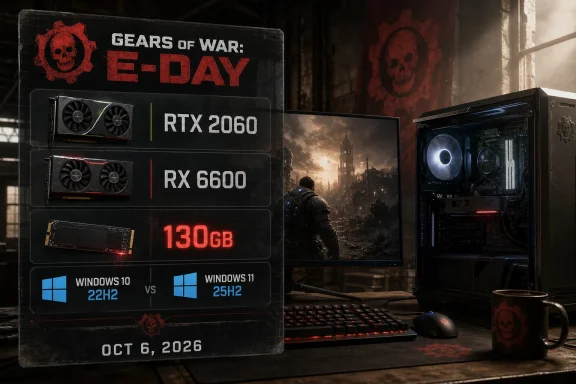
Gears of War: E-Day now has published PC requirements ahead of its October 6, 2026 launch on Windows PC and Xbox Series X|S, with The Coalition listing an RTX 2060 or Radeon RX 6600 as the minimum GPU and a 130GB SSD install as the entry ticket. The headline is not that Microsoft’s biggest fall shooter needs a modern-ish graphics card. It is that the acceptable floor for blockbuster PC gaming has moved, visibly and perhaps permanently, beyond the old GTX comfort zone. For Windows gamers and IT-minded households that still treat a Pascal-era rig as “good enough,” E-Day is a warning shot dressed up as a spec sheet.
PC requirements used to be a kind of optimism ritual. A publisher would list a heroic minimum configuration, players would squint at it, and half the community would attempt to run the thing on hardware that barely met the letter of the spec. In 2026, that dance is becoming less forgiving.
The Coalition’s minimum PC requirements for Gears of War: E-Day start with Windows 10 22H2, 12GB of RAM, a Ryzen 5 2600X or Core i7-6850K, and an RTX 2060 or Radeon RX 6600. The recommended tier moves to Windows 11 25H2, 16GB of RAM, a Ryzen 5 5600 or Core i5-11600K, and an RTX 3060 Ti or Radeon RX 6700 XT. Both tiers point toward a game built for SSDs and modern rendering assumptions rather than for the broadest possible installed base.
That RTX 2060 minimum is the symbolic break. Nvidia’s first-generation RTX card is not new, glamorous, or exotic. It launched into the market years ago as the affordable gateway to hardware ray tracing and DLSS, and by today’s standards it is a modest card. But it is also the first mainstream Nvidia generation that crossed the architectural line developers increasingly care about.
That makes E-Day’s requirements less a case of one demanding shooter and more a visible marker of a broader PC gaming reset. The question is no longer whether an old GTX 1060 can still launch new games. The question is whether studios can afford to design around hardware that lacks the features their engines, lighting systems, upscalers, and asset pipelines now assume.
But relevance in PC gaming is not just rasterization performance. It is also driver support, feature support, testing coverage, and the willingness of studios to keep fallback paths alive. Once Nvidia stopped delivering new game-specific optimizations for Pascal-era GTX cards, the economics changed even if the silicon did not suddenly stop working.
That distinction matters. A GTX 1080 Ti may still outrun an RTX 2060 in many traditional rasterized workloads, and it will continue to play a long tail of existing games very well. But if a modern title leans on hardware ray tracing, mesh shaders, advanced upscaling integration, or rendering paths validated primarily on newer APIs and architectures, raw legacy muscle becomes less useful than compatibility with the current stack.
E-Day’s minimum spec does not necessarily mean the game is impossible to boot on a GTX card. PC games are messy, launchers are leaky, and unsupported hardware sometimes runs better than expected. But the absence of GTX from the official minimum column tells users something more important than whether they can brute-force the executable: if it breaks, stutters, renders incorrectly, or fails to perform, they are outside the supported bargain.
The reported 130GB footprint includes the campaign, multiplayer modes, and Horde co-op, which makes the figure easier to understand but not easier to swallow. Gears has always been a spectacle franchise: dense environments, heavy texture work, cinematic animation, elaborate effects, and a soundscape designed to make cover shooting feel like artillery. Modern versions of that formula are not small.
The SSD requirement also reflects the way current consoles have reshaped PC assumptions. Xbox Series X|S and PlayStation 5 made fast storage a baseline design element rather than a luxury. Even on PC, developers increasingly expect rapid streaming of high-resolution assets instead of building around the seek-time limitations of hard drives.
That is good for level design and visual consistency. It is bad for anyone trying to keep a modest gaming library installed without juggling uninstall queues. Windows users who bought a 512GB or 1TB system drive during the last upgrade cycle are now discovering that the real minimum spec for premium gaming is not just a GPU; it is a storage strategy.
Windows 10 remains present because PC gaming markets move more slowly than Microsoft’s lifecycle posters would like. A hard Windows 11 requirement would create unnecessary friction, especially for users whose systems remain technically capable but blocked by TPM, CPU support lists, or simple inertia. A minimum Windows 10 listing keeps the funnel wide.
But the recommended Windows 11 25H2 line is equally meaningful. It tells performance-minded players where Microsoft and The Coalition expect the better-supported path to be. That can include scheduler behavior, graphics stack improvements, DirectStorage-era plumbing, driver validation, HDR handling, and the simple fact that new first-party testing effort tends to follow the current platform.
For WindowsForum readers, this is the quiet enterprise-adjacent angle. Gaming requirements are consumer documents, but they often reveal where Microsoft sees the mainstream client stack going. Windows 10 may run the game, but Windows 11 is where the platform owner wants the performance conversation to happen.
Gears of War: E-Day fits that strategy neatly. It launches day one on PC and Xbox, and it will be available through PC Game Pass and Game Pass Ultimate. That makes the access story generous on paper, particularly compared with the older model of platform exclusivity and delayed PC ports.
But access is not the same as readiness. Game Pass can remove the $70 purchase barrier, but it cannot make an aging GPU understand new rendering assumptions or create 130GB of fast storage out of thin air. Subscription distribution makes the hardware floor more visible because more people will be able to try the game immediately.
That is where Microsoft’s PC pitch has become more complicated. The company wants Windows to be the natural home for Xbox games, but high-end first-party releases increasingly behave like console-generation showcases. The result is a broad storefront funnel narrowing quickly at the point of actual hardware.
That boundary matters because Gears is not just another shooter in the catalog. It is one of the series that defined Xbox as a console brand, alongside Halo and Forza. A prequel about Emergence Day is therefore not merely content; it is brand archaeology.
The reported shift away from a PS5 plan, or at least away from expectations that a PS5 version was in the cards at launch, reinforces how fluid Microsoft’s platform messaging has become. Some Xbox games are now multiplatform ambassadors. Others remain ecosystem anchors. E-Day appears to be in the second camp, at least for launch.
For PC players, this is a win in practical terms. Windows is treated as part of the primary launch platform, not as a later port destination. For Xbox console owners, Microsoft gets to say the franchise still belongs to the Xbox side of the map. For PlayStation users, the message is less friendly: Microsoft may be more open than it used to be, but it has not abandoned exclusivity as leverage.
The important change is that developers are no longer simply asking for more power. They are asking for different kinds of capability. Hardware ray tracing, modern shader models, fast decompression paths, and upscaler-friendly rendering pipelines are not interchangeable with the old formula of “turn down shadows and hope.”
This is why the GTX 10 omission resonates beyond Nvidia branding. Pascal cards were terrific products, but they come from a pre-RTX design era. They were built for a world where real-time ray tracing was a demo-stage luxury and temporal upscalers had not become central to mainstream performance targets.
The Coalition has not said that E-Day is impossible on anything older than the listed GPUs, and players should be wary of reading too much technical certainty into a marketing spec table. But the industry direction is plain enough. The mainstream PC minimum is converging with the feature set of the current console generation and the early RTX era, not with the beloved cards that dominated Steam charts five years ago.
An RTX 3060 Ti or Radeon RX 6700 XT suggests The Coalition is targeting a relatively capable 1080p or 1440p experience rather than a low-end survival mode. These are not ultra-premium GPUs in 2026, but they are also far above the integrated graphics and old midrange cards found in casual gaming PCs. The recommended CPUs, a Ryzen 5 5600 or Core i5-11600K, point to six-core mainstream systems from the last several years rather than exotic workstation builds.
In other words, E-Day is not making an absurd demand of current PC gamers. It is making a cold demand of old PC gamers. If you built or bought a sensible midrange gaming machine during the Ampere and RDNA 2 era, you are probably in the conversation. If you have been riding a 2016 GPU because it still handles esports and older AAA games, the conversation is moving on without you.
This is the uncomfortable reality of PC gaming’s long hardware tail. The platform’s strength is that old machines can remain useful for years. Its weakness is that every major rendering transition eventually turns that long tail into a support problem. E-Day is arriving at exactly the moment when publishers are willing to stop pretending that the tail is still the center.
That can be consumer-friendly. Players can test performance without committing to a standalone purchase. They can decide whether their system is close enough, whether settings compromises are acceptable, and whether an upgrade is worth it. In that sense, Game Pass turns PC requirements from a pre-purchase warning into a practical experiment.
But it also exposes a gap in Microsoft’s ecosystem story. The subscription gets you the license, not the experience. If the download is 130GB, the install takes hours, and the game then tells a GTX 1070 owner that unsupported means unsupported, the “day-one access” pitch may feel less magical.
For Microsoft, that is still probably an acceptable trade. Game Pass thrives on big launches that make the library feel alive. For users, the smarter approach is to treat E-Day as a benchmark for the health of the whole system, not just a game to squeeze onto a drive in October.
That is especially true for the storage requirement. A 130GB install on a nearly full SATA SSD is not the same experience as the same install on a modern NVMe drive with ample free space. Windows itself, shader caches, Game Pass app behavior, driver packages, and updates all need breathing room.
CPU requirements are less dramatic but still worth respecting. The minimum Ryzen 5 2600X and Core i7-6850K suggest that older four-core systems are no longer comfortable assumptions for a marquee shooter with campaign, multiplayer, and co-op simulation demands. The recommended Ryzen 5 5600 and Core i5-11600K are mainstream chips, but they represent the post-quad-core normal.
This is where Windows enthusiasts should resist the temptation to reduce the news to a GPU meme. The GTX 10 exit is the flashy part. The real shift is platform-wide: modern AAA games increasingly expect a balanced PC with enough CPU threads, enough memory, enough GPU features, and enough fast storage.
For years, PC players benefited from the cross-generation drag of older consoles. Developers had to make games run on Jaguar CPUs, hard drives, and relatively constrained memory pools, and PC minimum specs reflected that compromise. The current generation has finally been allowed to breathe, and PC requirements are catching up with the design freedom that consoles normalized.
That does not mean optimization no longer matters. It matters more than ever, because modern engines can be brutally uneven across hardware. The difference between a demanding but well-optimized game and a demanding mess remains enormous. The Coalition will still have to prove that E-Day’s requirements translate into stable frame pacing, scalable settings, sensible shader compilation, and good support across Nvidia, AMD, and Intel GPUs.
But the baseline itself is shifting whether any one game lands gracefully or not. The era when a GTX 1060 could be assumed to sit near the minimum line for every major release is over. E-Day simply writes that reality in one of Microsoft’s most visible franchises.
 The Minimum Spec Is the Message
PC requirements used to be a kind of optimism ritual. A publisher would list a heroic minimum configuration, players would squint at it, and half the community would attempt to run the thing on hardware that barely met the letter of the spec. In 2026, that dance is becoming less forgiving.The Coalition’s minimum PC requirements for Gears of War: E-Day start with Windows 10 22H2, 12GB of RAM, a Ryzen 5 2600X or Core i7-6850K, and an RTX 2060 or Radeon RX 6600. The recommended tier moves to Windows 11 25H2, 16GB of RAM, a Ryzen 5 5600 or Core i5-11600K, and an RTX 3060 Ti or Radeon RX 6700 XT. Both tiers point toward a game built for SSDs and modern rendering assumptions rather than for the broadest possible installed base.
That RTX 2060 minimum is the symbolic break. Nvidia’s first-generation RTX card is not new, glamorous, or exotic. It launched into the market years ago as the affordable gateway to hardware ray tracing and DLSS, and by today’s standards it is a modest card. But it is also the first mainstream Nvidia generation that crossed the architectural line developers increasingly care about.
That makes E-Day’s requirements less a case of one demanding shooter and more a visible marker of a broader PC gaming reset. The question is no longer whether an old GTX 1060 can still launch new games. The question is whether studios can afford to design around hardware that lacks the features their engines, lighting systems, upscalers, and asset pipelines now assume.
GTX 10 Cards Are Not Dead, but They Are Being Left Outside the Door
The GeForce GTX 10 series had one of the best runs in PC gaming history. The GTX 1060 became the default Steam survey workhorse, the GTX 1070 and 1080 carried an entire generation of high-refresh 1080p and early 1440p builds, and the GTX 1080 Ti developed the kind of reputation usually reserved for cult CPUs. These cards were fast, efficient, and stubbornly relevant.But relevance in PC gaming is not just rasterization performance. It is also driver support, feature support, testing coverage, and the willingness of studios to keep fallback paths alive. Once Nvidia stopped delivering new game-specific optimizations for Pascal-era GTX cards, the economics changed even if the silicon did not suddenly stop working.
That distinction matters. A GTX 1080 Ti may still outrun an RTX 2060 in many traditional rasterized workloads, and it will continue to play a long tail of existing games very well. But if a modern title leans on hardware ray tracing, mesh shaders, advanced upscaling integration, or rendering paths validated primarily on newer APIs and architectures, raw legacy muscle becomes less useful than compatibility with the current stack.
E-Day’s minimum spec does not necessarily mean the game is impossible to boot on a GTX card. PC games are messy, launchers are leaky, and unsupported hardware sometimes runs better than expected. But the absence of GTX from the official minimum column tells users something more important than whether they can brute-force the executable: if it breaks, stutters, renders incorrectly, or fails to perform, they are outside the supported bargain.
The 130GB Install Is the Other Hardware Requirement Nobody Wants to Talk About
The GPU line will get the argument clicks, but the 130GB storage requirement may be the more universal pain point. It is one thing to ask PC enthusiasts to retire eight- or nine-year-old graphics cards. It is another to normalize single games consuming a substantial slice of a 1TB SSD.The reported 130GB footprint includes the campaign, multiplayer modes, and Horde co-op, which makes the figure easier to understand but not easier to swallow. Gears has always been a spectacle franchise: dense environments, heavy texture work, cinematic animation, elaborate effects, and a soundscape designed to make cover shooting feel like artillery. Modern versions of that formula are not small.
The SSD requirement also reflects the way current consoles have reshaped PC assumptions. Xbox Series X|S and PlayStation 5 made fast storage a baseline design element rather than a luxury. Even on PC, developers increasingly expect rapid streaming of high-resolution assets instead of building around the seek-time limitations of hard drives.
That is good for level design and visual consistency. It is bad for anyone trying to keep a modest gaming library installed without juggling uninstall queues. Windows users who bought a 512GB or 1TB system drive during the last upgrade cycle are now discovering that the real minimum spec for premium gaming is not just a GPU; it is a storage strategy.
Windows 10 Survives at Minimum, Windows 11 Gets the Preferred Seat
The split between Windows 10 22H2 at minimum and Windows 11 25H2 at recommended is classic Microsoft positioning. It avoids cutting off the large remaining Windows 10 audience while nudging the enthusiast baseline toward the current OS. For a first-party Xbox title, that balance is not accidental.Windows 10 remains present because PC gaming markets move more slowly than Microsoft’s lifecycle posters would like. A hard Windows 11 requirement would create unnecessary friction, especially for users whose systems remain technically capable but blocked by TPM, CPU support lists, or simple inertia. A minimum Windows 10 listing keeps the funnel wide.
But the recommended Windows 11 25H2 line is equally meaningful. It tells performance-minded players where Microsoft and The Coalition expect the better-supported path to be. That can include scheduler behavior, graphics stack improvements, DirectStorage-era plumbing, driver validation, HDR handling, and the simple fact that new first-party testing effort tends to follow the current platform.
For WindowsForum readers, this is the quiet enterprise-adjacent angle. Gaming requirements are consumer documents, but they often reveal where Microsoft sees the mainstream client stack going. Windows 10 may run the game, but Windows 11 is where the platform owner wants the performance conversation to happen.
E-Day Turns the Xbox PC Strategy Into a Hardware Filter
Microsoft’s modern Xbox strategy is built on reach. A major first-party game arrives on Xbox consoles, Windows PCs, Steam, Microsoft Store, and Game Pass. The old wall between console and PC has been replaced by an ecosystem pitch: play where you want, pay how you want, stay inside Microsoft’s orbit.Gears of War: E-Day fits that strategy neatly. It launches day one on PC and Xbox, and it will be available through PC Game Pass and Game Pass Ultimate. That makes the access story generous on paper, particularly compared with the older model of platform exclusivity and delayed PC ports.
But access is not the same as readiness. Game Pass can remove the $70 purchase barrier, but it cannot make an aging GPU understand new rendering assumptions or create 130GB of fast storage out of thin air. Subscription distribution makes the hardware floor more visible because more people will be able to try the game immediately.
That is where Microsoft’s PC pitch has become more complicated. The company wants Windows to be the natural home for Xbox games, but high-end first-party releases increasingly behave like console-generation showcases. The result is a broad storefront funnel narrowing quickly at the point of actual hardware.
The Console Exclusive Language Is Doing Political Work
The platform story around E-Day is also notable for what it is not. After Microsoft’s broader experiments with bringing selected Xbox games to PlayStation and Nintendo platforms, every major first-party announcement now carries an extra layer of scrutiny. E-Day being positioned as an Xbox console exclusive, with PC included on day one, is Microsoft drawing a boundary around one of its identity franchises.That boundary matters because Gears is not just another shooter in the catalog. It is one of the series that defined Xbox as a console brand, alongside Halo and Forza. A prequel about Emergence Day is therefore not merely content; it is brand archaeology.
The reported shift away from a PS5 plan, or at least away from expectations that a PS5 version was in the cards at launch, reinforces how fluid Microsoft’s platform messaging has become. Some Xbox games are now multiplatform ambassadors. Others remain ecosystem anchors. E-Day appears to be in the second camp, at least for launch.
For PC players, this is a win in practical terms. Windows is treated as part of the primary launch platform, not as a later port destination. For Xbox console owners, Microsoft gets to say the franchise still belongs to the Xbox side of the map. For PlayStation users, the message is less friendly: Microsoft may be more open than it used to be, but it has not abandoned exclusivity as leverage.
Unreal Engine 5 Has Changed the Shape of “Reasonable”
Even without reducing E-Day to an engine story, it is hard to ignore the broader context of modern Unreal Engine 5 development. The industry’s visual baseline has shifted toward dense geometry, complex lighting, temporal reconstruction, aggressive streaming, and large asset sets. Those choices produce impressive screenshots and cinematic trailers, but they also move the burden onto GPUs, VRAM, CPUs, and storage.The important change is that developers are no longer simply asking for more power. They are asking for different kinds of capability. Hardware ray tracing, modern shader models, fast decompression paths, and upscaler-friendly rendering pipelines are not interchangeable with the old formula of “turn down shadows and hope.”
This is why the GTX 10 omission resonates beyond Nvidia branding. Pascal cards were terrific products, but they come from a pre-RTX design era. They were built for a world where real-time ray tracing was a demo-stage luxury and temporal upscalers had not become central to mainstream performance targets.
The Coalition has not said that E-Day is impossible on anything older than the listed GPUs, and players should be wary of reading too much technical certainty into a marketing spec table. But the industry direction is plain enough. The mainstream PC minimum is converging with the feature set of the current console generation and the early RTX era, not with the beloved cards that dominated Steam charts five years ago.
Recommended Now Means “The Experience We Want Reviewed”
The recommended tier is often more revealing than the minimum tier. Minimum specs define liability. Recommended specs define aspiration.An RTX 3060 Ti or Radeon RX 6700 XT suggests The Coalition is targeting a relatively capable 1080p or 1440p experience rather than a low-end survival mode. These are not ultra-premium GPUs in 2026, but they are also far above the integrated graphics and old midrange cards found in casual gaming PCs. The recommended CPUs, a Ryzen 5 5600 or Core i5-11600K, point to six-core mainstream systems from the last several years rather than exotic workstation builds.
In other words, E-Day is not making an absurd demand of current PC gamers. It is making a cold demand of old PC gamers. If you built or bought a sensible midrange gaming machine during the Ampere and RDNA 2 era, you are probably in the conversation. If you have been riding a 2016 GPU because it still handles esports and older AAA games, the conversation is moving on without you.
This is the uncomfortable reality of PC gaming’s long hardware tail. The platform’s strength is that old machines can remain useful for years. Its weakness is that every major rendering transition eventually turns that long tail into a support problem. E-Day is arriving at exactly the moment when publishers are willing to stop pretending that the tail is still the center.
Game Pass Makes the Upgrade Question More Honest
Game Pass changes how players evaluate a game like E-Day. If the game were only a full-price boxed-style purchase, some users with borderline PCs might wait for benchmarks, patches, and a sale. With a subscription, the temptation is to install first and diagnose later.That can be consumer-friendly. Players can test performance without committing to a standalone purchase. They can decide whether their system is close enough, whether settings compromises are acceptable, and whether an upgrade is worth it. In that sense, Game Pass turns PC requirements from a pre-purchase warning into a practical experiment.
But it also exposes a gap in Microsoft’s ecosystem story. The subscription gets you the license, not the experience. If the download is 130GB, the install takes hours, and the game then tells a GTX 1070 owner that unsupported means unsupported, the “day-one access” pitch may feel less magical.
For Microsoft, that is still probably an acceptable trade. Game Pass thrives on big launches that make the library feel alive. For users, the smarter approach is to treat E-Day as a benchmark for the health of the whole system, not just a game to squeeze onto a drive in October.
The Upgrade Path Is Narrower Than It Looks
The obvious advice is to upgrade the GPU, but the real upgrade path may involve more than one component. A user with a GTX 1060-era system may also have 8GB or 16GB of slower RAM, a smaller SATA SSD, an older quad-core CPU, and a power supply that was never meant for modern graphics cards. E-Day’s spec sheet may be the first warning sign, not the only bottleneck.That is especially true for the storage requirement. A 130GB install on a nearly full SATA SSD is not the same experience as the same install on a modern NVMe drive with ample free space. Windows itself, shader caches, Game Pass app behavior, driver packages, and updates all need breathing room.
CPU requirements are less dramatic but still worth respecting. The minimum Ryzen 5 2600X and Core i7-6850K suggest that older four-core systems are no longer comfortable assumptions for a marquee shooter with campaign, multiplayer, and co-op simulation demands. The recommended Ryzen 5 5600 and Core i5-11600K are mainstream chips, but they represent the post-quad-core normal.
This is where Windows enthusiasts should resist the temptation to reduce the news to a GPU meme. The GTX 10 exit is the flashy part. The real shift is platform-wide: modern AAA games increasingly expect a balanced PC with enough CPU threads, enough memory, enough GPU features, and enough fast storage.
The Windows Gaming Baseline Just Moved Again
The E-Day requirements are not outrageous by 2026 standards. That is precisely why they matter. A shocking spec sheet can be dismissed as one studio’s indulgence; a reasonable spec sheet that quietly excludes a huge class of older hardware is a trend.For years, PC players benefited from the cross-generation drag of older consoles. Developers had to make games run on Jaguar CPUs, hard drives, and relatively constrained memory pools, and PC minimum specs reflected that compromise. The current generation has finally been allowed to breathe, and PC requirements are catching up with the design freedom that consoles normalized.
That does not mean optimization no longer matters. It matters more than ever, because modern engines can be brutally uneven across hardware. The difference between a demanding but well-optimized game and a demanding mess remains enormous. The Coalition will still have to prove that E-Day’s requirements translate into stable frame pacing, scalable settings, sensible shader compilation, and good support across Nvidia, AMD, and Intel GPUs.
But the baseline itself is shifting whether any one game lands gracefully or not. The era when a GTX 1060 could be assumed to sit near the minimum line for every major release is over. E-Day simply writes that reality in one of Microsoft’s most visible franchises.
E-Day’s Spec Sheet Draws the New Line in the Sand
The practical lesson is not panic-buying a GPU before October. It is understanding what The Coalition’s published requirements imply about the next phase of Windows gaming. E-Day looks less like an isolated heavyweight and more like a signpost for where first-party showcases, Unreal Engine 5 production values, and post-GTX driver realities are converging.- Gears of War: E-Day launches on October 6, 2026 for Windows PC and Xbox Series X|S, with day-one availability through PC Game Pass and Game Pass Ultimate.
- The minimum PC GPU tier begins at the RTX 2060 or Radeon RX 6600, effectively moving official support beyond Nvidia’s GTX 10-series generation.
- The game’s 130GB SSD footprint makes storage capacity and speed part of the real-world requirement, not an afterthought.
- Windows 10 22H2 remains listed at minimum, but Windows 11 25H2 is the recommended operating system for the preferred PC experience.
- The recommended tier points to a modern midrange machine rather than an enthusiast monster, which makes the exclusion of older systems more significant.
- Players with Pascal-era rigs should treat E-Day as a broader upgrade audit rather than a single-game compatibility problem.
References
- Primary source: KitGuru
Published: 2026-06-16T13:20:08.227448
Gears of War E-Day PC system requirements announced | KitGuru
Following on from the Gears of War E-Day showcase earlier this month, the team at The Coalition haswww.kitguru.net - Related coverage: pcgamer.com
Gears of War: E-Day system requirements are here and it might be bad news for GTX 10-series cards and, well, storage in general | PC Gamer
130 GB is a whopper and a half.www.pcgamer.com - Related coverage: gamesradar.com
The Coalition says that Gears of War: E-Day "isn't a reaction to Gears 5" | GamesRadar+
Summer Preview | The Coalition takes you inside Gears of War: E-Day, the upcoming Xbox console exclusive that marks 20 years of Gearswww.gamesradar.com - Related coverage: xbox.com
Gears of War: E-Day – Available 10/6/2026 on XBOX and with Game Pass | XBOX
Pre-order now. Available October 6, 2026 on XBOX Series X|S, XBOX on PC, and with Game Pass. Experience the horror of Emergence Day.www.xbox.com - Related coverage: store.steampowered.com
Forhåndskjøp Gears of War: E-Day på Steam
Opplev Emergence Day – den brutale opprinnelseshistorien til en av spilleverdenens mest kritikerroste tredjepersons skytespillfranchiser.store.steampowered.com
- Related coverage: allthings.how
Gears of War: E-Day PC Requirements Drop GTX Cards and Demand an SSD
The October 6 shooter skips older GTX hardware, leans on DirectX 12 Ultimate GPUs, and needs 130GB of solid-state space.allthings.how
- Related coverage: tweaktown.com
Gears of War: E-Day PC requirements detailed with GeForce RTX 2060 minimum and RTX 5060 recommended
Gears of War: E-Day's PC hardware requirements are here, the Minimum spec calls for a GeForce RTX 2060, while the Recommended calls for an RTX 5060 GPU. www.tweaktown.com
- Related coverage: pcmrace.com
Gears of War: E-Day llega a PC y XS el 6 de Octubre - Requisitos, Reserva Screenshots y Trailer de Gameplay | PC Master Race Latinoamérica
Xbox Game Studios y la desarrolladora The Coalition han anunciado hoy Gears of War: E-Day, la brutal historia de origen de la franquicia de disparos enwww.pcmrace.com - Related coverage: techmymoney.com
Gears of War E-Day Release Date: October 6
Gears of War: E-Day arrives October 6, 2026 for Xbox and PC, with Game Pass day-one access and an August open beta for pre-orders. techmymoney.com
- Related coverage: gameinformer.com
Gears Of War: E-Day Launches As A Console Exclusive On Xbox Series X/S And PC This October
Surive Emergence Day.gameinformer.com - Related coverage: pausehardware.com
Gears Of War: E-Day : Une RTX 2060 Suffit
Gears of War: E-Day demandera au minimum une RTX 2060, 12 Go de RAM et 130 Go SSD pour son lancement le 6 octobre 2026.pausehardware.com - Related coverage: techradar.com
'It's only fitting' — Sorry PS5 owners, Gears of War: E-Day will be an Xbox console exclusive when it launches in October | TechRadar
Microsoft has officially confirmed a release date for Gears of War: E-Day and confirmed that it will be an Xbox console launch exclusive.www.techradar.com - Related coverage: gaming-st.com
ギアーズ オブ ウォー E-Day PC必要スペック|RTX 2060で動くがGTX世代は全滅・130GB SSDの罠【2026年最新】 - ゲーミングスタイル
ギアーズ オブ ウォー E-Day のPC必要スペックを最低・推奨で整理。最低はRTX 2060クラスで動きますがGTX 10/16世代は対象外、推奨はRTX 5060クラスで130GB SSDが必須です。手持ちのPCで遊べるか、何を足せば足りるかが分かります。gaming-st.com - Related coverage: as.com
