

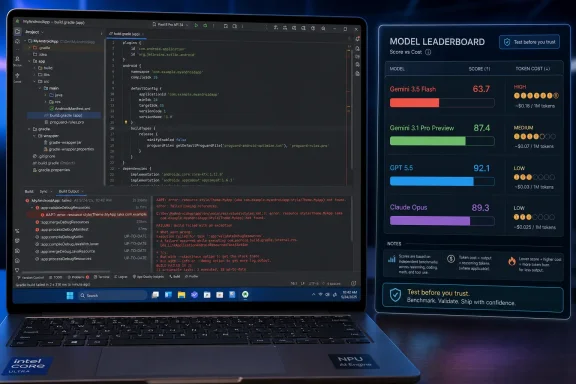
Google’s refreshed Android Bench rankings, published in June 2026 on the Android Developers site, show Gemini 3.5 Flash scoring 63.7 on Android coding tasks, behind OpenAI’s GPT 5.5, GPT 5.4, Gemini 3.1 Pro Preview, and two Claude Opus models. That is not a catastrophic result, but it is an awkward one. The model Google positioned as a faster, sharper successor looks, in this particular workload, like a premium-priced compromise. For developers, the lesson is blunt: the newest model is not automatically the best model, and “Flash” no longer guarantees the cheapest path through a coding job.
The uncomfortable part for Google is not that Gemini 3.5 Flash lost to OpenAI’s latest model. Frontier AI rankings move constantly, and a sixth-place finish on a demanding benchmark is not evidence of failure. The problem is that the result comes from Google’s own Android-focused benchmark, on Google’s own developer turf, in the exact category where Android Studio users might reasonably expect a Google model to shine.
Android Bench is not a general-purpose popularity contest. It is aimed at practical Android development tasks, the kind of work that exposes whether a model can reason through APIs, project structure, Kotlin or Java changes, Gradle behavior, UI conventions, and testable implementation details. That makes the result more meaningful to WindowsForum readers than another abstract leaderboard: many developers using Windows laptops, Android Studio, WSL, cloud agents, or CI pipelines are already deciding which AI tool gets to touch real code.
Gemini 3.5 Flash’s 63.7 score would be easier to shrug off if it came with the expected Flash tradeoff: less intelligence, but much better speed and cost. Instead, the published figures show the model averaging far more total tokens than the leading entries and carrying the highest average cost in the ranking. That flips the traditional bargain upside down.
Google did not brand Flash as the “lavish reasoning” tier. Flash has historically meant fast, scalable, and comparatively inexpensive. When the Flash-branded model is neither the best performer nor the cheapest runner, the branding starts to work against the product.
The strange number is not just the score. It is the cost.
According to the benchmark figures reported around the Android Bench update, Gemini 3.5 Flash averaged 355.9 total tokens and $147.1 per run. Gemini 3.1 Pro Preview, the older Google model above it, scored 72.4 while averaging 73.3 total tokens and $47.9 per run. In plain English: the older Google model did better, used far fewer tokens, and cost roughly a third as much in that ranking.
That is precisely the kind of data point that changes behavior inside development teams. A hobbyist may tolerate odd pricing if a model feels magical in a chat window. A platform team paying for repeated agentic runs against a codebase will notice when one model burns tokens while producing lower success rates.
It also complicates Google’s I/O 2026 story. Google pitched Gemini 3.5 Flash as a strong agentic and coding model, reportedly faster than rival frontier models and better than Gemini 3.1 Pro on several internal or broader benchmarks. Android Bench does not necessarily disprove those claims, but it narrows them. A model can be strong on terminal tasks, general coding suites, and agentic evaluations while still underperforming on Android-specific engineering work.
That distinction matters because developers do not buy benchmark averages. They buy outcomes inside their stack.
That is why an Android-specific benchmark can reveal weaknesses hidden by general coding tests. Android work often punishes confident partial solutions. A model that writes too much, reasons too broadly, or over-explains its way into irrelevant edits can become expensive without becoming more correct.
The token count attached to Gemini 3.5 Flash is therefore not just a billing curiosity. It suggests a model that may be spending more language to arrive at less successful outcomes on this test. In agentic coding, verbosity is not free; it consumes context, burns quota, slows review, and can bury the one change that actually matters.
For Windows developers working in Android Studio, JetBrains tooling, GitHub-hosted repositories, or local emulators, this is the practical concern. The best assistant is not the one that sounds most industrious. It is the one that changes the right file, respects the project, runs or suggests the right validation, and stops before it invents work.
There are possible explanations that do not involve Google shipping a worse model in every respect. Gemini 3.5 Flash may be tuned for different reasoning patterns. It may perform better in longer agent loops than in the benchmark’s task distribution. It may have stronger multimodal, planning, or general-purpose behavior that Android Bench does not reward. It may also improve through serving-side updates, prompt changes, or tool integrations.
But those caveats do not erase the result developers actually see. If Google’s Android benchmark says the older Pro Preview is a better and cheaper Android coding model, teams have permission to ignore the newer label. That is a healthy correction to the industry’s relentless version-number worship.
It also highlights a broader truth about AI coding assistants: model families are not linear products. They are shifting collections of tradeoffs. A “Flash” model may be faster in chat and still inefficient inside an agent harness. A “Pro” model may be older and still better calibrated for a narrow engineering task. A newer model may be more generally capable and still worse at the exact workflow a developer needs on Monday morning.
That message fits how developers actually work. Most coding assistant interactions are not heroic one-shot feats. They are small edits, explanation requests, test generation, refactors, error triage, dependency questions, and repetitive glue. A Flash model that gets 85 percent of those right quickly and cheaply is arguably more useful than a more expensive model reserved for rare deep problems.
That is why this Android Bench result stings. It does not merely say Gemini 3.5 Flash is behind GPT 5.5. It says the model missed the economic role its name implies, at least in this evaluation. It was not the low-cost scrappy contender. It was the most expensive model listed.
For enterprise buyers, naming matters because it becomes policy. Admins define which models are allowed in IDEs, which tiers are available to developers, and which workloads can touch external APIs. If Flash no longer reliably means “efficient default,” procurement and engineering leads need more granular controls than a brand label.
Android Bench also measures a particular kind of success. It does not represent every Android project, every IDE workflow, or every enterprise coding policy. A model that struggles with one benchmark may still be useful for explanation, code review, migration planning, UI prototyping, or documentation work. Developers should treat the ranking as evidence, not destiny.
But the opposite mistake is more common in AI marketing: dismissing any bad benchmark as narrow while celebrating every favorable benchmark as proof of general superiority. Google cannot have it both ways. If benchmark leadership is used to sell Gemini 3.5 Flash as a coding and agentic upgrade, then a benchmark where it trails older and rival models deserves attention.
The most honest reading is that Gemini 3.5 Flash may be uneven. It can be strong in some broader agentic tasks while weaker in Android-specific coding. That is not unusual for modern models. It is, however, a problem when the product is being pushed into Android Studio and related developer workflows.
AI coding tools increasingly sit inside that Windows workflow. They read local repositories, propose patches, explain stack traces, generate tests, and coordinate with terminals. The model choice behind those tools can affect build reliability, code review load, data exposure, and monthly spend.
For sysadmins and IT managers, the issue is governance. If a coding assistant is bundled into a familiar IDE or productivity suite, users may assume the default model is the recommended one. Android Bench suggests that default choices need auditing. The right model for a help chat is not necessarily the right model for editing production code.
For developers, the lesson is more tactical. Keep a small model roster. Use one model for quick explanation, another for patch generation, another for review, and another for gnarly debugging if budgets allow. The best teams will not ask, “Which AI is best?” They will ask, “Which model is best for this class of change, at this cost, with this failure mode?”
An agent that loops too much is not just annoying. It is expensive. An agent that reads too broadly, writes too verbosely, or fails to converge can generate real costs before a human sees the damage. If Gemini 3.5 Flash is using far more tokens in Android Bench than rivals while scoring lower, that is the exact pattern enterprises fear.
This is where AI coding moves from novelty to software asset management. Organizations will need dashboards that show not only model usage but task success, rework rates, token burn, and downstream defects. A model that looks cheap per input token can become costly if it needs five times as much context to do the same job.
The irony is that “Flash” should be the model class best suited to this world. Fast, lower-cost models are ideal for agentic scaffolding if they are reliable enough. But when the scaffolding model becomes the expensive one, the economics of agents start to wobble.
The issue is trust during the transition. Developers remember when autocomplete tools were deterministic enough to blame themselves for mistakes. AI coding assistants are different: they are probabilistic collaborators with vendor-controlled behavior. If a model changes quietly, gets more expensive, or underperforms its predecessor, developers notice.
Google’s challenge is to be precise about where Gemini 3.5 Flash is meant to win. If the model is optimized for general agentic responsiveness, say that. If Android coding needs Pro, say that. If cost figures in Android Bench reflect a benchmark-specific harness rather than real-world API economics, explain the gap. Silence leaves users to draw the simplest conclusion: the new model is not the obvious upgrade.
That conclusion may be unfair in some workloads. It is also rational based on the data currently in front of Android developers.
Google can still turn Gemini 3.5 Flash into the dependable fast model it wants developers to use, and the coming Gemini 3.5 Pro may reset the leaderboard again. But Android Bench has done something useful by puncturing the assumption that a newer model with a louder launch automatically deserves the default slot. The next phase of AI development tooling will belong not to the vendor with the flashiest benchmark slide, but to the one that can make speed, cost, and correctness line up in the messy projects developers actually ship.
 Google’s Own Benchmark Makes the Marketing Harder to Defend
The uncomfortable part for Google is not that Gemini 3.5 Flash lost to OpenAI’s latest model. Frontier AI rankings move constantly, and a sixth-place finish on a demanding benchmark is not evidence of failure. The problem is that the result comes from Google’s own Android-focused benchmark, on Google’s own developer turf, in the exact category where Android Studio users might reasonably expect a Google model to shine.Android Bench is not a general-purpose popularity contest. It is aimed at practical Android development tasks, the kind of work that exposes whether a model can reason through APIs, project structure, Kotlin or Java changes, Gradle behavior, UI conventions, and testable implementation details. That makes the result more meaningful to WindowsForum readers than another abstract leaderboard: many developers using Windows laptops, Android Studio, WSL, cloud agents, or CI pipelines are already deciding which AI tool gets to touch real code.
Gemini 3.5 Flash’s 63.7 score would be easier to shrug off if it came with the expected Flash tradeoff: less intelligence, but much better speed and cost. Instead, the published figures show the model averaging far more total tokens than the leading entries and carrying the highest average cost in the ranking. That flips the traditional bargain upside down.
Google did not brand Flash as the “lavish reasoning” tier. Flash has historically meant fast, scalable, and comparatively inexpensive. When the Flash-branded model is neither the best performer nor the cheapest runner, the branding starts to work against the product.
The Surprise Is Not Sixth Place, but the Cost of Getting There
The ranking itself tells a familiar story: OpenAI and Anthropic remain brutal competitors in coding, while Google’s older Pro model still has life in it. GPT 5.5 led the table with a score of 74. GPT 5.4 and Gemini 3.1 Pro Preview followed at 72.4. Claude Opus 4.7 and 4.6 also landed ahead of Gemini 3.5 Flash.The strange number is not just the score. It is the cost.
According to the benchmark figures reported around the Android Bench update, Gemini 3.5 Flash averaged 355.9 total tokens and $147.1 per run. Gemini 3.1 Pro Preview, the older Google model above it, scored 72.4 while averaging 73.3 total tokens and $47.9 per run. In plain English: the older Google model did better, used far fewer tokens, and cost roughly a third as much in that ranking.
That is precisely the kind of data point that changes behavior inside development teams. A hobbyist may tolerate odd pricing if a model feels magical in a chat window. A platform team paying for repeated agentic runs against a codebase will notice when one model burns tokens while producing lower success rates.
It also complicates Google’s I/O 2026 story. Google pitched Gemini 3.5 Flash as a strong agentic and coding model, reportedly faster than rival frontier models and better than Gemini 3.1 Pro on several internal or broader benchmarks. Android Bench does not necessarily disprove those claims, but it narrows them. A model can be strong on terminal tasks, general coding suites, and agentic evaluations while still underperforming on Android-specific engineering work.
That distinction matters because developers do not buy benchmark averages. They buy outcomes inside their stack.
Android Development Is Where Vibes Meet Build Errors
The AI industry loves broad claims about coding because demos are forgiving. A model can generate a polished React component, write a plausible Python script, or sketch an API wrapper in seconds. Android development is less forgiving because success often depends on fitting a change into a real project with build tooling, lifecycle constraints, UI framework expectations, dependency versions, permissions, and platform-specific behavior.That is why an Android-specific benchmark can reveal weaknesses hidden by general coding tests. Android work often punishes confident partial solutions. A model that writes too much, reasons too broadly, or over-explains its way into irrelevant edits can become expensive without becoming more correct.
The token count attached to Gemini 3.5 Flash is therefore not just a billing curiosity. It suggests a model that may be spending more language to arrive at less successful outcomes on this test. In agentic coding, verbosity is not free; it consumes context, burns quota, slows review, and can bury the one change that actually matters.
For Windows developers working in Android Studio, JetBrains tooling, GitHub-hosted repositories, or local emulators, this is the practical concern. The best assistant is not the one that sounds most industrious. It is the one that changes the right file, respects the project, runs or suggests the right validation, and stops before it invents work.
The Older Gemini Result Is the Most Damaging Comparison
Vendor benchmarks are usually easiest to explain when they show a simple ladder: old model below new model, cheap model below premium model, fast model below thinking model. Android Bench breaks that narrative. Gemini 3.1 Pro Preview beating Gemini 3.5 Flash is more damaging than GPT 5.5 beating it, because it turns the story into an internal regression.There are possible explanations that do not involve Google shipping a worse model in every respect. Gemini 3.5 Flash may be tuned for different reasoning patterns. It may perform better in longer agent loops than in the benchmark’s task distribution. It may have stronger multimodal, planning, or general-purpose behavior that Android Bench does not reward. It may also improve through serving-side updates, prompt changes, or tool integrations.
But those caveats do not erase the result developers actually see. If Google’s Android benchmark says the older Pro Preview is a better and cheaper Android coding model, teams have permission to ignore the newer label. That is a healthy correction to the industry’s relentless version-number worship.
It also highlights a broader truth about AI coding assistants: model families are not linear products. They are shifting collections of tradeoffs. A “Flash” model may be faster in chat and still inefficient inside an agent harness. A “Pro” model may be older and still better calibrated for a narrow engineering task. A newer model may be more generally capable and still worse at the exact workflow a developer needs on Monday morning.
Flash Was Supposed to Be the Sensible Default
Google’s Flash branding has been one of its stronger AI product ideas. In a market obsessed with giant frontier models, Flash offered a practical message: not every task needs the heaviest model in the fleet. For everyday assistance, quick iteration, and high-volume use, speed and cost can matter as much as peak reasoning.That message fits how developers actually work. Most coding assistant interactions are not heroic one-shot feats. They are small edits, explanation requests, test generation, refactors, error triage, dependency questions, and repetitive glue. A Flash model that gets 85 percent of those right quickly and cheaply is arguably more useful than a more expensive model reserved for rare deep problems.
That is why this Android Bench result stings. It does not merely say Gemini 3.5 Flash is behind GPT 5.5. It says the model missed the economic role its name implies, at least in this evaluation. It was not the low-cost scrappy contender. It was the most expensive model listed.
For enterprise buyers, naming matters because it becomes policy. Admins define which models are allowed in IDEs, which tiers are available to developers, and which workloads can touch external APIs. If Flash no longer reliably means “efficient default,” procurement and engineering leads need more granular controls than a brand label.
Benchmarks Are Imperfect, but They Are Not Meaningless
It would be easy to overcorrect and declare Gemini 3.5 Flash a coding disappointment across the board. That would be too neat. Benchmarks are snapshots, and AI model behavior can vary sharply with prompt format, system instructions, tool access, temperature settings, context limits, and evaluation harness design.Android Bench also measures a particular kind of success. It does not represent every Android project, every IDE workflow, or every enterprise coding policy. A model that struggles with one benchmark may still be useful for explanation, code review, migration planning, UI prototyping, or documentation work. Developers should treat the ranking as evidence, not destiny.
But the opposite mistake is more common in AI marketing: dismissing any bad benchmark as narrow while celebrating every favorable benchmark as proof of general superiority. Google cannot have it both ways. If benchmark leadership is used to sell Gemini 3.5 Flash as a coding and agentic upgrade, then a benchmark where it trails older and rival models deserves attention.
The most honest reading is that Gemini 3.5 Flash may be uneven. It can be strong in some broader agentic tasks while weaker in Android-specific coding. That is not unusual for modern models. It is, however, a problem when the product is being pushed into Android Studio and related developer workflows.
The Windows Angle Is Bigger Than Android
At first glance, an Android coding benchmark sounds like a niche concern for mobile developers. In practice, it belongs to a much larger Windows developer story. Windows remains a common base for Android Studio, cross-platform mobile work, game development, enterprise app maintenance, and cloud-connected build environments.AI coding tools increasingly sit inside that Windows workflow. They read local repositories, propose patches, explain stack traces, generate tests, and coordinate with terminals. The model choice behind those tools can affect build reliability, code review load, data exposure, and monthly spend.
For sysadmins and IT managers, the issue is governance. If a coding assistant is bundled into a familiar IDE or productivity suite, users may assume the default model is the recommended one. Android Bench suggests that default choices need auditing. The right model for a help chat is not necessarily the right model for editing production code.
For developers, the lesson is more tactical. Keep a small model roster. Use one model for quick explanation, another for patch generation, another for review, and another for gnarly debugging if budgets allow. The best teams will not ask, “Which AI is best?” They will ask, “Which model is best for this class of change, at this cost, with this failure mode?”
The Agentic Future Has a Cost Accounting Problem
The Gemini 3.5 Flash result also points toward a larger tension in agentic coding. AI companies want models to do more than answer questions. They want them to plan, inspect files, run commands, revise code, interpret failures, and continue until a task is complete. That future is powerful, but it turns token usage from an abstraction into an operating expense.An agent that loops too much is not just annoying. It is expensive. An agent that reads too broadly, writes too verbosely, or fails to converge can generate real costs before a human sees the damage. If Gemini 3.5 Flash is using far more tokens in Android Bench than rivals while scoring lower, that is the exact pattern enterprises fear.
This is where AI coding moves from novelty to software asset management. Organizations will need dashboards that show not only model usage but task success, rework rates, token burn, and downstream defects. A model that looks cheap per input token can become costly if it needs five times as much context to do the same job.
The irony is that “Flash” should be the model class best suited to this world. Fast, lower-cost models are ideal for agentic scaffolding if they are reliable enough. But when the scaffolding model becomes the expensive one, the economics of agents start to wobble.
Google Still Has Time, but Not Infinite Patience
None of this means Google has lost the developer AI race. Google owns Android, operates massive cloud infrastructure, controls important developer surfaces, and has deep AI research capacity. It can improve Gemini 3.5 Flash through tuning, update Android Studio integrations, adjust pricing, or release Gemini 3.5 Pro with stronger coding performance.The issue is trust during the transition. Developers remember when autocomplete tools were deterministic enough to blame themselves for mistakes. AI coding assistants are different: they are probabilistic collaborators with vendor-controlled behavior. If a model changes quietly, gets more expensive, or underperforms its predecessor, developers notice.
Google’s challenge is to be precise about where Gemini 3.5 Flash is meant to win. If the model is optimized for general agentic responsiveness, say that. If Android coding needs Pro, say that. If cost figures in Android Bench reflect a benchmark-specific harness rather than real-world API economics, explain the gap. Silence leaves users to draw the simplest conclusion: the new model is not the obvious upgrade.
That conclusion may be unfair in some workloads. It is also rational based on the data currently in front of Android developers.
The Numbers Tell Developers to Test Before They Trust
The immediate takeaway is not to abandon Gemini 3.5 Flash. It is to stop treating model announcements as deployment guidance. Google’s own Android ranking shows why serious teams need their own evals before changing defaults in coding tools.- Gemini 3.5 Flash scored 63.7 in the refreshed Android Bench ranking, placing behind OpenAI, Anthropic, and Google’s own Gemini 3.1 Pro Preview.
- The model’s reported average cost per run was higher than every other listed model, despite Flash traditionally implying a faster and cheaper tier.
- Gemini 3.1 Pro Preview remains a more attractive Android coding option in this benchmark because it scored higher while costing much less.
- Android-specific coding results should matter to Windows developers who use Android Studio, local emulators, cloud build tools, and AI-assisted IDE workflows.
- Teams should evaluate AI models against their own repositories, build systems, and review standards rather than relying on vendor launch claims.
Google can still turn Gemini 3.5 Flash into the dependable fast model it wants developers to use, and the coming Gemini 3.5 Pro may reset the leaderboard again. But Android Bench has done something useful by puncturing the assumption that a newer model with a louder launch automatically deserves the default slot. The next phase of AI development tooling will belong not to the vendor with the flashiest benchmark slide, but to the one that can make speed, cost, and correctness line up in the messy projects developers actually ship.
References
- Primary source: Android Authority
Published: 2026-06-15T15:30:15.138000
Loading…
www.androidauthority.com - Official source: 9to5google.com
Loading…
9to5google.com - Related coverage: androidcentral.com

Google thinks Gemini 3.5 Flash can finally make AI agents more useful
Google just supercharged AI speed with Gemini 3.5 Flash, but the Pro model is still weeks away. www.androidcentral.com
- Related coverage: developer.android.com
Loading…
developer.android.com - Related coverage: helentech.jp
Loading…
helentech.jp - Related coverage: datacamp.com
Loading…
www.datacamp.com
- Related coverage: techcrunch.com
Loading…
techcrunch.com - Related coverage: benchlm.ai
Loading…
benchlm.ai - Related coverage: llmreference.com
Loading…
www.llmreference.com - Related coverage: storage.googleapis.com
Loading…
storage.googleapis.com - Official source: modelcards.withgoogle.com
Loading…
modelcards.withgoogle.com
