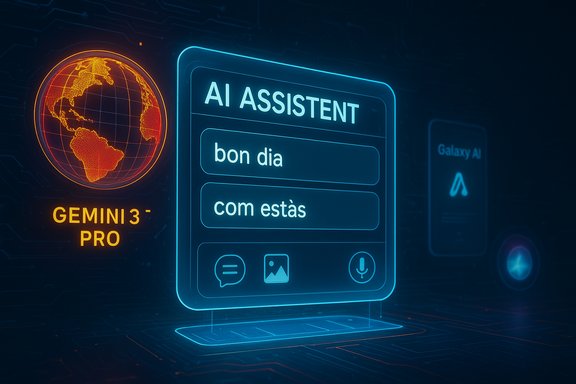
Google’s latest Gemini 3 Pro release finally gives Catalan an official seat at the AI table — and that small line in a long product bulletin is a much bigger story about language equity, platform geopolitics, and how modern AI is moving from experimental novelty into everyday infrastructure.
The short version: Google’s Gemini 3 Pro launch brought a raft of technical advances — a new Deep Thinking reasoning mode, expanded multimodal abilities, and tighter mobile integrations — and, perhaps most consequential for Catalan speakers, official support for Catalan among a broad list of newly supported languages. That designation removes a long-standing practical ambiguity: systems trained on web-scale corpora could often understand Catalan, but they frequently lacked formal support or consistent behavior in real-world products. The new classification changes that. Equally important, the Gemini rollout roughly coincides with growing cross‑platform deals: Samsung is integrating Google’s image model (nicknamed “Nano Banana”) into Galaxy AI features, and major reporting indicates Apple is negotiating to run a custom Gemini instance inside Apple’s Private Cloud Compute to power the next generation of Siri — a deal widely reported as costing in the ballpark of $1 billion per year. These partnerships mean Gemini’s language coverage and capabilities could propagate fast — across Android devices, Samsung skins, and even into iPhone users’ Siri experiences.
At the same time, the launch sits inside a larger, uncertain industry moment. Deep technical advances and widespread OEM adoption are real and valuable — but so are the commercial pressures, energy demands, and investment cycles that Sundar Pichai warned could lead to broader market stress. For Catalan speakers and language advocates, the right response is pragmatic: seize the immediate benefits of first-class support, push for governance and transparency around deployments, and make localized datasets and safety work sustainable so that language parity survives whatever market cycles come next.
Source: Diari ARA Google's AI already works in Catalan (and Siri will eventually do so)
 Background / Overview
The short version: Google’s Gemini 3 Pro launch brought a raft of technical advances — a new Deep Thinking reasoning mode, expanded multimodal abilities, and tighter mobile integrations — and, perhaps most consequential for Catalan speakers, official support for Catalan among a broad list of newly supported languages. That designation removes a long-standing practical ambiguity: systems trained on web-scale corpora could often understand Catalan, but they frequently lacked formal support or consistent behavior in real-world products. The new classification changes that. Equally important, the Gemini rollout roughly coincides with growing cross‑platform deals: Samsung is integrating Google’s image model (nicknamed “Nano Banana”) into Galaxy AI features, and major reporting indicates Apple is negotiating to run a custom Gemini instance inside Apple’s Private Cloud Compute to power the next generation of Siri — a deal widely reported as costing in the ballpark of $1 billion per year. These partnerships mean Gemini’s language coverage and capabilities could propagate fast — across Android devices, Samsung skins, and even into iPhone users’ Siri experiences. What exactly changed for Catalan — and why that matters
From tolerated corpus to supported language
For years Catalan content has been part of the web datasets that large models are trained on, which meant models could often reply intelligibly when prompted in Catalan. But there was a difference between incidentally understanding a language and officially supporting it in product settings — the latter involves UI labels, text-to-speech/dictation support, conversational tuning, safety checks for local idioms, and product rollouts that respect locale-specific formatting. Google’s recent language matrix for Gemini explicitly lists Catalan among the model’s supported languages, placing it on par with other officially supported European languages. This is the change of status that affects millions of everyday interactions.Real-world effects for users
- Device assistants and in-app chat UIs will more reliably accept Catalan voice and text input and return responses in Catalan.
- On-device and cloud-powered features (e.g., summary, translation, image captioning) will be able to present user-facing strings, suggestions, and error messages localized properly.
- App integrations that depend on vendor-supported language metadata (voice variants, TTS, locale-aware spell-checking) can now enable Catalan without bespoke engineering.
The rollout: features, partners, and the language list
Gemini 3 Pro’s headline capabilities
Gemini 3 Pro is being billed as a multimodal, long-context model with enhanced reasoning abilities. Key product-level changes announced by Google and reported across specialist outlets include:- Deep Thinking / Deep Think: a reasoning mode that explores multiple solution paths before producing an answer, designed to reduce simple mistakes on complex math and logic tasks. This is being positioned as a qualitative leap for tasks that need stepwise reasoning.
- Massive context windows: support for very long documents and multi‑document workflows, enabling analysis of manuscripts, long codebases, or entire books in a single context.
- Generative interfaces: responses that are not just text but interactive modules — mini-maps, itineraries, and short-lived micro-apps produced on the fly.
- Native multimodality: integration of text, image, audio, and video understanding within a single model (not stitched-on vision modules).
- Agentic tooling and Antigravity IDE: model-driven workflows that can orchestrate multi-step tasks and even generate and deploy code.
The thirty-language expansion and geopolitics
Google’s published language list for Gemini includes Catalan alongside many other additions — a clear prioritization of high-growth regions such as South Asia and Southeast Asia, but also mid-sized European and African languages. The list spans demographic heavyweights (Bengali, Urdu, Indonesian, Vietnamese, Telugu, Tamil, Marathi) and regional languages with strong digital publishing ecosystems (Catalan, Basque, Galician, Ukrainian). The selection signals where companies anticipate their next billion users will come from and how dataset quality and local digital activism can influence platform decisions.Mobile and OEM integrations: how Catalan reaches devices
Samsung, Nano Banana and Galaxy AI
Samsung has been one of the fastest partners to adopt and surface Google’s image models in its Galaxy AI experience. The image-editing model known colloquially as Nano Banana — formally described in Google’s family of Gemini image models — has been embedded via “Now Brief” and gallery integrations so users can quickly apply generative edits or stylized transformations without leaving their default gallery app. That in-phone distribution accelerates adoption: when manufacturers tune these features into the camera and gallery experience, local-language support bundled with the model propagates to millions of devices.Xiaomi, Oppo and the Android OEM landscape
Beyond Samsung, multiple Android OEMs are integrating Gemini-powered features under white-label names: Xiaomi’s HyperAI, Oppo’s Mind Space, and other manufacturer hubs are using Google’s inference backend or tuned variants to add reminders, summarization, and creative features. As those OEMs roll Gemini-based features to their local markets, official language support in the underlying model simplifies regional rollouts — including Catalan in markets where it’s relevant or as part of European language packs.The Apple wrinkle: Siri and Private Cloud Compute
Possibly the biggest cross-ecosystem story is Apple’s reported plan to license a tailored Gemini instance for Apple Intelligence / Siri and host it inside Apple’s Private Cloud Compute environment. Multiple outlets — including Reuters and The Verge, echoing Bloomberg reporting — say Apple is close to a commercial arrangement to use a custom Gemini model inside Apple’s privacy-first hosting to upgrade Siri’s reasoning and multimodal capabilities. The implications are straightforward: Siri could immediately gain the languages and capabilities Google has certified in Gemini, including Catalan, even if Apple historically avoided adding Catalan natively. Note: the Apple–Google deal remains reporting-based and not an Apple press release; timeline and commercial detail are widely discussed but proprietary contract details are not public. Independent summaries corroborate that talks happened and that Apple evaluated multiple vendors, but readers should treat the exact price tag and scope as reported figures rather than contractually confirmed facts.Economics: pricing, tiers, and the developer equation
Token pricing and value framing
Gemini 3 Pro’s API and developer pricing use a token-based model with a context-dependent tier. Reported preview pricing (consistent across multiple industry write-ups) is approximately:- Standard context (≤200k tokens): Input ≈ $2 per 1M tokens, Output ≈ $12 per 1M tokens.
- Long context (>200k tokens): Input ≈ $4 per 1M tokens, Output ≈ $18 per 1M tokens.
Consumer vs. enterprise economics
- Consumers: mobile app access and limited desktop tiers keep basic experimentation free or subscription-based (Google has traditionally offered free access with limits and paid tiers for advanced features).
- Developers & enterprises: tokenized API pricing, enterprise Vertex AI integrations, and contextual window tiers determine landed costs for production applications.
- Carriers & OEM bargains: in some markets (notably India), carriers or OEMs have already bundled high-tier access into customer plans — a distribution play that values user engagement and data over per-user ARPU.
Technical verification and what we could and could not confirm
It’s essential to separate what companies officially document from press claims and bench‑marks that circulate after model launches.- Confirmed: Google’s Gemini language support list shows Catalan among supported languages; Google Cloud documentation publicly lists the languages that Gemini models “can understand and respond in.” That is the authoritative product-level confirmation that matters for local-language support.
- Confirmed: Samsung’s integration of Google’s image models under Galaxy AI (Now Brief) and the nickname “Nano Banana” for Gemini image variants have been reported by device-hardware and tech press, showing a working OEM pathway for in-phone generative features.
- Confirmed (reporting consensus): Apple has been in advanced talks to license a Gemini variant to power Siri’s next generation, and outlets cite a figure near $1 billion annually — but the details are sourced to investigative reporting and unnamed sources. Reuters and The Verge provide consistent reporting about these negotiations. Treat the number as a widely reported estimate rather than an audited contract.
- Unverified / cautionary: Specific benchmark claims that sometimes appear in coverage — for example an exact MathArena or MathArena Apex percentage comparing Gemini 3 Pro and GPT-5.1.3 with very precise numbers — could not be traced to a primary benchmark page or peer-reviewed release. Many benchmark numbers are reported by outlets summarizing vendor claims; independent reproduction is required before treating such exact figures as settled facts. In short: Deep Think is documented as a better reasoning mode, but any single-percentage claim from secondary coverage should be treated cautiously until directly validated with the benchmark maintainer or a transparent methodology.
Strengths and the upside for Catalan users and small-language communities
- Visibility and parity: being included in the official language list means Catalan will now appear in product UIs, voice assistant settings, and developer language metadata — practical parity that drives real usage.
- Faster ecosystem adoption: manufacturer and carrier integrations (Samsung, Xiaomi, carriers like Jio) turn a model-level change into device-level reality quickly, expanding reach beyond power users to mainstream mobile customers.
- Better localized experiences: when models are tuned for a language, downstream artifacts such as prompt templates, safety filters, and text-to-speech voice models can be localized, improving fluency, idiom handling, and cultural sensitivity.
- Platform leverage: language recognition at a major vendor reduces entry barriers for local startups and public institutions to ship Catalan-first services (chatbots for government services, localized education tools, community translation platforms).
Risks, caveats and governance concerns
1) Vendor lock-in and opacity
Large language providers are platforms: language support comes packaged with cloud tooling, APIs, and commercial terms that can lock public services and businesses into specific vendors. That increases systemic risk if pricing or access terms change. The economic importance of carriers and OEM deals also means language coverage may depend more on commercial priorities than on cultural or civic value.2) Data, privacy and on‑device promises
The Apple–Google reports show one mitigation pathway — running third‑party models inside Apple’s Private Cloud Compute — but also demonstrate a growing complexity: third-party models hosted inside vendor-controlled enclaves rely on contractual and engineering safeguards to prevent telemetry leaks. The privacy guarantees are architectural but require hardened contractual terms, audits, and verifiable attestations. These are not trivial to audit externally.3) Sustainability and the investment cycle
Sundar Pichai himself warned publicly that the AI sector shows elements of “irrationality” and that “no company is going to be immune” if an AI bubble bursts. That reality check should temper celebratory narratives: many startups are surviving on investor expectations of endless demand; a market correction would affect feature availability, free tiers, and R&D that underpins language support. For citizen languages, this matters because smaller-market initiatives are often fragile and depend on large-platform subsidies during the growth phase.4) Safety, hallucination and cultural fit
Official language support does not automatically solve model hallucinations, bias, or harmful stereotypes — especially with local idioms, historical sensitivities, or political nuance. Local safety teams, curated corpora, and post-deployment monitoring remain essential to prevent culturally inappropriate outputs.Practical advice for developers, local institutions, and power users
- Evaluate the Gemini APIs and platform offerings for feature parity with your use case (TTS, dictation, long-context analysis). Prototype quickly on the free tier and measure behavior on Catalan queries.
- If you are a public institution or NGO, insist on contractual transparency for data handling, logging, and the right to audit when you adopt third‑party LLM services for citizen services.
- For mobile app teams, prioritize hybrid architectures that keep sensitive data local and send only anonymized, minimal context to cloud models when necessary.
- Plan for contingency: vendor-agnostic designs (modular LLM layers, interface abstraction) let you switch backends if pricing or policy changes occur.
- Advocate for independent benchmarking and community-driven test suites that measure performance for Catalan across factuality, fluency, safety, and cultural competence.
Conclusion
The practical consequence of Google’s Gemini 3 Pro including Catalan on an official language list is deceptively simple: it signals the end of a liminal phase in which Catalan existed in models but lacked production-level guarantees. That small administrative change opens real doors for localized assistants, integrated on‑device experiences, and a faster path for Catalan-language apps.At the same time, the launch sits inside a larger, uncertain industry moment. Deep technical advances and widespread OEM adoption are real and valuable — but so are the commercial pressures, energy demands, and investment cycles that Sundar Pichai warned could lead to broader market stress. For Catalan speakers and language advocates, the right response is pragmatic: seize the immediate benefits of first-class support, push for governance and transparency around deployments, and make localized datasets and safety work sustainable so that language parity survives whatever market cycles come next.
Source: Diari ARA Google's AI already works in Catalan (and Siri will eventually do so)