

Google’s enterprise AI push and a worrying jobs narrative collided this week: Storyboard18’s roundup flagged that over a lakh (100,000+) jobs have been lost amid AI-driven restructuring, while Google Cloud formally packaged its model and agent stack as Gemini Enterprise — a subscription platform aimed squarely at automating knowledge work and competing with Microsoft and OpenAI. The twin headlines capture two sides of the same coin: massive productivity promises for IT and procurement teams, and real, measurable disruption in labor markets. Storyboard18’s coverage of both items frames the debate but leaves critical technical and commercial specifics that enterprises must verify before committing to a rollout.
The enterprise AI market has matured from proof-of-concept LLM pilots into a competitive product category where cloud vendors sell platforms, not just models. Google’s Gemini family, already embedded into several consumer and Workspace surfaces, has now been productized as Gemini Enterprise — an integrated platform that combines the Gemini model family, a no-code/low-code agent workbench, prebuilt agents, a curated agent marketplace, broad third‑party connectors, and centralized governance tools. Google positions the offering as a “front door” to AI in the workplace and published headline pricing and editioning at launch.
Concurrently, multiple news trackers and industry summaries report heavy job losses across tech and adjacent sectors in 2025, with several outlets and layoff trackers placing the cumulative figure in the range of tens of thousands to well north of 100,000 — numbers often tied to corporate restructurings that cite AI, cloud shifts, and cost-cutting as drivers. These counts are aggregated from company announcements, public filings and layoff trackers and are uneven depending on methodology. Treat the raw headcount as an indicator of scale rather than a precise attribution to AI alone.
Conclusion
Storyboard18’s paired coverage — the jobs tally and Google’s enterprise product push — captures the tension at the heart of 2025’s AI moment: powerful automation tools driving measurable productivity gains while forcing organizations and societies to confront redistribution, reskilling and governance. For WindowsForum readers and IT decision-makers, the immediate path is clear: pilot selectively, measure continuously, require contractual protections, and integrate workforce strategies into every automation roadmap. The technical promise is real; the operational and human costs must be managed consciously.
Source: Storyboard18 Today in AI | Over a lakh jobs lost due to AI | Google's Gemini Enterprise for businesses
Source: Storyboard18 Google Cloud unveils Gemini Enterprise, an AI platform for businesses
 Background / Overview
The enterprise AI market has matured from proof-of-concept LLM pilots into a competitive product category where cloud vendors sell platforms, not just models. Google’s Gemini family, already embedded into several consumer and Workspace surfaces, has now been productized as Gemini Enterprise — an integrated platform that combines the Gemini model family, a no-code/low-code agent workbench, prebuilt agents, a curated agent marketplace, broad third‑party connectors, and centralized governance tools. Google positions the offering as a “front door” to AI in the workplace and published headline pricing and editioning at launch.Concurrently, multiple news trackers and industry summaries report heavy job losses across tech and adjacent sectors in 2025, with several outlets and layoff trackers placing the cumulative figure in the range of tens of thousands to well north of 100,000 — numbers often tied to corporate restructurings that cite AI, cloud shifts, and cost-cutting as drivers. These counts are aggregated from company announcements, public filings and layoff trackers and are uneven depending on methodology. Treat the raw headcount as an indicator of scale rather than a precise attribution to AI alone.
What Google Announced: Gemini Enterprise, explained
A platform, not a single chatbot
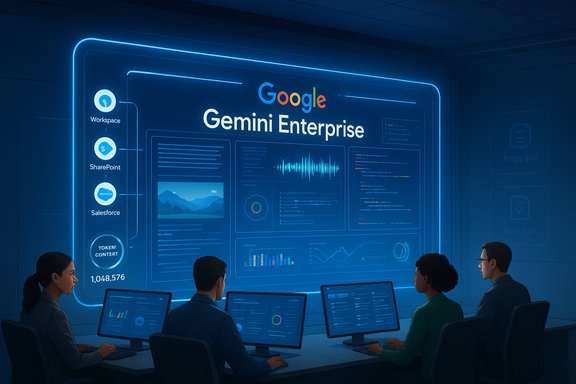
Google’s pitch is explicit: Gemini Enterprise is a platform that bundles model access, agent orchestration, connectors to data where it lives, and governance controls into a single subscription offering. The product is intentionally broader than a chat UI — it aims to let business users “chat with their data,” spin up prebuilt agents (research, analytics, meeting summarization, campaign automation), and build low‑code/no‑code agents that can run multi‑step workflows. This is a clear pivot from selling raw models to selling managed, auditable automation.Key components (launch framing)
- Gemini model access (multimodal, reasoning-optimized variants).
- Agent Workbench: a no-code/low-code visual builder for composing and chaining agent steps.
- Agent Store / curated marketplace with validated third‑party agents.
- Native connectors to Google Workspace and many third‑party SaaS systems (Microsoft 365/SharePoint, Salesforce, SAP, BigQuery, Jira, Confluence).
- Governance and observability: admin dashboards, audit trails, tenant policies and retention settings.
- Deployment options: cloud-native, managed on‑prem/hybrid via Google Distributed Cloud for regulated customers.
Launch timing and pricing — headline numbers
Google publicly unveiled Gemini Enterprise in October 2025, positioning the offering with headline per-seat pricing that puts it in direct unit-price parity with Microsoft’s Copilot family. Reported launch pricing includes a Business edition (aimed at small teams) in the low‑$20s per seat per month and Enterprise tiers starting at roughly $30 per user per month (annual commitments and negotiated enterprise terms will alter the real bill). These figures were reported in multiple launch briefings and technology press accounts. Organizations should treat headline seat prices as planning inputs, not final TCO.Confirmed technical limits and model capabilities (verified)
- The Gemini family includes high-capacity variants such as Gemini 2.5 Pro, which Google documents with input token limits up to 1,048,576 tokens and significant output budgets — a capability that materially changes how enterprises handle long-doc, multi-hour transcript, and large codebase reasoning tasks. This million‑token context is documented in Google’s model pages and Vertex AI docs. Validate regional availability and quotas with Google Cloud before assuming full access for production workloads.
- Gemini models are natively multimodal — supporting text, images, audio, video and structured documents — enabling agents that can reason across meeting recordings, slide decks and textual corpora in the same session when permitted by the selected model variant.
Why the technical details matter for IT and security teams
Multimodality + million‑token context = new use cases — and new risks
The combination of large context windows and multimodality enables single-session reasoning over entire contracts, long legal briefs, hours‑long meeting transcripts, or complete engineering codebases. That simplifies many workflows and reduces the need for complex chunking and retrieval plumbing — a real productivity win for research, legal, healthcare and R&D teams. But it also means greater surface area for data exposure if connectors or access controls are misconfigured. Confirm exact model limits, per‑region quotas, and cost profiles before authorizing high‑context operations.Agents that act require governance
Agents that can call functions, update CRMs, trigger approvals or post to external services convert AI from assistant to executor. That capability magnifies benefits and risk in equal measure. Enterprises must ensure:- Policy gates and human-in-the-loop approvals for actioning agents.
- Per‑agent credentials, least privilege connectors, and narrow scopes for data access.
- Comprehensive audit trails that record both prompts and actions for compliance and forensics.
Cost and procurement complexity
Headline per-seat prices understate execution costs. Agent runs, large-context “thinking” jobs, Vertex compute consumption, API egress and premium connectors all change TCO materially. Procurement must model:- Seat price × seat count × annual commitment.
- Expected Vertex AI consumption for agent execution and long‑context runs.
- Professional services, integration and migration costs (agent libraries, connectors).
- Minimum seat counts, negotiated discounts and regional pricing differentials.
Strengths: where Gemini Enterprise could genuinely help teams
- Native multimodality lets teams analyze mixed media more naturally than text-only setups. This is useful for product teams (design + specs + recorded feedback), legal (contracts + exhibits + deposition transcripts), and marketing (assets + campaign analytics).
- Large context windows reduce engineering friction when you need single-session reasoning on massive inputs, avoiding expensive and brittle chunking logic.
- Agent-first design and Workbench enable citizen builders and non‑dev business owners to compose workflows quickly, potentially accelerating time-to-value for automation pilots.
- Ecosystem grounding — connectors to Workspace, SharePoint, Salesforce and more — makes the assistant practically useful in mixed stacks where enterprises are rarely cloud-homogeneous.
Risks, unknowns, and caveats IT leaders must validate
1) Hallucination and provenance risk
No vendor marketing claim that models never hallucinate should be trusted without independent verification in your environment. When agents are permitted to act, erroneous outputs can translate directly into erroneous system changes. Add human validation gates for any agent that performs write operations.2) Data training and contractual detail
Google has publicized contractual protections (enterprise agreements that restrict training on customer data in some tiers), but the precise legal language, regional residency and enforcement mechanisms vary by contract. Demand explicit non‑training clauses, exportable logs, and audit rights during negotiation. Treat vendor statements as marketing until validated in signed legal terms.3) Connector coverage and permission mapping
Prebuilt connectors are valuable, but many enterprises run on legacy or bespoke systems. Validate whether your critical on‑prem systems and custom APIs are supported, and insist on least‑privilege connector modes rather than broad indexing of corpora.4) Operational cost surprises
Large-context runs are computationally expensive. Run cost modeling using representative workloads during pilots to forecast Vertex consumption and to set sensible quotas and alerts. Without caps, “thinking” jobs can balloon cloud bills quickly.5) Vendor lock-in and agent portability
Agents, connectors, and prompt engineering are organizational assets. Negotiate exportable agent definitions and data portability clauses; build CI/CD pipelines and tests for agents to make future migration less costly.The jobs question: what “over a lakh jobs lost” means — and what it doesn’t
Storyboard18’s roundup highlights a widely-reported trend: tech and non-tech industries have announced large rounds of layoffs in 2025, and many stories tie a portion of those cuts to AI-driven automation and restructurings. Multiple trackers and press outlets place cumulative cut counts in ranges that meet or exceed 100,000 — but the headline number requires careful qualification.What the public numbers actually show
- Layoff trackers and aggregated press reports indicate tens of thousands to over 100,000 job cuts across technology companies and adjacent industries in 2025. Counts vary by tracker and cutoff date; some outlets cite >112,700 jobs tracked across hundreds of companies. These trackers compile company announcements and public filings rather than attributing causation strictly to AI.
- Industry analyses show that many corporate statements combine multiple rationales — cost reduction after pandemic hiring, macroeconomic pressures, and AI-driven reorganizations. Distinguishing “jobs lost because of AI” from “jobs cut as part of broader restructuring that includes investment in AI” is nontrivial and often impossible without company-level disclosures and granular headcount mapping.
Why attribution to AI is complex
- Many layoffs cite “restructuring to focus on AI and cloud” as part of a broader strategic shift. That often means companies are reallocating budgets from older product teams into AI and platform teams — which is not the same as direct automation-driven layoffs of specific roles.
- Some jobs are “reshaped” rather than eliminated: roles may shift from execution to supervision, moving employees toward higher‑value, AI-augmented responsibilities. The distributional impacts — which workers are most affected — are frequently age- and tenure‑dependent, with early-career and mid-level roles sometimes most exposed.
What matters for policymakers and IT leaders
- The scale of job dislocation is non-trivial and calls for intentional reskilling, job-transition support, and corporate upskilling programs.
- Enterprises adopting agentic automation must plan workforce transformation deliberately: pair automation pilots with reskilling paths, redeployment programs, and clear communication to avoid morale and compliance problems.
Practical 90‑day pilot checklist (for IT leaders)
- Define the business outcome (30 days)
- Pick 1–3 high-value, low-risk workflows (e.g., meeting summarization, campaign research, contract triage).
- Set measurable KPIs (time saved, error rate, human escalation rate, cost per transaction).
- Scope data access and governance (30 days)
- Classify data sensitivity (PHI/PII/IP/general).
- Apply least‑privilege connectors; index minimal corpora.
- Create per‑agent approval workflows and role-based access controls.
- Run controlled pilots and measure (30–90 days)
- Use a small user cohort (10–50 seats) and monitor consumption.
- Track total Vertex/agent compute and map costs to observed value.
- Perform red-team tests: adversarial prompts, corrupted connectors, and chained failures.
- Negotiate contracts and SLAs
- Demand non‑training language for enterprise data where required.
- Insist on exportable logs, audit trails and clear incident response SLAs.
- Confirm regional availability of the model tiers and token quotas you need.
- Build an operational runbook
- Define monitoring, cost alerts, and approval gates.
- Create rollback procedures for agents that perform external actions.
- Maintain CI/CD for agent definitions and test suites.
Governance and compliance: short checklist for security teams
- Require auditing of both prompts and downstream API actions.
- Place approval gates on any agent with write privileges.
- Use token and action quotas to bound blast radius.
- Retain artifacts per regulatory requirements and confirm data residency options if operating in regulated regions.
Final assessment — practical verdict for WindowsForum readers
Gemini Enterprise is consequential: it consolidates Google’s most competitive technical differentiators — multimodality and very large context windows — into a productized platform that directly targets the same procurement conversations Microsoft and OpenAI are already having with large enterprises. The product’s agent-first orientation and no‑code builder have real potential to move many knowledge workflows from drafting assistance to partial execution, which is where measurable productivity gains become visible. The million‑token context and native multimodality are verifiable technical differentiators and are already documented in Google’s public model pages and Vertex AI docs. But the launch also intensifies the long-standing enterprise trade-offs: governance complexity, cost modeling, vendor lock‑in risk and operational security. Headline prices (Business ≈ low‑$20s, Enterprise ≈ $30/user/month) are a useful starting point — but procurement teams must model cloud execution and integration costs, contractually lock down data‑use promises, and plan for workforce reskilling in the face of demonstrable labor market shifts. The larger jobs story — aggregate layoffs in 2025 that Storyboard18 cited as over a lakh — is alarming and underscores the need for measured, humane adoption practices: pilots tied to reskilling, redeployment opportunities, and transparency about the role of automation in staffing decisions. Enterprises that pair disciplined engineering and procurement work with clear governance will extract real value. Those that chase convenience without controls are more likely to face costly incidents and unpleasant surprises. In short: Gemini Enterprise raises the operational stakes in the workplace AI arms race — it is a credible, technically powerful entrant — but realizing its benefits safely will require engineering rigor, procurement discipline, and a commitment to workforce transition.Conclusion
Storyboard18’s paired coverage — the jobs tally and Google’s enterprise product push — captures the tension at the heart of 2025’s AI moment: powerful automation tools driving measurable productivity gains while forcing organizations and societies to confront redistribution, reskilling and governance. For WindowsForum readers and IT decision-makers, the immediate path is clear: pilot selectively, measure continuously, require contractual protections, and integrate workforce strategies into every automation roadmap. The technical promise is real; the operational and human costs must be managed consciously.
Source: Storyboard18 Today in AI | Over a lakh jobs lost due to AI | Google's Gemini Enterprise for businesses
Source: Storyboard18 Google Cloud unveils Gemini Enterprise, an AI platform for businesses
