

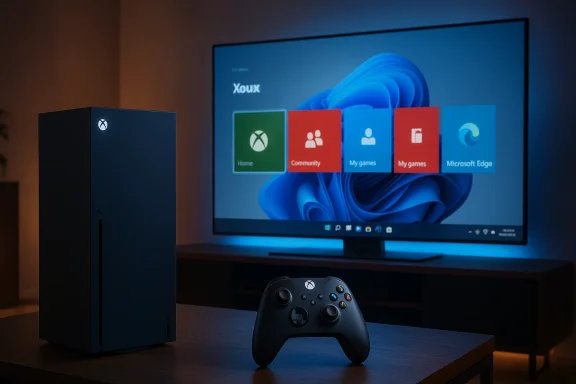
Microsoft's next console looks less like a sealed appliance and more like a living, breathing Windows 11 PC wearing a controller-friendly skin — at least that's the picture painted by multiple recent reports and industry signals pointing to a Gen‑10 Xbox that runs full Windows 11 beneath a TV‑optimized, console‑like interface.
Microsoft's Xbox division has quietly pivoted strategy over the last few years away from strict platform exclusivity and toward a cross‑device, service‑first approach. The company publicly announced a strategic, multi‑year partnership with AMD to co‑engineer custom silicon across consoles, handhelds, cloud servers, and PCs, and has already seeded the market with hardware that hints at what’s coming: the ROG Xbox Ally handheld and the "Xbox Full Screen Experience" used on that device show how Windows and Xbox UX can coexist in a handheld form factor. Recent reporting suggests Microsoft intends to take that architecture to its next full‑size home console generation — running the full Windows 11 operating system under a TV‑centric shell that preserves the familiar Xbox dashboard experience for mainstream users while allowing power users to exit into the standard Windows desktop and PC ecosystem.
This is not a one‑off whisper; the narrative has been reinforced by a string of sources across the industry, and AMD’s public comments that its semi‑custom SoC work for Microsoft is “progressing well to support a launch in 2027” give the timeline some real teeth. That said, the plan remains unconfirmed by Microsoft in official product terms and the words "report" and "rumor" still apply to many of the finer claims. Even so, the implications of a Windows‑first Xbox are large and deserve a detailed unpacking.
Potential Game Pass advantages:
For first‑party strategy, Microsoft faces a paradox: openness makes their studios’ titles more available, but ubiquity reduces the leverage of exclusives. The company has been moving toward platform‑agnostic releases for many major franchises — Forza Horizon 6 and Fable, for example, are positioned for multi‑platform releases — and a Windows‑capable console would materially facilitate that strategy.
Realistically, a 2027 release is the best‑case scenario if manufacturing, validation, and developer ecosystems align. Delays could push a broader rollout into 2028. Even if the hardware ships in 2027, software polish, third‑party store relationships, and developer adoption will take time to mature.
But ambition carries real risks. Security, cheating, UX fragmentation, and price sensitivity are nontrivial problems that can erode goodwill quickly if mishandled. The technical challenge of delivering a frictionless, controller‑centric TV experience while also enabling the openness of Windows is enormous. Execution will be everything.
Microsoft must thread a needle: preserve the simplicity and reliability gamers expect from a console, while delivering enough of Windows’ openness to make the hybrid story meaningful. If it succeeds, the Gen‑10 Xbox could reshape how the industry thinks about hardware boundaries. If it fails, it risks alienating both console purists and PC enthusiasts.
Microsoft’s next Xbox era could be the company’s boldest experiment yet in platform convergence. A living‑room box that is both a trusted console and an honest, PC‑capable Windows machine would rewrite long‑held assumptions about gaming hardware. But the window between a game‑changing product and a confusing, fractured user experience is thin — and Microsoft’s success will depend on the pragmatic engineering and ecosystem agreements it can finalize in the next 12–24 months.
Source: glitched.online Next-Gen Xbox Will Run Full Windows 11 With Console-Like Interface - Report
 Background
Microsoft's Xbox division has quietly pivoted strategy over the last few years away from strict platform exclusivity and toward a cross‑device, service‑first approach. The company publicly announced a strategic, multi‑year partnership with AMD to co‑engineer custom silicon across consoles, handhelds, cloud servers, and PCs, and has already seeded the market with hardware that hints at what’s coming: the ROG Xbox Ally handheld and the "Xbox Full Screen Experience" used on that device show how Windows and Xbox UX can coexist in a handheld form factor. Recent reporting suggests Microsoft intends to take that architecture to its next full‑size home console generation — running the full Windows 11 operating system under a TV‑centric shell that preserves the familiar Xbox dashboard experience for mainstream users while allowing power users to exit into the standard Windows desktop and PC ecosystem.This is not a one‑off whisper; the narrative has been reinforced by a string of sources across the industry, and AMD’s public comments that its semi‑custom SoC work for Microsoft is “progressing well to support a launch in 2027” give the timeline some real teeth. That said, the plan remains unconfirmed by Microsoft in official product terms and the words "report" and "rumor" still apply to many of the finer claims. Even so, the implications of a Windows‑first Xbox are large and deserve a detailed unpacking.
What the reports actually say — and what is still unverified
The core claim
The clearest recurring claim across investigative reporting is simple: the next‑generation Xbox will ship with full Windows 11 as its underlying operating system, while defaulting to a TV‑optimized, console‑style interface for the living‑room experience. The manufacturer skin — sometimes referred to as the "Xbox Full Screen Experience" — will act as the default dashboard; users who prefer can "exit to Windows" to access the wider PC ecosystem, including third‑party stores and non‑game applications.Timeline and AMD's role
Public statements from AMD executives and the company’s status as Microsoft’s co‑engineered silicon partner strongly suggest a production timeline that could support a 2027 launch. AMD has confirmed work on a semi‑custom SoC for Xbox devices and indicated readiness to support a 2027 launch window; historically, AMD has been the trusted silicon partner for Xbox generations, so their timetable is meaningful even if not definitive.What remains unverified
- Whether Microsoft will ship with Windows 11 exactly as consumers get on PCs, or a bespoke variant with heavy lockdown/optimizations.
- Pricing, SKU segmentation (e.g., multiple Gen‑10 models), and exact hardware specifications beyond the general expectation of AMD Zen‑derived CPU cores and RDNA‑derived GPUs.
- The extent of Microsoft’s commitment to enabling third‑party storefronts and the user experience for installing and launching non‑Microsoft games and apps.
- Whether every edition of the console will allow access to full Windows, or if that will be restricted to a higher‑end "creator" SKU.
Why Microsoft might want Windows 11 under the hood
Unifying development and reducing friction
A Windows‑based console could dramatically reduce friction for developers who build for both PC and console. Right now, ports require platform‑specific optimization and QA; a unified OS could make the path from Steam/Epic/PC storefronts to Xbox materially shorter. That aligns with Microsoft’s broader messaging about making Windows the "number one platform for gaming" and its long‑running Play Anywhere ethos.Feature depth for power users
Running full Windows opens the console to many non‑gaming use cases: content creation tools, productivity suites, modding utilities, and legacy PC titles. For enthusiasts and creators, a console that can double as a lightweight workstation or retro PC is appealing. It would also allow for running third‑party clients like Steam, Epic, GOG, and other launchers without complicated emulation or compatibility layers.Strategic flexibility
A Windows‑native console could be a strategic masterstroke for Microsoft because it blurs the traditional lines of console exclusivity and hardware verticality. Microsoft could ship the "console experience" to a mass market while also catering to power users and developers who want the openness of a PC — all while consolidating revenue channels around Game Pass, Microsoft Store, and services.The Xbox Full Screen Experience: how Windows would be hidden — or not
Console‑first onboarding
Reports emphasize that the default experience will be familiar to current Xbox users: a TV‑first dashboard, controller‑centric navigation, and Game Pass integration remain primary. The goal is to present the console as just that — a simple, locked‑down gaming device — with Windows as an optional layer for those who want it.Exit to Windows workflows
Conceptually similar to how some handhelds let users jump from a console UI into a desktop OS, the Gen‑10 Xbox could let users exit to Windows to:- Install and run PC storefronts and non‑Xbox game clients.
- Use keyboard and mouse apps such as web browsers, productivity tools, and creative software.
- Run background services or utilities not offered in the console ecosystem.
Hardware: what to expect from AMD and system architecture
Semi‑custom SoC trajectory
AMD’s semi‑custom SoC business has powered Xbox generations for years. The expectation is a chip family combining Zen CPU cores and RDNA GPU architecture, with AI accelerators increasingly mentioned in Xbox messaging. AMD’s public suggestions that a 2027 launch is supported are meaningful: they imply tape‑out and validation windows are aligned with that timeframe.Potential hardware features
- Hybrid CPU cores: leveraging high‑performance and high‑efficiency core mixes to manage power and thermal budgets across living‑room consoles and handheld variants.
- Advanced GPU features: RDNA‑derived cores with hardware ray tracing and AI compute units designed to accelerate upscaling and in‑game AI.
- AI and ML accelerators: dedicated silicon for features like dynamic upscaling, adaptive streaming, and real‑time compute tasks.
- High memory bandwidth: to satisfy both Windows system needs and next‑gen game workloads.
- Modular storage and I/O: NVMe and fast PCIe channels for quick load times and modern PC game streaming.
Developer and ecosystem implications
Easier ports, but new certification paths
A Windows‑native console theoretically reduces porting friction. But to preserve a consistent player experience, Microsoft will need to create new certification and compatibility guidelines for Windows apps on TV screens. Developers will face choices:- Target the Xbox Full Screen Experience for console polish and Game Pass integration.
- Target full Windows mode for features not available via Xbox tools.
- Maintain dual builds to ensure optimal controller support and on‑screen ergonomics.
Monetization and storefronts
If Microsoft allows competing storefronts on Xbox hardware via Windows, that could:- Increase PC game availability on console hardware.
- Introduce new revenue dynamics and potential platform‑fee disputes.
- Force negotiation with storefronts and publishers about cross‑entitlement and DLC portability.
Consumer benefits
- Choice: Users can stay in the cozy console sandbox or unlock the power of Windows.
- Broader game library: Potential access to Steam, Epic, GOG, and legacy PC titles without buying a separate PC.
- Productivity: On a single living‑room machine, users could edit video, stream, or run office apps.
- Better parity for cross‑platform play: Easier cross‑save and cross‑play support when platform internals converge.
Risks, tradeoffs, and unanswered technical questions
Security and DRM complexity
Allowing a full Windows environment on a mainstream console introduces a spectrum of security and DRM challenges. Microsoft will need to separate the trusted console layer (Game Pass, Achievements, online services) from user‑installed Windows apps that may not meet the same trust model. The company will face questions about:- Secure boot and whether the console shell can enforce a locked environment for competitive integrity in online titles.
- Cheating vectors when the underlying OS is open to PC mods and third‑party tools.
- DRM fragmentation if publishers insist on Windows‑only anti‑cheat systems that don't map cleanly to the console experience.
Fragmentation risk
A device that can be either a pure console or a Windows PC risks fragmenting the install base and user experience. Developers may be forced to decide whether to tailor for the console UI, the Windows desktop, or both. Without clear guidelines, players could see inconsistent behavior across titles depending on how developers choose to support the platform.Price and positioning
A hardware platform capable of running full Windows with PC‑grade features will likely cost more to produce. Microsoft must balance ambition with mass‑market price expectations. If Gen‑10's lowest SKU is too expensive, adoption will lag; if Microsoft cuts corners to hit a low price, early adopters may feel shortchanged.Support and lifecycle
Consoles traditionally have long lifecycles with stability guarantees; Windows evolves more rapidly. Microsoft must decide how Windows updates, driver changes, and OS‑level feature shifts will be handled on a device marketed as an Xbox. Will the console receive Windows feature updates on the same cadence as PCs, or will Microsoft maintain a curated, slower update stream for consoles?Game Pass, subscription strategy, and platform dynamics
Microsoft's biggest strategic asset remains Game Pass. A Windows‑capable Xbox ties Game Pass more tightly to the PC ecosystem: Game Pass for PC already reaches millions of users, and a hardware device that can run both Game Pass and non‑Game Pass stores unlocks powerful consumer propositions.Potential Game Pass advantages:
- Bundling hardware and subscription incentives to drive adoption.
- Tighter integration for cloud sync and cross‑save across PC and console.
- A unified ecosystem where Microsoft controls both the service and one of the distribution surfaces.
What this means for backward compatibility and first‑party strategy
Microsoft has emphasized backwards compatibility in prior generations and wants to continue releasing first‑party titles on multiple platforms, including PlayStation, consistent with its recent multi‑platform posture. A Windows‑based Xbox simplifies backward compatibility: the PC ecosystem already hosts legacy titles, and a unified platform could make old games more accessible.For first‑party strategy, Microsoft faces a paradox: openness makes their studios’ titles more available, but ubiquity reduces the leverage of exclusives. The company has been moving toward platform‑agnostic releases for many major franchises — Forza Horizon 6 and Fable, for example, are positioned for multi‑platform releases — and a Windows‑capable console would materially facilitate that strategy.
UX challenges: Big‑screen Windows apps and controller ergonomics
Running Windows apps on a TV with a controller is nontrivial. Desktop apps presume a mouse and keyboard and small, densely populated UIs. To make Windows viable on the big screen, Microsoft must:- Provide a consistent, controller‑friendly application layer or translation layer.
- Encourage app developers to ship "TV‑mode" manifests or UIs.
- Offer robust mouse and keyboard support for users who want the full PC experience.
Timeline and likelihood
Industry signals suggest the pieces are in place for a product cycle that could support a 2027 launch: AMD’s semi‑custom SoC work, Xbox's public statements about co‑engineering silicon, and the existence of prototype handhelds all point toward a coordinated roadmap. However, Microsoft historically keeps launch windows flexible and will push out a product until it meets internal quality thresholds.Realistically, a 2027 release is the best‑case scenario if manufacturing, validation, and developer ecosystems align. Delays could push a broader rollout into 2028. Even if the hardware ships in 2027, software polish, third‑party store relationships, and developer adoption will take time to mature.
How the market might react
- Enthusiasts: Likely very positive, seeing a hybrid device as the best of both worlds.
- Developers: Mixed; many will welcome easier PC‑to‑console ports but worry about certification complexity and platform fragmentation.
- Publishers: Wary yet pragmatic — more distribution is good, but revenue splits and anti‑cheat compatibility must be negotiated.
- Console incumbents (competitors): Likely to highlight the risks Microsoft faces in security and user experience to differentiate their own closed‑system advantages.
Final analysis: ambition with caveats
Microsoft’s strategy here is unmistakably ambitious. A console that runs full Windows 11 under a polished, TV‑first shell would be an inflection point: it could blur the boundary between PC and console in a way that benefits consumers, developers, and Microsoft’s services ecosystem. The model plays directly into Microsoft’s strengths — OS leadership, cloud services, and deep relations with silicon partners like AMD.But ambition carries real risks. Security, cheating, UX fragmentation, and price sensitivity are nontrivial problems that can erode goodwill quickly if mishandled. The technical challenge of delivering a frictionless, controller‑centric TV experience while also enabling the openness of Windows is enormous. Execution will be everything.
Microsoft must thread a needle: preserve the simplicity and reliability gamers expect from a console, while delivering enough of Windows’ openness to make the hybrid story meaningful. If it succeeds, the Gen‑10 Xbox could reshape how the industry thinks about hardware boundaries. If it fails, it risks alienating both console purists and PC enthusiasts.
What to watch next
- Official Microsoft announcements about the OS strategy for the next‑gen console and whether Windows will be explicitly supported.
- AMD roadmaps and any public detail about the semi‑custom SoC family meant for Xbox hardware.
- Microsoft developer guidance and GDK updates that indicate how Windows‑native features will be exposed to game creators.
- Details on SKU segmentation and pricing that reveal whether Microsoft intends to make full Windows available across the board or reserve it for premium models.
- Early third‑party developer reactions that will signal how straightforward or fraught porting will be.
Microsoft’s next Xbox era could be the company’s boldest experiment yet in platform convergence. A living‑room box that is both a trusted console and an honest, PC‑capable Windows machine would rewrite long‑held assumptions about gaming hardware. But the window between a game‑changing product and a confusing, fractured user experience is thin — and Microsoft’s success will depend on the pragmatic engineering and ecosystem agreements it can finalize in the next 12–24 months.
Source: glitched.online Next-Gen Xbox Will Run Full Windows 11 With Console-Like Interface - Report
