• Thread Author
Microsoft’s next living‑room console may not be a sealed, bespoke appliance at all but rather a full Windows 11 PC wearing a console‑style skin — a hybrid device that boots to a TV‑first Xbox interface by default while keeping the full Windows 11 runtime and PC storefronts accessible underneath.

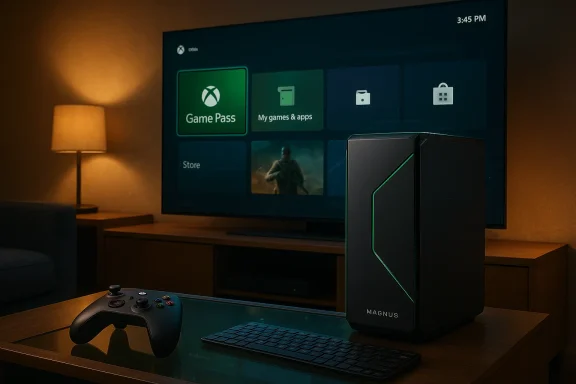
A MAGNUS PC with neon trim sits beside a TV displaying Xbox Game Pass.Background / Overview​

For several years Microsoft has been quietly converging Xbox and Windows engineering work in ways that make a Windows‑rooted console plausible. The company shipped the Xbox Full Screen Experience (FSE) on Windows handhelds such as the ASUS ROG Xbox Ally family, and has been previewing FSE functionality in Windows 11 Insider builds, showing that a controller‑first, full‑screen shell can be layered over a standard Windows 11 installation.
Multiple industry reports describe the next full‑sized Xbox as booting into that TV‑optimized FSE by default while leaving the full Windows 11 stack intact underneath. In other words, a player could turn on their console, get the familiar Xbox dashboard and Game Pass experience, and at any time “exit to Windows” to run Steam, Epic, desktop productivity apps, mod tools, or other PC storefronts. Those reports are reinforced by signals from OEMs and silicon partners, and by Microsoft‑level talk about creating richer PC/console continuity.
This article summarizes the core claims, verifies technical elements visible today, explains the practical benefits and trade‑offs for players, developers, and Microsoft, and highlights the open questions and risks that still require confirmation.

How the hybrid would work: shell over kernel​

The architectural concept​

The technical concept being reported is straightforward: keep Windows 11 as the underlying OS and present a specialized, controller‑first session (the Xbox Full Screen Experience) at boot. That session launches a full‑screen Xbox home app, defers or suppresses non‑essential Explorer services, and optimizes runtime memory and background activity to create a console‑like feel — while the Windows kernel, drivers, anti‑cheat, and DRM subsystems continue to run underneath. This layered model is similar in spirit to how handhelds like the Steam Deck expose a console‑grade UI while allowing users to drop to a desktop environment.

User-facing modes​

  • Console Mode (default) — Controller‑first dashboard, fast boot‑to‑game, curated Game Pass and Xbox storefront, TV UX with large tiles and controller navigation.
  • Windows Mode (one‑tap exit) — Full Windows 11 desktop, ability to install and run native Windows apps and third‑party storefronts (Steam, Epic, GOG, Battle.net), support for keyboard/mouse workflows, and access to productivity/creative tools.
This duality is the defining user promise: keep console simplicity for mainstream players while giving power users the openness of a Windows PC.

What FSE actually does — and does not do​

Hands‑on testing on shipping hardware and Microsoft’s own documentation make the distinction clear: FSE is a session posture layered on Windows, not a replacement OS. When active, FSE launches a chosen home application full‑screen, defers desktop ornamentation and many startup apps to reclaim memory (reported directionally around 1–2 GB on tuned handhelds), and adapts the Game Bar and Task View for controller navigation. FSE does not rewrite the Windows kernel, replace GPU driver models, or bypass kernel‑mode anti‑cheat requirements that games may depend on.

The hardware picture: Magnus, AMD, and a premium SKU​

Industry reporting points to a semi‑custom AMD APU, internally codenamed Magnus, co‑engineered with Microsoft to power a family of Gen‑10 Xbox devices. Public signals from Microsoft and AMD suggest the timeline could support a 2027 launch window, though those dates are supplier‑side estimates rather than Microsoft retail confirmations. Microsoft is reportedly considering a portfolio approach — a Microsoft‑made premium SKU alongside OEM variants — mirroring the diversity of the PC market.
Key hardware themes repeated across reporting:
  • Higher RAM budgets: To support a full Windows stack and multitasking, the next‑gen hardware is expected to carry more memory than previous consoles, increasing Bill of Materials (BOM) cost and putting pressure on retail pricing.
  • AI acceleration (NPU): Microsoft is reportedly considering on‑device NPUs to support OS‑level upscaling features such as Auto Super Resolution.
  • Focus on sustained, console‑like performance: Work across OS and drivers aims to reduce shader compile stutters, stabilize frame pacing, and deliver predictable, sustained performance on thermally constrained devices.
These hardware ambitions explain why Microsoft executives have described the next device as “very premium, very high‑end, curated,” language that signals higher component targets and potentially higher retail prices than prior Xbox generations.

Cross‑stack software changes Microsoft is shipping​

Microsoft is not relying solely on UI changes; several OS and graphics improvements are being coordinated to make Windows gaming behave more like consoles:
  • Advanced Shader Delivery (ASD) — shipping precompiled shader bundles with games or downloading them at install time to reduce first‑run shader compile hitches.
  • Auto Super Resolution (Auto SR) — an OS‑level AI upscaler that can use on‑device NPUs to upscale internal render resolution with lower GPU cost.
  • DirectX and Agility SDK updates — targeted at reducing stuttering and improving shader and ray‑tracing runtimes.
These changes are designed to shrink historical UX gaps between Windows and consoles: faster cold starts, fewer micro‑stutters, and better sustained performance, especially on handheld or thermally constrained TV devices.

Why Microsoft might pursue a Windows‑first Xbox​

Strategic consolidation and developer friction reduction​

A Windows‑based living‑room device simplifies cross‑platform development: PC tools, middleware, and installers used on Windows could be more directly portable to Xbox hardware, reducing porting work and QA surface for studios that target both PC and Xbox. That fits Microsoft’s long‑running Play Anywhere and “Windows as the number one platform for gaming” narrative.

Business flexibility and services​

Running Windows opens Microsoft to a hybrid commercial model: keep Game Pass and the Microsoft Store as first‑class citizens while allowing other PC stores to run under Windows mode. That could broaden Game Pass reach and preserve Microsoft’s service revenue while avoiding the closed‑store model that has historically driven friction with PC storefronts. Reported plans suggest the Xbox PC app will evolve into an aggregated launcher that discovers installs from Steam, Epic, GOG, Battle.net and more, acting as a single discovery surface for players.

Consumer value proposition​

For consumers, the value is clear:
  • One device that serves as a living‑room console and a general‑purpose PC.
  • Access to Game Pass and Xbox‑centric features alongside Steam/Epic libraries and PC mod tools.
  • Backward compatibility with existing Xbox One and Series X|S libraries preserved.

Developer, platform, and policy implications​

Aggregated storefronts and anti‑cheat realities​

An aggregated Xbox library in FSE could surface games from multiple storefronts, but how games actually launch will depend on DRM and anti‑cheat requirements. In many cases the Xbox app will hand off execution to native clients when kernel‑mode anti‑cheat is required; in others, it may launch executables directly. Expect hybrid behavior — not a universal bypass — which preserves dispute‑prone DRM integrity but complicates the seamless storefront experience Microsoft would ideally prefer. This orchestration preserves security while offering convenience, but it creates nontrivial engineering overhead.

Certification, updates, and patching complexity​

A Windows‑rooted Xbox means Microsoft must coordinate console certification with the long tail of Windows drivers, Windows Update flows, and third‑party client updates. That increases complexity: incorrect driver updates or misbehaving Windows components can affect the console experience, which previously benefited from a tightly controlled OS environment. Microsoft will need to maintain stricter update gating and potentially implement tailored Windows update channels for console SKUs. These operational challenges are real and must be solved for a premium, living‑room device.

Revenue and store economics​

Allowing third‑party PC storefronts undermines classic console margins from first‑party transactions. Microsoft can still capture subscription revenue via Game Pass, and it may retain storefront revenue from the Microsoft Store, but openness risks reducing per‑transaction revenue capture. Microsoft’s strategic calculus likely prioritizes ecosystem control via services (Game Pass, Live) over single‑store economics, but that’s a material shift in console monetization.

Costs, pricing, and timeline — what is verified and what remains rumor​

Verified signals​

  • FSE exists and ships on the ROG Xbox Ally handhelds; FSE is present in Windows Insider builds and can be enabled via Settings → Gaming → Full screen experience.
  • Microsoft and AMD have publicly discussed co‑engineering silicon across consoles, handhelds, and PCs, establishing a credible hardware roadmap.

Reported but unverified claims​

  • The next full‑sized Xbox will ship with full Windows 11 under a TV‑optimized shell by default. Multiple outlets report this, but Microsoft has not issued a single, definitive product statement. Treat this as a credible industry narrative rather than an official specification.
  • Internal codename Magnus and an AMD semi‑custom APU underpinning a 2027 launch window are widely reported by supply‑chain sources, but specifics such as core counts, GPU compute units, memory bus width, and final SKU segmentation remain unverified.

Pricing pressure​

Rising memory costs and the need for larger RAM budgets to support Windows plus gaming will likely push BOM higher. That’s why reporting repeatedly uses the phrase “premium” for the rumored Gen‑10 Xbox. Higher BOM combined with Microsoft’s desire to target a high‑end market means it may price above the typical console‑generation baseline. Consumers should view the premium claim as probable given the hardware ambitions, but details will only be firm once Microsoft publishes SKUs and pricing.

Player experience — benefits and downsides​

Benefits​

  • One device, two workflows: console simplicity for living‑room play and full Windows for productivity, mods, and PC storefronts.
  • Better parity for cross‑platform titles: easier porting and shared tooling between PC and console builds reduces friction for developers.
  • Modern UX improvements: fewer shader hitches, OS‑level upscaling, and improved frame pacing aim to make Windows gaming feel more console‑like.

Downsides and trade‑offs​

  • Complexity of updates and reliability: a Windows‑first box inherits the broader ecosystem’s update surface and potential instability if updates are not tightly controlled.
  • Potentially higher price: premium hardware ambitions and larger memory configurations increase cost to consumers.
  • Policy ambiguity: how multiplayer subscriptions, cloud saves, entitlement checks, and store revenue splits will work across mixed storefronts is unclear and could generate friction with publishers.

Security, privacy, and antitrust considerations​

Running a full Windows stack on a living‑room console raises new security and privacy considerations. A console that doubles as a PC could expose users to the same privacy‑sensitive telemetry and driver surfaces that Windows desktops have historically carried. Microsoft will need to clearly document and opt‑in/opt‑out controls to preserve a trusted living‑room environment.
On antitrust lines, opening a console to third‑party stores is more likely to reduce antitrust scrutiny than increase it — since a Windows‑first Xbox would be less able to lock users into a single storefront. However, the details of how Microsoft integrates or aggregates third‑party stores will be watched closely by regulators and competitors alike.

What still needs confirmation — the open questions​

  • Will every retail SKU allow full Windows desktop access, or will that be limited to a higher‑end “creator” SKU? Reports differ and Microsoft has not formally clarified.
  • How will Microsoft reconcile Windows Update flows with console stability needs? Will there be a separate update ring for console SKUs?
  • How seamless will aggregated storefront integration be when anti‑cheat is required — handoff to native clients, or deeper orchestration within FSE? Expect hybrid behavior, but the UX still needs work.
  • Pricing and SKU segmentation remain unconfirmed: Microsoft’s “very premium” language suggests higher price points, but retail pricing is unknown.
Each of these points matters for consumer expectations and developer planning; until Microsoft provides an official specification, they should be treated as plausible scenarios rather than commitments.

Practical advice for players and developers preparing for this shift​

  • Players who value a simple living‑room console should wait for SKU clarifications and review whether a Windows‑first box meets their price and reliability expectations.
  • Enthusiasts and creators should welcome the prospect: a Windows‑rooted console could dramatically lower barriers to running creative tools, mod workflows, and alternate storefronts from a single device.
  • Developers should plan for a broader compatibility matrix: expect consoles to run native Windows builds, but keep anti‑cheat/DRM and certification differences in mind.
  • Retailers and OEM partners should budget for diversified SKUs and prepare distribution channels that can manage both console‑style bundles and PC‑style accessories.

Critical appraisal: strengths, risks, and whether the strategy makes sense​

Notable strengths​

  • Strategic coherence: The Windows‑first Xbox leverages Microsoft’s unique asset: ownership of both Windows and the Xbox brand. It aligns with a long‑term vision to make Windows the central gaming platform while preserving a console experience for mainstream audiences.
  • Developer friendliness: Reduced porting friction and shared PC/quasi‑console tooling could accelerate cross‑platform releases and unlock new indie reach.
  • Consumer flexibility: Combining Game Pass convenience with access to the broader PC ecosystem is a compelling offer for power users and households that currently maintain separate devices.

Significant risks​

  • Operational complexity: Maintaining a premium, stable living‑room experience on top of Windows requires disciplined update, driver, and store orchestration. Any misstep could erode console reliability expectations.
  • Pricing and adoption: Higher BOMs for memory, NPUs, and premium silicon may push pricing higher, potentially slowing mass adoption.
  • UX fragmentation: If Microsoft’s aggregation is imperfect due to DRM/anti‑cheat handoffs, players could face inconsistent behaviors when launching games from different storefronts.
Overall, the strategy makes strategic sense for Microsoft’s long‑term vision, but its success hinges on execution across hardware pricing, update reliability, and a frictionless, secure aggregator UX.

Conclusion​

The emerging picture of Microsoft’s next Xbox is not of a traditional closed console cycle, but of a Windows 11 PC/console hybrid: a device that defaults to a TV‑centric Xbox Full Screen Experience for mainstream, controller‑first play, while preserving full Windows 11 underneath for power users, third‑party storefronts, and productivity. This hybrid promises significant benefits — developer friction reduction, expanded consumer versatility, and strategic alignment with Game Pass and Windows — but it also brings serious engineering, update, pricing, and policy challenges that will determine whether the idea is a generational shift or an ambitious experiment.
What is clear today: Microsoft has shipped the technical building blocks (FSE on retail handhelds, Windows 11 insider previews, OS‑level graphics features) and has credible hardware and partner signals pointing toward a 2027 runway. What remains to be confirmed are the final SKU designs, exact silicon specs, retail pricing, and the nitty‑gritty of how third‑party storefronts and anti‑cheat systems will be handled in day‑to‑day play. Until Microsoft publishes concrete product specifications, treat the Windows‑first Xbox as a strategic blueprint with large upside — and several hard engineering problems to solve.

Source: TechPowerUp Next-Generation Xbox is Windows 11 PC/Console Hybrid for Gaming and Productivity
 

Microsoft’s next-generation Xbox is being described in multiple recent reports as less a traditional closed console and more a TV‑focused Windows 11 PC with a console‑style front end — a hybrid that would boot into a controller‑first Xbox interface by default but let owners “exit to Windows” to run Steam, the Epic Games Store, and standard Windows apps. overview
For years Microsoft has blurred the lines between PC and console at the edges — Play Anywhere titles, Xbox on Windows, and the Xbox PC app’s library aggregation were early steps. Now those efforts appear to be converging into a deliberate platform strategy: a living‑room device that presents a familiar, console‑first UX while running the full Windows 11 runtime underneath. That idea is central to recent reporting from Windows Central and several downstream outlets, and Microsoft’s own Windows 11 “Full Screen Experience” (FSE) is already shipping on Windows handhelds, giving the company a real hardware and software testbed.
At the same time, chip‑level and manufacturing signals point to AMD co‑engineering a semi‑custom APU — codenamed “Magnus” in leaks — and AMD executives have publicly stated that semi‑custom SoC development is “progressing well to support a launch in 2027,” which many outlets interpret as Microsoft’s earliest realistic release window. Those two vectors — Windows‑first software and a powerful AMD APU — form the core plausibility case for a true console/PC hybrid.
This article digs into what we know, what’s still speculative, the technical trade‑offs such an approach implies, and the strategic risks and opportunities for gamers, developers, and the broader industry.

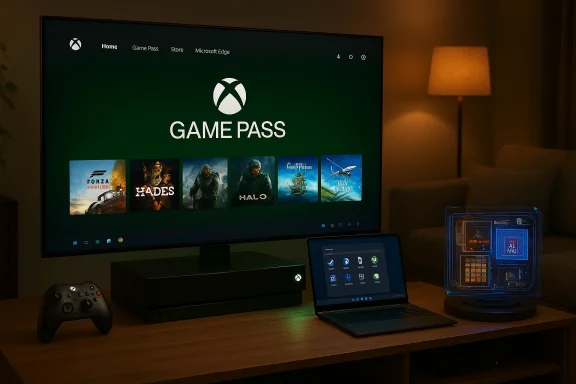
Cozy living-room gaming setup with Xbox Game Pass on a large monitor, Xbox console, controller, and a laptop.The software model: a console shell layered over Windows 11​

What is the Full Screen Experience (FSE)?​

Microsoft’s Full Screen Experience is a Windows 11 session posture that can launch a single “home app” (commonly the Xbox PC app) at sign‑in, suppress or defer many background desktop services, and tune the OS for controller‑first navigation and a TV‑style UX. FSE is explicitly designed to deliver a plug‑and‑play living‑room flow while retaining the underlying Windows kernel, drivers, DRM and anti‑cheat subsystems. That packaging is what reporters mean when they say the next Xbox will “run Windows.”
Hands‑on previews and Microsoft documentation show measurable wins from FSE on handhelds and PCs: reduced background CPU wakeups, deferred Explorer subsystems, and reclaimed RAM (on the order of 1–2 GB on tuned handhelds). Those are meaningful optimizations for constray are not magic — on a high‑TDP living‑room box the engineering challenges shift toward thermal design, sustained power delivery, and driver/firmware integration.

How storefronts would work: aggregation, orchestration, and handoffs​

The practical model described by reporting and current telemetry is an aggregated discovery surface rather than a wholesale replacement of third‑party launchers. The Xbox PC app will act as a unified library that discovers installed titles from Steam, Epic, GOG, Battle.net and others and will, where possible, launch executables directly. When kernel‑mode anti‑cheat or DRM requires it, the Xbox app is expected to hand off execution to the native client. Expect hybrid launch behaviors rather than a universal bypass.
Put simply:
  • The default boot: FSE → Xbox PC app (console‑style UI, Game Pass front and center).
  • The power user path: one‑tap or menu option to exit the shell and reach the full Windows 11 desktop to install/run non‑Xbox apps and other storefronts.
  • DRM/anti‑cheat: native clients and kernel protections remain authoritative; orchestration must respect those constraints.
This design is why outlets report Epic and Valve are ready to support their storefronts if policy and runtime behavior remain welcoming. Surface‑level compatibility is feasible; legal and policy work will determine the ultimate user experience.

Hardware: the “Magnus” APU, memory, and AI accelerators (what leaks say)​

The leak summary — what Moore’s Law Is Dead and subsequent coverage claim​

A major leak from Moore’s Law Is Dead (MLID), widely syndicated by gaming and hardware outlets, asserts AMD’s semi‑custom APU for the next Xbox will be a large, multi‑chip design codenamed Magnus, with these headline specifications reportedly under consideration:
  • Up to 68 RDNA 5 Compute Units (CUs) on the GPU side (70 physically present, 2 disabled for yields).
  • A hybrid Zen 6 CPU cluster — up to 3 large cores + 8 small Zen 6c cores, with ~12 MB L3 cache.
  • A 192‑bit memory bus supporting up to 48 GB GDDR7.
  • An on‑chip NPU with modes quoted as up to 110 TOPS in higher power states.
  • Two‑chiplet die area estimates (circa 408 mm² total) and an estimated TDP in the 250–350 W range (leaked/derived numbers carry large uncertainty).
Those numbers place Magnus notably above other rumored consoles in raw CU counts, and they would support higher memory pools useful for running a full Windows stack and multitasking. Independent outlets have re‑reported the MLID video and images, but the data remains a leak — plausible but unverified.

What AMD has said publicly​

AMD has publicly acknowledged a multi‑year partnership with Microsoft to co‑engineer semi‑custom silicon for a future Xbox family and, during recent investor commentary, said development is “progressing well to support a launch in 2027.” That corporate confirmation supports the plausibility of a 2027‑era device and gives weight to the idea that Microsoft’s next console will be a high‑end AMD design. However, AMD did not confirm specific CU counts, memory sizes, or leaked NPU figures.

Why the leaked specs matter — and why to treat them cautiously​

If accurate, the leaked Magnus figures imply:
  • A significant raw GPU compute uplift over current consoles, improving raster and ray tracing headroom.
  • A much larger memory budget to host Windows, multiple stores, background apps, and modme assets.
  • On‑die NPU capabilities that could enable OS‑level upscaling, Auto Super Resolution, and other AI enhancements.
But leaks have a long history of being inaccurate in final shipping details (disabled units, yield‑driven cuts, revisions during validation). The more aggressive numbers (68 CUs, 48 GB GDDR7, 110 TOPS NPU) should be considered engineering targets or early samples rather than guaranteed retail specs. Independent reporting mirrors the same caveats: MSI, Tom’s, TweakTown and others are repeating the MLID figures but stop short of calling them official.

OEM strategy and form factors: an “Xbox ecosystem” of devices​

Multiple SKUs and OEM partners​

What’s unusual in the reported plan is Microsoft’s apparent intent to adopt a portfolio/OEM model alongside a first‑party baseline console. Sources say Microsoft intends to ship a Microsoft‑designed “baseline” Xbox — the traditional console experience — and to license the platform or provide a validated module for OEM partners (ASUS, Lenovo, etc.) to build Xbox‑branded Windows machines in multiple price and form‑factor classes. That’s a major shift from the single‑SKU console model toward a PC‑style ecosystem of devices that share a platform identity.
Examples we’ve already seen in practice:
  • The ASUS ROG Xbox Ally and Ally X: Windows 11 handhelds that boot into the Xbox FSE by default. They act as real‑world testbeds for FSE and controller‑first UX flows.
  • Early announcements that FSE will be rolled out to other OEM handhelds and previewed on laptops/desktops show Microsoft is actively cultivating partners beyond its own hardware team.

Consumer implications​

If the strategy holds, consumers could choose between:
  • A Microsoft‑branded, curated “quintessential Xbox” console for living‑room buyers.
  • Premium “super‑consoles” from OEM partners with higher BOM and expanded features.
  • Slimmed, budget variants optimized for price or portability.
This opens the door for price and performance segmentation similar to Windows PC laptop lines — with the attendant benefits (choice, innovation) and problems (fragmentation, warranty and support complexity).

Developer and compatibility implications​

Easier PC → Xbox ports, in theory​

A Windows‑first Xbox reduces build and QA divergence between PC and console. If the OS, driver model and runtime are shared, studios won’t need to manage entirely separate platform toolchains; much of the same middleware and engine code could be reused across store targets. That is a real productivity win for multiplatform studios and indies alike. Windows Central and other reporting emphasize this as a key strategic rationale.

Anti‑cheat and points​

However, the devil is in the DRM and anti‑cheat mechanics. Many PC games employ kernel‑mode anti‑cheat drivers (e.g., some EAC/BE/other implementations) that require privileged access and can conflict with console security models, parental controls, and stability expectations. In practice:
  • Some titles will launch directly from the Xbox app library.
  • Others will require the native storefront client to run (triggering handoff behavior).
  • A third class may need specialized platform agreements or certification to run seamlessly.
Microsoft will have to negotiate runtime policies, certification flows, and maybe even API guarantees with third‑party anti‑cheat vendors. This is solvable but not trivial.

Backward compatibility remains a key requirement​

Every report stresses Microsoft’s insistence on deep backward compatibility — Xbox One and Series X|S libraries must continue to run. Maintaining that compatibility layer alongside a Windows runtime will require careful systems engineering (abstraction layers, compatibility shims, and QA across legacy titles). That work is one reason Microsoft has framed this as “very premium, very high‑end.”

Performance engineering: shaders, upscaling, and OS optimizations​

Microsoft isn’t relying solely on UI changes to make Windows behave like a console. Work across the OS and graphics stack is already underway:
  • Advanced Shader Delivery (ASD): precompiled shader bundles to reduce first‑run shader compile stutters.
  • Auto Super Resolution (Auto SR): an OS‑level AI upscaler that can leverage on‑device NPUs to deliver better performance at higher effective resolutions.
  • Updates to DirectX and the Agility SDK to improve shader and ray tracing runtime behavior.
These platform changes are designed to mitigate the long‑standing micro‑stutter and shader‑compile pain points for Windows gaming and to approximate the smooth “first‑run” experience consoles provide. But shipping these as reliable system features at scale — across OEM SKUs and with various GPU/driver combinations — will be a major engineering and validation exercise.

Business and policy implications​

Store openness vs. commercial incentives​

Opening the platform to Steam and Epic in Windows mode gives consumers more choice but complicates Microsoft’s commercial calculus. Game Pass, the Microsoft Store, and associated service revenue are strategic priorities; allowing other storefronts on the device is generous, but the real question is how Microsoft balances:
  • Default experience curation and promotion of Game Pass.
  • Commission and billing policies for third‑party storefronts inside the console shell.
  • OEM certification and potential hardware‑level restrictions.
Early statements from Epic indicate willingness to support their store “day one” if Microsoft’s policies are favorable, but details matter and will shape developer economics for years to come.

Antitrust optics and regulatory risk​

A Windows‑powered Xbox that runs rival storefronts will likely reduce regulatory heat on Microsoft’s platform dominance arguments, but the company will still face scrutiny over default settings, curated stores, and any privileges given to Microsoft products. Openness in name is different from openness in practice; regulators will watch whether Microsoft’s UX choices nudge users toward Microsoft services in ways that thwart competition.

Key risks and unanswered questions​

  • Leaked hardware specs remain unverified. The MLID Magnus figures (68 CUs, 48 GB GDDR7, 110 TOPS NPU) are plausible but should be treated as early leaks until AMD/Microsoft confirm. Hardware targets often shift in silicon validation.
  • Performance vs. cost trade‑offs. A Windows‑first design with large RAM budgets and NPUs drives BOM costs upward. That could push retail pricing into a premium bracket and reduce mainstream accessibility.
  • Fragmentation and support complexity. Multiple OEM SKUs mean more driver/firmware permutations, longer certification matrices, and potentially inconsistent user experiences across devices.
  • Anti‑cheat and DRM friction. Kernel‑mode protections used by PC storefronts may require privileged drivers or platform agreements to work seamlessly, complicating a “turn on and play” promise.
  • Storefront UX arbitration. Aggregation is useful, but subtle differences in how games launch and how DRM is resolved could frustrate less technical users.
  • Timeline uncertainty. AMD’s statement that silicon is “ready to support 2027” is supplier‑side readiness, not a guaranteed retail launch date; schedules can slip.

What a consumer should expect and how to prepare​

If Microsoft follows this path, buyers should anticipate:
  • A default console experience that looks and behaves like a modern Xbox on first boot, with Game Pass and the Xbox PC app front‑and‑center.
  • A switch to Windows pathway for power users who want Steam, Epic, productivity apps, or modding capability.
  • Multiple hardware SKUs across price/performance points — Microsoft’s own baseline console plus partner devices.
  • Higher average retail prices for premium Gen‑10 hardware, particularly for SKUs that include larger memory and NPUs.
For consumers thinking about purchases:
  • Decide whether you want a closed console simplicity or the flexibility of a Windows‑enabled device.
  • If you value modding, PC storefront access, or multitasking, prioritize models explicitly marketed with full Windows access.
  • Expect early software patches and drivers to be necessary; new platform launches always involve post‑launch optimization.

Timeline: what we can reasonably infer​

Publicly verifiable signals:
  • Microsoft shipped the Xbox Full Screen Experience on the ASUS ROG Xbox Ally family and is expanding FSE to more Windows 11 devices via Insiders, showing the software model is real and shipping.
  • AMD has said semi‑custom SoC work is “progressing well” to supndow; industry reporting aligns on a 2027 earliest retail launch if all supply and validation runs smoothly. That makes 2027 the “best case scenario” but not a hard guarantee.
Treat every date after this as provisional until Microsoft publishes an official roadmap.

Final analysis: bold ambition, real engineering complexity​

Microsoft’s move to fold a console‑grade front end over a full Windows 11 runtime is one of the most ambitious platform plays in modern gaming. It promises genuine benefits:
  • Developer efficiency: a narrower gap between PC and console code paths.
  • Consumer choice: access to both Game Pass/Xbox libraries and PC storefronts.
  • Feature richness: OS‑level AI upscaling, broader app support, and unified discovery surfaces.
At the same time, the plan introduces real risks:
  • Complexity at scale: multi‑OEM ecosystems, driver permutations, and certification burdens that historically challenge the Windows ecosystem.
  • Higher cost pressures: larger memory and AI hardware budgets risk premium pricing that could limit adoption.
  • UX fragmentation: a smooth “console” feeling depends on tight coordination between OS, drivers, anti‑cheat vendors, and storefronts — a tall order.
If Microsoft can execute the technical plumbing (FSE + aggregated launcher + OS graphics improvements) and secure straightforward anti‑cheat/workflow agreements with major PC storefronts, this architecture could reshape how we think about consoles — not as locked boxes, but as purpose‑optimised Windows appliances that scale from the couch to the creative studio.
Until Microsoft confirms specifics — hardware SKUs, final APU specs, precise Windows configuration and policy details — readers should treat detailed hardware numbers and timelines as provisional. The broad trend, however, is now visible: Microsoft is intentionally designing a future where Xbox and Windows converge in the living room, and that idea alone is likely to drive months of industry negotiation and technical tuning.

In the coming months expect more clarifying announcements from Microsoft and AMD on platform strategy and silicon readiness, incremental FSE rollouts on OEM devices that will stress‑test the concept, and industry conversations around how third‑party stores will coexist with a Microsoft‑curated front door. For players and developers, the promise is tangible; the execution will determine whether it becomes the next dominant model or a niche, premium play.

Source: TweakTown The next-gen Xbox console runs full Windows 11: Steam, Epic Games Store, fresh OEM designs
 

Microsoft’s next living‑room console is being described not as a closed, single‑purpose appliance but as a TV‑centric Windows 11 machine wearing a console skin — a hybrid design that would boot into a controller‑first Xbox Full Screen Experience (FSE) by default while keeping the full Windows runtime available to power users and developers. Multiple industry reports and visible engineering signals suggest Microsoft is moving deliberately in this direction, combining the Xbox PC app and FSE work with a multi‑year, co‑engineering partnership with AMD to produce a premium, high‑end device that could also run third‑party PC storefronts and native Windows apps.

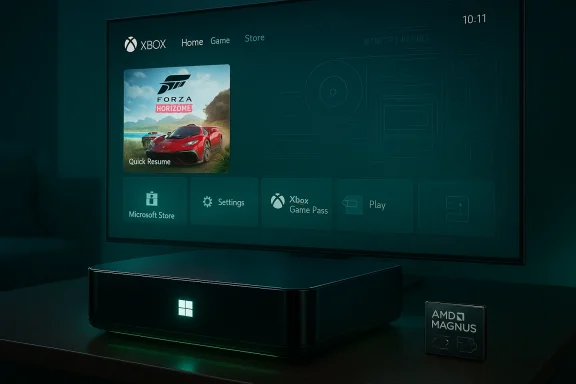
Xbox console on a table with a large screen displaying the Xbox dashboard and Forza Horizon.Background​

How we got here: years of convergence between Xbox and Windows​

Microsoft’s strategy since the Xbox One era has incrementally blurred the boundary between PC and console: Play Anywhere, Xbox Game Pass across devices, and the Xbox PC app’s library aggregation were early steps toward platform convergence. More recently, Microsoft shipped Windows 11 handhelds that boot directly into an Xbox Full Screen Experience (FSE), and it has been rolling the FSE into Windows Insider previews — both moves that act as practical testbeds for a Windows‑rooted living‑room device. Those public signals, combined with a formal silicon partnership with AMD, form the primary evidence behind the Xbox‑on‑Windows thesis.

The core idea: a layered model, not a replacement​

Crucially, the model being described by reporters is layering rather than replacement: FSE would be a controller‑first shell and session posture on top of the Windows 11 kernel and driver model. That means the console‑grade UX would be the visible, default layer for mainstream players while Windows 11 — including its drivers, anti‑cheat subsystems and app model — would remain underneath, accessible to those who choose to “exit to Windows.” This layered approach is what makes the hybrid proposal technically plausible and strategically attractive.

What the reports actually claim​

The headline features being reported​

  • The next Xbox will use a Windows‑based core and boot by default into a TV‑optimized, controller‑first Xbox Full Screen Experience (FSE).
  • Owners would be able to exit to the full Windows desktop to install or run third‑party PC storefronts (Steam, Epic, GOG, Battle.net) and standard Windows apps.
  • Microsoft plans to evolve the Xbox PC app into a robust aggregation/orchestration layer that discovers and surfaces titles from multiple stores in a single controller‑friendly library.
  • The hardware is reportedly being co‑engineered with AMD — semi‑custom SoCs are expected — and public comments from AMD imply a development timeline that could support a 2027 launch.
Each of these items has been repeated across multiple outlets and preview materials, but the fine print — exact SKUs, default lockdown policies, certification specifics and pricing — remains unannounced. Treat the high‑level architecture as plausible and the implementation details as still reported, not finalized.

Why Microsoft would pursue this design​

  • Developer friction reduction: A shared Windows runtime reduces porting and QA overhead for titles targeting both PC and console.
  • Ecosystem leverage: Turning Xbox into a Windows‑compatible family expands Microsoft’s opportunity to sell Game Pass, cloud services, and Windows‑based value propositions across devices.
  • OEM flexibility: Building on Windows allows OEM partners to ship Xbox‑branded devices in varied form factors (handhelds, living‑room boxes), broadening product variety and reducing reliance on single‑device economics.

Technical architecture: how a Windows‑under‑the‑hood Xbox would actually work​

The Full Screen Experience (FSE) is a session posture, not a kernel swap​

Hands‑on reporting and Microsoft preview documentation make an important technical distinction: FSE is a user session posture that launches one or more “home apps” (the Xbox PC app by default), suppresses Explorer and many background services, and optimizes runtime resources for controller‑first gaming. It is not a kernel rewrite. The Windows kernel, driver model, DRM and kernel‑mode anti‑cheat systems remain intact beneath the shell. That distinction matters for compatibility, security, and performance trade‑offs.

Launch orchestration and third‑party stores​

Rather than acting as a universal compatibility shim, the practical model is aggregation plus handoff: the Xbox PC app will aggregate discovered installs from Steam, Epic, GOG and others and will, where possible, launch executables directly. When native client execution is required for DRM or kernel‑mode anti‑cheat reasons, the UX is expected to hand off to the native client. Expect hybrid launch behaviors and explicit policies around when the Xbox app intervenes versus when it defers.

Isolation strategies: containers, virtualization and security boundaries​

Running third‑party storefronts (and their associated anti‑cheat/DRM stacks) on a device expected to offer console‑grade reliability suggests Microsoft will need isolation primitives. Reports and expert analysis point to options such as:
  • Lightweight container sandboxes for storefronts and ancillary services.
  • Hypervisor‑level compartments for high‑risk processes to preserve the integrity of platform services.
  • A new certification framework defining how third‑party clients may access hardware features.
These are engineering approaches we’ve seen elsewhere in the Windows and cloud ecosystems; implementing them correctly is non‑trivial and will be a major technical lift.

Hardware and performance: AMD, "Magnus," and the move toward premium silicon​

AMD’s role and the 2027 cue​

Microsoft’s public multi‑year partnership with AMD — and AMD executives’ comments that their semi‑custom SoC development is “progressing well to support a launch in 2027” — are the clearest hard signals about hardware readiness and timeframes. Historically AMD has been Microsoft’s console silicon partner, and co‑engineering again implies bespoke design choices tuned to Xbox workloads (Zen‑based CPU cores, RDNA‑derived GPUs, and potential integrated AI accelerators). Those choices will shape thermal, power, and cost envelopes for any living‑room Windows‑rooted box.

What “premium” likely means in practice​

Reporters characterizing the next Xbox as a “very premium, very high‑end, curated experience” are flagging a likely deviation from historically loss‑leader console pricing. Expect decisions such as:
  • Higher RAM budgets (to support multitasking and Windows desktop workflows).
  • Increased storage baseline and perhaps higher‑speed memory types (GDDR/LPDDR variants).
  • Potential inclusion of NPUs for on‑device AI features (Auto Super Resolution, upscale/denoise).
  • More sophisticated thermal solutions and higher TDP envelopes than prior consoles.
Those choices improve flexibility and cross‑device feature parity with PC hardware — but they also raise BOM costs and retail price expectations.

What this means for developers and publishers​

Easier ports — but not a free pass​

A shared Windows runtime reduces friction: games built for Windows can theoretically target the Xbox platform with fewer platform‑specific changes, accelerating multiplatform releases and reducing duplicate engineering. That benefits smaller developers and accelerates time‑to‑market for PC‑native titles looking for the couch‑play audience. However, “easier” does not mean “zero effort”: controller tuning, TV UI optimizations, certification, and performance/playability QA for Big‑screen experiences still demand engineering and QA investment.

Anti‑cheat and middleware complexity​

Many PC games rely on kernel‑level anti‑cheat drivers that are controversial on Windows PCs; integrating those stacks into a living‑room Xbox that markets itself as a reliable, always‑on console will require careful policy and technical work. Microsoft must either:
  • Define a supported anti‑cheat/DRM framework that preserves console reliability while enabling publishers to protect online multiplayer, or
  • Create isolation/hand‑off mechanisms so untrusted clients can run without compromising system integrity.
Either path has technical and legal complexity — and Microsoft’s choices will materially affect publisher willingness to support the platform.

Store economics and relationships​

If Xbox allows third‑party PC storefronts, the platform design changes the bargaining landscape between publishers and Microsoft. Publishers could distribute via the stores they prefer, but Microsoft’s control over the default console UX, Game Pass placement, and discovery surfaces gives it meaningful leverage. Negotiations over revenue share, discovery placement and platform entitlements will be a central commercial battleground.

User experience: for mainstream players and power users​

Mainstream UX: a console in appearance, Windows in the background​

For most buyers, the device would behave like a modern console: turn on the TV, use a controller, sign into Xbox, and see Game Pass, friends, achievements and a curated dashboard. That familiarity is essential; consoles are judged on the simplicity and reliability of their living‑room experience. Microsoft’s reported intention to keep FSE the default is essential to preserving the console UX mainstream buyers expect.

Power users: exit to Windows, install Steam, run productivity apps​

For enthusiasts, creators and modders, the ability to “exit to Windows” is a major attraction. It unlocks:
  • Native PC storefronts and PC‑only titles.
  • Keyboard and mouse‑first apps like browsers, office suites and creative tools.
  • Modding toolchains and legacy software not packaged for consoles.
This duality — a plug‑and‑play living‑room box that also becomes a general‑purpose Windows machine — could expand the device’s appeal but will also introduce complexity in discovery, navigation and support.

UX challenges: discoverability, navigation and defaults​

Crucial UX questions remain: which apps appear in the primary dashboard, how will controller navigation work inside native Windows apps, and what are the default behaviors for installing third‑party stores? Microsoft will have to design clear pathways that protect mainstream simplicity while exposing Windows power without confusing average users. Poor defaults or unclear policies could fragment the user base and degrade the “turn on and play” promise consoles have historically delivered.

Risks, trade‑offs and unresolved questions​

Software quality, updates and reliability risk​

Consoles are expected to be stable over long lifetimes. Windows is a general‑purpose OS with a broad update surface and frequent driver and firmware changes. Microsoft must reconcile two competing demands: keep Windows up to date for security and features, and maintain predictable, highly stable behavior for living‑room play. That’s a tough engineering and release‑management problem and a leading source of risk for the hybrid approach.

Certification, anti‑cheat and security hazards​

Allowing third‑party stores and native clients increases the attack surface and the likelihood of incompatible anti‑cheat drivers or DRM interfering with system stability. Isolation layers and new certification rules will be necessary, but building a robust framework that balances openness and integrity is difficult and time‑consuming. Publishers and players both have incentives to push different policies, and Microsoft will be pressured from both sides.

Cost, pricing and market positioning​

Higher RAM, NPUs, premium SoCs and more sophisticated thermal designs push BOM upward. Reports that Microsoft envisions a “very premium” device suggest a materially higher retail price than previous Xbox generations in exchange for greater flexibility. That changes market dynamics: will mainstream buyers accept a more expensive Xbox that also doubles as a PC? Will Microsoft offer differentiated SKUs (a locked console SKU and an unlocked creator SKU) to segment the market? Those choices will determine adoption curves and developer support.

Fragmentation and support complexity​

If Microsoft permits OEMs to ship Xbox‑branded Windows machines at a range of performance and capability points, the company inherits a PC‑like diversity problem: driver fragmentation, divergent feature sets and inconsistent certification experiences. That runs counter to the simplicity consoles historically offer, and it will make quality assurance and customer support more complex and costly.

What remains unverified (and what to watch for)​

These points remain reported but unconfirmed and should be treated with caution:
  • Whether Microsoft will ship a retail unit with unrestricted access to the full Windows 11 desktop by default, or if that access will be gated to specific SKUs or developer modes.
  • The exact nature and limits of third‑party storefront access: will stores be first‑class citizens or subject to platform restrictions?
  • Precise hardware specifications of the semi‑custom AMD SoC (clock, core counts, GPU configuration, memory types, TOPS for NPU). Leaked numbers exist but remain unconfirmed.
  • Pricing, SKU segmentation, and the presence (or absence) of a “creator” unlocked SKU versus a mainstream locked SKU.
Until Microsoft issues concrete product specifications and policy documents, treat specifics as provisional. The public signals form a strong plausibility case, but the final product could differ substantially.

Recommendations and practical takeaways​

For developers​

  • Begin evaluating GameCore and Windows‑centric builds: cross‑compilation and controller UX will be essential.
  • Plan for anti‑cheat and DRM variations: consider modular anti‑cheat strategies and be prepared for platform certification.
  • Track Microsoft’s Xbox PC app updates and FSE developer documentation to understand launch orchestration behaviors.

For consumers​

  • If you prioritize a simple console experience, wait for final SKU and default‑lockdown policy details before buying. The default UX and whether Windows is accessible out of the box matters.
  • If you want a hybrid that doubles as a Windows PC, the device could be transformative — but expect a higher price and the need to manage updates and desktop workflows.

For Microsoft (what we’d like to see)​

  • Publish clear, concrete policies about Windows access, third‑party storefront rules, and certification to reduce developer and consumer uncertainty.
  • Build robust isolation and anti‑cheat frameworks that allow third‑party stores without undermining platform reliability.
  • Offer distinct SKUs or a user‑mode switch so mainstream buyers and power users get predictable, optimized experiences without compromising each other.

Final analysis: a strategic pivot with big upside and real headaches​

The idea of a next‑gen Xbox that is essentially a Windows 11 machine with a polished, console‑grade front end represents a strategic pivot that leverages Microsoft’s biggest software asset to expand Xbox’s reach and developer convenience. The potential upside is substantial: easier cross‑platform development, richer hardware features for creators, and a unified endpoint for Game Pass, cloud streaming and local execution.
Yet the risks are non‑trivial. Shipping a console that’s also a general‑purpose PC raises thorny questions about update cadence, driver and anti‑cheat compatibility, certification complexity, user experience defaults, and price positioning. Balancing mainstream simplicity against power‑user openness is a notoriously difficult product design challenge; Microsoft will need precise policy decisions and rigorous engineering to pull it off.
In short: the next Xbox — if it follows the Windows‑under‑the‑hood playbook reported by multiple outlets — could redefine what “console” means for a generation. But the move trades the old console’s elegant simplicity for the PC world’s flexibility and complexity. That trade‑off is powerful when done right, and perilous when done poorly. Until Microsoft publishes explicit product, policy and SKU details, industry observers, developers and consumers should treat the plan as a carefully signaled strategy in motion — one with significant promise and equally significant engineering and policy hurdles to clear.
Conclusion: Microsoft appears to be preparing a bold reimagining of the Xbox — a premium, Windows‑rooted, console‑skinned platform that blurs the line between PC and living‑room gaming. The architecture and signals make the idea plausible; the execution will determine whether it becomes a defining generational success or an ambitious experiment that requires more time to mature.

Source: Windows Report https://windowsreport.com/next-gen-xbox-could-become-a-windows-based-gaming-platform/
 

Back
Top