

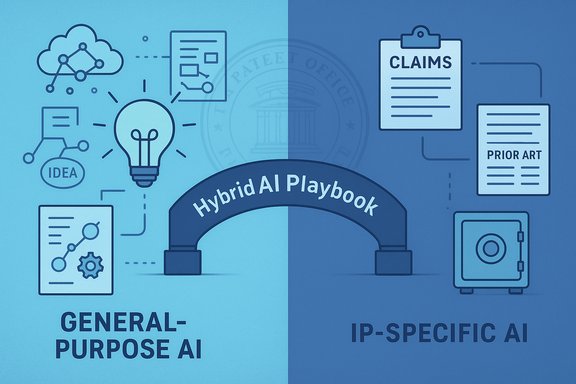
The upcoming IPWatchdog webinar on November 20, 2025, frames a question that has quietly become central to every patent shop and in‑house IP team: when should you reach for a general‑purpose AI like ChatGPT or Microsoft Copilot, and when does the task demand an IP‑specific AI trained and engineered for patent drafting, claim optimization, and office‑action responses?
Background
AI adoption in intellectual property workflows has moved past pilots and proofs‑of‑concept into everyday practice. Patent professionals are now balancing two classes of tools: broadly capable, general‑purpose systems that excel at ideation and human‑style reasoning, and domain‑focused platforms that promise higher precision, provenance, and legal defensibility for prosecution tasks. The IPWatchdog webinar scheduled for November 20 highlights this split and promises practical guidance from industry figures involved in both camps. This coverage examines the practical tradeoffs — performance, risk, integration, compliance, cost — and offers an operational playbook for patent counsel, paralegals, and IP teams deciding how to combine general and IP‑specific AI in daily work. Analysis draws on public reporting about IP‑specialized startups and established vendor documentation for general tools to verify technical claims and flag areas that require caution.Overview: Two Toolchains, Two Philosophies
General‑Purpose AI: breadth, creativity, and conversational reasoning
General‑purpose models (ChatGPT, Microsoft Copilot, and similar LLM‑driven assistants) are optimized to generate natural language, connect diverse ideas, and act as productivity copilots across many domains. They are particularly effective for:- Quick ideation and invention disclosure cleanup.
- Summarizing long technical documents into digestible briefs.
- Brainstorming claim scopes, alternative embodiments, and prior art search strategies at a conceptual level.
- Generating first‑draft non‑legal content: presentations, outreach emails, and visual concepts.
IP‑Specific AI: precision, evidence, and prosecution workflows
IP‑specific platforms — exemplified by newer startups and specialized modules from legacy vendors — are engineered for the patent lifecycle: invention harvesting, novelty and patentability analysis against curated patent corpora, claim drafting with attention to legal standards, office‑action response drafting, and freedom‑to‑operate or infringement screening. Ankar AI, a London‑based IP startup, explicitly markets agentic workflows for patentability checking, drafting, and infringement detection and has raised seed funding to scale those capabilities. Those platforms often combine model‑based generation with deterministic patent search and metadata extraction to reduce factual error and to provide traces back to prior art. IP‑specific tools trade the broad flexibility of general models for structured, verifiable outputs tailored to the prosecution context. They aim to reduce reviewer workload by surfacing candidate claim language, mapping claim terms to prior art references, and producing citation‑anchored drafts ready for attorney editing.Who’s Who: Vendors and Voices
Ankar AI — agentic IP workflows
Ankar AI has positioned itself as an agentic IP platform that automates multiple stages of the patent lifecycle: identifying patent gaps, evaluating patentability against large patent corpora, drafting submissions, and detecting infringement and licensing opportunities. Public reporting describes Ankar’s technology as integrating AI agents trained on legal and scientific data and notes a £3 million seed round led by Index Ventures — a sign that investors see commercial potential in IP‑specific AI. Those reports further claim enterprise deployments with Fortune‑level clients, though vendor claims about specific customer use cases should be validated during vendor evaluation.Quartal IP and practitioner expertise
Quartal IP, founded by Carlo Cotrone, is an IP strategy and consulting practice that advises law firms and corporate IP teams on leadership, operations, and strategy. Practitioners like Cotrone are increasingly vocal about integrating AI into prosecution workflows while managing risk and maintaining strategic oversight. His public contributions and firm materials indicate a focus on aligning AI adoption with business outcomes and legal duties.General‑purpose incumbents
OpenAI’s ChatGPT family and Microsoft’s Copilot line remain the de facto general‑purpose systems in many enterprises. Microsoft’s Copilot is deeply integrated into Microsoft 365 and has enterprise‑grade controls, but watchdogs and documentation have raised questions about how marketing claims map to measurable productivity improvements and about governance defaults that require admin configuration. Documentation emphasizes tenant controls, data boundary options, and DLP configurations designed to limit the risk of exposing confidential information. Still, proper configuration and human‑review workflows are essential.Practical Comparison: Where Each Tool Delivers Most Value
When to use general‑purpose AI
- Early‑stage ideation and invention harvesting where the goal is to expand possibilities rather than produce legally binding language.
- Non‑privileged summaries and collaboration across teams (R&D, marketing, product) where speed trumps formal citation.
- Preparing client‑facing overviews, slide decks, or red‑team brainstorming to identify alternate ways of claiming an invention.
- Fast turnaround and low friction.
- Strong natural‑language fluency and multi‑modal outputs (text + images) in many platforms.
- Excellent for exploratory reasoning and cross‑disciplinary synthesis.
- Higher rate of factual inaccuracies and invented citations unless externally grounded.
- Potential confidentiality risks if used with client‑sensitive prompts on public or improperly configured services.
When to use IP‑specific AI
- Patentability assessment that must be defensible and reproducible: searching patent corpus with validated retrieval logic and providing traceable hits.
- Drafting claims and office‑action responses where legal precision, claim dependency chains, and citation accuracy matter.
- Freedom‑to‑operate and infringement analysis that requires large‑scale prior‑art matching and entity‑linking across structured patent metadata.
- Designed for legal and technical accuracy with audit trails and references.
- Tailored workflows for prosecution: claim templates, dependent claim generation, and draft office‑action counters aligned with practice norms.
- Vendor controls to host data in secure environments and avoid model training on confidential inputs.
- May be less flexible for cross‑domain creative brainstorming.
- Vendor maturity varies: some startups are still building coverage and edge‑case handling; verify corpus completeness and update cadence during evaluation.
Legal, Ethical, and Security Risks — What Patent Teams Must Manage
IP teams operate under duties of competence, confidentiality, and candor; these legal obligations shape how AI should be used:- Duty of competence and supervision: Attorneys must understand AI limits and supervise non‑lawyer assistants (including AI). Public guidance from legal‑ethics commentators and jurisdictional bar guidance stresses verification, documentation, and transparent client communication about AI use. Overreliance on raw LLM outputs can create malpractice risk if errors remain uncorrected.
- Confidentiality and data residency: Inputting invention disclosures, trade secrets, or privileged strategy into public LLM endpoints can expose client data. Enterprise tools like Microsoft Copilot offer tenant‑level protections and DLP options, but require correct configuration; vendor promises about non‑training on customer data should be validated contractually and technically. IP‑specific platforms often provide on‑premises or dedicated cloud instances and contractual assurances about data handling — yet these claims should be tested.
- Hallucinations and false authorities: LLMs can fabricate plausible‑looking prior art citations, case law, or technical references. Patent prosecution cannot tolerate invented references; every citation used to justify novelty or non‑obviousness must be verifiable. IP‑specific tools mitigate this by coupling model outputs with deterministic search results; general models should only be used for hypothesis generation unless calls are grounded to verified databases.
- Inventorship, authorship, and regulatory compliance: Many jurisdictions and the USPTO have considered the role of AI in inventorship and patent eligibility. Guidance and litigation continue to evolve; teams must avoid assuming that AI can be an inventor and instead document human contributions when preparing filings. Practitioners should watch evolving USPTO guidance for AI‑assisted inventions.
An Operational Playbook: Combining General and IP‑Specific AI
A hybrid approach captures the benefits of both tool classes while containing risk. Recommended steps for pilot‑to‑production:- Classify the task by risk and required defensibility (e.g., research vs. filing).
- For low‑risk ideation, use general‑purpose AI with internal policies preventing confidential disclosures.
- For high‑risk prosecution work (claims, office‑action responses), use IP‑specific platforms or secure instances of general tools with tenant‑level protections plus human review.
- Implement mandatory verification and citation‑anchoring: every assertion used in a filing must link to a retrievable source and be human‑signed off.
- Maintain an AI usage log per matter: tool used, prompts, outputs, and reviewer sign‑off to support auditability and conflict resolution.
- Data classification and DLP rules to prevent sensitive inputs to public models.
- Vendor‑contract provisions for data handling, model training rights, and audit access.
- Version control for AI drafts and attorney edits.
- Regular model performance testing and bias assessment for specific domains and jurisdictions.
Verification and Vendor Evaluation: Questions to Ask
When evaluating IP‑specific vendors or configuring general‑purpose systems for prosecution work, insist on answers and demonstrations for these points:- Corpus coverage and update cadence: What patent offices, publications, and non‑patent literature are indexed? How often is the index updated?
- Traceability: Can the system produce exportable evidence showing which documents supported a patentability conclusion or a claim element mapping?
- Data residency and model training: Does the vendor retain or use client inputs for training future models? Is there an option to isolate customer data?
- Error rates and validation: What are measured false‑positive/false‑negative rates for prior‑art matches and claim mapping? Ask for benchmark datasets and validation results.
- Integration and workflow support: Does the platform integrate with docketing systems, e‑filing tools, or internal knowledge bases?
- Incident and change management: How are model updates handled and communicated? Is there a rollback policy if a model change affects outputs materially?
Real‑World Example: Claims About Patentability at Machine Scale
Vendor public statements for IP platforms often highlight rapid patentability checks against millions of patents. Reporting on Ankar, for example, notes the company’s seed funding and claims of rapid analysis against large patent repositories. Those claims are commercially plausible and supported by investor coverage, but they require two practical verifications during procurement:- Confirm the exact corpus size and jurisdictional breadth (US, EP, WIPO, CN, JP, etc..
- Validate the retrieval precision on your most critical technology areas: not all models perform equally across biotech, semiconductor, and mechanical arts.
Risks That Are Often Overlooked
- Cross‑matter bleed: If a vendor reuses uploaded invention disclosures to fine‑tune models unless contractually prohibited, confidential insights could be exposed across clients.
- Over‑automation of claims: Relying on AI to auto‑generate dependent claim chains without human oversight can lead to inconsistent dependencies or improperly scoped claims that create prosecution headaches.
- Regulatory and tribunal expectations: Courts and patent offices may scrutinize AI‑assisted filings more closely, particularly where AI‑generated language is used to assert novelty or inventorship. Documentation of human involvement and review is essential.
Short‑Term Roadmap for IP Teams
- Months 0–3: Run parallel pilots — general AI for ideation; IP‑specific for selected prosecution tasks. Implement DLP and classification.
- Months 3–6: Measure KPIs — time saved per office action, error rates in draft claims, and reviewer time. Validate vendor claims with a test corpus.
- Months 6–12: Roll out mixed workflows with governance playbooks, mandatory sign‑offs, and client disclosure templates. Update matter intake forms to capture AI usage permissions.
- Ongoing: Monitor model performance, legal developments on AI inventorship and data rights, and update vendor agreements accordingly.
Conclusion
The binary choice between general‑purpose AI and IP‑specific AI is a false dichotomy for most patent teams; the real decision is tactical: which tool is right for which step of the IP lifecycle. General models are unmatched for creativity, speed, and cross‑functional collaboration, while IP‑specific platforms are engineered to deliver the accuracy, auditability, and legal rigor needed for drafting claims, preparing office‑action responses, and running defensible patentability and infringement analyses. The pragmatic path forward is hybrid: exploit general AI for ideation and early triage, then hand off to IP‑specific systems — and ultimately to trained humans — before filings, opinions, or client deliverables are finalized.Public reporting confirms that startups focused on IP workflows are attracting capital and building differentiated features, but vendor claims should be verified against your organization’s corpus, security requirements, and prosecutorial standards. Similarly, enterprise general‑purpose offerings now include tenant protections and DLP, but safe deployment depends on governance and configuration, not on vendor marketing alone. The IPWatchdog webinar on November 20 is a timely forum to explore these tradeoffs in more depth and to hear practitioners discuss real‑world integrations and failures. Patent teams should approach adoption with both enthusiasm for the productivity gains and disciplined controls to preserve client confidentiality, legal accuracy, and professional responsibility.
Source: IPWatchdog.com Webinar: IP Specific vs. General Purpose AI - Choosing the Right Tool for the Task


