

AI-powered answer engines are quietly rerouting attention away from websites and into model-generated responses — and for brands that still measure success by clicks and organic sessions, the shift is already measurable and urgent.
Generative Engine Optimization (GEO) is the practice of adapting content, metadata, and the broader digital footprint so that large language models (LLMs) and other generative systems select, summarize, and cite a brand correctly inside an AI answer. The phrase has moved from niche SEO chatter into boardroom priorities because the underlying technologies — ChatGPT, Gemini, Claude, Perplexity and proprietary retail engines — are now primary discovery tools for many buyers and researchers. Evidence of rapid adoption and market growth is visible across market projections and industry surveys: analysts project a multibillion-dollar LLM market trajectory, and multiple surveys show broad LLM adoption inside enterprises. This is not an academic problem. When AI systems surface an authoritative summary or shopping suggestion at the top of a pathway to purchase, users often accept the result without clicking further. Publishers and product sites have reported shrinking organic referrals when AI summaries appear, prompting lawsuits and industry complaints that underscore the economic stakes. The change is uneven across verticals — news and simple-answer categories are particularly affected — but the overall signal is clear: visibility inside AI answers matters now.
Two technical shifts make GEO different:
Key reasons GEO belongs in core strategy:
Immediate, pragmatic steps for brands:
AI is changing the shape of discovery from pages to synthesized answers. Brands that learn to be seen inside those answers — accurate, authoritative, and useful — will continue to be found.
Source: prnewsonline.com AI Search Is Stealing Your Traffic: 10 Fixes Every Brand Needs in 2026
 Background
Generative Engine Optimization (GEO) is the practice of adapting content, metadata, and the broader digital footprint so that large language models (LLMs) and other generative systems select, summarize, and cite a brand correctly inside an AI answer. The phrase has moved from niche SEO chatter into boardroom priorities because the underlying technologies — ChatGPT, Gemini, Claude, Perplexity and proprietary retail engines — are now primary discovery tools for many buyers and researchers. Evidence of rapid adoption and market growth is visible across market projections and industry surveys: analysts project a multibillion-dollar LLM market trajectory, and multiple surveys show broad LLM adoption inside enterprises. This is not an academic problem. When AI systems surface an authoritative summary or shopping suggestion at the top of a pathway to purchase, users often accept the result without clicking further. Publishers and product sites have reported shrinking organic referrals when AI summaries appear, prompting lawsuits and industry complaints that underscore the economic stakes. The change is uneven across verticals — news and simple-answer categories are particularly affected — but the overall signal is clear: visibility inside AI answers matters now. What changed in search: from links to answers
The mechanics of the shift
Traditional SEO optimizes pages to win rankings on search engine result pages (SERPs). GEO targets the decision layer that LLMs produce: short-form answers, bulleted comparisons, and curated shopping suggestions. These answers are often built from a blend of web sources (indexed pages, knowledge graphs, reviews) and model-internal reasoning, sometimes enriched via retrieval-augmented generation (RAG).Two technical shifts make GEO different:
- Answer-first behavior: Many users now treat the AI-generated response as a finished answer, which reduces downstream clicks and increases zero-click outcomes.
- Entity and citation bias: LLMs rely more heavily on perceived authority signals and structured knowledge (schemas, directories, analyst reports) than on traditional ranking signals alone.
Early impacts by vertical
- News and simple-reference content saw the largest immediate declines. Independent analyses and publisher reports show substantial drops in referral traffic where AI summaries are used heavily. The legal and commercial responses to these declines indicate the problem is more than anecdotal.
- E‑commerce is being reshaped as retail platforms and AI assistants offer direct product suggestions and answer-driven shopping flows. Several industry analyses cite meaningful falls in traditional search referrals for product pages, though precise figures vary by report and methodology.
Why PR and marketing teams must treat GEO as core discovery
PR and marketing traditionally aim to control narrative and surface the brand in discovery channels. GEO is simply the next frontier of discovery where the unit of value is not a click but a citation and an accurate, persuasive short-form summary inside an AI answer.Key reasons GEO belongs in core strategy:
- Discovery behavior is evolving: A rising share of research and vendor selection occurs inside AI chat and answer engines rather than via a sequence of search-result clicks.
- Reputation now travels via synthesized answers: One misattributed or inaccurate claim in a high-frequency AI response can propagate and influence buyer decisions at scale.
- Measurement and buy-in require new KPIs: Traditional KPIs (organic sessions, backlinks) are necessary but no longer sufficient; brands need AI-visibility and citation metrics.
What the numbers say — and what to treat cautiously
Several data points are now commonly cited in industry coverage:- Market analysts project the LLM market expanding rapidly over the next decade, with widely cited forecasts estimating multibillion-dollar growth by 2033.
- Surveys show high enterprise adoption of LLM tools and a rising share of marketers acknowledging GEO as important — but many also report that companies aren’t yet investing properly. One recent survey found a large fraction of marketers have not yet dedicated time or budget to GEO.
- Multiple industry studies and vendor analyses report traffic declines associated with AI overviews and answer boxes. The magnitude varies by dataset and vertical: news publishers have documented severe declines in some cases, while vendor reports quote specific percentages for e‑commerce and other sectors. These per-vertical numbers are often aggregated or derived from proprietary toolsets; they are directionally useful but should be treated with care until the underlying methodology is public.
Ten practical fixes every brand needs in 2026 (implemented as a rigorous GEO playbook)
The following ten fixes combine measurement, content engineering, technical SEO, PR, and organizational changes. The goal is not to abandon SEO, but to align SEO and GEO so brands are present both as a link and as an authoritative citation inside AI answers.1. Build an AI Visibility Index (GEO scorecard)
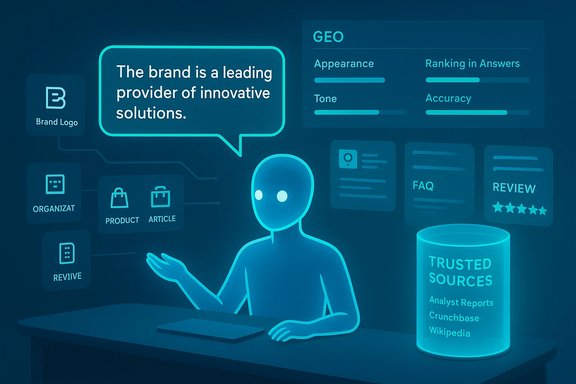
Create a single-sheet GEO scorecard to track AI visibility across engines. Core dimensions:- Appearance: Does the brand show up for target buyer-intent queries?
- Ranking inside answers: Is the brand the first-cited option or buried?
- Tone & sentiment: Is the mention positive, neutral, or negative?
- Accuracy: Are product categories, pricing, or ownership described correctly?
Combine these into a rolling score to communicate traction to stakeholders.
2. Track across multiple LLMs and platforms (not just one)
Monitor presence in at least four engines: ChatGPT (OpenAI), Gemini (Google), Claude (Anthropic), and Perplexity — and add industry-specific agents (platform shopping engines, Amazon/Alexa, proprietary enterprise assistants).- Use both automated trackers and manual spot checks.
- Sample buyer-intent prompts and localize queries by market.
3. Start with manual, repeatable audits
Before investing in expensive tooling, run a disciplined manual audit for 4–6 weeks:- Create a spreadsheet of 50–200 buyer-intent prompts.
- Record whether your brand appears, the exact phrasing the model used, and any competitors or errors.
- Track changes weekly to map model drift and update cycles.
4. Use buyer-intent prompts and scenario testing
Generic queries reveal little; simulate real-world purchase scenarios:- “Best analytics vendor for Series A SaaS”
- “How to reduce app latency for real-time multiplayer games”
- “Affordable PR agencies for consumer tech launches”
5. Harden facts and entity signals (structured data + citations)
GEO rewards structured, verifiable signals:- Implement Organization, Product, FAQ, Article, and Review schema thoroughly.
- Ensure directories, analyst reports, and authoritative profiles (company site, Crunchbase, LinkedIn, Wikipedia where appropriate) are consistent and up-to-date.
- Encourage earned mentions (analyst quotes, industry reports) that LLMs and agents prefer as citation sources.
6. Treat PR as a direct GEO input
Journalist coverage, analyst reports, and trusted third-party posts are high-velocity signals for many LLMs. Map which outlets and authors consistently influence AI answers and target them proactively.- Maintain a prioritized media list based on AI influence (not just reach).
- Convert long-form coverage into short, citable assets like one‑page factsheets and verified data points for re-use.
7. Adopt a hybrid tooling + human validation approach
Use specialized GEO tools for scale but validate with humans:- Automated tools: run queries at scale, detect mention patterns, and flag sudden drops.
- Human review: check accuracy, tone, and the context in which your brand is cited.
- Rotate in manual audits to validate tool outputs every 30–90 days.
8. Measure beyond mentions — measure task completion and conversion
Shift KPIs beyond presence metrics:- Track whether the AI answer leads to a task completion (e.g., a click, a lead, a conversion path).
- Measure the quality of AI-referred sessions: bounce, pages per session, lead conversion, average order value.
- Attribute AI-origin traffic in your analytics stack using UTM hygiene, landing templates, and server-side event capture where possible.
9. Design content for extractability and snippet readiness
Write with AI extraction in mind:- Front-load factual answers in the first 100–150 words.
- Use clear headings, bullet points, numbered steps, and canonical phrasing for product names and categories.
- Maintain a public “data hub” of facts, press releases, and spec sheets that agents can draw from.
10. Prepare governance and risk controls for hallucinations and compliance
AI answers sometimes misstate facts or invent claims. Implement governance:- Maintain an internal “GEO issue tracker” for misstatements the models produce.
- Escalate persistent inaccuracies to the content team, legal, or product so corrections are published where the models can pick them up.
- Monitor for bias, defamation risk, and toxic outputs and have a response playbook (corrections, takedowns, or media outreach).
The measurement stack: what to instrument in 2026
A practical GEO measurement stack includes:- Query-level trackers (sampled prompts across engines) — daily or weekly.
- Citation and mention logs (engine, prompt, full answer) — retained for 90+ days to detect drift.
- Analytics mapping (session attribution, conversion funnels, LTV of AI-referred users).
- Schema coverage report (pages with proper Product/Organization/FAQ markup).
- Media influence index (track which publications/voices are shaping AI outputs).
Critical analysis: strengths, blind spots, and risks
Notable strengths of the GEO thesis
- Alignment with user behavior: GEO meets users where they increasingly start their research: in AI assistants and answer panels. Prioritizing GEO reduces the risk of being invisible in decision-making flows.
- Actionable interventions: Structured data, factual corrections, and earned mentions are tangible levers PR and SEO teams can pull quickly.
- Competitive moat potential: Brands that invest early in authoritative, structured signals and relationships with influential journalists/analysts can obtain durable AI visibility.
Potential risks and limits
- Data ambiguity and vendor lock: Many GEO claims rely on proprietary measurements from vendors with commercial incentives. Single-tool readings can mislead. Independent cross-checks are necessary.
- Model opacity and volatility: LLMs update frequently. A sustained presence this month may evaporate after a model refresh. Investments in GEO require ongoing monitoring and a tolerance for churn.
- Legal and ethical exposure: As publishers have signalled, platforms that synthesize content without consistent attribution raise copyright and business-model questions. Litigation and regulation could alter the landscape rapidly.
- Measurement challenges: Many analytics tools cannot distinguish “AI-referral” without additional instrumentation; brands will need to rely on pattern detection, server-side logging, and careful experimental design to attribute impact.
On headline statistics: treat some figures as directional, not absolute
Several widely circulated numbers — e.g., a specific percent drop in e‑commerce search traffic or a stated uplift in “brand citations” from a vendor guide — are repeated across vendor blogs and tool pages. Those figures are valuable as directional evidence but should be validated against your own telemetry before they drive large budget shifts. Vendor claims about citation uplifts (for example, a 150%+ boost from GEO tactics) are plausible when a program is well executed, but they often reflect controlled case studies rather than industry-wide averages. Cross-check vendor claims with independent industry research and your test results.Practical rollout plan (90-day sprint)
- Week 1–2: Baseline audit
- Run 100 buyer-intent prompts across 3–4 engines; document presence and accuracy.
- Publish a one-page GEO scorecard for leadership.
- Week 3–6: Tactical fixes
- Correct top 10 factual errors discovered.
- Implement or improve schema on high-value pages.
- Create short, citation-ready factsheets for product / pricing / differentiators.
- Week 7–10: Earned signal push
- Target three high-AI-influence outlets with clear, factual content and offer analyst briefings.
- Convert legacy press around product facts into canonical resources the models can reference.
- Week 11–12: Measure and iterate
- Compare AI Visibility Index from baseline; measure changes in AI-origin sessions and conversions.
- Plan next-quarter investments: tooling, content, and PR focus areas.
Final assessment and recommendations
Generative Engine Optimization is not a fad — it is an operational shift in how search, discovery, and early-stage decisioning work. Brands that treat GEO as an add-on will lose ground; those that weave it into PR, content operations, and analytics will gain share of voice inside the answers people actually consume.Immediate, pragmatic steps for brands:
- Build a repeatable GEO audit and scorecard.
- Prioritize factual integrity, structured data, and third-party citations.
- Combine tooling with disciplined human validation.
- Measure downstream business impact, not just mentions.
AI is changing the shape of discovery from pages to synthesized answers. Brands that learn to be seen inside those answers — accurate, authoritative, and useful — will continue to be found.
Source: prnewsonline.com AI Search Is Stealing Your Traffic: 10 Fixes Every Brand Needs in 2026
