

Gentoo has quietly started the operational phase of a migration away from GitHub by placing its primary ebuild repository on Codeberg and inviting contributions there — a deliberate, community-driven move shaped as much by technical caution as by a principled resistance to platform-driven AI features such as GitHub Copilot.
Gentoo has long been a distribution defined by deliberate choices: source-based package management, hands-on developer governance, and a culture that prizes correctness and transparency. Over the past two years the project’s maintainers and councils have discussed the future of their public infrastructure at length, weighing convenience against control, third-party feature creep, and the legal and ethical questions surrounding AI systems trained on publicly available code. Those discussions culminated in a decision to pursue a phased migration away from GitHub toward alternative forges, with Codeberg selected as an initial host for core repositories.
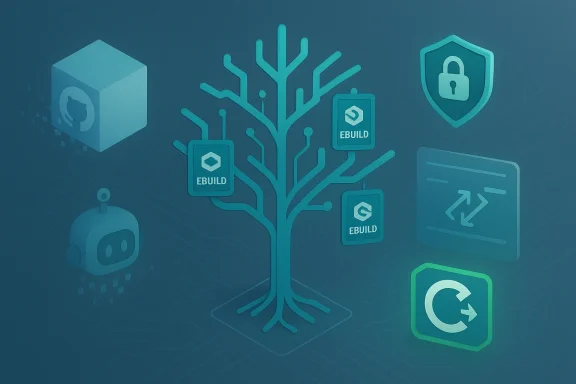
This step marks the transition from planning to practice: the Gentoo ebuild tree — the Portage “tree” that contains ebuilds, eclasses, and metadata that Portage uses to build and install packages — is now hosted and accepting pull requests on Codeberg as an alternative contribution channel while the wider migration proceeds over time. The project emphasises that this is a gradual process, not an instant cutover, continuing to operate mirrors and workflows that keep contributors who still use GitHub in the loop.
This trend increases pressure on community-owned forges, non-profit hosts, and self-hosted alternatives to provide the scale, tooling, and reliability that projects need. It also raises questions about sustainability: can association-funded platforms like Codeberg scale to handle many large projects moving away from commercial hosts? How will they finance global CDNs, CI runners and redundancy? The answers will shape the long-term topology of open-source hosting: a mosaic of community forges, self-hosted instances, and corporate platforms, each chosen for different trade-offs between convenience, control and legal/regulatory domicile.
However, the risks are real and non-negligible. The project will need to marshal volunteer time and potentially financial resources to replicate or replace GitHub-flavored conveniences and maintain mirror performance at a global scale. The transitional period poses a real operational complexity: duplicated workflows, CI rewrites, and the need to keep user-facing operations stable while engineers focus on migration. For an organisation that runs largely on volunteer labour and a modest budget, missteps could cause contributor frustration or slowdowns in package maintenance.
Ultimately, the move is an explicit bet: that long-term project health is better served by control and predictable governance than by short-term convenience. Whether the bet pays off will depend on the speed of the infrastructure rebuild, the quality of the contributor experience on Codeberg, and the project’s ability to sustain the operational load of running mirrored services — factors the Gentoo community is aware of and actively managing through staged rollout and clear communications.
For contributors and users the practical advice is simple: expect a staged migration, follow Gentoo’s official communications for mirror and sync changes, and be prepared for a period of dual workflows as the project re-establishes CI and tooling on Codeberg. For the broader open-source ecosystem, Gentoo’s move is part of a growing test of whether community-led forges can shoulder the operational demands of major projects and whether the open-source world will prioritise governance and control over the convenience of large corporate platforms.
The story is still being written, and Gentoo’s next set of updates will show whether the project can balance its ideals with the realities of maintaining a global package repository.
Source: Phoronix Gentoo Linux Begins Codeberg Migration In Moving Away From GitHub, Avoiding Copilot - Phoronix
 Background
Gentoo has long been a distribution defined by deliberate choices: source-based package management, hands-on developer governance, and a culture that prizes correctness and transparency. Over the past two years the project’s maintainers and councils have discussed the future of their public infrastructure at length, weighing convenience against control, third-party feature creep, and the legal and ethical questions surrounding AI systems trained on publicly available code. Those discussions culminated in a decision to pursue a phased migration away from GitHub toward alternative forges, with Codeberg selected as an initial host for core repositories.This step marks the transition from planning to practice: the Gentoo ebuild tree — the Portage “tree” that contains ebuilds, eclasses, and metadata that Portage uses to build and install packages — is now hosted and accepting pull requests on Codeberg as an alternative contribution channel while the wider migration proceeds over time. The project emphasises that this is a gradual process, not an instant cutover, continuing to operate mirrors and workflows that keep contributors who still use GitHub in the loop.
Why Codeberg? A technical and philosophical fit
Codeberg in brief
Codeberg is a European, non‑profit forge run by Codeberg e.V. and built on the Forgejo platform (a fork of Gitea). It offers repository hosting, issue trackers, pull-request-style workflows (merge requests), Pages, and integrations such as hosted CI and Weblate for translations. Its governance model — community-run association, hosted in Germany — and its reliance on free software for core tooling align with projects that want to maximise transparency and local legal protections for contributor data. For projects wanting to minimise vendor lock-in and platform feature creep, Codeberg’s structure and governance model make it an appealing alternative.Why this matters for Gentoo
For Gentoo, the choice is practical as well as ideological. The ebuild tree is massive and foundational: Portage clients sync it daily to deliver package metadata to tens of thousands of users. Hosting the tree on a forge with policy, privacy and the ability to control non-core features (like automatic UI prompts or AI integrations) reduces the risk that platform-level changes will silently alter contributor workflows or inject features the project explicitly disapproves of. Put bluntly: Gentoo wants to avoid a future in which repository pages show persistent prompts to “enable” AI assistance or where automated AI reviewers can interpose themselves into PR workflows unless the project chooses otherwise.The immediate technical details: what moved, and what hasn't
The ebuild tree is first
Gentoo’s initial push onto Codeberg centres on the Gentoo ebuild repository — the Portage tree that contains the recipe-level instructions (ebuilds) used to build packages. The repository is now mirrored and available on Codeberg, and maintainers are accepting pull requests there in addition to their existing GitHub presence. This is not yet a full redirect of all services; the migration is deliberately incremental so that tooling, CI, mirrors, and contributor workflows can be adapted without disruption.Mirrors, syncing, and Portage behavior
A central technical question for Gentoo users is whether emerge --sync and automated mirrors will be affected. The project has indicated that the migration will be gradual and that existing mirrors and Portage sync mechanisms will be maintained and evolved as needed. In practice this means users should not expect immediate breakage to normal Portage operations; over a transitional period, the Codeberg tree will act as an authoritative or near-authoritative host while mirror infrastructure and any necessary migration tooling are validated. Specific details about final mirror endpoints, rsync or git sync deprecations, and timelines will be communicated by Gentoo infrastructure teams as they complete the work.CI, repositories and feature parity
Moving code hosting is the first step; the real engineering work is re-establishing equivalently robust continuous integration, code review tooling, and webhooks that integrate with Gentoo’s automated QA. Codeberg and Forgejo provide common features (merge requests, basic CI integration via Woodpecker or other tools), but projects with long-standing GitHub-flavored workflows will need to reconfigure CI runners, bots, and permissioning. Gentoo’s decision to proceed slowly recognises the time required to reimplement or adapt CI/CD pipelines and QA hooks without interrupting the Portage quality gate and package testing.The catalyst: Copilot, AI prompts, and community policy
What triggered the exodus
The proximate cause of Gentoo's migration discussions was rising unease about GitHub’s increasing integration of AI into the repository experience — particularly Copilot and UI-level prompts that encourage users to enable Copilot or that surface automated suggestions on pull requests. Gentoo developers reported incidents where Copilot-like features appeared in the review interface or prompted repository visitors, and the project’s leadership concluded that they could not dependably prevent platform-level AI features from being applied to repositories hosted on GitHub. Those incidents and the broader unresolved legal questions around AI training datasets drove the project to seek alternatives that let them retain control over the repository UI and review experience.The project's AI stance
Gentoo’s developer community has debated the role of AI in contributions for several years. An RFC proposing the banning of AI‑backed (LLM-generated) contributions surfaced in 2024, with core contributors raising copyright, quality, and ethical concerns. The consensus within Gentoo leans toward strict controls on the provenance of content submitted to the project: contributions should be attributable to identifiable human authors and meet the project’s quality expectations. That cultural context helps explain why accepting a platform that actively promotes integrated AI assistance — even as a convenience for some users — was judged unacceptable by a vocal subset of the community.Legal and reputational risks
Beyond workflow preferences, the legal risk of relying on platforms whose AI systems are trained on public source code is nontrivial. Litigation and public debate have repeatedly raised questions about whether code-generation tools can reproduce copyrighted fragments or produce outputs derived from copyrighted corpora without adequate provenance. For a distribution like Gentoo, which curates package build instructions and must ensure license compliance, those uncertainties translated into a governance-level concern: hosting where an external vendor can unilaterally surface or embed AI-generated content could complicate copyright stewardship and community trust.Benefits and immediate upsides
- Control over repository UX: Hosting on Codeberg avoids automatic AI prompts and gives maintainers clearer control over what contributors see on repository pages.
- European legal domicile and data practices: With Codeberg’s operations anchored in Germany, GDPR and European data-process standards give additional legal clarity and protections for contributor data.
- Alignment with free-software tooling: Forgejo, Woodpecker CI, and other self-hosted, libre replacements are standard on Codeberg, aligning with Gentoo’s long-term commitment to FOSS control of infrastructure.
- A community‑centric governance model: Codeberg e.V.’s association structure allows membership and greater community input into platform-level decisions than what a large corporate-hosted platform typically offers.
Risks, costs, and operational realities
Migration is not free
Even as the philosophical case is strong, the migration carries real costs: engineering time to rebuild CI/CD pipelines, re-establish mirrors, and ensure performance parity; administrative overhead to manage access control, teams, and onboard new contributor workflows; and the ongoing cost of maintaining mirror infrastructure and ensuring worldwide sync performance for Portage clients. Gentoo runs with a small budget and volunteer labour, so these transition costs will be absorbed by a community already stretched thin.Fragmentation and contributor friction
A dual-hosting model during transition runs the risk of fragmenting contribution pathways. Some contributors will continue to prefer GitHub because of convenience or habit; others will migrate to Codeberg. Maintaining two canonical workflows and ensuring CI actions, commit signing, bot integrations, and review processes behave consistently will be an ongoing operational burden. If not carefully managed, this could increase PR turnaround time and create confusion over where a canonical review chain should occur.Feature gaps and third-party ecosystem
GitHub’s ecosystem is, for many developers, thick with third-party integrations: specialized CI providers, bots, GitHub Actions, package registries and a vast marketplace. Replicating or replacing that ecosystem on a different forge is nontrivial. While Codeberg/Forgejo and community tools (Woodpecker CI, Weblate) cover a lot of ground, some niche integrations may not be immediately available, requiring Gentoo to either host its own tooling or live without certain conveniences. That costs time and, potentially, money for hosted runners or extra infrastructure.Long-term lock-in trade-offs
Shifting to Codeberg is a move away from corporate control, but it is still a form of platform dependence: Codeberg itself relies on a set of volunteers, paid staff, and hosting providers. The advantage is that Codeberg is community steered, but the project must nonetheless treat Codeberg as a critical piece of infrastructure and plan for continuity and backup (mirrors, export policies, and contingency plans) just as it would for any key service. In other words, moving from one provider to another doesn't eliminate the need for resilience planning; it changes who the project must collaborate with to ensure uptime and portability.Practical guidance for users and contributors
For users running Gentoo systems
- Continue your normal Portage workflows: for now, Portage syncs and mirrors remain available and are being managed to avoid disruption. Monitor official Gentoo news channels and mailing lists for definitive mirror changes or updates to emerge --sync endpoints. Do not change production systems based on early reports; the project has emphasised a staged migration to avoid sudden breakage.
For contributors who use GitHub
- Expect a transitional period of dual workflows. You can continue to open and review PRs on GitHub for repositories that remain there, but consider creating accounts on Codeberg if you want to participate in PRs where maintainers prefer Codeberg-based contributions. The Gentoo developers have requested patience as CI and tooling are redeployed on the new platform and as contribution guidelines are updated.
For organisations and downstream packagers
- If you maintain CI that integrates against Gentoo repositories, review your automation to ensure it can handle Codeberg-hosted endpoints or mirrors. If you rely on webhooks or GitHub Actions against Gentoo repositories, plan for updated webhook targets or alternative CI runners during the migration window. Engaging with Gentoo infrastructure maintainers early will reduce surprises.
Broader implications for open-source governance
Gentoo’s migration is part of a larger pattern across open-source communities reacting to platform-level AI features and perceived corporate control. Starting in 2022, multiple projects and organisations publicly debated whether to continue using GitHub after Copilot’s introduction. Some communities sought to ban AI‑assisted contributions outright; others pursued partial mitigations. Gentoo’s choice to seek new infrastructure reflects a pragmatic route: preserve contributor workflows and the integrity of the review process by hosting where platform operators cannot unilaterally surface AI features they do not consent to.This trend increases pressure on community-owned forges, non-profit hosts, and self-hosted alternatives to provide the scale, tooling, and reliability that projects need. It also raises questions about sustainability: can association-funded platforms like Codeberg scale to handle many large projects moving away from commercial hosts? How will they finance global CDNs, CI runners and redundancy? The answers will shape the long-term topology of open-source hosting: a mosaic of community forges, self-hosted instances, and corporate platforms, each chosen for different trade-offs between convenience, control and legal/regulatory domicile.
What to watch next
- Gentoo’s official migration timeline and mirror endpoints. The project will publish follow-ups with concrete dates for repository transitions and when specific services become canonical on Codeberg. Watch the Gentoo news page and developer lists for those announcements.
- CI and QA parity. Keep an eye on how Gentoo reimplements CI pipelines on Codeberg or alternative runners. The completeness and reliability of testing infrastructure will determine whether the migration speeds up or stalls.
- Community uptake and contributor experience. The dual-hosting period is an experiment in human factors: how many contributors adopt Codeberg voluntarily, and how quickly will documentation and onboarding reduce friction? Contributor sentiment will drive continued momentum.
- Third‑party projects and downstream relationships. If major derivatives, overlays, or binary-package hosts prefer a single canonical Git endpoint, Gentoo’s choices may influence dependent projects’ hosting decisions. This network effect could amplify the migration or fragment tooling further.
Critical assessment: is this the right move?
Gentoo’s migration to Codeberg is both defensible and risky. It is defensible because it foregrounds governance, provenance, and legal clarity — priorities especially salient to a source-focused distribution with a strong culture of human-authored contributions. The move reduces exposure to platform-level changes that could undermine contribution quality or raise legal questions about AI training. For a project that prizes choice and explicit control, that’s a material gain.However, the risks are real and non-negligible. The project will need to marshal volunteer time and potentially financial resources to replicate or replace GitHub-flavored conveniences and maintain mirror performance at a global scale. The transitional period poses a real operational complexity: duplicated workflows, CI rewrites, and the need to keep user-facing operations stable while engineers focus on migration. For an organisation that runs largely on volunteer labour and a modest budget, missteps could cause contributor frustration or slowdowns in package maintenance.
Ultimately, the move is an explicit bet: that long-term project health is better served by control and predictable governance than by short-term convenience. Whether the bet pays off will depend on the speed of the infrastructure rebuild, the quality of the contributor experience on Codeberg, and the project’s ability to sustain the operational load of running mirrored services — factors the Gentoo community is aware of and actively managing through staged rollout and clear communications.
Conclusion
Gentoo’s decision to begin using Codeberg is a careful, community-oriented reaction to a changing platform landscape where AI features and commercial priorities increasingly shape developer tooling. The project has chosen to prioritise governance, control, and the integrity of its contribution processes over the convenience of a single dominant hosting platform. That choice comes with engineering costs and organisational trade-offs, but it also offers a path to preserving the project’s values and legal clarity in an era of uncertain AI provenance.For contributors and users the practical advice is simple: expect a staged migration, follow Gentoo’s official communications for mirror and sync changes, and be prepared for a period of dual workflows as the project re-establishes CI and tooling on Codeberg. For the broader open-source ecosystem, Gentoo’s move is part of a growing test of whether community-led forges can shoulder the operational demands of major projects and whether the open-source world will prioritise governance and control over the convenience of large corporate platforms.
The story is still being written, and Gentoo’s next set of updates will show whether the project can balance its ideals with the realities of maintaining a global package repository.
Source: Phoronix Gentoo Linux Begins Codeberg Migration In Moving Away From GitHub, Avoiding Copilot - Phoronix
