

A high‑severity Git vulnerability, tracked as CVE‑2024‑32465, allows an attacker to bypass Git’s safeguards when you work with repositories that were obtained from untrusted sources (for example, archives that contain a full .git directory). The flaw was publicly disclosed in May 2024 and patched in multiple maintenance releases across the Git project; organizations that build, ship, or simply open repositories from third‑party archives should treat this as an urgent patch-and-mitigation priority.
Git’s defensive model assumes that handling an untrusted repository is a riskier operation than cloning from a trusted remote. The recommended safe practice is to clone an untrusted repository with explicit options (for example, git clone --no-local) to produce a fresh, sanitized copy instead of working inside a checked-out archive that contains a .git directory. Those protections are intended to prevent repository-supplied artifacts—hooks, configuration, symlinks, or object store manipulations—from being able to execute or modify files outside the repository’s intended scope.
CVE‑2024‑32465 exposes circumstances in which those protections can be bypassed. The issue is not a single simple misconfiguration but a set of edge cases in how Git handles repositories that arrive not as network clone responses but as filesystem archives (for example, zip or tar files that include a complete .git tree). In those scenarios, repository-provided hooks or manipulated filesystem layouts can result in code execution or repository corruption when the user runs ordinary Git commands. The problem was considered serious enough to be shipped as part of a coordinated set of fixes and advisories in mid‑May 2024.
Two concrete problems are worth calling out:
CVE‑2024‑32465 is driven by the fact that Git’s sanitization assumptions differ between cloning (network/server protocol) and opening a repository that was merely unpacked from an archive. Attackers can craft an archive that makes Git execute a hook or write a hook file into place during the early stages of a user’s first Git actions. Because these hooks run with the user’s privileges, they can perform any action available to the user—modify files, exfiltrate secrets, install backdoors, or corrupt the repository.
If you maintain Windows developer images or Visual Studio templates that ship with a preinstalled Git binary, update those images and notify your teams. Build agents running on Windows need the same scrutiny as Linux runners: ensure they run patched Git builds and avoid consuming untrusted archives without sanitization.
From a defensive standpoint, this class of vulnerability underlines two perennial truths in secure software development:
CVE‑2024‑32465 is an important but manageable risk: it demands immediate attention where untrusted archives are used, but the mitigations are straightforward—patch, isolate, and educate. Implement the checklist above, prioritize build and shared hosts, and treat any unvetted repository archive as potentially malicious until proven otherwise.
Source: MSRC Security Update Guide - Microsoft Security Response Center
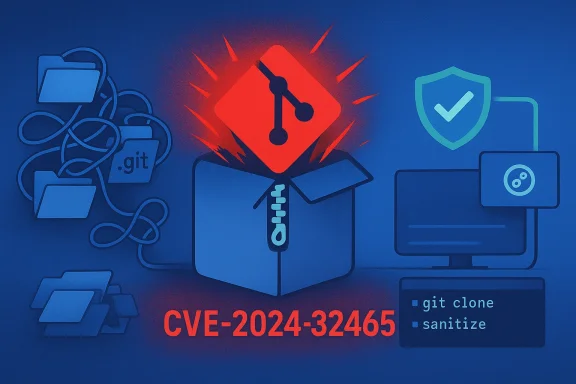 Background / Overview
Git’s defensive model assumes that handling an untrusted repository is a riskier operation than cloning from a trusted remote. The recommended safe practice is to clone an untrusted repository with explicit options (for example, git clone --no-local) to produce a fresh, sanitized copy instead of working inside a checked-out archive that contains a .git directory. Those protections are intended to prevent repository-supplied artifacts—hooks, configuration, symlinks, or object store manipulations—from being able to execute or modify files outside the repository’s intended scope.CVE‑2024‑32465 exposes circumstances in which those protections can be bypassed. The issue is not a single simple misconfiguration but a set of edge cases in how Git handles repositories that arrive not as network clone responses but as filesystem archives (for example, zip or tar files that include a complete .git tree). In those scenarios, repository-provided hooks or manipulated filesystem layouts can result in code execution or repository corruption when the user runs ordinary Git commands. The problem was considered serious enough to be shipped as part of a coordinated set of fixes and advisories in mid‑May 2024.
What the vulnerability actually is
The practical attack surface
At a high level, CVE‑2024‑32465 lets an attacker craft an archive or repository snapshot so that, when an end user extracts the archive and runs Git commands inside the extracted folder, attacker-controlled files (hooks, object store entries, or path-layout tricks) can run or otherwise influence the Git process before the user has a chance to inspect or sanitize the repository. This is a client‑side exploitation vector: the attacker convinces a user to extract or open a repository snapshot supplied as a file (email attachment, shared download, archive mirror) rather than performing a fresh clone from a trusted remote.Two concrete problems are worth calling out:
- Malicious or manipulated Git hooks included inside an extracted .git/hooks/ directory can be executed by Git commands (or by scripts and tooling that trigger hooks) without the user’s explicit knowledge. The hooks mechanism is powerful and runs with the user’s own privileges.
- File-system path and case‑sensitivity tricks (including symlink/directory confusion and carefully chosen filenames) can allow the clone/sanitization flow to be manipulated so that Git writes attacker-controlled files into places that will be used or executed while the clone operation is still in progress. Similar manipulation underpinned earlier related issues (for example, the CVE set disclosed alongside CVE‑2024‑32004).
Why this is not purely theoretical
The Git project and multiple vulnerability trackers gave this a High severity rating (CVSS ~7.3–7.4) because the vulnerability allows arbitrary code execution with the privileges of the user performing the Git operation, and because the attack requires only user interaction (extract an archive and run a Git command). Several mainstream distributions and vendors updated their Git packages quickly, and advisories were published to warn users to avoid running Git in archives from untrusted sources until they could patch.Timeline and disclosure
- Public disclosure and coordinated advisories were published in May 2024 as the Git project addressed multiple, related repository‑handling vulnerabilities. The GitHub security advisory GHSA‑vm9j‑46j9‑qvq4 enumerated the bypass for cloning protections as one of the items fixed in the maintenance releases.
- Patches were released across the 2.39.x → 2.45.x maintenance tracks. The Git project documented the fixed versions and added clarifying documentation about when an untrusted repository can and cannot be considered safe.
- Downstream vendors and Linux distributions incorporated the patches; security trackers such as NVD and Debian published CVE entries and guidance. CERT‑EU and other national CERTs included the issue in advisories aimed at enterprise administrators.
Affected versions and the patch
- Patched Git releases: 2.45.1, 2.44.1, 2.43.4, 2.42.2, 2.41.1, 2.40.2, and 2.39.4. If you are running Git older than the matching patched release in your maintenance track, you are considered vulnerable.
- Platforms affected: All platforms where Git runs—Windows, macOS, Linux, and BSD—were considered affected until patched versions were rolled out by vendors and distributions. Enterprise packagers should verify their distribution’s packaged Git version and apply updates or vendor-supplied hotfixes.
- Workarounds: The short‑term mitigations recommended by the Git project and by security advisories are:
- Avoid running Git inside directories that were produced by a user-supplied archive (zip, tar, etc.) containing a .git directory from an untrusted source.
- When you must consume an archive from an untrusted source, do not run Git commands inside it. Instead, perform a fresh clone from a trusted remote or explicitly sanitize the extracted repository on a machine isolated from sensitive resources.
Technical analysis: how attackers can exploit this
Hooks and early execution
Git hooks are a simple mechanism: scripts placed under .git/hooks/ that Git will execute for certain operations (commit, pre-commit, post-checkout, etc.). When a repository’s .git directory is trusted (for example, originates from your own work), hooks are a convenience. But when the repository itself comes from an untrusted archive, hooks become a remote code execution vector.CVE‑2024‑32465 is driven by the fact that Git’s sanitization assumptions differ between cloning (network/server protocol) and opening a repository that was merely unpacked from an archive. Attackers can craft an archive that makes Git execute a hook or write a hook file into place during the early stages of a user’s first Git actions. Because these hooks run with the user’s privileges, they can perform any action available to the user—modify files, exfiltrate secrets, install backdoors, or corrupt the repository.
Filesystem tricks and race conditions
A related exploitation class used symbolic link / directory / case‑sensitivity manipulations to make Git write a file to a location chosen by the attacker or to cause content to be executed while the clone is still ongoing. The Git maintainers explained scenarios in which Git might be tricked into writing a hook that executes before the operation completes—leaving no opportunity for inspection. Those same classes of filesystem and path handling edge cases are essential to the CVE story.Not necessarily a single code path
It’s important to note that CVE‑2024‑32465 isn’t a single function with a single obvious bug; it’s a set of interactions across clone/local‑clone code, object database handling, filesystem semantics, and hook execution semantics. That complexity made coordinated testing and backporting slightly more involved but also meant that the fixes focused on hardening the sanitization path and clarifying which repository forms are safe to use.Practical impact and risk model
- End‑user risk: A typical developer who downloads a repository snapshot (for example, a .zip attachment from an unknown source) and then runs Git commands in that folder could be subject to arbitrary code running as their user. The results range from credential theft and tooling compromise to lateral movement if the developer’s machine is network-joined to corporate resources.
- Build and CI risk: Automated build and CI systems that automatically materialize, extract, or run operations on repository archives present a high-value target. If an attacker can cause a CI pipeline to unpack a malicious repository and run Git or other build tasks, they may be able to inject steps into the CI process or exfiltrate artifacts. Organizations should audit jobs that consume unvalidated archives.
- Enterprise scale: On multi‑user machines or shared build hosts, earlier related CVEs (for example, CVE‑2024‑32004) demonstrated remote code execution during clone of local repositories owned by other users. CVE‑2024‑32465 expands the attack surface by adding archive‑based delivery scenarios and other corner cases—meaning that system administrators need to ensure both user endpoints and shared build hosts receive patched Git versions.
- Availability considerations: Although the most immediate risk is code execution and integrity compromise, advisories indicate availability impact can be high in worst-case scenarios: attackers able to write malformed object stores or repeatedly trigger destructive repository modifications could disrupt development workflows or CI pipelines until fully remediated. This is consistent with the CVSS availability classification assigned to the issue.
Detection and incident response guidance
Detecting exploitation of this class of vulnerability requires attention to both host activity and repository behavior. The following practical indicators and steps help triage and respond:- Monitor for unexpected processes and scripts launched from developer home directories or from build-agent workspaces immediately following an archive extraction or git command. Unusual network connections from build agents immediately after job startup are high priority.
- Audit logs and process trees for Git processes that spawn child shells or curl/wget/PowerShell sessions; hooks often use command-line tooling to perform actions. Correlate those events to recent file extraction events (tar, unzip, 7zip).
- For CI systems, enforce workspace immutability or sanitization steps before allowing artifacts to run: extract archives into an isolated container that is discarded, or run a deterministic sanitization script that strips .git directories and hook scripts before the build executes.
- If you suspect compromise: isolate the host, collect relevant Git worktree and .git contents for analysis (preserve timestamps), and rotate any credentials that could have been read by processes running in user context. For CI, rebuild agents from known-good images and invalidate any caches that could retain malicious state.
Mitigations and hardening — immediate steps
- Patch immediately. Update Git to one of the patched releases listed for your maintenance train. If you manage distribution packages, ensure your package repository points to a patched build and redeploy. Many Linux distributions, Windows installers, and package managers provided updates soon after disclosure.
- Avoid running Git inside archives. If you receive a zip or tarball containing a .git directory from an untrusted source, do not run Git commands to inspect it. Instead, obtain the repository from a trusted remote, or inspect the archive in a read-only, isolated environment.
- Sanitize workspaces in automation. CI pipelines and developer VMs should extract untrusted archives into ephemeral containers or VMs that do not have access to persistent secrets, and should strip .git/hooks or the entire .git directory before invoking Git.
- Enforce principle of least privilege. Where possible, run build agents and local developer tools with reduced privileges and isolated credentials; avoid storing long-lived secrets on developer endpoints fetchable by arbitrary processes.
- Use file integrity monitoring for developer home directories and CI workspace roots.
- Add an organizational policy that discourages sharing full .git archives and encourages protocol-based transport (git clone over HTTPS/SSH) from authenticated remotes.
- For Windows users, ensure Git for Windows installations are kept up to date through your standard patching channels; Git for Windows builds are distributed separately from OS updates and must be updated explicitly.
Patching at scale: enterprise playbook
- Inventory your fleet: determine who runs Git, which versions are installed, and which build/CI systems or developer images include Git. Centralized endpoint management or configuration management databases (CMDBs) make this straightforward.
- Prioritize high-risk assets: build servers, CI/CD runners, shared development hosts, and any machine that automatically consumes archive artifacts should be first. These hosts have the highest blast radius if exploited.
- Coordinate staged rollouts: for large organizations, create a staged rollout plan that updates build agents in isolated clusters, validates build outputs on patched agents, and then progressively updates developer desktops. Ensure that you have the ability to rapidly reinstall or rebuild compromised runners.
- Update developer guidance and training: publish a short advisory to developers explaining the risk (don’t open .git‑containing archives from unknown sources; use git clone), and include step-by-step instructions for how to update Git on their platforms. Developer practices are the last line of defense.
Why this matters to Windows users and developers
Windows remains a primary development platform and Git for Windows is widely used inside developer tooling, Visual Studio integrations, and scripting environments. Because the vulnerability is platform‑agnostic, Windows developers are equally at risk if they open or extract archives containing malicious .git content. Windows-specific distributions (Git for Windows installer) shipped updates in the same timeframe as upstream Git, and Windows‑specific guidance emphasized that archive‑based delivery (for example, a .zip attached to an email) is an obvious social-engineering vector on Windows endpoints.If you maintain Windows developer images or Visual Studio templates that ship with a preinstalled Git binary, update those images and notify your teams. Build agents running on Windows need the same scrutiny as Linux runners: ensure they run patched Git builds and avoid consuming untrusted archives without sanitization.
Strengths of the response and remaining uncertainties
Notable strengths
- The Git project responded quickly and published patches across multiple maintenance branches, reflecting good upstream coordination and responsible disclosure. The advisory included specific guidance about unsafe archive usage and clarified the recommended sanitization behavior.
- Major distributions and security organizations documented the issue and advised follow-on mitigations, giving enterprise teams multiple, consistent sources for remediation steps.
Remaining risks and open questions
- Exploit proof-of-concept availability: as of the coordinated disclosures, public, reliable proof-of-concept exploit code for CVE‑2024‑32465 was limited. That said, the attack class (hooks + archive delivery) is straightforward enough for moderately skilled attackers to attempt; organizations should not wato patch. If you see credible exploit activity in the wild, treat it as incident-level. Flagged for caution: if you encounter claims of active exploitation, verify against vendor advisories and telemetry.
- Long-term supply-chain hygiene: developers and teams continue to exchange repo snapshots, t. Without cultural and tool changes (for example, default project templates that intentionally omit .git, or packaging formats that strip .git metadata), the same attack vector will remain attractive. Consider shifting internal processes to use authenticated remotes, signed artifacts, and immutable images.
Practical checklist (short and actionable)
- Patch: update Git to a patched version for your maintenance track. (See the patched versions above.)
- Stop: do not run Git commands inside directories created by extracting untrusted archives that contain .git.
- Sanitize: in CI, extract archives into disposable containers and strip .git or .git/hooks before running builds.
- Harden: reduce privileges for build agents and scan for unusual child processes spawned by Git.
- Educate: publish a one‑page advisory to your developer population with the “do not open .git archives” rule.
Broader context and final analysis
CVE‑2024‑32465 is a valuable reminder that distributed version control’s flexibility—files that can be moved, copied, and archived—also raises unique security challenges. The Git maintainers were right to emphasize that archives containing a full .git directory are fundamentally different from a network clone and should not be treated as trusted inputs. The rapid backporting and broad vendor engagement are good news, but the real work is organizational: patching, changing developer habits, and hardening CI and build processes.From a defensive standpoint, this class of vulnerability underlines two perennial truths in secure software development:
- Never trust unverified content, even if it looks like a repository.
- Apply layered defenses: patching, isolation (containers/VMs), runtime monitoring, and developer education—no single control will solve the problem alone.
Appendix: quick references and reminders
- Patched Git releases include: 2.45.1, 2.44.1, 2.43.4, 2.42.2, 2.41.1, 2.40.2, 2.39.4 — update to the matching maintenance release for your environment.
- Short-term behavioral rule for developers: Never run git commands in an extracted .zip/.tar that includes a .git directory if the archive came from an untrusted source. Clone from the canonical remote instead.
CVE‑2024‑32465 is an important but manageable risk: it demands immediate attention where untrusted archives are used, but the mitigations are straightforward—patch, isolate, and educate. Implement the checklist above, prioritize build and shared hosts, and treat any unvetted repository archive as potentially malicious until proven otherwise.
Source: MSRC Security Update Guide - Microsoft Security Response Center
