

AI agents are moving from niche productivity tools to enterprise-grade collaborators, and as GitHub’s new Agent HQ promises to centralize and orchestrate third‑party coding agents, the balance between developer velocity and brand confidentiality has become urgent and precarious.
AI agents—autonomous or semi‑autonomous systems that retrieve, synthesize, and act on data using large language models (LLMs)—are now embedded in code editors, help desks, shopping experiences, and internal workflows. They offer dramatic productivity gains by collapsing multi‑step tasks into single interactions, but they also expand an organization’s data plane in ways traditional security tooling was not built to monitor. The recent MediaPost coverage that triggered industry alarm traces these dynamics through vendor telemetry, vulnerability research, and real‑world incidents.
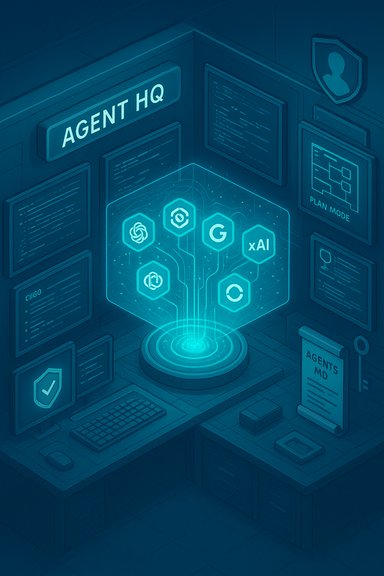
GitHub unveiled Agent HQ at its Universe conference as a “mission control” to assign, steer, and track AI agents across GitHub, VS Code, CLI, and other surfaces—integrating third‑party agents from OpenAI, Anthropic, Google, xAI, Cognition and others under one control plane and planning to make many of these available to paid GitHub Copilot subscribers. The change reframes GitHub as not just a home for developers but a hub for agents-as-collaborators. At the same time, practical incidents—like searchable Grok chat transcripts and a high‑severity Copilot vulnerability dubbed EchoLeak (CVE‑2025‑32711)—have made the threat surface tangible, not hypothetical. These episodes demonstrate how easily agent interactions or agent‑driven behaviors can expose sensitive content if governance is incomplete.
Brands that proactively combine policy, engineering controls, and contractual safeguards will preserve the upside of agentic AI—improving developer velocity and customer experiences—while reducing the material risk that brand secrets, customer data, or proprietary strategies will be unintentionally disclosed. The technical and governance playbook exists; the imperative is implementation at scale.
Source: MediaPost Divulging Brand Secrets Rises With AI Agent Concerns
 Background
AI agents—autonomous or semi‑autonomous systems that retrieve, synthesize, and act on data using large language models (LLMs)—are now embedded in code editors, help desks, shopping experiences, and internal workflows. They offer dramatic productivity gains by collapsing multi‑step tasks into single interactions, but they also expand an organization’s data plane in ways traditional security tooling was not built to monitor. The recent MediaPost coverage that triggered industry alarm traces these dynamics through vendor telemetry, vulnerability research, and real‑world incidents.GitHub unveiled Agent HQ at its Universe conference as a “mission control” to assign, steer, and track AI agents across GitHub, VS Code, CLI, and other surfaces—integrating third‑party agents from OpenAI, Anthropic, Google, xAI, Cognition and others under one control plane and planning to make many of these available to paid GitHub Copilot subscribers. The change reframes GitHub as not just a home for developers but a hub for agents-as-collaborators. At the same time, practical incidents—like searchable Grok chat transcripts and a high‑severity Copilot vulnerability dubbed EchoLeak (CVE‑2025‑32711)—have made the threat surface tangible, not hypothetical. These episodes demonstrate how easily agent interactions or agent‑driven behaviors can expose sensitive content if governance is incomplete.
Why brands and agencies are alarmed
Agents as new data planes
Unlike conventional apps that read files or query databases, LLM‑driven agents synthesize and re‑express information, making outputs potentially re‑disclosable even if the original source is ephemeral. Retrieval‑augmented generation (RAG) systems pull documents into a context window that becomes fodder for generation; those outputs can leak proprietary phrasing, strategy, or customer data. Classic DLP that scans attachments or cloud storage won’t necessarily catch a sales rep who pastes a sensitive list into a web chat.The common leakage vectors
Security telemetry and incident analysis highlight several recurring paths:- Clipboard/paste events — Employees copying and pasting content from internal portals into consumer or third‑party AI interfaces bypass server‑side inspection and often escape enterprise logging. Vendors report paste events as a dominant exfiltration vector.
- Browser extensions and client‑side widgets — Extensions with broad page‑content permissions can exfiltrate data or bypass secure web gateways if installed in unmanaged browser profiles.
- Server‑side API flows and plugins — Backend integrations that call external models can leak information if not masked, partitioned, or governed by strict contractual and technical constraints.
- Agentic privilege — Agents often operate with standing credentials or broad API keys. If compromised, they behave like high‑privilege service accounts with machine‑speed lateral movement. Treating agents as identities subject to least privilege is essential.
- Prompt injection and model‑level exploits — Input that appears innocuous can coerce an agent into exposing internal context. The EchoLeak case is a vivid example of how natural language can become a zero‑click exfiltration vector.
Real incidents that elevated concern
- Grok chats: Tens or hundreds of thousands of conversations created via Grok’s “share” links were indexed by search engines, exposing user content—including sensitive queries—to public search results. The indexing was driven by publicly shareable URLs that lacked privacy controls and expiration. The episode mirrors previous ChatGPT indexing incidents and underscores the assumption risk when users click “share” without understanding permanence.
- EchoLeak (CVE‑2025‑32711): Researchers disclosed an attack chain that embeds malicious instructions in documents (hidden text or metadata) that, when processed by Copilot/Copilot‑style features, can cause the model to output data in ways that trigger external retrieval (for example, loading an image URL that contains exfiltrated text). The exploit class is notable because it requires no code execution and can operate across Word, PowerPoint, Outlook, and Teams—effectively converting benign business documents into exfiltration vehicles. Microsoft and vendors patched identified attack surfaces, but the architectural class persists.
GitHub’s Agent HQ: promise and peril
What Agent HQ brings
Agent HQ consolidates agent orchestration into a single experience:- A mission control dashboard to run, compare, and rate multiple agents against the same task.
- Plan Mode and VS Code integrations to design agent workflows and scaffold multi‑step tasks.
- Enterprise governance primitives: an agent control plane, identity and permissioning, agentic code review, and a metrics dashboard for adoption and impact.
Why agencies distrust a central repository
Agencies and brand teams are concerned that a central, open ecosystem for agents could inadvertently aggregate or expose proprietary strategies and client secrets. The fear is not only accidental (misconfigured scopes, accidental pastes) but also systemic: GitHub itself sits within Microsoft’s cloud and product family, yet developers may configure agents that run on competitor models (Anthropic Claude, Google Gemini, xAI’s models), creating complex cross‑vendor data flows whose retention and training policies differ. This multiplicity of model provenance makes contractual and technical assurances harder to enforce.Financial and strategic context: why every vendor is doubling down
Large cloud and platform vendors are dramatically expanding CapEx to support AI infrastructure—data centers, GPUs, and specialized networking—because agentized experiences are resource‑heavy and latency‑sensitive. Estimates of combined CapEx for major players in 2025 vary in public reporting, with widely cited figures ranging into the low‑hundreds of billions and some forecasts exceeding $400 billion when aggregating Amazon, Microsoft, Alphabet, Meta, and other large cloud players. These investments signal that platform owners view agents and agent‑driven commerce as core future channels. That race both accelerates innovation and raises the stakes for governance.Governance and technical controls that work
Bridging the utility‑security divide requires both policy and engineering. Below is a prioritized, practical playbook for IT, security, and product teams.Immediate (0–30 days)
- Inventory agents and extensions:
- Identify all sanctioned and unsanctioned agents, browser extensions, SDKs, and plugins that touch endpoints. Treat the list as living and enforce registration.
- Rapid containment:
- Block or restrict high‑risk browser extensions via group policy or endpoint configuration. Disable share features or public indexing for agent outputs until expiration/ACLs are enforced.
- Patch validation:
- Verify that services have applied emergency patches or vendor mitigations for known CVEs (EchoLeak) and that Copilot‑style features are configured with recommended guardrails.
Near term (30–90 days)
- Apply least privilege and ephemeral credentials:
- Rotate long‑lived API keys, require short‑lived tokens for agent identities, and place agents under vault‑backed secrets management with automated rotation.
- Expand DLP to cover generated outputs and retrieval indexes:
- Extend content inspection to RAG pipelines, pre‑send filters, and to agent outputs that could be posted externally.
- Agent lifecycle policy:
- Require registration, documented scope, explicit approvals, retention rules, and expiration dates for every agent identity. Automate revocation for stale agents.
Long term (90+ days)
- Model provenance and contractual commitments:
- Prefer enterprise model endpoints with explicit no‑training/no‑retention clauses for sensitive workloads. Negotiate SLAs that include audit rights and data escrowing.
- Observability and audit rails:
- Instrument every retrieval and generation with auditable traces—who asked, which agent, what context, and where outputs were sent. This is necessary to convert access events into forensics-ready incidents.
- Adversarial testing and red teaming:
- Regularly run prompt injection and exfiltration scenarios against production‑adjacent agents to validate mitigations.
Practical developer controls inside GitHub/VS Code
- Treat agents like CI/CD tools: require code review lanes for agent‑generated pull requests, human gates before merges, and automated lint/security checks (CodeQL) as part of agent workflows.
- Use AGENTS.md (or similar manifest) per repository to define allowed agents, permitted data scopes, and default guardrails—place this under version control and include it in onboarding checklists.
- For public repos, enforce scrubbers: secrets scanning, repo allowlists, and pre‑commit hooks that prevent accidental indexing of private data into agent prompts.
Legal, contractual and regulatory levers
- Contract language must explicitly cover data usage, retention, and training rights. Vendors should commit not to use submitted customer prompts or documents for model training unless explicitly authorized.
- Insist on auditability: ask for logs, provenance metadata, and the right to third‑party audits where sensitive data is involved.
- Understand cross‑border considerations: model endpoints hosted in different jurisdictions may implicate data residency rules and export controls. This matters for regulated industries (finance, health) and for contracts that forbid third‑party processing.
What’s strong in current reporting — and what needs caution
The aggregated reporting that spurred alarm is valuable in several ways:- It converts abstract risk into operational pathways (clipboard, extensions, API flows) that security teams can act on immediately.
- It highlights agentic identity and standing credentials as systemic failure points that require architectural changes (ephemeral tokens, least privilege).
- It provides concrete vulnerability cases—EchoLeak—that move the debate from theoretical to operational remediation.
- Sample bias: Vendor telemetry is powerful but not universally representative. Browser‑level instrumentation datasets over‑represent customers who deploy those tools; headline percentages should be treated as directional rather than universal averages.
- Vendor metric caution: Conversion uplift and adoption claims made by platforms are often proprietary and not independently audited. Treat vendor ROI numbers as planning inputs, not definitive proofs.
- Patching is necessary but not sufficient: Fixing a particular CVE (EchoLeak) does not eliminate the entire class of prompt injection and model‑scope vulnerabilities; architectural mitigations and ongoing red teaming are required.
Operational checklist for Windows‑centric IT teams
- Enforce SSO and managed identities for all enterprise AI accounts.
- Block or audit browser extensions that request page content permissions.
- Add agent access to endpoint protection and MDM policies; enforce policies via Intune or comparable tooling.
- Centralize agent logs into SIEM and make retrieval traces visible.
- Harden Microsoft‑adjacent integrations: ensure Microsoft 365 Connected Experiences and Copilot settings are configured per enterprise policy and that guardrails are tested.
Strategic implications for agencies and brands
Agencies must reconcile two competing pressures: the commercial value of brand‑centric agents (personal shopping assistants, creative copilots, ad optimization agents) and the reputational/civil/legal risk if those agents leak competitive strategies or PII.- For client work, create agent‑safe deliverables that redact or abstract sensitive inputs.
- Offer clients contractual guarantees about model provenance and retention when building branded agents.
- Where possible, design agents to operate on sanitized indexes or private enterprise endpoints with provable no‑training terms.
Conclusion
Agent HQ and the broader agentification of development represent a pivotal turning point: the productivity benefits are real and compelling, but so are the risks. Recent incidents—search‑indexed Grok transcripts and the EchoLeak vulnerability—demonstrate that agent interactions can expose sensitive content in new, non‑traditional ways. The appropriate organizational response is not to abandon agents, but to treat them as first‑class identities and data planes: enforce least privilege, instrument retrieval and generation, expand DLP to cover ephemeral flows, and negotiate contractual and technical assurances with model providers.Brands that proactively combine policy, engineering controls, and contractual safeguards will preserve the upside of agentic AI—improving developer velocity and customer experiences—while reducing the material risk that brand secrets, customer data, or proprietary strategies will be unintentionally disclosed. The technical and governance playbook exists; the imperative is implementation at scale.
Source: MediaPost Divulging Brand Secrets Rises With AI Agent Concerns
