

GitHub’s new Agent HQ and a string of high‑profile AI slipups have pushed a single, urgent message to the front pages of enterprise security teams: the rapid agentification of developer and consumer workflows is exposing brand secrets in ways that traditional data‑protection tooling was not designed to see. MediaPost’s coverage this week captured that alarm — noting GitHub’s intention to become a central repository for AI agents and agency developers’ worries that proprietary tasks and client strategies could be inadvertently disclosed through open agent ecosystems.
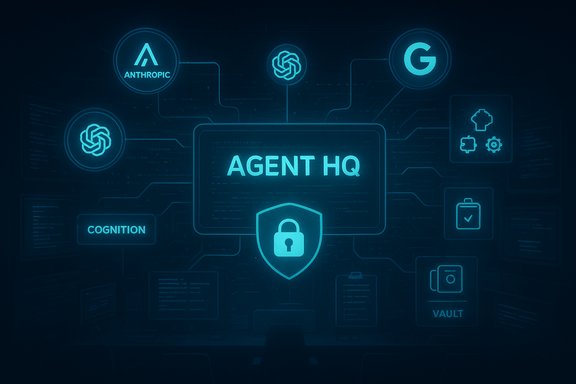
AI agents — autonomous or semi‑autonomous systems that fetch, synthesize and act on data using large language models (LLMs) — have moved fast from curiosity to core workflow tool. GitHub announced Agent HQ at its Universe conference as a “mission control” for coding agents: a central dashboard to run, compare and govern multiple third‑party agents from within GitHub and Visual Studio Code. The pitch is compelling for development velocity and vendor flexibility: developers will be able to choose agents from Anthropic, OpenAI, Google, Cognition, xAI and others via paid GitHub Copilot subscriptions, while organizations get a single place to audit agent activity. That consolidation, however, is exactly what alarmed brand and agency teams. MediaPost reported concerns that centralizing agent orchestration inside a Microsoft‑owned GitHub could create complex cross‑vendor data flows — where an agent’s model provenance, retention and training policies differ — and that misconfigurations or simple paste‑and‑query behaviors could leak proprietary strategies or PII.
At the same time, a string of real incidents has made the threat concrete: searchable conversations from xAI’s Grok appeared in search indices, and security researchers disclosed a critical “zero‑click” prompt‑injection exploit (tracked as CVE‑2025‑32711, nicknamed EchoLeak) that targeted Microsoft 365 Copilot’s retrieval and rendering behavior. These events have crystallized a new operational reality: agents expand an organization’s data plane and require identity‑aware, model‑aware governance rather than just file‑centric DLP.
The incidents of 2025 — searchable agent transcripts and the EchoLeak CVE‑2025‑32711 class of zero‑click prompt injection — are not just cautionary anecdotes. They are operational evidence that agent governance must be treated as a first‑order security and compliance problem. Brands that move quickly to inventory agent usage, harden authentication and scoping, extend DLP to include RAG and generated outputs, and bake contractual no‑training guarantees into vendor relationships will keep the productivity upside while shrinking the downside.
The task is not to halt agent adoption: it is to operationalize it. Treat agents as identities, treat retrieval as a potential exfiltration channel, and treat the control plane — whether GitHub Agent HQ or an equivalent orchestration service — as critical infrastructure worthy of hardened, auditable protections.
Source: MediaPost Divulging Brand Secrets Rises With AI Agent Concerns
 Background
AI agents — autonomous or semi‑autonomous systems that fetch, synthesize and act on data using large language models (LLMs) — have moved fast from curiosity to core workflow tool. GitHub announced Agent HQ at its Universe conference as a “mission control” for coding agents: a central dashboard to run, compare and govern multiple third‑party agents from within GitHub and Visual Studio Code. The pitch is compelling for development velocity and vendor flexibility: developers will be able to choose agents from Anthropic, OpenAI, Google, Cognition, xAI and others via paid GitHub Copilot subscriptions, while organizations get a single place to audit agent activity. That consolidation, however, is exactly what alarmed brand and agency teams. MediaPost reported concerns that centralizing agent orchestration inside a Microsoft‑owned GitHub could create complex cross‑vendor data flows — where an agent’s model provenance, retention and training policies differ — and that misconfigurations or simple paste‑and‑query behaviors could leak proprietary strategies or PII.At the same time, a string of real incidents has made the threat concrete: searchable conversations from xAI’s Grok appeared in search indices, and security researchers disclosed a critical “zero‑click” prompt‑injection exploit (tracked as CVE‑2025‑32711, nicknamed EchoLeak) that targeted Microsoft 365 Copilot’s retrieval and rendering behavior. These events have crystallized a new operational reality: agents expand an organization’s data plane and require identity‑aware, model‑aware governance rather than just file‑centric DLP.
Overview: what GitHub Agent HQ actually does
The promise — orchestration and reduced friction
Agent HQ is presented as an orchestration layer that treats agents as first‑class collaborators. Key capabilities announced or previewed include:- A mission control dashboard to assign, steer and compare multiple agents on the same task.
- Plan Mode and VS Code integrations that let teams design multi‑step agent workflows.
- An agent control plane with permissioning, agent‑centric code review and a metrics dashboard for adoption and impact measurement.
- Integration with GitHub primitives (Git, pull requests, issues) so agent outputs can enter established CI/CD workflows and governance checks.
The catch — a concentrated attack surface
However, centralization concentrates risk. When Agent HQ becomes the hub where agent identities, tokens and retrieval indices live, a misconfiguration or a compromise has amplified impact:- Agents often operate with standing privileges or machine‑level credentials that can access code, issue trackers and cloud resources. If an agent’s credentials are over‑permissive, the lateral movement possible at machine speed is substantial.
- Agents perform retrieval‑augmented generation (RAG): they pull documents into a model context window, synthesize outputs and may re‑express proprietary phrasing or customer data. A single RAG‑driven response can inadvertently expose intellectual property.
- Cross‑vendor flows complicate contractual assurances: an agent in GitHub might call a competitor’s model with different retention/training policies, creating friction for legal/contract teams trying to enforce “no‑training” or audit commitments.
Why brands fear “agent leaks” — technical anatomy of the risk
1) Clipboard and paste events: the invisible leak path
Traditional DLP systems inspect file uploads, attachments and cloud storages. They rarely inspect ephemeral clipboard events or content pasted directly into web chat boxes or browser‑based agents. Security telemetry from multiple vendors shows that employees frequently copy internal data (lead lists, contracts, code snippets) into chat assistants to get instant help — bypassing server side scanning and SSO. This paste‑and‑ask behavior is a dominant real‑world leakage vector.2) Browser extensions and client widgets: origin ambiguity
Agent features increasingly ship as browser extensions, helper widgets or embedded SDKs. Those clients may request broad page content permissions and can bypass corporate proxies if installed in unmanaged browser profiles. Extensions that read page HTML and send it to an external model create blind spots for secure web gateways.3) Server‑side APIs and third‑party models
Back‑end integrations that call external models introduce another risk class. If an application forwards business data to a third‑party model without masking or scoping, the model’s retention and training terms determine whether that data is reused. That creates contractual and regulatory exposure if models train on or retain sensitive inputs.4) Prompt injection and the EchoLeak class of exploits
EchoLeak (CVE‑2025‑32711) exposed a new attack vector: zero‑click or indirect prompt injection where malicious instructions embedded in a document or email are picked up by an assistant’s RAG pipeline and used to exfiltrate internal content. Researchers showed how hidden text or metadata can coerce Copilot‑style features into returning data embedded in an image URL or other side channel — without any user action beyond normal use. Microsoft patched the issue in mid‑2025. The incident underlines that model‑level guardrails and retrieval scoping are architectural requirements, not optional hardening.5) Indexed public transcripts (Grok, ChatGPT incidents)
User‑initiated “share” features can create public URLs that get indexed by search engines. Grok’s share links produced hundreds of thousands of conversations that surfaced in search results, mirroring earlier ChatGPT indexing incidents. The operational lesson is simple: any shareable artifact without expiry or ACLs can become a long‑tail exposure.Corroboration: independent signals and market context
Multiple independent outlets confirmed GitHub’s Agent HQ announcement and the roster of third‑party partners, underscoring that the move is strategic and broadly supported by the vendor ecosystem. TechTarget and The Verge both described Agent HQ as an orchestration layer that will roll out agent integrations to paid Copilot customers in the coming months. EchoLeak and its CVE identifier were tracked in public vulnerability databases and widely reported by security outlets (Hacker News, HackTheBox, cve.circl.lu), and vendors stated they patched the vulnerability in June 2025 — with no public evidence of widespread exploitation. That independent corroboration elevates EchoLeak from theory to operational precedent. Market forces are pressing platform owners to scale fast: major cloud providers told investors in 2025 that AI‑related CapEx would surge. Public reporting estimates combined capital expenditures for Amazon, Microsoft, Alphabet and Meta in 2025 at hundreds of billions of dollars — with public figures and analyst estimates ranging from the low‑hundreds to figures exceeding $400 billion when aggregated. That investment gravity makes enterprise agent platforms strategic infrastructure, not optional developer conveniences.The tradeoffs: strengths versus risks
GitHub’s Agent HQ is a pragmatic response to a real developer problem: tool sprawl, incompatible tokens and duplicated workflows. Its strengths include:- Developer velocity: agents collapse multi‑step tasks and scaffold code quickly.
- Vendor flexibility: teams can pick the best model for a task without forcing all work through one vendor.
- Operational visibility: a central control plane can enable unified logging, metrics and policy enforcement.
- Centralized credentials and tokens create a high‑value target.
- Cross‑vendor data flows complicate legal assurances about retention and training.
- User behavior (pastes, shares) and emergent vulnerabilities (EchoLeak‑style prompt injection) can expose data even if platform controls are robust.
Practical, prioritized playbook for brands and IT teams
The good news is that risk here is manageable with a mixture of rapid containment and architectural change. The following steps are prioritized and practical.Immediate (0–30 days)
- Run an agent inventory: identify all sanctioned and unsanctioned agents, browser extensions, SDKs and plugins in your environment. Treat the list as living and enforce registration.
- Lock down browser extensions via group policy or endpoint management and block high‑risk extensions that request broad page‑content permissions.
- Disable or restrict public share features for agent outputs until expiration rules and ACLs are enforced. Grok and ChatGPT indexing episodes show share links without expiry are a real exposure vector.
- Validate that critical vendor patches (e.g., EchoLeak fixes) have been applied and verify vendor mitigation statements. EchoLeak was patched in mid‑2025 and tracked as CVE‑2025‑32711.
Near term (30–90 days)
- Enforce least‑privilege and ephemeral credentials for agent identities. Rotate long‑lived tokens and place agent keys in vaults with automated rotation.
- Expand DLP to include RAG indexes and generated outputs; apply pre‑send filtering before agent outputs leave controlled channels. Add logging of retrieval traces.
- Require agent registration and lifecycle policies: documented purpose, scope, retention rules and expiration dates for each agent identity, with automation to revoke stale agents.
Long term (90+ days)
- Negotiate model provenance and contractual commitments: prefer enterprise model endpoints with explicit no‑training/no‑retention clauses for sensitive workloads and insist on audit rights.
- Build observability rails: instrument retrieval and generation actions with auditable traces (who asked, which agent, what context, destination of outputs). This is essential for incident response and forensics.
- Maintain a red‑team program for agent workflows: simulate prompt‑injection and exfiltration scenarios periodically to validate mitigations. EchoLeak shows that prompt‑injection is an emergent adversary technique that static patching won’t fully eliminate.
Contractual and cultural levers
Technical controls alone will not be sufficient. Brands need to change the governance operating model:- Update policies and training to clarify what can never be pasted into general‑purpose assistants. Enforce with automated controls and audits.
- Embed legal protections in vendor contracts: explicit data‑usage, auditing, and termination clauses if training terms change. Prefer vendors who provide verifiable no‑training endpoints for regulated data.
- Create cross‑functional ownership (security, legal, product, business) for agent lifecycle decisions so that the business value of agents is balanced against confidentiality and compliance obligations.
What to watch next: red flags and open questions
- Claims about adoption increases or leakage percentages in vendor telemetry are directional rather than definitive; vendor data often has sample bias and should be independently validated where possible. Treat headline numbers as planning inputs, not immutable truths.
- The interaction between cached public data and model suggestions remains a thorny area. Past findings (research showing Copilot surfacing content from previously public GitHub repos) demonstrate that models’ training and caching behavior can leave long tails of exposure. That dynamic will require new tooling and legal frameworks (model unlearning, right‑to‑forget practices).
- Centralization of agent orchestration (Agent HQ) is strategically sensible for platform owners and enterprises, but it elevates the importance of platform‑level assurances: verifiable audit logs, strong tenant isolation, and vendor SLAs that include security primitives relevant to agentic behavior.
Conclusion
GitHub’s Agent HQ is a logical next step in the industry’s move to make AI agents first‑class participants in digital workflows — but it also sharpens the operational tradeoff that organizations must manage. The productivity gains of multi‑agent orchestration are real, and platform centralization brings practical governance benefits. Yet those very benefits concentrate credentialed identities, expand the data plane via RAG, and create new, language‑native attack surfaces that traditional DLP and AV tooling cannot reliably detect.The incidents of 2025 — searchable agent transcripts and the EchoLeak CVE‑2025‑32711 class of zero‑click prompt injection — are not just cautionary anecdotes. They are operational evidence that agent governance must be treated as a first‑order security and compliance problem. Brands that move quickly to inventory agent usage, harden authentication and scoping, extend DLP to include RAG and generated outputs, and bake contractual no‑training guarantees into vendor relationships will keep the productivity upside while shrinking the downside.
The task is not to halt agent adoption: it is to operationalize it. Treat agents as identities, treat retrieval as a potential exfiltration channel, and treat the control plane — whether GitHub Agent HQ or an equivalent orchestration service — as critical infrastructure worthy of hardened, auditable protections.
Source: MediaPost Divulging Brand Secrets Rises With AI Agent Concerns
