

GitHub made Moonshot AI’s Kimi K2.7 Code generally available in the GitHub Copilot model picker on July 1, 2026, giving Copilot users access to a Beijing-built open-weight coding model hosted through Microsoft Azure rather than Moonshot’s own infrastructure. That is not just another model-card update. It is the moment Copilot’s model picker stops looking like a convenience feature and starts looking like a procurement surface.
The attraction is obvious: lower-cost coding inference, trillion-parameter marketing muscle, open weights, and fast availability inside the most familiar AI assistant in mainstream software development. The catch is equally obvious, even if some teams will be tempted to wave it away: model provenance now matters as much as model performance.
For individual Copilot Pro, Pro+, and Max users, the change is simple enough. Kimi K2.7 Code appears as a selectable model as the rollout reaches supported clients, including Visual Studio Code, Visual Studio, JetBrains IDEs, Xcode, Eclipse, Copilot CLI, GitHub.com, GitHub Mobile, and other Copilot surfaces. If the model is available to the account, the user can pick it and start sending coding tasks through it.
For Business and Enterprise customers, GitHub has made the more revealing choice: Kimi K2.7 Code is off by default. Administrators must explicitly enable the model before users in the organization can select it. That default is not a footnote; it is the product team quietly acknowledging that this model carries a different risk profile from another OpenAI or Anthropic variant.
The move also shows how quickly the AI coding market is compressing release cycles. Moonshot published Kimi K2.7 Code’s weights in mid-June, and GitHub made the model selectable inside Copilot less than three weeks later. In the old enterprise software world, that would have been an evaluation window. In the new AI platform world, it is nearly enough time for a model to go from research artifact to default-adjacent developer tool.
That speed is part of the value proposition. Copilot can now absorb new model releases quickly, route them through Microsoft’s infrastructure, and package them for millions of developers without requiring each organization to run its own model-serving stack. But speed also collapses the time administrators have to ask whether the new entry in the dropdown is compatible with their policies, contracts, and threat models.
But open-weight is not the same thing as risk-free. It does not reveal the full training data. It does not guarantee alignment behavior under adversarial prompting. It does not answer who controls future releases, which data pipeline choices were made upstream, or how quickly a hosted integration will track model changes. It also does not erase the legal and political context of the company that built the model.
This is where the Copilot integration becomes more complicated than a normal “new model available” announcement. Moonshot AI is a Beijing-based company. That means the corporate entity behind Kimi is subject to Chinese law, including the National Intelligence Law enacted in 2017. Article 7 of that law is widely cited because it requires organizations and citizens to support, assist, and cooperate with national intelligence work in accordance with law.
There is disagreement among legal analysts about how far that provision reaches in practice. Some argue it is overread in Western policy debates, lacks a straightforward enforcement pathway in ordinary commercial contexts, and should not be treated as a magic phrase that turns every Chinese company into an intelligence asset. Others argue the statute sits inside a broader political and regulatory system where formal legal compulsion, informal Party influence, and state security priorities can be difficult to separate.
A serious enterprise assessment has to hold both ideas at once. The law is not a packet sniffer. It does not mean every prompt sent to a Kimi model is automatically copied to Beijing. But neither is it irrelevant simply because GitHub runs inference through Azure.
For many organizations, that distinction will matter. If a developer asks Copilot to explain a proprietary module, summarize an internal API, or generate a patch, the inference path remains inside Microsoft’s cloud environment rather than being transmitted to a model provider’s separately operated cloud. Administrators already accept similar arrangements for other third-party Copilot models, including models from labs that are not Microsoft.
But Azure hosting only answers the question of where the prompt goes during inference. It does not answer the question of who built the model, who controls its future versions, how the weights were trained, how safety behavior was tuned, or what obligations the model developer may face in its home jurisdiction. Those are different risks, and they require different controls.
This distinction will be uncomfortable for organizations that want a clean binary answer. It is tempting to say either “Azure hosts it, so it is fine” or “Moonshot is Chinese, so it is banned.” Neither position is mature enough for the reality of modern AI procurement. The practical question is whether the residual risk after Azure hosting is acceptable for the kinds of code and data an organization’s developers are likely to expose.
That is why GitHub’s Business and Enterprise default matters. By making administrators opt in, GitHub is effectively saying that Kimi K2.7 Code belongs in the category of models that require policy review, not just user preference. The model picker is now part of the governance plane.
In a dense model, each token activates the full network. In a mixture-of-experts model, a routing system selects a subset of specialized expert networks for each token. Kimi K2.7 Code reportedly has hundreds of experts and activates only a small number on each pass, allowing it to carry a very large total parameter count while paying a much smaller compute cost during inference.
This matters for Copilot because GitHub’s AI Credit system prices usage in a way that makes model choice economically visible. The model picker is no longer just a quality slider. It is a cost control. A developer choosing a cheaper model for routine refactors, explanations, test generation, or lower-stakes agentic work can conserve credits for more expensive models when the task demands them.
The shift also changes how teams will think about performance. A model does not need to beat every frontier competitor on every benchmark to be valuable. It only needs to be good enough for a class of tasks at a price that changes behavior. If Kimi K2.7 Code can handle mundane coding work cheaply and reliably, it could become a default utility model even if developers still reach for more expensive proprietary models for architecture work, security-sensitive reasoning, or tricky debugging.
That is the procurement logic GitHub is enabling. Copilot increasingly looks less like a single assistant and more like a broker for model portfolios.
Benchmarks in AI coding are already fragile. A model can score well on a benchmark and still struggle with a messy monorepo, a brittle build system, a poorly documented internal framework, or a task that requires several tool calls and reversals. Agentic coding performance is especially difficult to measure because success depends not only on code generation but on planning, context management, tool use, error recovery, and the ability to stop before making a bad change worse.
GitHub’s own phrasing has been careful, positioning Kimi K2.7 Code as a lower-cost option with strong early testing rather than as an independently proven replacement for every frontier model. That caution is appropriate. The first useful evidence will come from developer telemetry, enterprise pilots, and independent evaluations that compare Kimi against other Copilot models on real repositories.
The danger is that open-weight availability can create a false sense of certainty. Because the model weights are downloadable, some users will assume the model is inherently more auditable than closed models and therefore more trustworthy. Auditability is valuable, but it is not the same thing as demonstrated production reliability. A model can be open, impressive, cheap, and still wrong in exactly the places a team cannot afford.
That matters because Copilot itself has been moving from autocomplete toward agentic development. The assistant is increasingly asked to inspect projects, propose changes, run commands, interpret test failures, and iterate. In that mode, the model’s context window, reasoning efficiency, and tool-use behavior matter more than its ability to produce a plausible snippet in isolation.
The model’s large context window also makes it attractive for repository-scale work. A 256,000-token context gives a coding assistant more room to ingest surrounding files, issue history, logs, documentation, and test output. In theory, that should reduce the classic AI coding failure mode where a model generates correct-looking code that violates local conventions or misses a dependency hidden elsewhere in the project.
In practice, context windows are not magic. More context can improve performance, but it can also introduce distraction, stale assumptions, and higher cost if the model is fed indiscriminately. The teams that benefit most will be the ones that pair large-context models with disciplined retrieval, scoped tasks, and clear review procedures. Throwing an entire codebase into a prompt and hoping the model “understands” it remains an expensive form of superstition.
Alignment in coding assistants is not only about refusing malware requests. It is about whether the model follows secure coding practices, resists prompt injection, handles secrets safely, avoids generating vulnerable patterns, and behaves predictably when asked to automate changes. For enterprise users, “harmful content” can include everything from insecure authentication logic to overconfident remediation advice.
There is also the issue of political and cultural conditioning in model behavior. Prior evaluations of PRC-developed models have found censorship or avoidance patterns around politically sensitive Chinese-language topics. That may seem distant from enterprise coding, but it is still evidence that model behavior can reflect governance constraints imposed during training and tuning.
The immediate coding risk is not that a Python refactor will suddenly produce geopolitical propaganda. The risk is that administrators forget models are artifacts of institutions. A model’s alignment profile, refusal behavior, safety filters, and blind spots are all shaped by the organization that built it and the environment in which that organization operates.
A startup building a public web app may reach a different answer than a defense contractor, bank, hospital system, semiconductor vendor, or public-sector agency. That is normal. AI model risk is contextual. A model suitable for generating unit tests in an open-source project may be unsuitable for reviewing proprietary firmware or code tied to export-controlled systems.
The hardest part for many organizations will be shadow AI behavior. Developers already route code through whatever tools help them move faster, especially when official tooling is slow, expensive, or unavailable. Adding Kimi to Copilot could actually reduce risk in some environments if it keeps work inside sanctioned Microsoft-managed tooling rather than pushing developers toward unsanctioned external services.
But that argument only works if the organization has a real policy. “Use Copilot, but don’t paste secrets” is not enough. Teams need guidance on repository sensitivity, generated-code review, credential handling, regulated data, and whether model selection itself is restricted by project type.
The administrator’s toggle is therefore less a technical setting than a declaration of trust boundaries. It says which model developers may involve in the work of understanding and changing company code.
That menu is powerful because model leadership keeps changing. A lab may lead on coding one quarter and fall behind the next. A cheaper model may become good enough for routine work. A new open-weight release may put pressure on proprietary pricing. A hosted model may gain a feature that matters to a particular workflow, such as stronger tool calling, better long-context behavior, or lower latency.
Copilot’s answer is to abstract the churn. If GitHub can integrate models quickly and bill them under one system, it can make Copilot the place where developers consume AI regardless of which lab is temporarily ahead. That is a platform play, not a feature update.
For Microsoft, the arrangement has another advantage: Azure becomes the neutral ground. Third-party model providers gain distribution without owning the full enterprise relationship. GitHub keeps the developer surface. Microsoft keeps the infrastructure and identity perimeter. Customers get choice, but the choice remains mediated by Microsoft’s cloud and policy controls.
The Kimi integration tests that model under geopolitical pressure. It asks whether enterprises are comfortable with Microsoft as the operational buffer between their developers and a Chinese AI lab. Some will say yes. Some will say no. Most will need a better process than they currently have.
Open-weight models complicate that further because they can appear in multiple forms. The same base model may be available through Copilot, a cloud API, a local inference stack, a third-party coding tool, or an internal deployment. Each route has different data flows, controls, and legal implications.
That means “we allow Kimi” is not a complete policy. An organization might allow Kimi K2.7 Code through Copilot because prompts stay within Azure, while prohibiting direct use of Moonshot’s own API. It might allow the model for public repositories but not private regulated code. It might allow self-hosted evaluation in a lab environment but block production use until independent benchmarks mature.
This is where open weights are genuinely useful. Security teams can test the model. Red teams can probe it. ML engineers can compare behavior across hosted and self-hosted deployments. But the existence of weights also means the model can spread through unofficial channels, making detection and governance more important.
Enterprise AI governance is moving from policy documents to runtime controls. The Copilot model picker is one of the places where that shift becomes visible to ordinary developers.
Many developer tasks are not deep reasoning problems. They are translation tasks, cleanup tasks, test-generation tasks, documentation tasks, boilerplate tasks, and “explain this unfamiliar code” tasks. A less expensive model that performs well enough on those jobs can absorb a large amount of Copilot usage.
That creates pressure on the premium model stack. If developers can reserve expensive models for hard problems and use lower-cost models for routine work, the economics of AI-assisted coding start to look less like a flat subscription and more like workload scheduling. The model picker becomes analogous to choosing compute instances in the cloud: use the powerful machine when needed, but do not run every cron job on the most expensive box.
This is also where administrators may find themselves pulled in opposite directions. Finance teams will like cheaper inference. Security teams may prefer fewer model providers. Developers will want choice. Legal teams will want jurisdictional clarity. Platform teams will want a policy that does not require them to adjudicate every new model launch from scratch.
Kimi K2.7 Code is therefore a preview of the next fight in enterprise AI: not whether developers will use AI coding tools, but how organizations will govern a rapidly rotating menu of models with different prices, capabilities, licenses, and geopolitical baggage.
That review should begin with data classification. Which repositories contain regulated data, export-controlled logic, security-sensitive code, authentication systems, customer secrets, or proprietary algorithms? Which teams are allowed to use external AI assistance at all? Which model providers are permitted under existing procurement and compliance rules?
It should then move to logging and auditability. Administrators should understand what Copilot records, what the organization can review, what Microsoft retains, and how model choice is represented in usage reporting. A model picker that spans multiple providers is only governable if the organization can see which model was used where.
Finally, the review should include developer education. If a model is cheaper, people will use it more. If it is available in the same dropdown as more familiar models, people will assume it has the same approval status unless told otherwise. The policy needs to be visible at the moment of use, not buried in a governance wiki no one reads.
This is the unglamorous work behind AI adoption. The model launch gets the headlines. The admin policy determines whether the launch becomes an advantage or a future incident report.
The uncomfortable part is that model neutrality is never truly neutral. Every model carries the imprint of its builder, its training process, its jurisdiction, its licensing, and its operational dependencies. Copilot can hide API complexity, but it cannot make those differences disappear.
For some organizations, the Azure-hosted arrangement will be enough. For others, Moonshot’s legal environment will be disqualifying. For many, the answer will fall somewhere in between: limited enablement, monitored pilots, restricted repository classes, or permission for individual plans but not enterprise-wide deployment.
That middle ground is where most real IT policy lives. It is also where GitHub is pushing its customers, whether intentionally or not.
The attraction is obvious: lower-cost coding inference, trillion-parameter marketing muscle, open weights, and fast availability inside the most familiar AI assistant in mainstream software development. The catch is equally obvious, even if some teams will be tempted to wave it away: model provenance now matters as much as model performance.
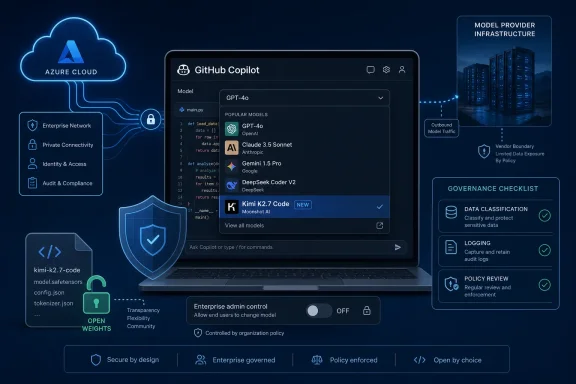 GitHub Turns the Dropdown Into a Governance Boundary
For individual Copilot Pro, Pro+, and Max users, the change is simple enough. Kimi K2.7 Code appears as a selectable model as the rollout reaches supported clients, including Visual Studio Code, Visual Studio, JetBrains IDEs, Xcode, Eclipse, Copilot CLI, GitHub.com, GitHub Mobile, and other Copilot surfaces. If the model is available to the account, the user can pick it and start sending coding tasks through it.For Business and Enterprise customers, GitHub has made the more revealing choice: Kimi K2.7 Code is off by default. Administrators must explicitly enable the model before users in the organization can select it. That default is not a footnote; it is the product team quietly acknowledging that this model carries a different risk profile from another OpenAI or Anthropic variant.
The move also shows how quickly the AI coding market is compressing release cycles. Moonshot published Kimi K2.7 Code’s weights in mid-June, and GitHub made the model selectable inside Copilot less than three weeks later. In the old enterprise software world, that would have been an evaluation window. In the new AI platform world, it is nearly enough time for a model to go from research artifact to default-adjacent developer tool.
That speed is part of the value proposition. Copilot can now absorb new model releases quickly, route them through Microsoft’s infrastructure, and package them for millions of developers without requiring each organization to run its own model-serving stack. But speed also collapses the time administrators have to ask whether the new entry in the dropdown is compatible with their policies, contracts, and threat models.
Open Weights Change the Audit, Not the Trust Problem
Kimi K2.7 Code is notable because its weights are publicly downloadable. That matters. Open weights allow researchers, competitors, auditors, and self-hosting teams to inspect and test the model in ways that are impossible with a purely closed hosted model.But open-weight is not the same thing as risk-free. It does not reveal the full training data. It does not guarantee alignment behavior under adversarial prompting. It does not answer who controls future releases, which data pipeline choices were made upstream, or how quickly a hosted integration will track model changes. It also does not erase the legal and political context of the company that built the model.
This is where the Copilot integration becomes more complicated than a normal “new model available” announcement. Moonshot AI is a Beijing-based company. That means the corporate entity behind Kimi is subject to Chinese law, including the National Intelligence Law enacted in 2017. Article 7 of that law is widely cited because it requires organizations and citizens to support, assist, and cooperate with national intelligence work in accordance with law.
There is disagreement among legal analysts about how far that provision reaches in practice. Some argue it is overread in Western policy debates, lacks a straightforward enforcement pathway in ordinary commercial contexts, and should not be treated as a magic phrase that turns every Chinese company into an intelligence asset. Others argue the statute sits inside a broader political and regulatory system where formal legal compulsion, informal Party influence, and state security priorities can be difficult to separate.
A serious enterprise assessment has to hold both ideas at once. The law is not a packet sniffer. It does not mean every prompt sent to a Kimi model is automatically copied to Beijing. But neither is it irrelevant simply because GitHub runs inference through Azure.
Azure Hosting Solves One Problem and Leaves Another Standing
GitHub’s hosting architecture is the strongest argument for why the Kimi integration is not equivalent to sending source code directly to Moonshot’s consumer service. Prompts inside Copilot route through Microsoft Azure infrastructure, not Moonshot’s own servers. That is a meaningful mitigation for data-in-transit risk.For many organizations, that distinction will matter. If a developer asks Copilot to explain a proprietary module, summarize an internal API, or generate a patch, the inference path remains inside Microsoft’s cloud environment rather than being transmitted to a model provider’s separately operated cloud. Administrators already accept similar arrangements for other third-party Copilot models, including models from labs that are not Microsoft.
But Azure hosting only answers the question of where the prompt goes during inference. It does not answer the question of who built the model, who controls its future versions, how the weights were trained, how safety behavior was tuned, or what obligations the model developer may face in its home jurisdiction. Those are different risks, and they require different controls.
This distinction will be uncomfortable for organizations that want a clean binary answer. It is tempting to say either “Azure hosts it, so it is fine” or “Moonshot is Chinese, so it is banned.” Neither position is mature enough for the reality of modern AI procurement. The practical question is whether the residual risk after Azure hosting is acceptable for the kinds of code and data an organization’s developers are likely to expose.
That is why GitHub’s Business and Enterprise default matters. By making administrators opt in, GitHub is effectively saying that Kimi K2.7 Code belongs in the category of models that require policy review, not just user preference. The model picker is now part of the governance plane.
The Cost Story Starts With MoE, Not With Discounting
Kimi K2.7 Code’s economic appeal comes from its architecture. The model is described as a trillion-parameter mixture-of-experts system with roughly 32 billion active parameters per token. That distinction is not marketing trivia; it is the mechanism that makes the model practical to serve at a lower price than a dense trillion-parameter model would imply.In a dense model, each token activates the full network. In a mixture-of-experts model, a routing system selects a subset of specialized expert networks for each token. Kimi K2.7 Code reportedly has hundreds of experts and activates only a small number on each pass, allowing it to carry a very large total parameter count while paying a much smaller compute cost during inference.
This matters for Copilot because GitHub’s AI Credit system prices usage in a way that makes model choice economically visible. The model picker is no longer just a quality slider. It is a cost control. A developer choosing a cheaper model for routine refactors, explanations, test generation, or lower-stakes agentic work can conserve credits for more expensive models when the task demands them.
The shift also changes how teams will think about performance. A model does not need to beat every frontier competitor on every benchmark to be valuable. It only needs to be good enough for a class of tasks at a price that changes behavior. If Kimi K2.7 Code can handle mundane coding work cheaply and reliably, it could become a default utility model even if developers still reach for more expensive proprietary models for architecture work, security-sensitive reasoning, or tricky debugging.
That is the procurement logic GitHub is enabling. Copilot increasingly looks less like a single assistant and more like a broker for model portfolios.
Benchmark Claims Are Signals, Not Settled Facts
Moonshot has published favorable performance claims for Kimi K2.7 Code, but administrators should treat them as vendor signals rather than settled evidence. As of the launch window, the available public performance picture was still heavily dependent on Moonshot’s own benchmark reporting. That is not unusual in AI, but it is particularly important when a model is entering an enterprise tool used on production code.Benchmarks in AI coding are already fragile. A model can score well on a benchmark and still struggle with a messy monorepo, a brittle build system, a poorly documented internal framework, or a task that requires several tool calls and reversals. Agentic coding performance is especially difficult to measure because success depends not only on code generation but on planning, context management, tool use, error recovery, and the ability to stop before making a bad change worse.
GitHub’s own phrasing has been careful, positioning Kimi K2.7 Code as a lower-cost option with strong early testing rather than as an independently proven replacement for every frontier model. That caution is appropriate. The first useful evidence will come from developer telemetry, enterprise pilots, and independent evaluations that compare Kimi against other Copilot models on real repositories.
The danger is that open-weight availability can create a false sense of certainty. Because the model weights are downloadable, some users will assume the model is inherently more auditable than closed models and therefore more trustworthy. Auditability is valuable, but it is not the same thing as demonstrated production reliability. A model can be open, impressive, cheap, and still wrong in exactly the places a team cannot afford.
Mandatory Thinking Mode Makes the Model More Agent Than Autocomplete
Kimi K2.7 Code is built for long-horizon coding tasks rather than only short completions. Its reported “thinking” behavior is part of that design. The model is meant to plan, reason, and work through multi-step coding operations, not merely finish the next line.That matters because Copilot itself has been moving from autocomplete toward agentic development. The assistant is increasingly asked to inspect projects, propose changes, run commands, interpret test failures, and iterate. In that mode, the model’s context window, reasoning efficiency, and tool-use behavior matter more than its ability to produce a plausible snippet in isolation.
The model’s large context window also makes it attractive for repository-scale work. A 256,000-token context gives a coding assistant more room to ingest surrounding files, issue history, logs, documentation, and test output. In theory, that should reduce the classic AI coding failure mode where a model generates correct-looking code that violates local conventions or misses a dependency hidden elsewhere in the project.
In practice, context windows are not magic. More context can improve performance, but it can also introduce distraction, stale assumptions, and higher cost if the model is fed indiscriminately. The teams that benefit most will be the ones that pair large-context models with disciplined retrieval, scoped tasks, and clear review procedures. Throwing an entire codebase into a prompt and hoping the model “understands” it remains an expensive form of superstition.
Alignment Warnings Deserve More Attention Than Model Hype
GitHub’s warning around open-weight models should not be treated as decorative legal text. The company has noted that Kimi K2.7 Code may be less aligned than other Copilot models and could carry an elevated risk of producing harmful content, even as GitHub’s standard content filters continue to apply. That is a meaningful disclosure.Alignment in coding assistants is not only about refusing malware requests. It is about whether the model follows secure coding practices, resists prompt injection, handles secrets safely, avoids generating vulnerable patterns, and behaves predictably when asked to automate changes. For enterprise users, “harmful content” can include everything from insecure authentication logic to overconfident remediation advice.
There is also the issue of political and cultural conditioning in model behavior. Prior evaluations of PRC-developed models have found censorship or avoidance patterns around politically sensitive Chinese-language topics. That may seem distant from enterprise coding, but it is still evidence that model behavior can reflect governance constraints imposed during training and tuning.
The immediate coding risk is not that a Python refactor will suddenly produce geopolitical propaganda. The risk is that administrators forget models are artifacts of institutions. A model’s alignment profile, refusal behavior, safety filters, and blind spots are all shaped by the organization that built it and the environment in which that organization operates.
The Enterprise Decision Is About Data Classes, Not Vibes
The right administrative response is not panic. It is classification. Before enabling Kimi K2.7 Code, organizations should decide which categories of code and data may be exposed to the model, which teams may use it, and whether the cost savings justify the governance overhead.A startup building a public web app may reach a different answer than a defense contractor, bank, hospital system, semiconductor vendor, or public-sector agency. That is normal. AI model risk is contextual. A model suitable for generating unit tests in an open-source project may be unsuitable for reviewing proprietary firmware or code tied to export-controlled systems.
The hardest part for many organizations will be shadow AI behavior. Developers already route code through whatever tools help them move faster, especially when official tooling is slow, expensive, or unavailable. Adding Kimi to Copilot could actually reduce risk in some environments if it keeps work inside sanctioned Microsoft-managed tooling rather than pushing developers toward unsanctioned external services.
But that argument only works if the organization has a real policy. “Use Copilot, but don’t paste secrets” is not enough. Teams need guidance on repository sensitivity, generated-code review, credential handling, regulated data, and whether model selection itself is restricted by project type.
The administrator’s toggle is therefore less a technical setting than a declaration of trust boundaries. It says which model developers may involve in the work of understanding and changing company code.
Copilot Is Becoming the AI Procurement Layer Microsoft Always Wanted
The strategic upside for GitHub is enormous. By bringing OpenAI, Anthropic, Google, Microsoft, and Moonshot models into Copilot, GitHub is making itself the switching layer between developers and the increasingly volatile model market. Developers do not need five subscriptions, five APIs, five billing relationships, and five IDE extensions. They need one assistant with a menu.That menu is powerful because model leadership keeps changing. A lab may lead on coding one quarter and fall behind the next. A cheaper model may become good enough for routine work. A new open-weight release may put pressure on proprietary pricing. A hosted model may gain a feature that matters to a particular workflow, such as stronger tool calling, better long-context behavior, or lower latency.
Copilot’s answer is to abstract the churn. If GitHub can integrate models quickly and bill them under one system, it can make Copilot the place where developers consume AI regardless of which lab is temporarily ahead. That is a platform play, not a feature update.
For Microsoft, the arrangement has another advantage: Azure becomes the neutral ground. Third-party model providers gain distribution without owning the full enterprise relationship. GitHub keeps the developer surface. Microsoft keeps the infrastructure and identity perimeter. Customers get choice, but the choice remains mediated by Microsoft’s cloud and policy controls.
The Kimi integration tests that model under geopolitical pressure. It asks whether enterprises are comfortable with Microsoft as the operational buffer between their developers and a Chinese AI lab. Some will say yes. Some will say no. Most will need a better process than they currently have.
Open-Weight Models Will Force Better AI Asset Management
The old software asset management problem was knowing what applications were installed, who licensed them, and whether they were patched. The AI equivalent is more slippery. Organizations need to know which models are being used, through which surfaces, for which data, under which terms, and with which retention and logging rules.Open-weight models complicate that further because they can appear in multiple forms. The same base model may be available through Copilot, a cloud API, a local inference stack, a third-party coding tool, or an internal deployment. Each route has different data flows, controls, and legal implications.
That means “we allow Kimi” is not a complete policy. An organization might allow Kimi K2.7 Code through Copilot because prompts stay within Azure, while prohibiting direct use of Moonshot’s own API. It might allow the model for public repositories but not private regulated code. It might allow self-hosted evaluation in a lab environment but block production use until independent benchmarks mature.
This is where open weights are genuinely useful. Security teams can test the model. Red teams can probe it. ML engineers can compare behavior across hosted and self-hosted deployments. But the existence of weights also means the model can spread through unofficial channels, making detection and governance more important.
Enterprise AI governance is moving from policy documents to runtime controls. The Copilot model picker is one of the places where that shift becomes visible to ordinary developers.
The Cheap Model Is Also the Hardest One to Ignore
Kimi K2.7 Code’s most disruptive trait may not be that it is open-weight or Chinese or architecturally clever. It may be that it is cheap enough to make teams reconsider how much “frontier” intelligence they actually need for day-to-day coding.Many developer tasks are not deep reasoning problems. They are translation tasks, cleanup tasks, test-generation tasks, documentation tasks, boilerplate tasks, and “explain this unfamiliar code” tasks. A less expensive model that performs well enough on those jobs can absorb a large amount of Copilot usage.
That creates pressure on the premium model stack. If developers can reserve expensive models for hard problems and use lower-cost models for routine work, the economics of AI-assisted coding start to look less like a flat subscription and more like workload scheduling. The model picker becomes analogous to choosing compute instances in the cloud: use the powerful machine when needed, but do not run every cron job on the most expensive box.
This is also where administrators may find themselves pulled in opposite directions. Finance teams will like cheaper inference. Security teams may prefer fewer model providers. Developers will want choice. Legal teams will want jurisdictional clarity. Platform teams will want a policy that does not require them to adjudicate every new model launch from scratch.
Kimi K2.7 Code is therefore a preview of the next fight in enterprise AI: not whether developers will use AI coding tools, but how organizations will govern a rapidly rotating menu of models with different prices, capabilities, licenses, and geopolitical baggage.
The Admin Toggle Now Carries the Weight of the Model Market
The practical guidance for WindowsForum’s IT-pro audience is not to overreact, but also not to sleepwalk. If you administer Copilot for an organization, Kimi K2.7 Code should trigger the same kind of review you would apply to a new SaaS vendor touching source code, even if Microsoft is hosting the inference path.That review should begin with data classification. Which repositories contain regulated data, export-controlled logic, security-sensitive code, authentication systems, customer secrets, or proprietary algorithms? Which teams are allowed to use external AI assistance at all? Which model providers are permitted under existing procurement and compliance rules?
It should then move to logging and auditability. Administrators should understand what Copilot records, what the organization can review, what Microsoft retains, and how model choice is represented in usage reporting. A model picker that spans multiple providers is only governable if the organization can see which model was used where.
Finally, the review should include developer education. If a model is cheaper, people will use it more. If it is available in the same dropdown as more familiar models, people will assume it has the same approval status unless told otherwise. The policy needs to be visible at the moment of use, not buried in a governance wiki no one reads.
This is the unglamorous work behind AI adoption. The model launch gets the headlines. The admin policy determines whether the launch becomes an advantage or a future incident report.
Kimi’s Arrival Leaves Copilot Customers With a Narrower Margin for Pretending
GitHub’s decision is easy to understand. Developers want more models, enterprises want cost controls, and open-weight systems have become too capable to ignore. Kimi K2.7 Code gives Copilot a lower-cost option with serious technical credentials and makes GitHub look faster and more model-neutral than coding tools tied to a single lab.The uncomfortable part is that model neutrality is never truly neutral. Every model carries the imprint of its builder, its training process, its jurisdiction, its licensing, and its operational dependencies. Copilot can hide API complexity, but it cannot make those differences disappear.
For some organizations, the Azure-hosted arrangement will be enough. For others, Moonshot’s legal environment will be disqualifying. For many, the answer will fall somewhere in between: limited enablement, monitored pilots, restricted repository classes, or permission for individual plans but not enterprise-wide deployment.
That middle ground is where most real IT policy lives. It is also where GitHub is pushing its customers, whether intentionally or not.
The Copilot Dropdown Just Became a Risk Register
Kimi K2.7 Code is worth testing, but it should not be enabled casually across sensitive environments. The model’s launch is best understood as a signal that AI coding governance has moved from abstract principles into specific product settings.- GitHub made Kimi K2.7 Code generally available in Copilot on July 1, 2026, with Business and Enterprise access requiring administrator enablement.
- The model’s lower cost is tied to its mixture-of-experts architecture, which activates only a fraction of its trillion total parameters for each token.
- Azure hosting reduces direct prompt-routing risk because Copilot inference does not send user prompts to Moonshot’s own servers.
- Azure hosting does not eliminate questions about Moonshot’s jurisdiction, model development pipeline, future updates, or Chinese legal obligations.
- Performance claims should be treated cautiously until independent benchmark results and production developer experience accumulate.
- Administrators should map model access to repository sensitivity, regulatory obligations, and internal policy before exposing the option broadly.
References
- Primary source: Tech Times
Published: 2026-07-03T00:21:09.095477
Loading…
www.techtimes.com - Related coverage: github.blog
Kimi K2.7 Code is generally available in GitHub Copilot - GitHub Changelog
Kimi K2.7 Code, an open-weight model, is now generally available in GitHub Copilot. This is the first open-weight model offered as a selectable option in the Copilot model picker, giving…github.blog
- Related coverage: best-ai.org
Loading…
best-ai.org - Related coverage: awesomeagents.ai
Loading…
awesomeagents.ai - Related coverage: tokenmix.ai
GitHub Copilot July 2026: Kimi K2.7, Browser, Credit Caps - TokenMix Blog
GitHub Copilot July updates add Kimi K2.7 Code, browser tools, Auto routing, and AI credit session limits. Useful, but budget caps are now mandatory.tokenmix.ai - Related coverage: remio.ai
Loading…
www.remio.ai
- Related coverage: kimi.com
Loading…
www.kimi.com - Related coverage: hokai.io
Loading…
hokai.io - Related coverage: emergent.sh
Loading…
emergent.sh - Related coverage: webdeveloper.com
Loading…
webdeveloper.com - Related coverage: explainx.ai
Loading…
www.explainx.ai - Related coverage: developers.cloudflare.com
Loading…
developers.cloudflare.com - Related coverage: 52nlp.cn
Loading…
www.52nlp.cn - Related coverage: intuitionlabs.ai
Loading…
intuitionlabs.ai
