

On May 21, 2026, GitHub announced that GitHub Copilot for Eclipse is now open source, with Microsoft publishing the Eclipse plugin’s code on GitHub under the MIT license after previously promising the move in April. The practical story is not that Copilot itself has become open source; it has not. The more important shift is that one of Copilot’s IDE front ends, including its Eclipse-specific chat, completion, agent, prompt, and integration layers, can now be inspected and changed in public. For developers and IT teams who have been asked to trust increasingly capable AI tools inside their source trees, that distinction matters.
The newly opened Copilot for Eclipse repository gives developers a look at how GitHub’s AI assistant is wired into one of the software industry’s oldest and most durable IDE ecosystems. GitHub says the code exposes implementation details for inline completions, Next Edit Suggestions, chat, agent mode, skills, prompt files, Bring Your Own Key support, custom agents, isolated subagents, a plan agent, and Model Context Protocol integration.
That is a substantial disclosure at the plugin layer. It means Eclipse users can inspect how context is gathered, how UI surfaces behave, how tool calls are orchestrated, and how agentic workflows are presented inside the IDE. It also means the community can file issues and submit pull requests against the same codebase that implements the official experience.
But the announcement should not be mistaken for an open-source Copilot in the maximal sense. The service, models, hosted infrastructure, commercial plans, and policy machinery remain outside the repository. What GitHub has opened is the client-side integration between Eclipse and the Copilot service, not the entire AI stack that produces the suggestions.
That boundary is the core of the story. GitHub is using openness to reduce friction around trust and participation, while preserving the parts of Copilot that define the business. In 2026, that is probably the only kind of open sourcing a major AI coding product was ever likely to get.
For years, the center of gravity in AI coding tools has leaned toward Visual Studio Code, JetBrains IDEs, and newer AI-native editors. Eclipse users have often watched that race from a slightly awkward distance: still numerous, still important, but not always first in line for the shiniest integrations. Copilot’s Eclipse support helped close that gap, and open sourcing the plugin signals that GitHub understands the cultural terms of entry.
The Eclipse ecosystem expects more than a binary download and a marketing page. It expects extensibility, inspectability, and some credible route for community influence. By releasing the plugin under MIT, GitHub is speaking that language without forcing contributors into a more restrictive license model.
There is also a tactical reason Eclipse makes sense as the proving ground. Visual Studio Code is already GitHub and Microsoft’s home-field advantage. JetBrains is a competitive commercial ecosystem with its own AI ambitions. Eclipse, by contrast, is a place where GitHub can demonstrate openness with comparatively less strategic risk and potentially more goodwill.
Modern AI coding assistants do not merely autocomplete strings. They read files, summarize context, invoke tools, run workflows, and increasingly act across multiple steps. Once a tool begins operating in that way, the IDE plugin becomes part user interface, part policy boundary, part context broker, and part automation engine.
That makes the source code of the plugin unusually important. A closed plugin asks users to trust that context is gathered responsibly, prompts are assembled as advertised, and agent features do not reach further than expected. An open plugin lets developers inspect those pathways, even if they still cannot see into the remote model or service-side ranking logic.
For security-minded teams, that distinction is not cosmetic. The most immediate risks around AI assistants often live in the integration layer: what files are read, what metadata is attached, how secrets might be exposed, how commands are gated, and how much autonomy an agent receives. Public source does not eliminate those risks, but it gives administrators and developers a better place to start asking specific questions.
That is why opening the Eclipse plugin matters more than it may sound. The repository is not just a wrapper around an API. It contains the interface between Copilot’s cloud intelligence and Eclipse’s local development environment, which is where the user experience either becomes useful or collapses into novelty.
Features like Next Edit Suggestions and agent mode also raise the stakes. A completion engine suggests a line. An agentic workflow may plan, inspect, edit, and iterate across a task. The more capable the tool becomes, the more developers need to understand the scaffolding that turns model output into IDE behavior.
This is especially relevant in Eclipse, where many projects are large, old, and configuration-heavy. A plugin that works beautifully in a small demo project may struggle with multi-module Java workspaces, enterprise build systems, custom plugins, and decades of internal conventions. Community visibility gives those users a path to diagnose and improve the rough edges rather than waiting for a vendor roadmap to notice them.
A more restrictive license might have signaled ideological alignment with open-source governance, but it could also have slowed adoption by companies that are cautious about reciprocal license obligations. MIT tells enterprise legal departments that the code is easier to evaluate and reuse. It tells independent contributors that the project is not wrapped in unnecessary ceremony.
It also tells competitors something else: the client-side patterns for Copilot’s Eclipse integration are now visible. That does not mean a rival can clone Copilot’s service, but it does mean the UX and architecture of an AI assistant inside Eclipse are easier to study. In a market where agentic coding tools are converging quickly, that is not trivial.
GitHub appears to be betting that the benefits outweigh the leakage. The proprietary advantage is no longer simply the plugin shell; it is the service, the model access, the GitHub ecosystem, enterprise controls, billing relationships, and policy infrastructure around it. Open sourcing the Eclipse client may make Copilot more credible without giving away the economic center of the product.
Against that backdrop, open sourcing an IDE plugin is a useful trust gesture. It gives GitHub something concrete to point to when users ask how Copilot behaves in Eclipse. It also shifts some of the conversation from “believe us” to “inspect the code.”
But it is not a cure-all. Developers frustrated by subscription changes, plan availability, model selection, or cloud dependency will not be satisfied merely because one plugin is now public. The open-source repository does not change the fact that Copilot remains a hosted commercial service for most meaningful usage.
That tension is not a contradiction; it is the business model. GitHub is opening the part of Copilot that benefits from community review while keeping control over the parts that generate recurring revenue and strategic leverage. The question for users is whether that trade-off is good enough.
On Windows, Eclipse also remains a practical part of many mixed development shops. It sits alongside Visual Studio, VS Code, JetBrains tools, Android tooling, embedded SDKs, and older internal platforms. Copilot support in Eclipse is therefore not just a courtesy to nostalgic developers; it is a way to bring AI assistance into workflows that still run real businesses.
Open sourcing the plugin may help those environments more than it helps hobbyists. Enterprise teams often need to know how a tool behaves before they can approve it. If the IDE integration is public, internal platform teams can review code paths, test behavior, file precise issues, and potentially contribute fixes for edge cases that GitHub’s own team might never encounter.
There is a Windows angle here beyond Eclipse itself. Microsoft’s developer strategy increasingly assumes that AI assistance should follow the developer across tools rather than remain confined to one editor. Supporting Eclipse openly reinforces that posture: Copilot wants to be a layer over the development workflow, not merely a feature of a Microsoft-branded IDE.
That shift changes the trust model. Developers can ignore a bad inline suggestion. They can reject a chat answer. But an agent that plans edits, invokes tools, or coordinates multiple steps needs clearer boundaries. Users need to know what it can touch, what it can infer, and how it decides when to act.
By opening the Eclipse plugin, GitHub lets developers examine at least the local machinery around those workflows. They can look at how agent mode is wired into the IDE, how chat and tool calls interact, and how prompt files and skills are discovered and invoked. That is not the same as auditing the model’s reasoning, but it is still valuable.
The industry has been too casual about the word agent. It can mean anything from a glorified macro to a multi-step system with meaningful autonomy. Public plugin code helps narrow the ambiguity. It gives the community a shared artifact to debate rather than relying entirely on branding.
Bring Your Own Key support matters because developers and organizations increasingly want control over which model provider or account backs their AI workflows. Even when BYOK does not make a product fully open or self-hosted, it changes procurement and governance conversations. It can separate the interface from the consumption model in ways that appeal to advanced users.
Model Context Protocol matters because the AI tooling ecosystem is moving toward standardized ways for assistants to discover and use external tools and data sources. If MCP becomes a common connective layer, IDE plugins become orchestration points rather than isolated feature bundles. That makes the plugin architecture more strategically important.
For Eclipse, this could be particularly powerful. The IDE has always been a platform as much as an editor. A Copilot plugin that can participate in broader tool and context protocols fits naturally into that history, even if the commercial service behind it remains proprietary.
The announcement says contribution guidelines and collaboration processes will evolve with the community. That is encouraging, but vague by design. Mature open-source users will watch whether external pull requests are reviewed promptly, whether architectural decisions are explained, whether rejected proposals receive useful rationale, and whether the repository becomes a real development venue or a public mirror with occasional housekeeping.
There is a reputational risk here. If GitHub invites the Eclipse community in but keeps meaningful decisions behind closed doors, the transparency argument weakens. If outside contributions are accepted and visible, the project can become a useful bridge between Copilot’s product team and a community that knows Eclipse’s rough edges better than any vendor team could.
This is where Eclipse’s culture may be demanding in a good way. The community has long experience with public development, extension points, compatibility constraints, and slow-but-serious maintenance. If GitHub wants credibility there, it will need to meet that culture on its own terms.
Security teams can now review the plugin’s handling of prompts, context, local files, chat flows, and tool invocations. They can compare implementation behavior with internal policy. They can look for accidental overcollection, weak boundaries, or surprising integrations. They can also decide whether agentic capabilities should be enabled broadly, piloted narrowly, or disabled in sensitive environments.
The harder questions remain outside the repository. What data is transmitted to the service? How is it retained? Which model processes it? What enterprise controls apply? How do policy settings interact with the Eclipse plugin? Those questions still require documentation, contractual commitments, and administrative tooling.
Still, this is progress. Many AI coding tools ask organizations to approve a black box inside the developer workstation. Copilot for Eclipse is now at least a partially inspectable box, and partial inspectability is better than none when the tool is operating inside production codebases.
AI coding assistants are still new enough that best practices are unsettled. Teams are experimenting with how to present suggestions, how to manage context, how to make agent actions reversible, how to explain tool calls, and how to avoid overwhelming developers with automation. A production-grade plugin from GitHub gives the ecosystem a concrete example to study.
That does not mean every decision in the codebase should be treated as canonical. Copilot is a commercial product with its own constraints, telemetry needs, service assumptions, and UX priorities. But visible implementation details can accelerate learning across the ecosystem.
For students and plugin authors, this may be especially useful. Eclipse plugin development has its own complexity, and AI tooling adds another layer. Seeing how a major vendor integrates modern AI workflows into a mature IDE is more valuable than another abstract blog post about the future of software development.
That is not a criticism so much as a map. The AI coding market is settling into a hybrid pattern: open clients, open protocols, sometimes open models, but often proprietary orchestration and hosted services. Vendors will open the layers that improve adoption and trust while retaining the layers that define differentiation and revenue.
Users should evaluate Copilot for Eclipse with that structure in mind. The MIT license is meaningful. The public repository is meaningful. Community contributions are meaningful. None of those facts turn Copilot into a community-governed AI assistant from top to bottom.
This distinction will matter more as AI tools become more capable. A code completion plugin could get by on convenience and brand trust. An agentic development system needs deeper accountability. Opening the Eclipse plugin is a step in that direction, but it is not the final destination.
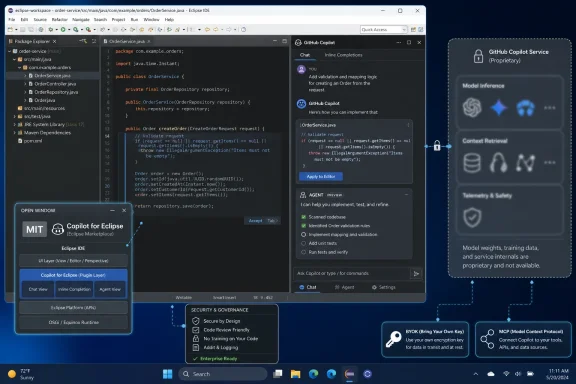 GitHub Opens the Window, Not the Whole Machine
The newly opened Copilot for Eclipse repository gives developers a look at how GitHub’s AI assistant is wired into one of the software industry’s oldest and most durable IDE ecosystems. GitHub says the code exposes implementation details for inline completions, Next Edit Suggestions, chat, agent mode, skills, prompt files, Bring Your Own Key support, custom agents, isolated subagents, a plan agent, and Model Context Protocol integration.That is a substantial disclosure at the plugin layer. It means Eclipse users can inspect how context is gathered, how UI surfaces behave, how tool calls are orchestrated, and how agentic workflows are presented inside the IDE. It also means the community can file issues and submit pull requests against the same codebase that implements the official experience.
But the announcement should not be mistaken for an open-source Copilot in the maximal sense. The service, models, hosted infrastructure, commercial plans, and policy machinery remain outside the repository. What GitHub has opened is the client-side integration between Eclipse and the Copilot service, not the entire AI stack that produces the suggestions.
That boundary is the core of the story. GitHub is using openness to reduce friction around trust and participation, while preserving the parts of Copilot that define the business. In 2026, that is probably the only kind of open sourcing a major AI coding product was ever likely to get.
Eclipse Was the Right Place to Make This Argument
Eclipse is not just another editor target. It is an ecosystem with a long memory, a strong plugin culture, and a user base that includes Java developers, enterprise teams, embedded software shops, academic users, and organizations that still care deeply about open governance.For years, the center of gravity in AI coding tools has leaned toward Visual Studio Code, JetBrains IDEs, and newer AI-native editors. Eclipse users have often watched that race from a slightly awkward distance: still numerous, still important, but not always first in line for the shiniest integrations. Copilot’s Eclipse support helped close that gap, and open sourcing the plugin signals that GitHub understands the cultural terms of entry.
The Eclipse ecosystem expects more than a binary download and a marketing page. It expects extensibility, inspectability, and some credible route for community influence. By releasing the plugin under MIT, GitHub is speaking that language without forcing contributors into a more restrictive license model.
There is also a tactical reason Eclipse makes sense as the proving ground. Visual Studio Code is already GitHub and Microsoft’s home-field advantage. JetBrains is a competitive commercial ecosystem with its own AI ambitions. Eclipse, by contrast, is a place where GitHub can demonstrate openness with comparatively less strategic risk and potentially more goodwill.
Transparency Becomes a Product Feature
The announcement’s most interesting phrase is not “open source.” It is GitHub’s claim that developers can “see exactly how Copilot works” in Eclipse. That is the pitch enterprises and skeptical developers increasingly want to hear, even when the reality is necessarily narrower.Modern AI coding assistants do not merely autocomplete strings. They read files, summarize context, invoke tools, run workflows, and increasingly act across multiple steps. Once a tool begins operating in that way, the IDE plugin becomes part user interface, part policy boundary, part context broker, and part automation engine.
That makes the source code of the plugin unusually important. A closed plugin asks users to trust that context is gathered responsibly, prompts are assembled as advertised, and agent features do not reach further than expected. An open plugin lets developers inspect those pathways, even if they still cannot see into the remote model or service-side ranking logic.
For security-minded teams, that distinction is not cosmetic. The most immediate risks around AI assistants often live in the integration layer: what files are read, what metadata is attached, how secrets might be exposed, how commands are gated, and how much autonomy an agent receives. Public source does not eliminate those risks, but it gives administrators and developers a better place to start asking specific questions.
The Plugin Layer Is Where AI Coding Gets Real
AI companies often talk about models, but developers live inside tooling. The difference between a clever demo and a daily workflow usually comes down to mundane integration: keyboard shortcuts, inline ghost text, chat panels, file context, error handling, authentication, project indexing, and whether the tool behaves predictably under pressure.That is why opening the Eclipse plugin matters more than it may sound. The repository is not just a wrapper around an API. It contains the interface between Copilot’s cloud intelligence and Eclipse’s local development environment, which is where the user experience either becomes useful or collapses into novelty.
Features like Next Edit Suggestions and agent mode also raise the stakes. A completion engine suggests a line. An agentic workflow may plan, inspect, edit, and iterate across a task. The more capable the tool becomes, the more developers need to understand the scaffolding that turns model output into IDE behavior.
This is especially relevant in Eclipse, where many projects are large, old, and configuration-heavy. A plugin that works beautifully in a small demo project may struggle with multi-module Java workspaces, enterprise build systems, custom plugins, and decades of internal conventions. Community visibility gives those users a path to diagnose and improve the rough edges rather than waiting for a vendor roadmap to notice them.
MIT Licensing Is a Signal to Contributors and Competitors
The MIT license is permissive, familiar, and deliberately low-friction. It allows developers to use, modify, distribute, and incorporate the code with relatively few obligations. For a plugin that GitHub wants the Eclipse community to inspect and improve, that choice matters.A more restrictive license might have signaled ideological alignment with open-source governance, but it could also have slowed adoption by companies that are cautious about reciprocal license obligations. MIT tells enterprise legal departments that the code is easier to evaluate and reuse. It tells independent contributors that the project is not wrapped in unnecessary ceremony.
It also tells competitors something else: the client-side patterns for Copilot’s Eclipse integration are now visible. That does not mean a rival can clone Copilot’s service, but it does mean the UX and architecture of an AI assistant inside Eclipse are easier to study. In a market where agentic coding tools are converging quickly, that is not trivial.
GitHub appears to be betting that the benefits outweigh the leakage. The proprietary advantage is no longer simply the plugin shell; it is the service, the model access, the GitHub ecosystem, enterprise controls, billing relationships, and policy infrastructure around it. Open sourcing the Eclipse client may make Copilot more credible without giving away the economic center of the product.
The Open-Source Move Arrives During a Noisy Copilot Moment
The timing gives the announcement extra texture. GitHub and Microsoft have spent the past year expanding Copilot from autocomplete into a broader AI development platform, with chat, agents, code review, editor integrations, and enterprise policy features becoming part of the pitch. At the same time, developers have grown more sensitive to pricing, limits, model availability, and the difference between vendor roadmaps and user expectations.Against that backdrop, open sourcing an IDE plugin is a useful trust gesture. It gives GitHub something concrete to point to when users ask how Copilot behaves in Eclipse. It also shifts some of the conversation from “believe us” to “inspect the code.”
But it is not a cure-all. Developers frustrated by subscription changes, plan availability, model selection, or cloud dependency will not be satisfied merely because one plugin is now public. The open-source repository does not change the fact that Copilot remains a hosted commercial service for most meaningful usage.
That tension is not a contradiction; it is the business model. GitHub is opening the part of Copilot that benefits from community review while keeping control over the parts that generate recurring revenue and strategic leverage. The question for users is whether that trade-off is good enough.
For Windows Developers, Eclipse Still Has a Seat at the Table
WindowsForum readers may be tempted to see Eclipse as yesterday’s IDE, especially in a world dominated by VS Code screenshots and AI-native editor hype. That would be a mistake. Eclipse remains deeply embedded in Java, enterprise development, embedded tooling, and vendor-specific environments that do not turn over every time a new editor trend appears.On Windows, Eclipse also remains a practical part of many mixed development shops. It sits alongside Visual Studio, VS Code, JetBrains tools, Android tooling, embedded SDKs, and older internal platforms. Copilot support in Eclipse is therefore not just a courtesy to nostalgic developers; it is a way to bring AI assistance into workflows that still run real businesses.
Open sourcing the plugin may help those environments more than it helps hobbyists. Enterprise teams often need to know how a tool behaves before they can approve it. If the IDE integration is public, internal platform teams can review code paths, test behavior, file precise issues, and potentially contribute fixes for edge cases that GitHub’s own team might never encounter.
There is a Windows angle here beyond Eclipse itself. Microsoft’s developer strategy increasingly assumes that AI assistance should follow the developer across tools rather than remain confined to one editor. Supporting Eclipse openly reinforces that posture: Copilot wants to be a layer over the development workflow, not merely a feature of a Microsoft-branded IDE.
Agent Mode Makes Inspectability More Than a Nicety
The most consequential part of the announcement may be the exposure of agentic workflows. Agent mode is where Copilot stops feeling like a smarter autocomplete engine and starts behaving like a semi-autonomous participant in the development process.That shift changes the trust model. Developers can ignore a bad inline suggestion. They can reject a chat answer. But an agent that plans edits, invokes tools, or coordinates multiple steps needs clearer boundaries. Users need to know what it can touch, what it can infer, and how it decides when to act.
By opening the Eclipse plugin, GitHub lets developers examine at least the local machinery around those workflows. They can look at how agent mode is wired into the IDE, how chat and tool calls interact, and how prompt files and skills are discovered and invoked. That is not the same as auditing the model’s reasoning, but it is still valuable.
The industry has been too casual about the word agent. It can mean anything from a glorified macro to a multi-step system with meaningful autonomy. Public plugin code helps narrow the ambiguity. It gives the community a shared artifact to debate rather than relying entirely on branding.
BYOK and MCP Point Toward a More Modular Copilot
Two details in GitHub’s list deserve special attention: Bring Your Own Key and Model Context Protocol integration. Both suggest that Copilot for Eclipse is not merely a fixed assistant bolted into an IDE, but part of a more modular development environment where models, context sources, and tools can be connected in more flexible ways.Bring Your Own Key support matters because developers and organizations increasingly want control over which model provider or account backs their AI workflows. Even when BYOK does not make a product fully open or self-hosted, it changes procurement and governance conversations. It can separate the interface from the consumption model in ways that appeal to advanced users.
Model Context Protocol matters because the AI tooling ecosystem is moving toward standardized ways for assistants to discover and use external tools and data sources. If MCP becomes a common connective layer, IDE plugins become orchestration points rather than isolated feature bundles. That makes the plugin architecture more strategically important.
For Eclipse, this could be particularly powerful. The IDE has always been a platform as much as an editor. A Copilot plugin that can participate in broader tool and context protocols fits naturally into that history, even if the commercial service behind it remains proprietary.
Community Contributions Will Test the Sincerity of the Move
Open sourcing code is easy compared with running an open project. The real test will be how GitHub and Microsoft handle issues, pull requests, roadmap discussions, and disagreements with contributors.The announcement says contribution guidelines and collaboration processes will evolve with the community. That is encouraging, but vague by design. Mature open-source users will watch whether external pull requests are reviewed promptly, whether architectural decisions are explained, whether rejected proposals receive useful rationale, and whether the repository becomes a real development venue or a public mirror with occasional housekeeping.
There is a reputational risk here. If GitHub invites the Eclipse community in but keeps meaningful decisions behind closed doors, the transparency argument weakens. If outside contributions are accepted and visible, the project can become a useful bridge between Copilot’s product team and a community that knows Eclipse’s rough edges better than any vendor team could.
This is where Eclipse’s culture may be demanding in a good way. The community has long experience with public development, extension points, compatibility constraints, and slow-but-serious maintenance. If GitHub wants credibility there, it will need to meet that culture on its own terms.
The Security Review Starts With Better Questions
For administrators, the announcement should trigger neither blind approval nor reflexive rejection. Open source does not make an AI assistant safe by default. It makes parts of the safety conversation more concrete.Security teams can now review the plugin’s handling of prompts, context, local files, chat flows, and tool invocations. They can compare implementation behavior with internal policy. They can look for accidental overcollection, weak boundaries, or surprising integrations. They can also decide whether agentic capabilities should be enabled broadly, piloted narrowly, or disabled in sensitive environments.
The harder questions remain outside the repository. What data is transmitted to the service? How is it retained? Which model processes it? What enterprise controls apply? How do policy settings interact with the Eclipse plugin? Those questions still require documentation, contractual commitments, and administrative tooling.
Still, this is progress. Many AI coding tools ask organizations to approve a black box inside the developer workstation. Copilot for Eclipse is now at least a partially inspectable box, and partial inspectability is better than none when the tool is operating inside production codebases.
Developers Get a Teaching Artifact, Not Just a Tool
There is another audience for this repository: developers building their own AI features. GitHub’s announcement explicitly invites people to learn from the implementation of chat, completions, prompt handling, skills, and agentic workflows inside Eclipse. That may prove to be one of the project’s most durable effects.AI coding assistants are still new enough that best practices are unsettled. Teams are experimenting with how to present suggestions, how to manage context, how to make agent actions reversible, how to explain tool calls, and how to avoid overwhelming developers with automation. A production-grade plugin from GitHub gives the ecosystem a concrete example to study.
That does not mean every decision in the codebase should be treated as canonical. Copilot is a commercial product with its own constraints, telemetry needs, service assumptions, and UX priorities. But visible implementation details can accelerate learning across the ecosystem.
For students and plugin authors, this may be especially useful. Eclipse plugin development has its own complexity, and AI tooling adds another layer. Seeing how a major vendor integrates modern AI workflows into a mature IDE is more valuable than another abstract blog post about the future of software development.
The Limits of Openness Are Now Easier to See
The paradox of this announcement is that by opening the plugin, GitHub also makes the remaining closed layers more obvious. Developers can inspect how Copilot for Eclipse asks for help, but not fully how the help is generated. They can study the prompt assembly, but not the complete service-side decision-making. They can contribute to the interface, but not necessarily to the commercial logic around access, limits, and model selection.That is not a criticism so much as a map. The AI coding market is settling into a hybrid pattern: open clients, open protocols, sometimes open models, but often proprietary orchestration and hosted services. Vendors will open the layers that improve adoption and trust while retaining the layers that define differentiation and revenue.
Users should evaluate Copilot for Eclipse with that structure in mind. The MIT license is meaningful. The public repository is meaningful. Community contributions are meaningful. None of those facts turn Copilot into a community-governed AI assistant from top to bottom.
This distinction will matter more as AI tools become more capable. A code completion plugin could get by on convenience and brand trust. An agentic development system needs deeper accountability. Opening the Eclipse plugin is a step in that direction, but it is not the final destination.
The Eclipse Release Tells IT Where to Aim the Flashlight
GitHub’s move gives developers and administrators a clearer view of one critical layer of the Copilot stack. The useful response is not celebration or cynicism, but inspection.- GitHub has open sourced the Copilot for Eclipse plugin under the MIT license, exposing the IDE integration rather than the entire Copilot service.
- The repository gives developers visibility into Eclipse-specific implementations for completions, chat, agent mode, prompt files, skills, BYOK, and MCP-related capabilities.
- Enterprise teams should treat the public code as a starting point for review, while continuing to evaluate service-side data handling, licensing, policy controls, and model governance separately.
- Eclipse users gain a more credible path to file bugs, propose features, and potentially improve support for complex workspaces and enterprise development patterns.
- The move strengthens GitHub’s transparency argument at the tooling layer, but it does not erase broader debates over Copilot pricing, cloud dependency, or proprietary model infrastructure.
References
- Primary source: The GitHub Blog
Published: Thu, 21 May 2026 23:50:38 GMT

GitHub Copilot for Eclipse is open source - GitHub Changelog
Following our previous updates, GitHub Copilot for Eclipse is open source, with the code available on GitHub under the MIT license. This marks an important milestone for GitHub Copilot in…github.blog
- Official source: docs.github.com
Quickstart for GitHub Copilot - GitHub Docs
Quickly learn how to use GitHub Copilot. docs.github.com
- Official source: devblogs.microsoft.com

GitHub Copilot for Eclipse Is Going Open Source - Microsoft for Java Developers
We’re excited to announce that the GitHub Copilot for Eclipse plugin is going open source under the MIT license and will be hosted on GitHub under the microsoft organization in the coming weeks. By open-sourcing the project, we’re inviting the community to contribute, extend, and innovate... devblogs.microsoft.com
- Official source: github.com
GitHub - vgcpge/eclipse.copilot: Unofficial Github Copilot for Eclipse
Unofficial Github Copilot for Eclipse. Contribute to vgcpge/eclipse.copilot development by creating an account on GitHub. github.com
- Related coverage: projects.eclipse.org
Eclipse Plug-in for Copilot
Eclipse Plug-in for Copilot provides code completion suggestions, chats, and deals with coding tasks using agents. It's a client app that talks to the GitHub online services.projects.eclipse.org
- Related coverage: metrics.eclipse.org
Eclipse Plug-in for Copilot | The Eclipse Foundation
Eclipse Plug-in for Copilot provides code completion suggestions, chats, and deals with coding tasks using agents. It's a client app that talks to the GitHub …metrics.eclipse.org
- Related coverage: repos.ecosyste.ms
vgcpge/eclipse.copilot | GitHub | Ecosyste.ms: Repos
Unofficial Github Copilot for Eclipserepos.ecosyste.ms - Related coverage: assets.ctfassets.net
- Related coverage: onlinescientificresearch.com
- Related coverage: abapeur.fr
