

GitHub is facing a strategic squeeze in May 2026 as AI coding rivals including Cursor, Anthropic’s Claude Code, and OpenAI’s Codex challenge GitHub Copilot, while Microsoft reportedly worries that GitHub’s role as the default home for software development could be weakened. The irony is brutal: the AI wave that should have cemented GitHub’s dominance is also teaching developers to work around it. Copilot gave Microsoft and GitHub the first great distribution advantage in AI coding, but the market has moved from autocomplete to agents, and agents care less about where the repository lives. That is why this moment looks less like a product-cycle stumble and more like a platform-risk warning.
GitHub Copilot’s original breakthrough was not subtle. In 2021, it made AI code completion feel practical, visible, and mainstream at a time when most generative AI demos still felt like parlor tricks. It sat where developers already worked, it benefited from GitHub’s gravity, and it turned the code editor into the first widely adopted interface for AI-assisted software development.
That was the first race: predicting the next line, filling in the boilerplate, generating the test stub, nudging the programmer forward. Copilot was astonishing because it made machine assistance feel native to the act of writing code. For Microsoft, it also offered something even better than a new subscription product: it made GitHub feel like the obvious control plane for AI-era development.
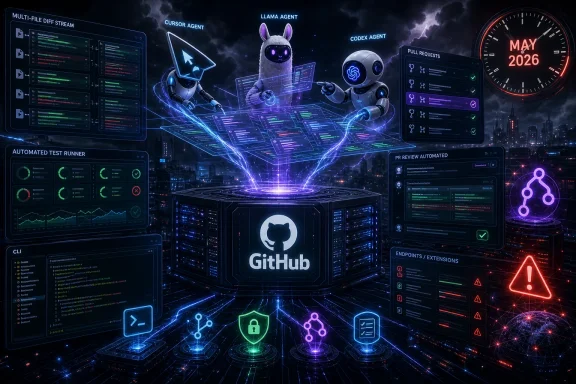
But the second race is not about smarter tab completion. It is about tools that read a repository, plan a change, edit multiple files, run tests, explain failures, open pull requests, and increasingly act like junior engineers with command-line access. Cursor, Claude Code, and Codex are not merely “Copilot competitors” in the old sense; they are bets that the developer’s real cockpit is the agentic workflow, not the repository host.
That distinction matters because first-mover advantage is most durable when the market keeps valuing the thing the first mover pioneered. GitHub pioneered AI pair programming at the moment when pair programming meant inline assistance. The market now wants something closer to delegated work.
That should be a dream scenario for the largest repository platform in the world. GitHub is the place where AI-generated prototypes become artifacts, where hobby projects become packages, where enterprise branches become pull requests, and where the world’s software supply chain leaves a trail. In a normal platform story, rising usage strengthens the moat.
Yet AI changes the economics of that story. A surge in AI-generated development can increase storage, compute, indexing, security scanning, and support costs while also encouraging developers to use external tools that sit above GitHub rather than inside it. The more productive AI makes individual developers, the more load it can place on the systems that host, scan, build, and coordinate their work.
That is why Microsoft’s own financial language matters. When a company says cloud gross margin is being pressured by AI investment and increased GitHub Copilot usage, it is saying the popular product is not just a growth engine; it is also a cost center. The old SaaS fantasy was that every additional user carried high-margin revenue. AI coding has a nastier profile: the most enthusiastic users can be the most expensive ones.
GitHub therefore sits in a paradox. The platform benefits from the AI coding boom, but the boom also increases operating pressure and invites competitors to own the developer relationship before the code ever reaches GitHub. A repository host can be indispensable and still lose the daily workflow.
GitHub Copilot began as an assistant inside existing editors. Cursor made the editor itself feel like the assistant. That was a subtle but important inversion: instead of bringing AI into a developer environment, it made the environment organize around AI.
For many developers, especially those working on AI-native startups or fast-moving web applications, that mattered more than enterprise procurement, repository hosting, or brand trust. The appeal was not that Cursor replaced GitHub as a place to store code. It was that Cursor became the place where the work felt like it happened.
This is the classic platform danger. The system of record can remain stable while the system of engagement changes. Salesforce understood this in customer management, Microsoft understood it in office productivity, and now GitHub has to confront it in software development.
If developers begin their day inside Cursor, ask Claude Code to restructure a service, use Codex to generate a pull request, and treat GitHub as the place where the result is deposited, GitHub still matters. But it matters in a more passive way. Passive infrastructure is powerful, but it rarely captures the same loyalty, pricing power, or strategic leverage as the active interface.
That does not mean Claude Code is universally better than Copilot, or that Microsoft engineers are a perfect proxy for the market. But it does suggest that agentic coding tools are being judged by developers on practical output, not corporate alignment. If a tool can understand a codebase, make coherent edits, and save real time, developers will use it unless stopped.
The command line is also a revealing battleground. It is less glamorous than a polished editor, but it is closer to the automation surface where agents can do serious work. A CLI-based coding agent can slot into scripts, terminals, build systems, and remote environments. It speaks the language of sysadmins and senior engineers who may not want a new IDE but will absolutely use a tool that can reason across a repo and execute a plan.
That is why a reported push to move Microsoft engineers from Claude Code toward GitHub Copilot CLI is more than an internal procurement decision. It is a sign that Microsoft sees the developer habit loop as strategically important. If its own engineers normalize a rival agent, the external market will notice.
There is a deeper cultural issue here too. GitHub’s brand was built on developer trust and voluntary adoption. Heavy-handed internal standardization may save money or consolidate telemetry, but it does not automatically prove that Copilot is winning hearts. In developer tools, mandated use can coexist with quiet resentment, and quiet resentment has a way of becoming migration energy when a credible alternative appears.
That matters because developer tools rely on precision. Developers are allergic to vague platform marketing, and they notice when a product name that once meant “the coding AI” becomes part of a company-wide naming architecture. GitHub Copilot still has strong recognition, but Microsoft’s broader Copilot push has diluted the sharpness of the original brand.
Cursor and Claude Code do not carry that baggage. Their identities are narrower and easier to understand. Cursor is the AI editor. Claude Code is Anthropic’s coding agent. Codex is OpenAI’s coding lineage reasserted for the agent era. GitHub Copilot, meanwhile, must fight both external rivals and internal brand sprawl.
This is not merely a marketing complaint. Naming confusion often signals product confusion. If Copilot is everywhere, then GitHub Copilot has to work harder to explain what makes it uniquely essential for developers. “It is Microsoft’s AI assistant for code” is no longer enough when Microsoft has AI assistants for everything.
The irony is that GitHub originally gave Microsoft something rare: developer credibility that Redmond could not simply manufacture. But when GitHub’s flagship AI tool is absorbed into a larger corporate Copilot story, that credibility becomes easier to blur. The more Copilot becomes a Microsoft umbrella, the less GitHub Copilot feels like a developer-native insurgent.
But timing is part of security reality. A repository platform under strategic pressure from AI competitors does not want to be explaining how a developer workstation and a poisoned extension became the path into internal code. The optics are especially sharp because the attack vector sits in the same developer tooling ecosystem where GitHub, Microsoft, VS Code, and AI coding agents all overlap.
For sysadmins and security teams, the lesson is less “GitHub got hacked” than “developer machines remain crown-jewel access points.” Modern software development has spent years pushing trust into plugins, extensions, package managers, CI/CD tokens, browser sessions, and local credentials. AI coding agents add another layer of tooling that wants broad context and permission to act.
That is the uncomfortable convergence. The same integration depth that makes coding agents useful also makes the development environment more sensitive. A tool that can read the repo, edit files, run commands, and authenticate against services is powerful in the hands of a developer and valuable in the hands of an attacker.
GitHub knows this better than almost anyone. Its platform is where supply-chain security warnings, dependency alerts, secret scanning, Actions hardening, and CodeQL analysis all live. That makes an internal repository incident more damaging to perception, even when the immediate customer impact appears limited.
Security-minded WindowsForum readers will recognize the pattern. The endpoint is still the battlefield, but the endpoint is no longer just a laptop with Office macros and a browser. It is an IDE with extensions, a terminal with cloud credentials, a package cache, a local clone of sensitive code, and perhaps an AI agent that can tie all of those things together.
This is the same problem facing the entire AI software industry. The old subscription model assumes that not every user fully consumes the service. AI flips that assumption because the best users often consume the most expensive resources. A developer who asks an agent to refactor a monorepo, run tests repeatedly, and iterate across failures may be creating far more cost than a developer who occasionally accepts a line completion.
Usage pricing may protect margins, but it changes the product psychology. Developers loved early Copilot partly because it felt abundant. It was there, it helped, and the marginal act of asking for assistance did not feel like feeding a meter. The more AI coding tools resemble cloud infrastructure pricing, the more teams will scrutinize usage, set policies, and compare vendors.
That could help GitHub in enterprises, where Microsoft knows how to sell governance, controls, and bundles. But it could hurt among individual developers and small teams who choose tools based on immediacy and perceived magic. Cursor, Claude Code, Codex, and whatever comes next will compete not only on quality but on whether their pricing feels aligned with how developers think.
The platform risk is that GitHub may become the place finance approves, while developers emotionally prefer something else. Enterprise software history is full of products that won procurement and lost enthusiasm. GitHub cannot afford that split because developer enthusiasm was always its moat.
GitHub’s repository corpus was a massive advantage in the autocomplete era because code prediction benefits from patterns at scale. But agentic coding depends on more than training examples. It requires reasoning over a specific project, maintaining context, choosing safe edits, interacting with tools, recovering from failure, and matching the developer’s intent without creating chaos.
Those capabilities are not exclusively unlocked by being the repository host. A rival tool can connect to a local clone, read the same code the developer has access to, and operate at the workspace level. Once code is checked out, the repository platform’s advantage is reduced unless the platform offers a meaningfully better end-to-end loop.
This is where GitHub should still have an edge. It owns issues, pull requests, code review, Actions, security scanning, dependency graphs, project management hooks, and the social layer of open-source collaboration. In theory, GitHub Copilot should be able to reason from issue to branch to test to pull request to review in a way standalone tools cannot easily match.
The problem is that in theory does not win developer markets. The experience has to feel faster, smarter, and less constrained than the alternatives. Developers will not award GitHub points for strategic architecture if the rival agent solves the bug more cleanly.
In the old model, the repository was the hub. Developers opened issues, created branches, pushed commits, requested reviews, ran CI, merged changes, and shipped releases. GitHub’s interface and APIs mediated much of that process.
In the emerging model, an agent may absorb the issue, inspect the codebase, make a branch, run tests, summarize the diff, respond to comments, and update the pull request. The human developer may spend less time in the repository UI and more time supervising a tool that treats GitHub as one backend among many.
That shift sounds subtle until you follow the money and attention. The company that owns the agentic interface can recommend workflows, choose integrations, capture usage data, shape habits, and eventually decide which repository host is most convenient. If the agent layer becomes dominant, GitHub’s lock-in weakens.
This is why the phrase “replace the platform itself” should not be read only as “everyone migrates their repositories away from GitHub next year.” Platform displacement often begins with demotion. A service can remain heavily used while losing strategic control.
Windows itself offers a useful analogy. Microsoft did not lose the PC overnight when the web rose; it lost the assumption that the operating system was always the primary application platform. GitHub’s danger is similar. It may remain the default code host while losing the assumption that the code host defines the developer platform.
GitHub and Microsoft have a strong enterprise argument here. They can bundle identity, policy, compliance, logging, repository permissions, and security features into a coherent story. For regulated organizations, that story matters more than whether a startup’s tool feels cooler in a demo.
But enterprise control is not the same as product leadership. IT departments can standardize on GitHub Copilot while developers quietly use other tools for side projects, prototypes, or local workflows. The consumerization of developer tooling has always worked this way: the tool that wins the weekend often invades the weekday.
The bigger question for IT is whether the organization can define safe boundaries without freezing productivity. Blocking every external AI coding tool may reduce one class of risk while driving developers toward unsanctioned workarounds. Allowing every tool may create a mess of data exposure, inconsistent outputs, and unreviewed automation.
The practical answer will look boring but necessary: approved toolchains, extension allowlists, secret scanning, model-use policies, repository access controls, audit logs, and careful treatment of local developer environments. AI coding does not eliminate traditional software governance. It makes the boring parts more important.
On one hand, AI tools can help maintainers triage issues, write tests, explain unfamiliar code, and lower the barrier for new contributors. That could be a gift to projects drowning in bug reports and undermaintained dependencies. GitHub is well positioned to turn those workflows into native platform advantages.
On the other hand, AI can flood projects with low-quality pull requests, plausible but wrong fixes, generated spam, and contributors who do not understand the code they are touching. Maintainers already complain about drive-by automation. Agentic coding could multiply that burden if platforms do not help separate useful contributions from synthetic noise.
The repository platform that solves this problem will earn real loyalty. It will not be enough to generate code; the system must help maintainers decide whether code is trustworthy. That means better review assistance, provenance signals, test confidence, dependency risk analysis, and perhaps new norms for disclosing AI-generated contributions.
GitHub should own this layer. It has the social graph, the project history, the review mechanics, and the security infrastructure. But ownership is not guaranteed. If agent vendors become the preferred interface for contribution and review, GitHub may again find itself hosting the artifacts while someone else shapes the behavior.
That strategy can work. Microsoft has spent decades turning product adjacency into distribution power. If GitHub Copilot becomes the easiest tool for organizations already committed to Microsoft identity, cloud, and compliance, it will remain formidable even if developers praise rival tools on social media.
But integration can also slow a product down. The more GitHub Copilot must satisfy enterprise policy, Microsoft branding, margin targets, and cross-product strategy, the harder it may be to match the speed of AI-native competitors. Cursor can obsess over the editor. Anthropic can obsess over Claude Code. OpenAI can push Codex as part of its broader model ecosystem. GitHub Copilot has to be a developer tool, an enterprise product, a Microsoft platform component, and a margin-managed AI service all at once.
That is a heavy backpack in a sprint. The danger is not that Microsoft lacks talent or resources. It is that organizational gravity can make the obvious product decision arrive six months late.
GitHub’s best chance is to use Microsoft’s scale without sounding like Microsoft’s bureaucracy. Developers will tolerate corporate ownership when the tool is excellent. They are less forgiving when the product feels like a licensing strategy with an editor plugin attached.
AI coding unsettles that symbolism. If an agent writes the first draft, another agent fixes the tests, and a human reviews the final diff, what does the contribution graph represent? If one developer can generate a week’s worth of commits in an afternoon, do more green squares mean more work, more automation, or more cleanup?
This is not an abstract cultural concern. Platforms encode incentives. GitHub’s workflows, metrics, and review conventions were built for human-centered collaboration, even when automation played a supporting role. Agentic development pushes automation toward the center.
GitHub will need to adapt its social and technical signals accordingly. Maintainers and enterprises will want to know not merely who committed code, but how it was produced, what tools touched it, what tests validated it, and whether sensitive data was exposed along the way. The future contribution graph may need to express trust as much as activity.
That is a product opportunity hiding inside an existential threat. If GitHub becomes the place where AI-generated software work is governed, verified, reviewed, and made accountable, it can remain central. If it remains mostly the place where generated code lands, it becomes easier to route around.
But the warning signs are real. The first-mover advantage in AI coding did not automatically become durable dominance. Rivals have defined the frontier around agents, editors, and command-line workflows. Developers are comparing results in public, and the market is moving quickly enough that a one-year lead can evaporate.
The worst mistake GitHub could make is to think of this primarily as a Copilot feature race. Better models, longer context windows, cheaper tokens, and slicker demos are necessary but insufficient. The strategic fight is over who owns the developer’s intent before it becomes a commit.
That means GitHub has to connect the entire loop: issue selection, code understanding, change planning, implementation, testing, review, security analysis, deployment, and maintenance. It has to make the repository platform feel like the natural home of the agent, not merely the agent’s storage backend.
If GitHub can do that, its first-mover advantage may look bruised rather than wasted. If it cannot, Copilot will be remembered as the product that introduced developers to AI coding before other companies captured what AI coding became.
 GitHub Won the First AI Coding Race, Then the Race Changed
GitHub Copilot’s original breakthrough was not subtle. In 2021, it made AI code completion feel practical, visible, and mainstream at a time when most generative AI demos still felt like parlor tricks. It sat where developers already worked, it benefited from GitHub’s gravity, and it turned the code editor into the first widely adopted interface for AI-assisted software development.That was the first race: predicting the next line, filling in the boilerplate, generating the test stub, nudging the programmer forward. Copilot was astonishing because it made machine assistance feel native to the act of writing code. For Microsoft, it also offered something even better than a new subscription product: it made GitHub feel like the obvious control plane for AI-era development.
But the second race is not about smarter tab completion. It is about tools that read a repository, plan a change, edit multiple files, run tests, explain failures, open pull requests, and increasingly act like junior engineers with command-line access. Cursor, Claude Code, and Codex are not merely “Copilot competitors” in the old sense; they are bets that the developer’s real cockpit is the agentic workflow, not the repository host.
That distinction matters because first-mover advantage is most durable when the market keeps valuing the thing the first mover pioneered. GitHub pioneered AI pair programming at the moment when pair programming meant inline assistance. The market now wants something closer to delegated work.
The Platform Is Stronger Than Ever, Which Is Exactly the Problem
The strange part is that GitHub is not obviously shrinking. If anything, AI has made the service more important on paper. More people are building software, more experiments are being committed, and more half-formed projects are being pushed into public or private repositories because generative AI lowered the activation energy for writing code.That should be a dream scenario for the largest repository platform in the world. GitHub is the place where AI-generated prototypes become artifacts, where hobby projects become packages, where enterprise branches become pull requests, and where the world’s software supply chain leaves a trail. In a normal platform story, rising usage strengthens the moat.
Yet AI changes the economics of that story. A surge in AI-generated development can increase storage, compute, indexing, security scanning, and support costs while also encouraging developers to use external tools that sit above GitHub rather than inside it. The more productive AI makes individual developers, the more load it can place on the systems that host, scan, build, and coordinate their work.
That is why Microsoft’s own financial language matters. When a company says cloud gross margin is being pressured by AI investment and increased GitHub Copilot usage, it is saying the popular product is not just a growth engine; it is also a cost center. The old SaaS fantasy was that every additional user carried high-margin revenue. AI coding has a nastier profile: the most enthusiastic users can be the most expensive ones.
GitHub therefore sits in a paradox. The platform benefits from the AI coding boom, but the boom also increases operating pressure and invites competitors to own the developer relationship before the code ever reaches GitHub. A repository host can be indispensable and still lose the daily workflow.
Cursor Understood That the Editor Was the Beachhead
Cursor’s rise is a reminder that developers do not experience platforms the way executives diagram them. They experience latency, context, keyboard shortcuts, friction, and whether the tool understands the codebase at 11:47 p.m. when the build is broken. Cursor attacked that layer directly.GitHub Copilot began as an assistant inside existing editors. Cursor made the editor itself feel like the assistant. That was a subtle but important inversion: instead of bringing AI into a developer environment, it made the environment organize around AI.
For many developers, especially those working on AI-native startups or fast-moving web applications, that mattered more than enterprise procurement, repository hosting, or brand trust. The appeal was not that Cursor replaced GitHub as a place to store code. It was that Cursor became the place where the work felt like it happened.
This is the classic platform danger. The system of record can remain stable while the system of engagement changes. Salesforce understood this in customer management, Microsoft understood it in office productivity, and now GitHub has to confront it in software development.
If developers begin their day inside Cursor, ask Claude Code to restructure a service, use Codex to generate a pull request, and treat GitHub as the place where the result is deposited, GitHub still matters. But it matters in a more passive way. Passive infrastructure is powerful, but it rarely captures the same loyalty, pricing power, or strategic leverage as the active interface.
Claude Code Made the Command Line Feel Dangerous Again
Claude Code’s reported popularity inside Microsoft is particularly awkward because it cuts through the usual corporate narrative. Microsoft has GitHub. Microsoft has Copilot. Microsoft has deep OpenAI ties. Yet developers reportedly found an Anthropic coding tool compelling enough that management had to worry about its internal spread.That does not mean Claude Code is universally better than Copilot, or that Microsoft engineers are a perfect proxy for the market. But it does suggest that agentic coding tools are being judged by developers on practical output, not corporate alignment. If a tool can understand a codebase, make coherent edits, and save real time, developers will use it unless stopped.
The command line is also a revealing battleground. It is less glamorous than a polished editor, but it is closer to the automation surface where agents can do serious work. A CLI-based coding agent can slot into scripts, terminals, build systems, and remote environments. It speaks the language of sysadmins and senior engineers who may not want a new IDE but will absolutely use a tool that can reason across a repo and execute a plan.
That is why a reported push to move Microsoft engineers from Claude Code toward GitHub Copilot CLI is more than an internal procurement decision. It is a sign that Microsoft sees the developer habit loop as strategically important. If its own engineers normalize a rival agent, the external market will notice.
There is a deeper cultural issue here too. GitHub’s brand was built on developer trust and voluntary adoption. Heavy-handed internal standardization may save money or consolidate telemetry, but it does not automatically prove that Copilot is winning hearts. In developer tools, mandated use can coexist with quiet resentment, and quiet resentment has a way of becoming migration energy when a credible alternative appears.
Microsoft’s Copilot Naming Fog Did GitHub No Favors
GitHub Copilot had one of the best product names in AI before Microsoft turned “Copilot” into a branding blanket. Today, Copilot can mean Windows Copilot, Microsoft 365 Copilot, Security Copilot, Copilot Studio, Copilot in Edge, Copilot in Teams, Copilot in Azure, and GitHub Copilot. The word now identifies a corporate strategy more than a specific product.That matters because developer tools rely on precision. Developers are allergic to vague platform marketing, and they notice when a product name that once meant “the coding AI” becomes part of a company-wide naming architecture. GitHub Copilot still has strong recognition, but Microsoft’s broader Copilot push has diluted the sharpness of the original brand.
Cursor and Claude Code do not carry that baggage. Their identities are narrower and easier to understand. Cursor is the AI editor. Claude Code is Anthropic’s coding agent. Codex is OpenAI’s coding lineage reasserted for the agent era. GitHub Copilot, meanwhile, must fight both external rivals and internal brand sprawl.
This is not merely a marketing complaint. Naming confusion often signals product confusion. If Copilot is everywhere, then GitHub Copilot has to work harder to explain what makes it uniquely essential for developers. “It is Microsoft’s AI assistant for code” is no longer enough when Microsoft has AI assistants for everything.
The irony is that GitHub originally gave Microsoft something rare: developer credibility that Redmond could not simply manufacture. But when GitHub’s flagship AI tool is absorbed into a larger corporate Copilot story, that credibility becomes easier to blur. The more Copilot becomes a Microsoft umbrella, the less GitHub Copilot feels like a developer-native insurgent.
The Security Incident Lands at the Worst Possible Time
The reported breach of thousands of GitHub internal repositories through a malicious Visual Studio Code extension is not, by itself, proof that GitHub’s platform is unsafe for customers. GitHub has indicated that the incident involved internal repositories and that there was no evidence, at least in early accounts, of customer repositories being affected. That distinction matters and should not be erased for dramatic effect.But timing is part of security reality. A repository platform under strategic pressure from AI competitors does not want to be explaining how a developer workstation and a poisoned extension became the path into internal code. The optics are especially sharp because the attack vector sits in the same developer tooling ecosystem where GitHub, Microsoft, VS Code, and AI coding agents all overlap.
For sysadmins and security teams, the lesson is less “GitHub got hacked” than “developer machines remain crown-jewel access points.” Modern software development has spent years pushing trust into plugins, extensions, package managers, CI/CD tokens, browser sessions, and local credentials. AI coding agents add another layer of tooling that wants broad context and permission to act.
That is the uncomfortable convergence. The same integration depth that makes coding agents useful also makes the development environment more sensitive. A tool that can read the repo, edit files, run commands, and authenticate against services is powerful in the hands of a developer and valuable in the hands of an attacker.
GitHub knows this better than almost anyone. Its platform is where supply-chain security warnings, dependency alerts, secret scanning, Actions hardening, and CodeQL analysis all live. That makes an internal repository incident more damaging to perception, even when the immediate customer impact appears limited.
Security-minded WindowsForum readers will recognize the pattern. The endpoint is still the battlefield, but the endpoint is no longer just a laptop with Office macros and a browser. It is an IDE with extensions, a terminal with cloud credentials, a package cache, a local clone of sensitive code, and perhaps an AI agent that can tie all of those things together.
Usage-Based Pricing Is the Bill Coming Due
GitHub’s move toward more usage-based economics is almost inevitable. Flat-rate pricing made sense when AI assistance looked like an autocomplete feature. It becomes harder to sustain when power users can generate large volumes of model calls, agentic operations, and compute-heavy context processing.This is the same problem facing the entire AI software industry. The old subscription model assumes that not every user fully consumes the service. AI flips that assumption because the best users often consume the most expensive resources. A developer who asks an agent to refactor a monorepo, run tests repeatedly, and iterate across failures may be creating far more cost than a developer who occasionally accepts a line completion.
Usage pricing may protect margins, but it changes the product psychology. Developers loved early Copilot partly because it felt abundant. It was there, it helped, and the marginal act of asking for assistance did not feel like feeding a meter. The more AI coding tools resemble cloud infrastructure pricing, the more teams will scrutinize usage, set policies, and compare vendors.
That could help GitHub in enterprises, where Microsoft knows how to sell governance, controls, and bundles. But it could hurt among individual developers and small teams who choose tools based on immediacy and perceived magic. Cursor, Claude Code, Codex, and whatever comes next will compete not only on quality but on whether their pricing feels aligned with how developers think.
The platform risk is that GitHub may become the place finance approves, while developers emotionally prefer something else. Enterprise software history is full of products that won procurement and lost enthusiasm. GitHub cannot afford that split because developer enthusiasm was always its moat.
The “All the Code in the World” Advantage Was Never Simple
The social-media dunk writes itself: GitHub had the code, the users, the Microsoft backing, and the first mainstream AI coding product, so how could it lose momentum? The answer is that access to code is not the same as owning the future of coding. Data advantage helps, but product shape, model quality, workflow design, and trust all matter.GitHub’s repository corpus was a massive advantage in the autocomplete era because code prediction benefits from patterns at scale. But agentic coding depends on more than training examples. It requires reasoning over a specific project, maintaining context, choosing safe edits, interacting with tools, recovering from failure, and matching the developer’s intent without creating chaos.
Those capabilities are not exclusively unlocked by being the repository host. A rival tool can connect to a local clone, read the same code the developer has access to, and operate at the workspace level. Once code is checked out, the repository platform’s advantage is reduced unless the platform offers a meaningfully better end-to-end loop.
This is where GitHub should still have an edge. It owns issues, pull requests, code review, Actions, security scanning, dependency graphs, project management hooks, and the social layer of open-source collaboration. In theory, GitHub Copilot should be able to reason from issue to branch to test to pull request to review in a way standalone tools cannot easily match.
The problem is that in theory does not win developer markets. The experience has to feel faster, smarter, and less constrained than the alternatives. Developers will not award GitHub points for strategic architecture if the rival agent solves the bug more cleanly.
The Real Threat Is Not Losing Copilot, It Is Losing the Workflow
Microsoft executives are reportedly right to worry that the risk extends beyond Copilot. Copilot is a product. GitHub is a platform. The nightmare scenario is not that developers cancel one AI subscription and buy another; it is that AI coding agents make GitHub less central to how software work is conceived, performed, and coordinated.In the old model, the repository was the hub. Developers opened issues, created branches, pushed commits, requested reviews, ran CI, merged changes, and shipped releases. GitHub’s interface and APIs mediated much of that process.
In the emerging model, an agent may absorb the issue, inspect the codebase, make a branch, run tests, summarize the diff, respond to comments, and update the pull request. The human developer may spend less time in the repository UI and more time supervising a tool that treats GitHub as one backend among many.
That shift sounds subtle until you follow the money and attention. The company that owns the agentic interface can recommend workflows, choose integrations, capture usage data, shape habits, and eventually decide which repository host is most convenient. If the agent layer becomes dominant, GitHub’s lock-in weakens.
This is why the phrase “replace the platform itself” should not be read only as “everyone migrates their repositories away from GitHub next year.” Platform displacement often begins with demotion. A service can remain heavily used while losing strategic control.
Windows itself offers a useful analogy. Microsoft did not lose the PC overnight when the web rose; it lost the assumption that the operating system was always the primary application platform. GitHub’s danger is similar. It may remain the default code host while losing the assumption that the code host defines the developer platform.
Enterprise IT Will Care Less About Hype Than Control
For corporate technology leaders, the Copilot-versus-Cursor-versus-Claude debate is not just a preference war among developers. It is a governance problem. AI coding tools touch intellectual property, secrets, dependency choices, test behavior, audit trails, and software supply-chain risk.GitHub and Microsoft have a strong enterprise argument here. They can bundle identity, policy, compliance, logging, repository permissions, and security features into a coherent story. For regulated organizations, that story matters more than whether a startup’s tool feels cooler in a demo.
But enterprise control is not the same as product leadership. IT departments can standardize on GitHub Copilot while developers quietly use other tools for side projects, prototypes, or local workflows. The consumerization of developer tooling has always worked this way: the tool that wins the weekend often invades the weekday.
The bigger question for IT is whether the organization can define safe boundaries without freezing productivity. Blocking every external AI coding tool may reduce one class of risk while driving developers toward unsanctioned workarounds. Allowing every tool may create a mess of data exposure, inconsistent outputs, and unreviewed automation.
The practical answer will look boring but necessary: approved toolchains, extension allowlists, secret scanning, model-use policies, repository access controls, audit logs, and careful treatment of local developer environments. AI coding does not eliminate traditional software governance. It makes the boring parts more important.
Open Source Is Becoming the Training Ground and the Stress Test
GitHub’s relationship with open source has always been both cultural and commercial. The platform became indispensable because open-source maintainers, contributors, package authors, and hobbyists made it the default public square for code. AI coding now tests that relationship in a new way.On one hand, AI tools can help maintainers triage issues, write tests, explain unfamiliar code, and lower the barrier for new contributors. That could be a gift to projects drowning in bug reports and undermaintained dependencies. GitHub is well positioned to turn those workflows into native platform advantages.
On the other hand, AI can flood projects with low-quality pull requests, plausible but wrong fixes, generated spam, and contributors who do not understand the code they are touching. Maintainers already complain about drive-by automation. Agentic coding could multiply that burden if platforms do not help separate useful contributions from synthetic noise.
The repository platform that solves this problem will earn real loyalty. It will not be enough to generate code; the system must help maintainers decide whether code is trustworthy. That means better review assistance, provenance signals, test confidence, dependency risk analysis, and perhaps new norms for disclosing AI-generated contributions.
GitHub should own this layer. It has the social graph, the project history, the review mechanics, and the security infrastructure. But ownership is not guaranteed. If agent vendors become the preferred interface for contribution and review, GitHub may again find itself hosting the artifacts while someone else shapes the behavior.
Microsoft’s Integration Instinct Is Both Asset and Liability
Microsoft’s obvious play is integration. Tie GitHub Copilot more deeply into VS Code, Visual Studio, Azure, Windows, Microsoft 365, Entra identity, Defender, and enterprise management. Make Copilot the sanctioned, secure, auditable path for AI-assisted development at scale.That strategy can work. Microsoft has spent decades turning product adjacency into distribution power. If GitHub Copilot becomes the easiest tool for organizations already committed to Microsoft identity, cloud, and compliance, it will remain formidable even if developers praise rival tools on social media.
But integration can also slow a product down. The more GitHub Copilot must satisfy enterprise policy, Microsoft branding, margin targets, and cross-product strategy, the harder it may be to match the speed of AI-native competitors. Cursor can obsess over the editor. Anthropic can obsess over Claude Code. OpenAI can push Codex as part of its broader model ecosystem. GitHub Copilot has to be a developer tool, an enterprise product, a Microsoft platform component, and a margin-managed AI service all at once.
That is a heavy backpack in a sprint. The danger is not that Microsoft lacks talent or resources. It is that organizational gravity can make the obvious product decision arrive six months late.
GitHub’s best chance is to use Microsoft’s scale without sounding like Microsoft’s bureaucracy. Developers will tolerate corporate ownership when the tool is excellent. They are less forgiving when the product feels like a licensing strategy with an editor plugin attached.
The Green Squares Still Matter, But They No Longer Define the Game
GitHub’s contribution graph became one of software culture’s most recognizable status symbols because it turned invisible work into a public rhythm. The green squares were never a perfect measure of productivity, but they captured GitHub’s deeper strength: it made software development visible, social, and cumulative.AI coding unsettles that symbolism. If an agent writes the first draft, another agent fixes the tests, and a human reviews the final diff, what does the contribution graph represent? If one developer can generate a week’s worth of commits in an afternoon, do more green squares mean more work, more automation, or more cleanup?
This is not an abstract cultural concern. Platforms encode incentives. GitHub’s workflows, metrics, and review conventions were built for human-centered collaboration, even when automation played a supporting role. Agentic development pushes automation toward the center.
GitHub will need to adapt its social and technical signals accordingly. Maintainers and enterprises will want to know not merely who committed code, but how it was produced, what tools touched it, what tests validated it, and whether sensitive data was exposed along the way. The future contribution graph may need to express trust as much as activity.
That is a product opportunity hiding inside an existential threat. If GitHub becomes the place where AI-generated software work is governed, verified, reviewed, and made accountable, it can remain central. If it remains mostly the place where generated code lands, it becomes easier to route around.
The Fumble Is Real Only If GitHub Treats Copilot Like the Whole Answer
Calling this a historic fumble is emotionally satisfying, but it may be too early. GitHub has not lost the developer platform. Copilot remains widely used. Microsoft still has distribution, enterprise reach, cloud infrastructure, and the ability to bundle AI coding into the tools many organizations already buy.But the warning signs are real. The first-mover advantage in AI coding did not automatically become durable dominance. Rivals have defined the frontier around agents, editors, and command-line workflows. Developers are comparing results in public, and the market is moving quickly enough that a one-year lead can evaporate.
The worst mistake GitHub could make is to think of this primarily as a Copilot feature race. Better models, longer context windows, cheaper tokens, and slicker demos are necessary but insufficient. The strategic fight is over who owns the developer’s intent before it becomes a commit.
That means GitHub has to connect the entire loop: issue selection, code understanding, change planning, implementation, testing, review, security analysis, deployment, and maintenance. It has to make the repository platform feel like the natural home of the agent, not merely the agent’s storage backend.
If GitHub can do that, its first-mover advantage may look bruised rather than wasted. If it cannot, Copilot will be remembered as the product that introduced developers to AI coding before other companies captured what AI coding became.
The Copilot Era Now Has a Much Shorter Grace Period
The concrete lessons for Windows developers, sysadmins, and IT leaders are already visible. This is no longer a novelty market where one AI coding subscription can be evaluated in isolation. It is becoming part of the software supply chain.- GitHub Copilot’s early lead matters less now that the market has shifted from autocomplete toward agentic workflows that can plan, edit, test, and iterate across entire repositories.
- Cursor, Claude Code, and Codex threaten GitHub most when they become the daily interface for development, even if GitHub remains the repository host.
- Microsoft’s reported internal pressure to favor GitHub Copilot CLI over Claude Code suggests the company views developer habit formation as a strategic battleground, not a side issue.
- Usage-based pricing is likely to become normal for AI coding tools because heavy agentic workloads can create real compute costs that flat subscriptions struggle to absorb.
- The reported GitHub internal repository breach reinforces that developer endpoints, extensions, tokens, and local environments are now central security concerns in AI-assisted software development.
- Enterprise teams should evaluate AI coding tools as governed development infrastructure, not as individual productivity toys.
References
- Primary source: sherwood.news
Published: 2026-05-20T15:50:08.592043
GitHub may have fumbled one of the biggest first-mover advantages in history - Sherwood News
Rivals like Cursor and Claude Code are eroding GitHub’s Copilot user base, and Microsoft execs are sounding the alarm about the platform itself.... sherwood.news
- Related coverage: windowscentral.com
Microsoft cancels Claude Code licenses, shifting developers to GitHub Copilot CLI — a move likely driven by financial motives | Windows Central
Claude Code was popular among Microsoft engineers, but the company now wants them to shift to GitHub Copilot CLI.www.windowscentral.com - Related coverage: techradar.com
Microsoft may discontinue Claude Code internally as it looks to push users towards GitHub Copilot | TechRadar
Microsoft wants developers to use GitHub, not Claudewww.techradar.com - Related coverage: bleepingcomputer.com
GitHub confirms breach of 3,800 repos via malicious VSCode extension
GitHub has confirmed that roughly 3,800 internal repositories were breached after one of its employees installed a malicious VS Code extension.www.bleepingcomputer.com - Related coverage: kucoin.com
GitHub Confirms Security Incident: Malicious VS Code Plugin Compromises 3,800 Internal Repositories | KuCoin
According to GitHub official (@github), on May 20, 2026, GitHub detected a security incident triggered by employee devices being compromised through a maliciouswww.kucoin.com - Related coverage: techcrunch.com
Anthropic took down thousands of GitHub repos trying to yank its leaked source code — a move the company says was an accident | TechCrunch
Anthropic executives said it was an accident and retracted the bulk of the takedown notices.techcrunch.com
- Related coverage: tomshardware.com
Invisible malicious code attacks 151 GitHub repos and VS Code — Glassworm attack uses blockchain to steal tokens, credentials, and secrets | Tom's Hardware
Attackers appear to be using LLMs to generate convincing cover commits alongside the injections.www.tomshardware.com - Related coverage: aikido.dev
GitHub Breached via VS Code Extension | Developer Supply Chain Attack 2026
GitHub confirmed a poisoned VS Code extension compromised an employee device, exposing 3,800 internal repos. Why developer workstations are now the top supply chain target.www.aikido.dev - Related coverage: weex.com
GitHub updates security incident investigation: An employee's device was compromised, involving a contaminated VS Code extension | WEEX Crypto News
GitHub has updated the details of the investigation into the unauthorized access incident of its intwww.weex.com
