

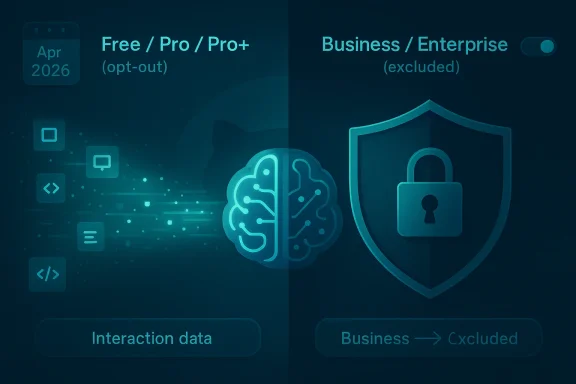
GitHub’s latest privacy-policy shift is more than a routine compliance update. It is a clear sign that Microsoft now sees the world’s largest developer platform as an AI data engine first and a neutral collaboration service second. Starting April 24, 2026, GitHub says it may use interaction data from Copilot Free, Pro, and Pro+ users for AI model training unless they opt out, while Copilot Business and Copilot Enterprise customers are excluded from the change. That creates a sharp divide inside the same product family: individual users are brought into the training pipeline by default, while enterprise customers remain fenced off by contract and policy.
The controversy around GitHub under Microsoft is not new; what is new is the bluntness of the AI monetization model. Microsoft bought GitHub in 2018 for $7.5 billion and promised that GitHub would keep operating independently and remain open to developers using any tools, cloud, or operating system. At the time, many developers feared lock-in and culture drift. Those fears did not materialize overnight, which is precisely why today’s changes matter: integration was slow, incremental, and technically defensible at each step.
GitHub’s own identity has evolved in parallel with Microsoft’s AI ambitions. In January 2025, Microsoft formally created CoreAI – Platform and Tools and placed GitHub, Azure AI Foundry, and VS Code inside the same strategic umbrella, with Jay Parikh leading the group. Then, in August 2025, GitHub CEO Thomas Dohmke announced his departure, saying GitHub would continue its mission as part of Microsoft’s CoreAI organization. Whatever residual symbolism remained around “independent GitHub” was significantly weakened by that move.
The user-scale backdrop is enormous. GitHub says more than 180 million developers and over 90% of Fortune 100 companies rely on its platform, with hundreds of millions of repositories hosted there. That makes GitHub one of the richest real-world sources of developer interaction data on the planet. In the AI era, that kind of behavioral exhaust is not just a byproduct; it is strategic fuel.
What makes the 2026 policy change especially important is that it does not simply govern stored code. GitHub says it will use interaction data such as inputs, outputs, code snippets, and associated context from Copilot sessions, and it explicitly says private repository content at rest is not being used to train the models. That distinction sounds reassuring, but for many developers it is not reassuring enough. In practice, Copilot is closest to the code when developers are actively editing their most sensitive projects, and that makes prompts, context windows, filenames, and surrounding code unusually revealing.
There is also a broader platform-economy issue at play. The policy creates a two-tier structure in which individual users and small teams can be turned into a training-data stream, while larger paying customers are protected by enterprise agreements and data-protection terms. That is not just a product design choice; it is a business model. And it reflects a familiar pattern: the cheapest tier often subsidizes the smartest tier.
The company says users can disable training through Copilot settings under Privacy, and its docs explain the steps for individual subscribers. That is a workable control for attentive users. It is also, obviously, a control that depends on awareness, time, and trust.
GitHub’s own documentation adds a further boundary: Copilot Business and Copilot Enterprise users are not affected, and the setting is not shown for those plans because enterprise data is protected under a Data Protection Agreement. So the policy is not universal, and that asymmetry is part of the point.
But context is where the intelligence lies. A filename, a partial function, a prompt, a surrounding block of code, or a repeated workflow pattern can reveal far more than a single static file fragment. For a developer trying to protect a proprietary system, the line between “interaction data” and “sensitive code knowledge” is thin.
This is why the policy is best understood as an AI telemetry framework. It captures how developers work, not just what they store. That is valuable because AI tools improve not only from code corpora but also from workflow signals about edits, acceptance rates, corrections, and iterative use.
Microsoft’s January 2025 CoreAI announcement made the architecture explicit: Azure should be the AI infrastructure layer, while GitHub and VS Code serve as the developer-facing surfaces built on top of it. In that world, training data from Copilot users is not an incidental side benefit. It is a core strategic input.
The hidden advantage is feedback quality. Public code alone tells you what exists; interaction data tells you what developers try, reject, revise, and accept. That is far more valuable for product tuning. It reveals which suggestions are genuinely helpful in the moment and which are merely plausible-looking noise.
Microsoft has already leaned heavily into this logic across its AI stack. GitHub Copilot, GitHub Models, Azure AI Foundry, and VS Code all sit inside a broader feedback-driven ecosystem. The more the tools are used, the more signal Microsoft can collect. The more signal it has, the more competitive its coding models can become.
This matters because enterprise customers are not buying a simple autocomplete tool anymore. They are buying a safer, more adaptive, more context-aware assistant that can justify higher per-seat pricing. By restricting training exclusions to the enterprise tier, Microsoft preserves confidence where the money is, while maximizing data intake where bargaining power is weaker.
In plain terms, the product learns most from the users least able to resist. That is not illegal by itself. It is, however, a sharp illustration of how AI business models extract value from asymmetric participation.
That is standard enterprise software behavior. The customer with the most negotiating power gets the strongest privacy guarantees. The customer with the weakest leverage gets the default policy and the checkbox. That is the structural divide.
This also explains why the company is unlikely to reverse course quickly. The enterprise segment is too valuable to unsettle, but the consumer segment is large enough to train on at scale. The policy is therefore optimized for both revenue and model quality.
Small teams and solo developers can generate highly sensitive prompts without any formal legal review. They may be working on unreleased products, internal tools, client code, security fixes, or prototypes. Even if GitHub avoids training on repository contents at rest, the interaction layer can still expose valuable business intelligence.
That is why some critics call this a “two-tier” system in privacy, not just in pricing. One class of users gets explicit protection by contract. Another class is asked to self-manage privacy in a product interface that many users will never revisit.
Then Copilot changed the equation. By embedding AI into the daily coding workflow, Microsoft made GitHub more valuable and more sticky. Copilot made the platform feel indispensable, which in turn made users more tolerant of deeper integration. That is the trap: utility can camouflage dependency.
The user community’s early concerns about vendor lock-in did not disappear; they became less visible because the product kept improving. When a platform becomes truly useful, friction over governance often fades into the background until a privacy or pricing change forces the issue back into view.
Thomas Dohmke’s departure in August 2025 reinforced that reading. GitHub said the leadership team would continue its mission as part of Microsoft’s CoreAI organization. The symbolism was hard to miss: a once-distinct company now operated inside the AI machine it helped create.
The current privacy shift is the logical next step. If the platform has already been organizationally absorbed, then using user interactions to improve AI features becomes not an edge case but a central business purpose. The policy simply makes explicit what the architecture had already implied.
This distinction is legally important because it narrows the exposure to active usage events. But it is operationally messy because development work is inherently interactive. Developers do not simply store code; they edit, inspect, refactor, compare, and ask systems for help. The more helpful the assistant becomes, the more context it needs.
The company also says it may de-identify or aggregate data during training when possible. That sounds prudent, but it does not eliminate the core concern for many users: the system still learns from their behavior, and behavior in a code editor can reveal a great deal.
There is also a trust issue. Users are being asked to accept a nuanced distinction between “content at rest” and “interaction data in use,” even though the practical outcome can feel similar from the developer’s seat. The policy may therefore be precise, but precision is not the same as reassurance.
That gives Microsoft a compounding advantage. The platform with the biggest audience gets the best feedback loop, which improves the product, which attracts more users. The data moat deepens as the product moat deepens. It is the classic flywheel, now applied to developer tooling.
GitHub’s huge footprint amplifies the effect. With more than 180 million developers and over 90% of Fortune 100 companies in its orbit, it has a scale position few competitors can challenge directly. In a market where model quality increasingly depends on real-world workflow signal, scale itself becomes a strategic asset.
This matters for open-source culture as well. GitHub remains the symbolic home of open development, but the economics around it are increasingly proprietary. If the platform’s intelligence comes from user interaction data, then the openness of the ecosystem does not automatically mean openness of the learning process.
That tension will likely define the next phase of competition. The winner may not be the company with the cleverest assistant, but the one that can lawfully and durably capture the most useful developer behavior.
The opportunity is to turn AI assistance from a generic autocomplete engine into a workflow-aware development partner. Done well, that could reduce repetitive coding, improve documentation quality, and help teams move faster with fewer mistakes. It also gives GitHub a way to defend premium pricing in a crowded market.
There is also a trust risk. Defaults matter, and a default that favors model training will feel extractive to users who thought Copilot was simply a paid assistant. Even if the policy is disclosed, disclosure is not the same as informed consent. Many developers will see a strategic pivot disguised as a settings change.
The bigger question is whether the industry accepts this as the new normal. AI tools need data, but the sources of that data are now politically and commercially sensitive. The platforms that win will be the ones that can build trust while still harvesting enough signal to stay ahead.
Source: Xpert.Digital - Konrad Wolfenstein https://xpert.digital/en/github-under-microsoft/?amp=1
 Overview
The controversy around GitHub under Microsoft is not new; what is new is the bluntness of the AI monetization model. Microsoft bought GitHub in 2018 for $7.5 billion and promised that GitHub would keep operating independently and remain open to developers using any tools, cloud, or operating system. At the time, many developers feared lock-in and culture drift. Those fears did not materialize overnight, which is precisely why today’s changes matter: integration was slow, incremental, and technically defensible at each step.GitHub’s own identity has evolved in parallel with Microsoft’s AI ambitions. In January 2025, Microsoft formally created CoreAI – Platform and Tools and placed GitHub, Azure AI Foundry, and VS Code inside the same strategic umbrella, with Jay Parikh leading the group. Then, in August 2025, GitHub CEO Thomas Dohmke announced his departure, saying GitHub would continue its mission as part of Microsoft’s CoreAI organization. Whatever residual symbolism remained around “independent GitHub” was significantly weakened by that move.
The user-scale backdrop is enormous. GitHub says more than 180 million developers and over 90% of Fortune 100 companies rely on its platform, with hundreds of millions of repositories hosted there. That makes GitHub one of the richest real-world sources of developer interaction data on the planet. In the AI era, that kind of behavioral exhaust is not just a byproduct; it is strategic fuel.
What makes the 2026 policy change especially important is that it does not simply govern stored code. GitHub says it will use interaction data such as inputs, outputs, code snippets, and associated context from Copilot sessions, and it explicitly says private repository content at rest is not being used to train the models. That distinction sounds reassuring, but for many developers it is not reassuring enough. In practice, Copilot is closest to the code when developers are actively editing their most sensitive projects, and that makes prompts, context windows, filenames, and surrounding code unusually revealing.
There is also a broader platform-economy issue at play. The policy creates a two-tier structure in which individual users and small teams can be turned into a training-data stream, while larger paying customers are protected by enterprise agreements and data-protection terms. That is not just a product design choice; it is a business model. And it reflects a familiar pattern: the cheapest tier often subsidizes the smartest tier.
What GitHub Actually Changed
The key fact is simple: GitHub said that, starting April 24, 2026, interaction data from Copilot Free, Pro, and Pro+ users may be used to train and improve AI models unless those users opt out. GitHub also said that if a user had already opted out of data collection for product improvements, that preference is preserved, and the data will not be used for training unless they opt in. That nuance matters, because it blunts the strongest version of the “silent consent” critique.The consent model is still the real story
Even with the retained opt-out, the default remains the point of friction. Default settings shape behavior more powerfully than policy prose does, and many users never revisit privacy controls after onboarding. In that sense, GitHub’s move is legally cleaner than a pure opt-in, but psychologically much stronger as a data-collection funnel.The company says users can disable training through Copilot settings under Privacy, and its docs explain the steps for individual subscribers. That is a workable control for attentive users. It is also, obviously, a control that depends on awareness, time, and trust.
GitHub’s own documentation adds a further boundary: Copilot Business and Copilot Enterprise users are not affected, and the setting is not shown for those plans because enterprise data is protected under a Data Protection Agreement. So the policy is not universal, and that asymmetry is part of the point.
- Copilot Free, Pro, and Pro+ are in scope.
- Copilot Business and Copilot Enterprise are excluded.
- Previously opted-out users keep their exclusion.
- Training can be disabled in personal settings.
- Enterprise governance overrides individual default behavior.
What data is in scope
GitHub’s post describes the data as interaction data rather than dormant repository content, including inputs, outputs, code snippets, and associated context. That is a narrower framing than “your private code is being vacuumed into a model,” and it is important not to overstate the claim. GitHub explicitly says it does not use private repository content at rest for training.But context is where the intelligence lies. A filename, a partial function, a prompt, a surrounding block of code, or a repeated workflow pattern can reveal far more than a single static file fragment. For a developer trying to protect a proprietary system, the line between “interaction data” and “sensitive code knowledge” is thin.
This is why the policy is best understood as an AI telemetry framework. It captures how developers work, not just what they store. That is valuable because AI tools improve not only from code corpora but also from workflow signals about edits, acceptance rates, corrections, and iterative use.
- Inputs and outputs are explicitly covered.
- Surrounding context is explicitly covered.
- Accepted or modified suggestions matter.
- Navigation and workflow signals can become useful metadata.
- The policy focuses on training quality, not just storage location.
Why Microsoft Wants This Data
Microsoft’s AI strategy depends on scale, feedback, and access to authentic work patterns. GitHub Copilot already sits inside the coding workflow, and that gives Microsoft an unusually rich stream of live developer signals. In the language of product strategy, this is not just “improvement”; it is a flywheel.Microsoft’s January 2025 CoreAI announcement made the architecture explicit: Azure should be the AI infrastructure layer, while GitHub and VS Code serve as the developer-facing surfaces built on top of it. In that world, training data from Copilot users is not an incidental side benefit. It is a core strategic input.
Copilot gets smarter from real-world usage
GitHub says the point of the change is to build more intelligent, context-aware coding assistance based on real-world development patterns. That statement is plausible. Models do improve when they learn from authentic workflows rather than sanitized demos.The hidden advantage is feedback quality. Public code alone tells you what exists; interaction data tells you what developers try, reject, revise, and accept. That is far more valuable for product tuning. It reveals which suggestions are genuinely helpful in the moment and which are merely plausible-looking noise.
Microsoft has already leaned heavily into this logic across its AI stack. GitHub Copilot, GitHub Models, Azure AI Foundry, and VS Code all sit inside a broader feedback-driven ecosystem. The more the tools are used, the more signal Microsoft can collect. The more signal it has, the more competitive its coding models can become.
The enterprise product benefits too
The cleanest commercial explanation is that training on individual users improves the product for everyone, including enterprise buyers. That means the free and lower-priced tiers can effectively subsidize the premium tiers’ intelligence. In platform economics, that is a classic cross-subsidy pattern.This matters because enterprise customers are not buying a simple autocomplete tool anymore. They are buying a safer, more adaptive, more context-aware assistant that can justify higher per-seat pricing. By restricting training exclusions to the enterprise tier, Microsoft preserves confidence where the money is, while maximizing data intake where bargaining power is weaker.
In plain terms, the product learns most from the users least able to resist. That is not illegal by itself. It is, however, a sharp illustration of how AI business models extract value from asymmetric participation.
- More real-world use means more training signal.
- More training signal means better code suggestions.
- Better suggestions justify higher pricing.
- Better pricing reinforces the enterprise moat.
- The smallest customers feed the largest strategic gains.
The Two-Tier Privacy System
The most revealing part of the policy is not its scope, but its asymmetry. GitHub says Business and Enterprise users are excluded entirely from the update, and the setting is not even shown for those plans. That creates a very clear line: if you are a consumer, freelancer, student, or small team, your interactions may become AI training data by default; if you are a large organization with a negotiated contract, they do not.Why enterprises get protected
Enterprise buyers are protected for practical reasons as much as ethical ones. They pay more, demand stronger assurances, and often operate under regulatory, contractual, or internal compliance constraints. GitHub’s own docs point to Data Protection Agreements and enterprise-managed policy controls as the reason the setting does not appear there.That is standard enterprise software behavior. The customer with the most negotiating power gets the strongest privacy guarantees. The customer with the weakest leverage gets the default policy and the checkbox. That is the structural divide.
This also explains why the company is unlikely to reverse course quickly. The enterprise segment is too valuable to unsettle, but the consumer segment is large enough to train on at scale. The policy is therefore optimized for both revenue and model quality.
Why smaller users carry the risk
Individual developers often treat paid subscriptions as a signal of trust, not as a contractual boundary. Yet Copilot Pro and Pro+ are still in the pool for this policy change, unless the user opts out. That is precisely why the issue resonates so strongly in the developer community.Small teams and solo developers can generate highly sensitive prompts without any formal legal review. They may be working on unreleased products, internal tools, client code, security fixes, or prototypes. Even if GitHub avoids training on repository contents at rest, the interaction layer can still expose valuable business intelligence.
That is why some critics call this a “two-tier” system in privacy, not just in pricing. One class of users gets explicit protection by contract. Another class is asked to self-manage privacy in a product interface that many users will never revisit.
- Enterprise customers receive contractual protection.
- Individual subscribers rely on settings and awareness.
- The same product can have two privacy regimes.
- The weaker regime is the one with the largest scale.
- The strongest regime is the one with the highest revenue.
Historical Arc: From Acquisition to Assimilation
The 2018 acquisition already foreshadowed this outcome. Microsoft’s promise at the time was to preserve GitHub’s independence while helping it scale and improve. For a while, that appeared to be true. GitHub kept its brand, its public-facing culture, and enough operational distance to reassure many developers.The first phase: trust-building
The first years after the acquisition were about reducing alarm. Microsoft did not immediately subsume GitHub into the rest of the company’s identity. Instead, it let GitHub serve as a symbol of Microsoft’s developer-first rebrand. That was strategically smart, because forcing the issue would have accelerated defection.Then Copilot changed the equation. By embedding AI into the daily coding workflow, Microsoft made GitHub more valuable and more sticky. Copilot made the platform feel indispensable, which in turn made users more tolerant of deeper integration. That is the trap: utility can camouflage dependency.
The user community’s early concerns about vendor lock-in did not disappear; they became less visible because the product kept improving. When a platform becomes truly useful, friction over governance often fades into the background until a privacy or pricing change forces the issue back into view.
The second phase: structural integration
The January 2025 CoreAI reorganization was the clearest sign that GitHub’s separate status was ending. Once GitHub became part of a Microsoft AI stack, it was no longer just a code-hosting company. It became a strategic node in a much larger model-training and product-distribution network.Thomas Dohmke’s departure in August 2025 reinforced that reading. GitHub said the leadership team would continue its mission as part of Microsoft’s CoreAI organization. The symbolism was hard to miss: a once-distinct company now operated inside the AI machine it helped create.
The current privacy shift is the logical next step. If the platform has already been organizationally absorbed, then using user interactions to improve AI features becomes not an edge case but a central business purpose. The policy simply makes explicit what the architecture had already implied.
- 2018: acquisition and reassurance.
- 2020s: Copilot adoption and dependency.
- 2025: CoreAI integration.
- 2025: CEO departure.
- 2026: default training policy expansion.
What GitHub Says It Is Not Doing
GitHub has drawn a boundary around private repository content at rest. According to its March 2026 update, the company does not use private repository source code stored on GitHub to train AI models. That is a meaningful distinction, and it should not be dismissed.The line between storage and interaction
A private repository sitting untouched is one thing. A private repository actively opened in Copilot, with prompts, completions, and surrounding code context, is another. GitHub says the latter can be included because it is part of the interaction data used to improve the service.This distinction is legally important because it narrows the exposure to active usage events. But it is operationally messy because development work is inherently interactive. Developers do not simply store code; they edit, inspect, refactor, compare, and ask systems for help. The more helpful the assistant becomes, the more context it needs.
The company also says it may de-identify or aggregate data during training when possible. That sounds prudent, but it does not eliminate the core concern for many users: the system still learns from their behavior, and behavior in a code editor can reveal a great deal.
Why the boundary may not calm critics
The privacy boundary is technically real, but psychologically it may not matter enough to skeptical users. Many will hear only one message: your workflow can be used to train the product unless you intervene. That is enough to trigger concern, especially in regulated industries or client-sensitive projects.There is also a trust issue. Users are being asked to accept a nuanced distinction between “content at rest” and “interaction data in use,” even though the practical outcome can feel similar from the developer’s seat. The policy may therefore be precise, but precision is not the same as reassurance.
- GitHub says stored private repos are not directly used at rest.
- Interaction data from active use can be used.
- De-identification may occur when possible.
- The company argues this improves code assistance.
- Critics may still see a privacy expansion, not a narrowing.
Competitive Implications for the Market
GitHub’s move is not just about GitHub. It is about the race to build the dominant AI-native developer environment. Microsoft wants GitHub, VS Code, Azure, and Copilot to operate as a single interconnected system, and data is the connective tissue.Pressure on rivals
Competitors such as GitLab, Bitbucket, JetBrains, and emerging AI-native coding platforms now face a harder sell. They must compete not only on features but also on trust architecture. If GitHub can continuously refine Copilot using a massive installed base, rivals may struggle to match the pace of improvement without similar scale.That gives Microsoft a compounding advantage. The platform with the biggest audience gets the best feedback loop, which improves the product, which attracts more users. The data moat deepens as the product moat deepens. It is the classic flywheel, now applied to developer tooling.
GitHub’s huge footprint amplifies the effect. With more than 180 million developers and over 90% of Fortune 100 companies in its orbit, it has a scale position few competitors can challenge directly. In a market where model quality increasingly depends on real-world workflow signal, scale itself becomes a strategic asset.
Ecosystem lock-in gets stronger
The long-term risk for the market is that “best” becomes indistinguishable from “most embedded.” Developers may adopt Copilot because it works well inside the tools they already use, while organizations standardize because it integrates with the rest of Microsoft’s stack. Over time, that makes leaving harder even if alternatives exist.This matters for open-source culture as well. GitHub remains the symbolic home of open development, but the economics around it are increasingly proprietary. If the platform’s intelligence comes from user interaction data, then the openness of the ecosystem does not automatically mean openness of the learning process.
That tension will likely define the next phase of competition. The winner may not be the company with the cleverest assistant, but the one that can lawfully and durably capture the most useful developer behavior.
- Scale creates better model feedback.
- Better models attract more users.
- More users create more scale.
- Integration raises switching costs.
- Trust becomes a competitive feature.
Strengths and Opportunities
GitHub’s strategy is not without merits. The company can legitimately argue that better training data produces more helpful coding tools, fewer irrelevant suggestions, and a more responsive product experience. If the controls remain clear and the enterprise exclusions hold, the update could improve Copilot materially without forcing a universal privacy reset.The opportunity is to turn AI assistance from a generic autocomplete engine into a workflow-aware development partner. Done well, that could reduce repetitive coding, improve documentation quality, and help teams move faster with fewer mistakes. It also gives GitHub a way to defend premium pricing in a crowded market.
- Better model quality from real-world usage signals.
- More context-aware suggestions for active developers.
- Cleaner enterprise positioning through contractual exclusions.
- Stronger product differentiation versus rivals.
- Potential productivity gains for small teams and solo developers.
- A clearer privacy control model than ambiguous legacy defaults.
- Higher willingness to pay if users see real value.
Risks and Concerns
The downside is equally clear. The biggest risk is not that GitHub is training on raw dormant repository contents, because the company says it is not. The bigger risk is that many users will not understand the distinction between repository storage and interactive code context, and will therefore underestimate what they are sharing.There is also a trust risk. Defaults matter, and a default that favors model training will feel extractive to users who thought Copilot was simply a paid assistant. Even if the policy is disclosed, disclosure is not the same as informed consent. Many developers will see a strategic pivot disguised as a settings change.
- Opt-out fatigue could leave users unaware of the change.
- Trust erosion may push privacy-conscious developers to alternatives.
- Enterprise/non-enterprise asymmetry may intensify class resentment.
- Regulatory scrutiny may grow around data classification and consent.
- Client-confidential work could become harder to govern safely.
- Open-source community backlash may revive old fears about Microsoft lock-in.
- Policy complexity may create misunderstanding even when compliance is technically sound.
Looking Ahead
What happens next will depend less on the announcement itself than on how developers respond in practice. If the opt-out rate is modest and Copilot usage keeps rising, Microsoft will likely treat the policy as validated. If backlash is severe, expect more explanatory messaging, more privacy controls, and possibly more segmentation by user type or region.The bigger question is whether the industry accepts this as the new normal. AI tools need data, but the sources of that data are now politically and commercially sensitive. The platforms that win will be the ones that can build trust while still harvesting enough signal to stay ahead.
- Watch whether GitHub expands the explanation of what counts as interaction data.
- Watch for changes in opt-out UX and default settings after April 24, 2026.
- Watch whether competitors use privacy as a differentiator in developer AI.
- Watch for enterprise customers to demand even stricter contractual language.
- Watch for renewed debate over whether “private” code is truly private inside AI workflows.
Source: Xpert.Digital - Konrad Wolfenstein https://xpert.digital/en/github-under-microsoft/?amp=1
