

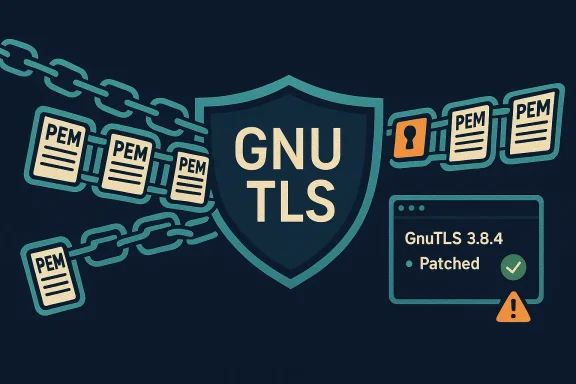
A newly disclosed GnuTLS vulnerability tracked as CVE‑2024‑28835 can crash applications during certificate chain building and verification — a denial‑of‑service (DoS) weakness that has been fixed upstream but has required careful distro-level backports and coordinated patching across Linux distributions. The bug is triggered by specially crafted PEM bundles (certificate chains) and causes an assertion failure when the library attempts to verify a chain containing more than 16 certificates; upstream addressed the root cause in the 3.8.4 release and distribution vendors have issued security updates and advisories.
Examples from vendor advisories:
Patching remains the cleanest and most reliable mitigation. Where immediate patching is not possible, restrict or isolate certificate verification operations and monitor for the crash indicators described above. Given the deterministic nature of the crash and the potential for remote triggering in services that accept uploads, this vulnerability is worth prioritizing in security maintenance cycles even though the CVSS vector nominally lists the attack as local. The upshot for operators is straightforward: validate, patch, and isolate — then test certificate workflows to ensure resilience against malformed inputs.
Source: MSRC Security Update Guide - Microsoft Security Response Center
 Background
What is GnuTLS and why this matters
GnuTLS is a widely used open‑source cryptographic library that implements TLS, X.509 certificate handling, and related cryptographic operations for clients and servers across many Linux distributions and applications. The library also ships utilities such as certtool, used for certificate creation and verification tasks. Because GnuTLS occupies a core role in TLS stacks and certificate toolchains, robustness issues can cascade into operational problems for certificate management systems, CI/CD pipelines, device provisioning, and administrative tooling.The specific symptom: certtool --verify-chain
The reported vulnerability manifests when running certtool --verify-chain (or when applications perform equivalent chain building/verification operations) against an input PEM bundle crafted to exercise an exceptional code path. Under certain conditions — notably when a chain contains more than 16 certificates — the verification code hits an assertion and the process aborts, producing a crash. The upstream release notes and advisories call out this precise failure mode.Technical overview
Where in the stack the failure occurs
The bug relates to the X.509 chain validation and path‑building logic inside GnuTLS. Upstream commentary and third‑party vulnerability analyses point to inadequate handling of exceptional states when computing or validating the certificate list size inside path building functions (for example, problems surfaced in functions used to verify trust lists and build chains). When the corner case is hit, an assertion fails and the library terminates the running process.Reproduction vectors and inputs
Available advisory text and issue tracker summaries indicate the fault is reproducible by passing a specially crafted PEM bundle to certtool (or by feeding similar certificate sequences to the chain building API). The crash is deterministic for inputs crafted to trigger the assertion (specifically chains with more than 16 entries arranged to produce the exceptional internal state). Public exploit code has not been reported as of the disclosures, but proof‑of‑concept inputs were sufficient for upstream maintainers and distro packagers to reproduce and confirm the defect.Attack surface: local vs remote
Official CVSS metrics and several vendor advisories assign this vulnerability a Medium rating (CVSS v3 base score ~5.0) and classify the attack vector as local with low privileges required and user interaction involved. That vectoring reflects the fact that the most direct exploitation route involves running certtool (or an application that performs local verification) on a crafted file. However, the practical attack surface can widen if an application accepts untrusted PEM bundles from remote users (for example, a web service that accepts uploaded certificates and runs server‑side verification), in which case the crash can be forced via a networked upload. Several distribution advisories therefore treat the issue as a significant availability risk for services that process user‑supplied certificate data.Impact assessment
Availability consequences
At its core, CVE‑2024‑28835 is an availability bug: the defect causes total loss of availability for the crashed process, and where the process handles certificate management or TLS operations, the effect can be operationally disruptive. Because the crash is deterministic for crafted inputs, an attacker with the ability to feed such inputs repeatedly can sustain denial of service. If a networked service accepts certificate bundles from remote sources and processes them without isolation, the vulnerability becomes remotely exploitable in practice — even though the upstream CVSS vector classifies it as local. Vendors explicitly call out the possibility that repeated or crafted uploads can render services unavailable until processes are restarted or patched.Confidentiality and integrity
Available reports consistently state the vulnerability does not lead to confidentiality or integrity loss — there are no reports of remote code execution (RCE) or data leakage stemming from this defect. The observable impact is process termination (crash) and therefore denial of service. That said, operational disruptions caused by a crash can have second‑order effects: certificate renewal jobs failing, automated provisioning halting, or manual processes being delayed — all of which can indirectly affect service continuity and SLAs.Who and what is affected
Affected versions and distributions
Upstream GnuTLS maintainers fixed the defect in the 3.8.x line; the public release notes list the crash fix in the 3.8.4 release. Distributions handled the issue in different ways: some upgraded to newer upstream versions, while others backported the fix into their maintained package versions (for example, Debian, Ubuntu, Amazon Linux, Oracle Linux and other vendors published advisories and packages that remediate the issue). Administrators must treat both upstream versions and distro‑packaged versions as possible carriers of the flaw — a distribution’s package version number may not map 1:1 to the upstream release number because of backports.Examples from vendor advisories:
- Debian and Debian LTS published fixes and security updates that incorporate the fix into the gnutls28 package for affected releases.
- Ubuntu’s security tracker lists fixed package builds for supported releases (Ubuntu 22.04/23.10/24.04 as applicable), noting the patched package versions that contain the fix.
- Amazon Linux and Oracle Linux advisories list the CVE and provide distro‑level update advisories referencing the issue.
Typical vulnerable deployments
Because GnuTLS is used in both user and system utilities, vulnerable instances include:- Administrative tools and scripts that use certtool for certificate operations.
- Custom applications and services that link against libgnutls and perform X.509 chain verifications, particularly if they accept certificate chains from untrusted or remote sources.
- Container images, appliance software, and network devices that embed older gnutls packages and that run certificate verification logic as part of provisioning or device enrollment.
Recommended remediation and mitigations
Immediate actions (prioritize)
- Inventory: Identify hosts and applications that ship with GnuTLS or run certtool. Check package lists across infrastructure and container images.
- Apply vendor patches: Upgrade to the patched GnuTLS package from your distribution or upstream. Upstream fixed the bug in GnuTLS 3.8.4; many distributions have issued security updates or backports. Applying those updates is the highest‑priority remediation.
- Restart affected services: After packages are updated, restart services that link to libgnutls or that call certtool to ensure the patched code is loaded.
- Harden input handling: If any service accepts certificate bundles from untrusted users, add validation, size checks, and sandboxing to the verification pipeline until updated packages are deployed.
Temporary workarounds (when immediate patching is infeasible)
- Do not process untrusted PEM bundles: Restrict uploads or require administrative approval before running verification on user‑supplied certificate files.
- Run verification in an isolated environment: Use a short‑lived container, chroot, or an isolated verification service that can be restarted automatically on failure; this prevents a crash in the verification process from bringing down a critical host agent.
- Rate‑limit certificate processing endpoints: If remote uploads are accepted, rate‑limit or queue the processing to reduce the chance an attacker can repeatedly force crashes and exhaust operational capacity.
- Audit and deny direct execution of certtool by low‑privilege users: Limit who can invoke certtool on production hosts.
Suggested patching commands (examples)
- On Debian/Ubuntu families: run package update and upgrade sequences (for example, apt update && apt install --only-upgrade gnutls28 or the distro’s recommended security update commands), then restart services.
- On RPM-based systems: use dnf/yum to apply the gnutls advisory (for example, dnf update gnutls or dnf update --advisory <advisory‑id>), then restart processes.
Always follow your distribution’s security advisory instructions and test updates in staging before rolling into production.
Detection and monitoring
What to look for
- Process crashes: Unexpected termination of certtool processes or services that link to libgnutls. Monitor systemd/journald logs and core dump events.
- Core dumps and assertion messages: The assertion failure referenced in advisories may leave diagnostic text in logs; capture and retain those logs for triage.
- Unusual certificate upload patterns: Spikes in uploads of PEM bundles or failed verification requests originating from the same source can indicate exploitation attempts.
- Automation failures: Sudden failures in certificate renewal or enrollment pipelines that use certtool or GnuTLS may be symptomatic of an exploited or triggering input.
Hunting queries and checks
- Search logs for process names and exit codes (certtool, applications that call libgnutls).
- Inspect core dumps (where available) to obtain backtraces that show the assertion location inside GnuTLS path building code.
- For web services, monitor HTTP endpoints that accept certificate uploads for abnormal 4xx/5xx error rates or repeated crashes after specific uploads.
Operational and security analysis
Strengths in the response
- Upstream transparency and fix: The GnuTLS maintainers acknowledged the issue and fixed it in the 3.8.4 release; the upstream release notes explicitly call out the crash fix and reference the issue tracker items used to triage the problem. That transparency accelerates downstream patching and validates vendor advisories.
- Wide distribution coverage: Major Linux distributions and vendors (Debian, Ubuntu, Amazon Linux, Oracle Linux, and others) published advisories and package updates, reducing the window where the bug could be left unaddressed in widely deployed packages.
Risks and weaknesses
- Backporting variance: Because distributions backport fixes into their package streams, the presence of a patched package version does not always map cleanly to the upstream version number. Administrators must rely on vendor advisories rather than just upstream release numbers. This fragmentation increases operational friction for large environments where different hosts run different distro versions.
- Hidden remote exposure: While CVSS classifies the vector as local, real‑world services that accept certificate bundles can present an effective remote attack surface. Organizations that run uploads and verification as part of web workflows may be exposed until they apply patches or introduce mitigation layers.
- No public exploit ≠ low urgency: The absence of publicly available exploit code reduces immediate threat noise but does not eliminate risk. DoS attacks are attractive to attackers because they are simple and can disrupt operations; the deterministic nature of this crash makes it easier to weaponize in targeted scenarios.
Practical checklist for administrators
- Inventory all systems that include GnuTLS or run certtool.
- Consult your distribution’s security tracker or advisories to determine whether the packaged gnutls has the upstream fix (do not assume upstream version numbers; check vendor advisories).
- Apply the security updates or upgrade libgnutls to a fixed release (upstream recommends 3.8.4; many distros have equivalent patched packages).
- Restart dependent services and verify they restart cleanly.
- Harden certificate processing endpoints: add input size constraints, validate chain length, sandbox verification, and rate‑limit untrusted inputs.
- Monitor logs for certtool or gnutls crashes and retain core dumps for triage if necessary.
- Update internal documentation and automation to avoid running unpatched certtool instances in production until patched.
Final assessment and recommendations
CVE‑2024‑28835 is a pragmatic, medium‑severity availability bug: it does not appear to allow code execution or data theft, but it reliably forces processes to crash during certificate chain verification when presented with crafted inputs. From an operational security perspective, the vulnerability is important because certificate processing runs in many unexpected places — system utilities, device provisioning, and user‑facing services — and a crash in those components can have outsized operational impact. Upstream maintainers fixed the defect in GnuTLS 3.8.4 and multiple vendors have issued patched packages or backports; operators should treat this as a routine but urgent patching task: identify impacted systems, apply vendor patches, and harden any path that accepts untrusted certificate inputs.Patching remains the cleanest and most reliable mitigation. Where immediate patching is not possible, restrict or isolate certificate verification operations and monitor for the crash indicators described above. Given the deterministic nature of the crash and the potential for remote triggering in services that accept uploads, this vulnerability is worth prioritizing in security maintenance cycles even though the CVSS vector nominally lists the attack as local. The upshot for operators is straightforward: validate, patch, and isolate — then test certificate workflows to ensure resilience against malformed inputs.
Source: MSRC Security Update Guide - Microsoft Security Response Center
