

A newly published vulnerability in the Go standard library — tracked as CVE-2025-61724 — exposes a classic performance pitfall: the Reader.ReadResponse function in net/textproto could be coaxed into excessive CPU consumption when it constructs response messages composed of a large number of short lines.
The Go standard library's net/textproto package provides generic support for text-based request/response protocols such as SMTP, NNTP, and HTTP-style numeric responses. Its Reader type implements helpers for reading multi-line numeric responses that follow the RFC-style pattern of a status code followed by lines, and the Reader.ReadResponse method assembles those lines into a single message string.
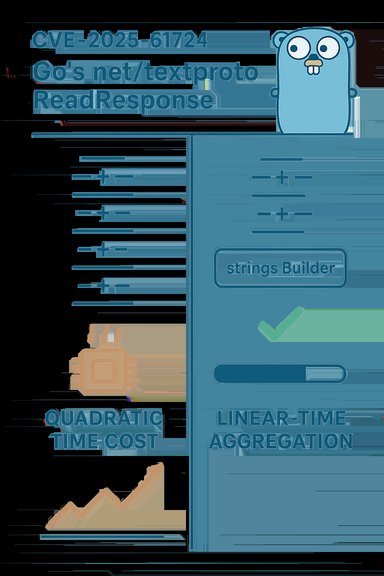
CVE-2025-61724 is not a memory-safety flaw or remote code execution bug. Instead, it is a performance vulnerability rooted in algorithmic complexity: the original implementation repeatedly concatenated strings in a loop, which makes the work done proportional to the square of the number of input lines in pathological cases. In practice, an attacker who can control the content of a response (for example, when a client or library reads responses from an untrusted network peer) can force a Go program to spend excessive CPU cycles handling a response containing many short lines.
The Go project issued fixes across release branches and the issue was addressed by switching to an efficient builder-based aggregation. The problem was reported by a third-party researcher and patched in maintenance releases. Multiple independent vulnerability databases list the issue as medium severity and record a CVSS v3.1 base score of 5.3, with availability impact classified as low (a denial-of-service-style impact rather than data compromise).
Reader.ReadResponse originally constructed the message by appending each line to an existing message string in a loop. For a response consisting of many short lines — for example, thousands of lines where each is just a few bytes — the repeated concatenation triggers repeated reallocations and copies. That behavior manifests as spiking CPU usage and additional memory churn, and can be weaponized into a denial-of-service scenario against code paths that read untrusted multi-line responses.
This is a textbook fix for the class of problem (inefficient algorithmic complexity due to repeated immutable concatenation).
Distributions that ship prebuilt Go runtimes and language toolchains (packaged Go) may take time to release updates. Similarly, third-party services that host precompiled Go binaries or language runtimes inside multi-language platforms may lag behind. For enterprise environments, CI/CD pipelines that cache or vendor older toolchains will need to be examined.
The security community increasingly treats inefficient algorithmic complexity as a first-class risk category. It shows up as CPU exhaustion, amplified resource usage, or denial-of-service conditions. Such issues are often easy to reason about and, in many languages, straightforward to fix (as in this case where the fix is to use an appropriate builder abstraction). But they become an operational headache when they exist deep in standard libraries or third-party dependencies: every consumer of the library must eventually rebuild or update to benefit from the fix.
For organizations with strict change control or with many internal builds, treat this as a standard supply-chain update: identify all artifacts built with older Go toolchains, rebuild with the patched toolchain, and redeploy in a staged fashion with monitoring.
Source: MSRC Security Update Guide - Microsoft Security Response Center
 Background
The Go standard library's net/textproto package provides generic support for text-based request/response protocols such as SMTP, NNTP, and HTTP-style numeric responses. Its Reader type implements helpers for reading multi-line numeric responses that follow the RFC-style pattern of a status code followed by lines, and the Reader.ReadResponse method assembles those lines into a single message string.CVE-2025-61724 is not a memory-safety flaw or remote code execution bug. Instead, it is a performance vulnerability rooted in algorithmic complexity: the original implementation repeatedly concatenated strings in a loop, which makes the work done proportional to the square of the number of input lines in pathological cases. In practice, an attacker who can control the content of a response (for example, when a client or library reads responses from an untrusted network peer) can force a Go program to spend excessive CPU cycles handling a response containing many short lines.
The Go project issued fixes across release branches and the issue was addressed by switching to an efficient builder-based aggregation. The problem was reported by a third-party researcher and patched in maintenance releases. Multiple independent vulnerability databases list the issue as medium severity and record a CVSS v3.1 base score of 5.3, with availability impact classified as low (a denial-of-service-style impact rather than data compromise).
What went wrong: the technical root cause
Quadratic string construction
In Go, strings are immutable. When you concatenate two strings with the + operator, the runtime generally allocates a new backing array and copies the content of both operands. Naive repeated concatenation in a loop therefore creates a series of allocations and copies whose total cost grows roughly as O(n^2) when building a string from n short fragments. For small n the cost is negligible, but when n grows into the thousands or more the cumulative copying becomes expensive.Reader.ReadResponse originally constructed the message by appending each line to an existing message string in a loop. For a response consisting of many short lines — for example, thousands of lines where each is just a few bytes — the repeated concatenation triggers repeated reallocations and copies. That behavior manifests as spiking CPU usage and additional memory churn, and can be weaponized into a denial-of-service scenario against code paths that read untrusted multi-line responses.
The fix: strings.Builder
The remediation applied by the Go team replaces repeated string concatenation with a preallocated, amortized-growth string builder. Using a strings.Builder or a bytes.Buffer avoids the quadratic copying behavior: it maintains a single backing buffer and writes appended fragments in amortized linear time. The applied patch changes the accumulation logic to use a builder, copies the initial fragment into the builder, and then appends subsequent lines efficiently before finally converting the builder to a string once.This is a textbook fix for the class of problem (inefficient algorithmic complexity due to repeated immutable concatenation).
Affected versions and remediation status
- Affected: prior to Go 1.24.8, and from Go 1.25.0 up to but not including 1.25.2 (that pattern arises because the fix was applied to the 1.24 maintenance branch and backported to the 1.25 branch).
- Fixed: Go 1.24.8 and Go 1.25.2 (and, by implication, any later point releases and the next major/minor releases that incorporate those changes).
- Reporter: credited to an external researcher.
- Patch: the change replaces repeated concatenation with strings.Builder; the upstream commits apply to the 1.24 and 1.25 release branches.
Impact analysis: who should care
Direct consumers of net/textproto
Any application or library that calls net/textproto.Reader.ReadResponse on untrusted or potentially large responses is a candidate for impact. Examples include:- SMTP clients or servers (net/smtp builds on net/textproto).
- NNTP or other line-oriented protocol implementations.
- Any custom protocol code that uses textproto.Reader for multi-line numeric responses.
- Some lower-level uses inside other standard packages that rely on textproto utilities.
Indirect and downstream impact
Even systems that do not import net/textproto directly may be affected indirectly if they depend on libraries that vendor or wrap Go’s networking stack. Container images, microservices, and embedded devices that run older Go binaries are at risk until those binaries are rebuilt with a patched Go toolchain.Distributions that ship prebuilt Go runtimes and language toolchains (packaged Go) may take time to release updates. Similarly, third-party services that host precompiled Go binaries or language runtimes inside multi-language platforms may lag behind. For enterprise environments, CI/CD pipelines that cache or vendor older toolchains will need to be examined.
Severity and exploitation likelihood
- Impact class: denial-of-service via CPU exhaustion on the local process (availability impact).
- CVSS v3.1 base score recorded at 5.3 (medium) reflects that the issue is remotely reachable over a network in typical uses, has low attack complexity, and results in low availability impact (process slowdown or elevated CPU).
- Exploitation: the flaw is not a memory-safety or arbitrary-code-execution issue. An attacker can trigger high CPU usage by supplying a crafted multi-line response, but they cannot directly execute code or steal data through this issue alone.
- Real-world exploitation: as of December 6, 2025, there is no widely reported evidence of mass exploitation in the wild for this specific CVE. That status should not be interpreted as permanent: performance-based denial-of-service vectors are often low-effort to weaponize in specific contexts.
Practical mitigations and remediation steps
The single best mitigation is to apply the upstream fix by updating the Go runtime and rebuilding the affected binaries. Follow this prioritized checklist:- Upgrade the Go toolchain and runtime
- Move to Go 1.24.8 or Go 1.25.2, or any later release that includes the fix.
- Rebuild all services and binaries that link to the standard library (static or dynamic builds) so they incorporate the patched library code.
- Apply distribution/vendor patches
- If you rely on OS-packaged Go, install your distribution’s security update for the Go package and rebuild your applications if required by your packaging model.
- For containers, pull updated base images that include the patched Go runtime and rebuild images.
- Temporary workarounds for unpatched environments
- Avoid passing untrusted input into net/textproto.Reader.ReadResponse where possible.
- Wrap network sources with io.LimitReader or similar to restrict the total number of bytes read from untrusted peers.
- Defensive programming: apply per-connection CPU and wall-time limits, increase observability, and add request/response thresholds.
- Apply resource controls (cgroups / container CPU limits) that prevent a single process from consuming all host CPU.
- Runtime safeguards and monitoring
- Add alerts for sustained high CPU usage in services that parse network responses.
- Use pprof or equivalent profilers to capture CPU profiles when spikes occur to identify whether net/textproto parsing is implicated.
- Implement circuit breakers, request throttles, and connection rate limits on endpoints that may receive malicious input.
- Scanning and dependency tracking
- Run software composition analysis (SCA) and vulnerability scanners that flag use of affected Go versions or vulnerable binaries.
- Search your repositories for imports of net/textproto and any code paths that call ReadResponse or similar functions.
- Test in lab before rollout
- Reproduce the fix in a controlled environment to ensure that the upgraded runtime and rebuilt binaries behave as expected and do not introduce regressions.
Detection guidance for operators
Detecting attempts to exploit this flaw is primarily about observing anomalous CPU behavior rather than identifying a specific network signature. Recommended detection signals:- Application-level metrics: sustained spikes in process CPU usage when reading network responses or processing mail/SMTP/NNTP sessions.
- Profiling snapshots: capture CPU profiles during a spike and look for heavy time spent in string concatenation and net/textproto code paths.
- Request volume correlation: DoS attempts often come with a high rate of specially crafted responses; correlate suspicious remote endpoints or peers with CPU spikes.
- Logging: instrument the code paths that call textproto.Reader to log response sizes (line count and total bytes) in debug or lab deployments; avoid verbose logging in production for privacy and performance reasons.
- Infrastructure alerts: use anomaly detection to surface deviations from normal CPU utilization per process or per node.
For developers: safe coding patterns
When writing code that parses text-based protocols, follow these guidelines:- Use io.LimitReader for any reader that will consume untrusted input. Enforce sensible size limits so that a single call cannot cause unbounded processing.
- Prefer streaming processing of large responses rather than assembling everything into a single giant string. In many cases you can act on lines as you receive them.
- For aggregation of many fragments, use strings.Builder or bytes.Buffer to avoid expensive repeated concatenation.
- Add sanity checks: limit the maximum number of lines or maximum message length you will accept for multi-line responses.
- Implement timeouts and per-request quotas. Network reads without deadlines make DoS easier; always set read deadlines where appropriate.
Why this matters: algorithmic complexity as a real security class
CVE-2025-61724 is an archetypal example of a vulnerability that is not about memory safety or logic errors in the sense of producing incorrect results, but about computational complexity. Attackers can force an otherwise correct implementation into worst-case behavior if the algorithm is not amortized or bounded.The security community increasingly treats inefficient algorithmic complexity as a first-class risk category. It shows up as CPU exhaustion, amplified resource usage, or denial-of-service conditions. Such issues are often easy to reason about and, in many languages, straightforward to fix (as in this case where the fix is to use an appropriate builder abstraction). But they become an operational headache when they exist deep in standard libraries or third-party dependencies: every consumer of the library must eventually rebuild or update to benefit from the fix.
Release cadence, vendor coordination, and the patch lifecycle
The Go project handled the issue through normal maintenance branches: a fix landed in the 1.24 and 1.25 release series. Upstream maintainers then issued point releases. Operating system maintainers and distributors subsequently packaged patched Go builds and published security advisories; downstream consumers should track those advisories. Container maintainers and CI/CD systems that bake Go toolchains into artifacts must also be updated to avoid carrying the vulnerable code forward.For organizations with strict change control or with many internal builds, treat this as a standard supply-chain update: identify all artifacts built with older Go toolchains, rebuild with the patched toolchain, and redeploy in a staged fashion with monitoring.
Risk assessment and final analysis
Strengths of the response- The vulnerability is limited to performance behavior; it does not enable privilege escalation, data exfiltration, or code execution.
- The upstream fix is small and straightforward, implemented in release branches and in subsequent point releases.
- The community and major package trackers quickly recorded and annotated the issue, and many OS vendors released updated packages.
- Any binary built with an unpatched runtime remains vulnerable until rebuilt — this includes older container images, embedded devices, and vendor-provided binaries that are not routinely rebuilt.
- Downstream projects that vendor older versions of the standard library may continue to carry the vulnerability undetected.
- Attackers can weaponize performance issues in high-volume settings (for example, multi-tenant services or mesh networks) where inducing even temporary CPU spikes has outsized operational consequences.
- Treat CVE-2025-61724 as a medium-priority update: schedule patching promptly, but the absence of code-execution or data-impact vectors means it does not require emergency patch windows unless you have services that expose textproto-style parsers to untrusted peers.
- Prioritize rebuilds of public-facing daemons and network-facing services that parse multi-line responses, and patch CI/CD pipelines that may create future vulnerable artifacts.
Short checklist for immediate action
- Confirm which services in your environment were built with Go versions older than 1.24.8 or 1.25.2.
- Upgrade the Go toolchain or install vendor/distribution security patches.
- Rebuild and redeploy affected binaries and container images.
- Add monitoring alerts for unexpected CPU spikes in processes that parse network responses.
- Audit code for unbounded textproto usage and add io.LimitReader and timeouts where applicable.
Conclusion
CVE-2025-61724 is a reminder that standard-library code — even highly vetted runtime code — can contain algorithmic edge cases that translate into security-relevant behavior. The flaw is fixable, and upstream fixes are small and well-contained, but operational exposure persists until binaries are rebuilt and redeployed. Organizations should treat this as a time-sensitive maintenance item: apply the patched releases, rebuild artifacts, and layer defensive runtime limits to reduce the attack surface for similar algorithmic complexity issues in the future.Source: MSRC Security Update Guide - Microsoft Security Response Center
