

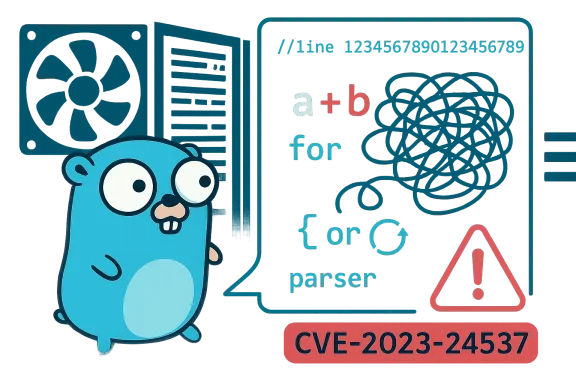
A subtle integer overflow in the Go standard library’s scanner can be weaponized to hang processes: CVE-2023-24537 causes the go/scanner parser to enter an infinite loop when it encounters //line directives with abnormally large line numbers, producing a reliable denial‑of‑service (DoS) condition unless the runtime or caller imposes strict limits.
Background
Go’s standard library includes the package go/scanner to tokenize and scan Go source code for compilers, linters, formatters, build tools, and other developer-facing services. The parser understands the special//line directive used by generated code and some tooling to map token positions back to original source files and line numbers. A flaw in the way line numbers were handled — specifically, an integer arithmetic wrap/overflow when extremely large line values are present — allowed the scanner to fall into a non‑terminating loop during Parse calls. The vulnerability was assigned CVE‑2023‑24537 and rated high severity by multiple authorities.This bug is not just academic: many server processes, CI pipelines, container image builders, language servers, online compilers, and automated formatting or vetting services routinely parse Go source code supplied by users, contributors, or third‑party repositories. If any such component invokes Parse on attacker‑controlled input that contains crafted
//line directives, the process can be driven to consume CPU indefinitely or become unresponsive — a classical denial‑of‑service outcome. Vendor advisories and distro security trackers documented the issue and recommended upgrades.What exactly went wrong: technical anatomy
The parsing context
- The
//linedirective syntax exists to let tools communicate the original filename and line number for subsequent tokens. It is commonly used in code generators and source-to-source tools. - The Go scanner consumes line number values and performs arithmetic to maintain position state as it scans tokens during Parse operations.
Failure mode: integer overflow → nonprogressing loop
- When the scanner receives a
//linedirective with an extremely large line number, the arithmetic used to advance or normalize positions can overflow the integer type used by the scanner's loop counters or position computations. - Instead of halting with a predictable panic or a handled error, the overflow produces values that keep the scanner’s internal loop condition satisfiable without making forward progress — the loop never reaches a termination point and the function never returns.
- The net result is a spinning, busy, or stuck process — availability is lost for the impacted component until the process is killed, restarted, or otherwise constrained.
Scope and affected versions
- The issue was reported in April 2023 and affects Go releases in common deployment ranges. Public guidance and vendor trackers list affected releases as older than the fixed releases (notably versions earlier than Go 1.19.8 and certain 1.20.x releases before 1.20.3), with fixes shipped in subsequent patch releases. Operators and packagers were advised to update to the patched releases.
- Linux distributions, container runtimes, and downstream packages that embed or ship vulnerable Go toolchains (for example, distros’ golang packages or containerd builds that include Go toolchains) issued their own advisories and backports; you must check the exact package name and version used in your environment. Distribution advisories from Ubuntu, SUSE, Amazon Linux and vendor advisories reference the same root cause and list fixed package versions for their trees.
Real-world exposure and exploitability
Attack surface
- Any service that parses Go code supplied from untrusted sources is a candidate: code-hosting hooks, online playgrounds, CI runners, container build systems, repository scanners, language servers exposed via code editors, linter-as-a-service APIs, and simply packaged tools that accept input files for formatting or static checks.
- Because the attack vector requires delivering crafted source text (a
//linedirective with a huge line number), it is trivially achievable by a remote actor submitting source to an endpoint that accepts files or repositories. The exploit complexity is low in practice.
Consequences
- Availability loss: a hung process, high CPU usage, inability to accept new connections, or repeated crashes requiring restarts. The impact is operationally important where the affected process is a central service (e.g., CI controller or code indexing service).
- Persistent outages: if the vulnerable parser runs inside long‑lived workers with no per‑job timeouts, a single crafted job can hold worker capacity indefinitely, creating cascading backlog and eventual service outage.
- Supply‑chain impact: packagers and distributors that ship vulnerable Go toolchains inside images or language packages can inadvertently propagate the risk to consumers. Several vendor advisories called this out, instructing downstream maintainers to upgrade their Go packages.
How vendors and distributions responded
Major downstream vendors and distributions issued advisories or security bulletins mapping the upstream CVE to their packages. Typical responses included:- Publishing security notices that identify the vulnerable package versions and the fixed package versions to upgrade to.
- Backporting the fix into long‑term distribution releases where necessary.
- Recommending users of affected products (including container runtimes, language toolchains, and orchestration components) upgrade or apply vendor-provided patches.
In community forums and downstream inventories, we also see conversations about how Microsoft and other cloud vendors publish attestation or product‑scope advisories for open‑source components that appear in their images — an important nuance for operators mapping CVE coverage across product portfolios. For example, forum summaries highlight how Azure Linux or other product attestations indicate the presence of a vulnerable component within a product family rather than an absolute statement about all Microsoft offerings.
Patching and remediation — an actionable checklist
- Identify affected Go toolchains and binaries
- Query your systems for installed Go versions and build toolchains (package manager metadata, go version, or compiled binaries that embed a specific runtime).
- Check container images and CI build nodes for embedded Go packages or images built from base images that supply golang packages. Distribution advisories list the exact package names and fixed versions you should look for.
- Upgrade to fixed Go releases
- Upgrade to Go releases that include the fix (for instance, releases identified by the Go project and referenced in vendor advisories; packagers indicate exact package versions). For most users the correct remediation is to move to the most recent stable patch release in the affected series or newer. Confirm the precise patched version in your distro’s advisory.
- Patch downstream packaged products
- If you run products that themselves embed golang (containerd, skopeo, etc.), install the vendor updates that rebuild those components with a patched Go toolchain or library. Vendor distributors often publish aggregated advisories mapping upstream CVEs to their packages.
- Apply runtime mitigations where immediate upgrades aren’t possible
- Enforce per‑job CPU and wall‑clock timeouts for any parsing jobs or worker tasks that accept untrusted source text.
- Run parsing and compilation in sandboxed processes with strict resource limits (cgroups, chroot/jail, container isolation).
- Introduce input validation that rejects
//linedirectives with line numbers that exceed a safe threshold before handing content to the scanner.
- Monitor and detect
- Implement process health monitors that detect stuck processes or excessive CPU consumption and trigger restart or isolation.
- Set alerts for sustained high CPU usage from language tooling or from worker pools that process user‑supplied code.
- Review CI/automation policies
- For public CI services that accept third‑party code, consider gating or running untrusted builds in strictly isolated ephemeral runners with resource caps.
Developer guidance: hardening code that uses go/scanner
- Assume untrusted input: Any public‑facing endpoint that accepts code should enforce validation and resource controls.
- Pre‑parse sanitization: Strip or validate
//linedirectives where the directive is not required; treat them as potentially malicious metadata. - Defensive coding: When invoking parse functions, do so from a short‑lived process or goroutine that can be timed out and killed if it blocks for longer than a reasonable processing window.
- Hard limits on positions: If your application interprets or normalizes line numbers, clamp excessively large values to a reasonable ceiling and log occurrences as potential abuse.
Detection and incident response playbook
- Triage signals
- Spike in CPU or CPU steal across workers that run parsing or compilation.
- Worker pools with gradually declining available capacity despite no backlog in upstream queues (workers stuck on single jobs).
- Unusually long parse durations for small or medium payloads.
- Immediate containment steps
- Kill and restart stuck parsing processes; if running in a container environment, redeploy and rotate the node.
- Quarantine the input that triggered the hang (store the file for forensic analysis).
- Apply rate limits or temporarily disable endpoints that accept code submissions until patches are deployed.
- Post‑incident hardening
- Add per‑job timeouts for parsers and compilers.
- Harden observability to correlate parsing times with originating request IDs.
- Push the patched Go version and rebuild consumer artifacts to remove the vulnerability from the code path.
Why this class of bug reoccurs and what it teaches operators
Parsing and position tracking are deceptively error‑prone. Many languages and tooling rely on integer arithmetic to track positions, columns, and line numbers — and generated code, third‑party source, or deliberately malformed input can stress those assumptions. Historically similar DoS vectors have appeared in multiple languages and libraries where malformed input leads to infinite loops or uncontrolled recursion; the Go ecosystem has seen a number of parsing or scanner‑related DoS CVEs in recent years. The fundamental lesson is that any code that accepts external artifacts for parsing must assume malicious inputs and implement both code‑level checks and operational limits. Vendor advisories repeatedly urge the same defensive posture.Supply‑chain implications
- Packagers and distributors must treat the Go toolchain as part of their attack surface. A vulnerable Go toolchain inside an image or development container can propagate to many downstream products. Multiple vendors and distributions issued coordinated advisories referencing the upstream Go patch; packagers were urged to rebuild and ship fixed packages promptly.
- Operators should verify not only the versions of Go they compile with, but also the versions of Go embedded in third‑party tooling (static analysis tools, formatters, or vendored toolchains) used in CI pipelines.
Verifying the fix and validating your environment
- Confirm Go version:
- Run
go versionon build nodes and verify you are on a patched release (consult your distro’s security notice for the fixed package name and release). - For container images, inspect the base image packages or rebuild images with a known patched toolchain.
- Run
- Rebuild dependent binaries:
- Where vendor packages embed the go toolchain or standard packages (for example, statically compiled tools or containers that bundle the toolchain), rebuild those artifacts with the patched Go and redeploy.
- Add tests:
- Add a small set of fuzz or negative tests that feed large
//linenumbers into parsing paths in staging to ensure the parser returns promptly or errors out under your runtime constraints.
- Add a small set of fuzz or negative tests that feed large
- Validate distro packages:
- Check vendor advisories (Ubuntu, SUSE, Red Hat, Amazon Linux) and apply their recommended package upgrades or backports where appropriate.
Strengths of the response — and the remaining risks
- Strengths
- The Go project and major vendors published patches and distribution upgrades in a timely manner; the remediation path is straightforward: update to patched Go releases or apply vendor backports. Multiple vendors’ advisories converge on the same remediation guidance.
- The vulnerability is not a remote code execution bug; it’s a high‑confidence denial‑of‑service issue. That narrows the victim impact model to availability rather than integrity or confidentiality in most real‑world scenarios.
- Remaining risks and caveats
- Service operators who cannot immediately upgrade (long release cycles, constrained appliances, or embedded products) remain exposed unless they adopt runtime mitigations (timeouts, sandboxing).
- The attack pattern — feeding crafted source to a parser — is trivial to automate and can be used as a low-cost resource exhaustion attack against public endpoints.
- Supply‑chain complexity means that even if your application is patched, transitive dependencies, CI runners, or container images may still ship with vulnerable toolchains until rebuilt and redeployed. Comprehensive inventory is required to be certain the exposure is fully removed.
Practical checklist for administrators (one page summary)
- Inventory: locate all hosts, containers, and build agents that run Go or include a golang package.
- Patch: upgrade to the patched Go releases or install vendor backports immediately.
- Contain: add per‑job CPU/time limits and sandbox parsing jobs when immediate patching is not possible.
- Monitor: set alerts for sustained CPU usage by parser/worker processes and monitor for stuck worker counts.
- Rebuild: rebuild images and artifacts that may have been compiled with a vulnerable toolchain.
- Verify: run negative tests (including inputs with large
//linenumbers) in staging to confirm no hung processes. - Communicate: if you ship products that embed Go, notify downstream users about the fixed versions and required upgrades.
Conclusion
CVE‑2023‑24537 is an instructive example of the outsized operational impact that a small parser bug can inflict: by turning a numeric overflow into an infinite processing loop, an attacker can reliably deny service to software that scans or compiles Go code. The remedy — upgrade to patched Go releases and apply vendor backports — is clear and available, but organizations must treat parsing pipelines as first‑class attack surfaces. Apply the patch, harden parsers with timeouts and quotas, inventory your supply chain, and treat any process that touches untrusted source as untrusted execution context. Vendor and distribution advisories and the NVD listing document the vulnerability and the upgrade path; act promptly to reduce your exposure.Source: MSRC Security Update Guide - Microsoft Security Response Center
