

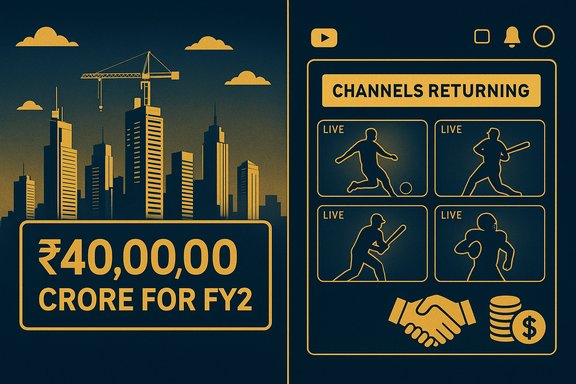
Godrej Properties has set an ambitious target to launch projects worth Rs 40,000 crore in FY26, even as it guides for Rs 32,500 crore in sales bookings — a move framed as both growth capture and market‑share defence — while, separately, YouTube TV and Disney have quietly closed a high‑stakes carriage dispute that left major Disney channels dark for roughly two weeks and exposed the fragile economics of live‑sports distribution in the streaming era.
Background / Overview
The two developments sit at different ends of business attention: one is corporate capital deployment in India’s listed real‑estate sector; the other is a US media carriage negotiation with immediate consumer impact. Both are, however, emblematic of larger structural forces shaping 2025 markets: developers and platforms are chasing scale and recurring revenue while negotiating finite inputs (land and capital for developers; content and per‑subscriber economics for platforms). The Storyboard18 items the newsroom received summarize these events; the Godrej piece highlights management guidance from Executive Chairperson Pirojsha Godrej, and the YouTube TV piece reports the restoration of Disney‑owned channels after the blackout.Godrej Properties: The Rs 40,000 crore launch plan
What the company announced
- Godrej Properties told press agencies and investors it plans to launch projects with an estimated sales value of Rs 40,000 crore in FY26 and is guiding for sales bookings of Rs 32,500 crore for the year. These figures come directly from executive commentary and investor presentations summarised in mainstream reports.
- Management pointed to a strong backlog and robust collection performance in FY25 (sales bookings of about Rs 29,444 crore and record collections), and said the firm has a pipeline of marquee projects — notably a Worli, Mumbai development in H1 and a planned Ashok Vihar project in Delhi targeted by March 2026 — which underpin the FY26 launch targets.
Why this matters
- Scale: A Rs 40,000 crore launch programme signals an intent to keep market leadership and to ensure a steady funnel of high‑value inventory that feeds future sales bookings and cash flows.
- Balance‑sheet ammunition: The company publicly referenced a recent QIP (roughly Rs 6,000 crore) plus operating cash flow as the financial base for land buys and development activity — a concrete funding posture rather than an unfunded aspiration.
- Geographic mix and risk diversification: Management highlighted project distribution across regions, aiming to avoid concentration risk tied to a single landmark project or city. That diversification matters in a capital‑intensive industry exposed to local regulatory or demand shocks.
Verification and cross‑checks
- Independent reports corroborate the headline guidance: Business Standard and other reputable outlets reported the Rs 40,000 crore launch target and the Rs 32,500 crore sales‑bookings guidance based on Pirojsha Godrej’s comments. That gives two independent confirmations of the numbers.
- The company’s prior fiscal performance is verifiable via investor presentations and audited disclosures that show FY25 sales bookings near the reported Rs 29,444 crore, supporting the management assertion that launches and bookings have momentum. Still, specific project economics (margins per project, phasing of customer receipts, or finalised launch schedules for every plot) remain company‑provided projections until formal launch notices and sales agreements are filed.
Strengths in the plan
- Financial preparedness: A recent QIP plus healthy collections reduce dependency on external debt for land acquisition and early‑stage development.
- Track record: The firm exceeded its prior FY guidance on launches — management points to a history of overshooting launch targets — which supports credibility that the Rs 40,000 crore target is operationally thought‑through.
- Large‑ticket pipeline: Named projects in premium micro‑markets (Worli, Ashok Vihar) signal an aspiration to book high‑value sales rather than a pure volume play. That can improve cash conversion per launch if priced and absorbed well by the market.
Key risks and caveats
- Target vs. guarantee: The Rs 40,000 crore figure is a management launch target and should be treated as guidance, not a binding commitment. Market absorption, regulatory clearances, and timing of launch approvals can alter actual released inventory. Flag: treat headline launch figures with caution until formal launch disclosures and subsequent launches are executed.
- Macro and demand sensitivity: Real‑estate absorption depends on interest rates, mortgage availability, and customer sentiment. Significant moves in interest rates or consumer confidence could widen the gap between planned launches and actual sales bookings.
- Execution complexity: Large launches require simultaneous land conversion, design approvals, marketing, and handover readiness; mis‑timing any stage can delay revenue recognition and cash flow. The firm’s prior success reduces but does not eliminate this execution risk.
Practical implications for stakeholders
- For investors: Watch quarterly launch disclosures and the pace of collections; verify how much of the Rs 40,000 crore is firm, shovel‑ready inventory versus aspirational pipeline.
- For buyers and brokers: Large launches may offer inventory choice but also temporary competition among projects that can compress initial absorption rates; pricing discipline will be key.
- For partners and subcontractors: A big launch programme creates demand for construction, materials, and subcontracting capacity — expect procurement schedules and cash‑flow terms to be negotiated early.
YouTube TV and Disney: blackout, negotiation and resolution
What happened
- A carriage dispute between YouTube TV (owned by Google/Alphabet) and The Walt Disney Company removed Disney‑owned linear channels — including ABC, ESPN and portfolio channels like FX and National Geographic — from YouTube TV around late October, leaving many subscribers without live sports, news and key entertainment channels for more than a week. The blackout dated from October 30 and lasted roughly two weeks before an agreement restored service.
- The companies reached an agreement that restores the channels to YouTube TV; while precise financial terms were not disclosed, reporting indicated the talks included contentious per‑subscriber economics (with public reporting that Disney sought substantially higher carriage fees reflecting ESPN’s value). The deal reportedly includes provisions to make ESPN’s new unlimited service available to base YouTube TV subscribers at no additional cost through the end of 2026, a notable concession in bundle mechanics.
Why the blackout mattered
- Live sports risk: Carriage fights disproportionately hurt viewers because sports rights generate appointment viewing and ad revenue; blackouts during major sports windows (college football, NFL lead‑ins, etc. create acute customer dissatisfaction and political attention.
- Subscriber economics under stress: Platforms like YouTube TV operate on thin margins where per‑subscriber carriage fees are a critical input. Content owners, especially those with premium sports assets, are pushing for higher per‑subscriber pricing as linear bundles remain a comparative cash cow versus direct‑to‑consumer ad‑supported models.
- Public optics and customer remedies: During the dispute YouTube TV issued customer credits (a $20 credit was publicly offered earlier in the impasse), which reduces goodwill costs but is not a long‑term solution to negotiating instability. The visible nature of the conflict — public statements and social‑media spats — also risks reputational damage on both sides.
Verification and cross‑checks
- Reuters and Associated Press both reported on the restoration and the basic contours of the deal, independently confirming the blackout length, channels affected, and that the agreement ended the outage. The Verge and other technology outlets also covered the terms, including the reported ESPN‑related concessions; using multiple reputable outlets confirms the timeline and the consumer impact.
Strengths in the resolution
- Rapid restoration: The parties reached an agreement within approximately two weeks, restoring channels to subscribers and minimising longer‑term churn risk.
- Distribution clarity: For now, the deal preserves YouTube TV’s content breadth and keeps a high‑value sports inventory in its base lineup — an important retention lever for live TV subscribers.
Persistent risks and structural implications
- Renewal friction remains: Carriage contracts are renegotiated periodically; the dispute is a reminder that future contract cycles could trigger new fights, especially as Disney seeks to monetise ESPN aggressively across platforms.
- Shift to hybrid monetisation: Disney and other content owners are increasingly balancing linear carriage revenue with direct‑to‑consumer subscriptions. That creates conflicting incentives: maximise distribution for ad reach vs. preserve scarcity to build DTC subscriptions.
- Consumer perception and platform competition: Repeated blackouts can accelerate cord‑cutting or drive subscribers to platforms perceived as more stable; however, major sports rights remain concentrated, giving traditional distributors leverage in customer retention.
Critical analysis — common threads and contrasts
1) Targets vs. leverage: scale demands capital and margin management
- Both stories are about scale plays: Godrej seeks scale in physical real‑estate launches; Disney seeks to extract maximum value for its content at scale through negotiated carriage fees. Scale, however, requires different forms of leverage.
- For Godrej, leverage is balance‑sheet strength and project execution capability. The company’s QIP and strong collections are the explicit levers cited by management.
- For Disney, leverage is exclusive content (ESPN) and scarcity. But scarcity carries consumer friction — blackouts are costly publicity and may accelerate fragmentation of distribution economics.
2) Transparency and verifiability
- Both cases show a mix of verifiable facts and executive guidance:
- Sales bookings, prior collections and QIP amounts are verifiable from company disclosures and investor presentations, and multiple press outlets replicated these numbers in their reporting on Godrej. That reduces the probability that the headline figures are erroneous, but phasing and project‑by‑project economics remain forward‑looking.
- The carriage deal’s high‑level outcome (channels restored) and blackout duration are verifiable via independent press reporting; however, detailed commercial terms and long‑term strategic concessions (e.g., how ESPN will be monetised inside bundles beyond 2026) are not disclosed and therefore remain opaque.
3) Consumer and counterparty risk
- Godrej’s ambitious launch plan improves choice for buyers but concentrates risk in developers’ execution — delays in delivery or sales absorption could create working capital stress.
- The YouTube TV blackout exposed end users to immediate service degradation; it also highlighted how consumers are collateral damage in a negotiation where per‑subscriber economics are the bargaining chip. Platforms that repeatedly face blackout risk may need stronger contractual backstops or hedges to maintain subscriber trust.
What to monitor next — checklist
- Godrej Properties: public launch notices and project timetables for Worli and Ashok Vihar; quarterly collection rates and the split between pre‑sales and actual recognition. Confirmations of milestone releases and project approvals are the best verification of the Rs 40,000 crore pipeline.
- Godrej Properties: how much of the Rs 40,000 crore is firm launches (approved projects / marketing launch) versus planned pipeline (land bank or pre‑development). Investors should ask for a breakdown in upcoming investor presentations.
- YouTube TV vs Disney: any ancillary clauses in the agreement (revenue‑sharing, bundling of ESPN Unlimited, promotional commitments) and how those terms influence subscriber pricing or future renegotiation cadence. Watch for regulatory filings or joint press releases for clarity.
- Industry signal: whether other MVPDs / vMVPDs use this renegotiation outcome as a price benchmark for future deals with Disney or other sports‑heavy media owners. If Disney achieves materially higher per‑subscriber economics, expect reverberations across the pay‑TV marketplace.
Conclusion
Both stories demonstrate a single truth about 2025 markets: growth ambitions collide with finite inputs and complex bargaining. Godrej Properties’ Rs 40,000 crore FY26 launch target is an assertive bet on demand and a signal of capital readiness, but it remains a guidance figure dependent on execution, approvals, and absorption. The YouTube TV–Disney blackout and its resolution illustrate the fragility of the live‑TV value chain where premium sports content becomes the fulcrum for recurring‑revenue economics. The quick restoration avoided deeper subscriber damage, but the episode underscores the structural tension between content owners seeking higher per‑subscriber returns and distributors balancing price sensitivity and churn. Both items are summarized in the Storyboard18 material supplied; those summaries provide a useful baseline but should be read alongside primary filings and independent reporting for any decision that depends on contractual detail or project‑level verification.Key takeaways (quick reference)
- Godrej Properties: Launch guidance Rs 40,000 crore; sales bookings guidance Rs 32,500 crore; strong FY25 collections underpin the plan — treat launch number as guidance until launch notices and phased project disclosures are published.
- YouTube TV/Disney: Channels restored after a two‑week outage; core disagreement concerned per‑subscriber economics for ESPN and Disney network portfolio; precise commercial terms remain undisclosed but multiple outlets confirm the blackout timeline and restoration.
Source: Storyboard18 Godrej Properties targets Rs 40,000 crore in FY26 launches, says Pirojsha Godrej
Source: Storyboard18 Disney channels return as YouTube TV strikes agreement to end two-week blackout
