

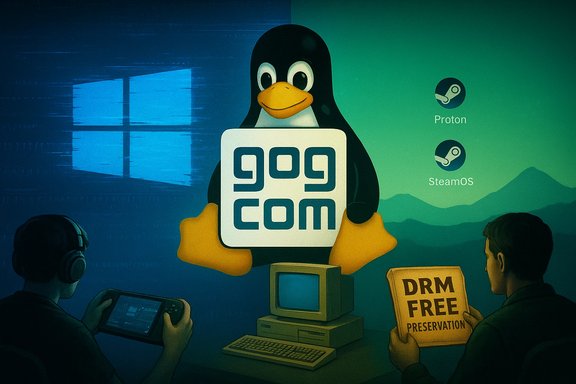
Michał Kiciński’s blistering dismissal of Windows 11 as “such poor‑quality software” has done more than provoke headlines — it has crystallized a strategic inflection point for PC gaming in 2026, with GOG announcing that Linux is now a strategic priority and the company preparing concrete workstreams to make DRM‑free gaming and preservation play more cleanly on non‑Windows platforms.
GOG’s rebirth as an independently owned storefront is the immediate catalyst for the conversation. Co‑founder Michał Kiciński completed a purchase of GOG from CD PROJEKT in late December 2025 — a deal reported at PLN 90,695,440 — returning the platform to individual ownership and freeing it to pursue a mission‑driven roadmap that explicitly includes Linux. That corporate reset landed during a period of rising user and developer frustration with parts of Windows’ recent trajectory: aggressive AI integrations, ongoing telemetry concerns, and the operational friction created by Windows 10’s end of support in October 2025. For many in the PC gaming community, those frictions combine with tangible improvements in Linux gaming tooling — Valve’s Proton and VKD3D‑Proton, distribution packaging advances such as Flatpak, and the maturation of compatibility layers like Wine — to create a credible alternative to the Windows‑first model that has dominated for decades.
Either way, GOG’s stance forces a public accountability moment for platform owners and middleware vendors alike: deliver stability and respect user choice, or cede ground to those who will. The result for gamers could be a healthier ecosystem — one where DRM‑free ownership and cross‑platform play are not aspirational points but practical realities.
Source: WebProNews GOG Owner Blasts Windows 11, Eyes Linux Pivot in 2026 for Gamers
 Background / Overview
GOG’s rebirth as an independently owned storefront is the immediate catalyst for the conversation. Co‑founder Michał Kiciński completed a purchase of GOG from CD PROJEKT in late December 2025 — a deal reported at PLN 90,695,440 — returning the platform to individual ownership and freeing it to pursue a mission‑driven roadmap that explicitly includes Linux. That corporate reset landed during a period of rising user and developer frustration with parts of Windows’ recent trajectory: aggressive AI integrations, ongoing telemetry concerns, and the operational friction created by Windows 10’s end of support in October 2025. For many in the PC gaming community, those frictions combine with tangible improvements in Linux gaming tooling — Valve’s Proton and VKD3D‑Proton, distribution packaging advances such as Flatpak, and the maturation of compatibility layers like Wine — to create a credible alternative to the Windows‑first model that has dominated for decades. What Kiciński actually said — and why it matters
Michał Kiciński’s remark — delivered in a recent interview as part of GOG’s transition coverage — was blunt and personal: he described Windows as “poor‑quality software,” framed by his own choice to use macOS and by repeated time spent maintaining Windows machines for family members. That candor matters for three reasons:- The speaker is an industry founder with direct credibility in PC gaming and distribution; his views carry weight beyond a mere social‑media outburst.
- The comment came alongside management signals that GOG will treat Linux as a meaningful strategic area in 2026, not merely a PR line.
- It aligns with observable market movements: Steam’s survey metrics and third‑party usage numbers show Linux share inching upward, Valve‑driven compatibility tech is improving rapidly, and multiple outlets have documented user frustration with Windows 11’s direction.
The facts behind the headlines
The acquisition: back to the founders
- The sale of GOG from CD PROJEKT to Michał Kiciński was executed in late December 2025 for PLN 90,695,440 and formalized in regulatory filings and the GOG pressroom. The agreement includes a distribution deal preserving CD PROJEKT titles on GOG.
The public critique and the strategic follow‑up
- Kiciński’s public statement—that Windows is “poor‑quality software”—was made during interviews about GOG’s independence. GOG’s managing director has framed Linux as “one of the things that we’ve put in our strategy for this year to look closer at,” signaling a concrete shift from rhetorical support to an engineering priority.
The compatibility context: Wine 11 and Proton momentum
- Wine 11.0 shipped in January 2026 with major architectural improvements — unified wine loader, completed WoW64 support, NTSync kernel integration for faster Windows synchronization primitives on Linux, better Wayland and Direct3D handling, and improved multimedia/video decoding pathways — materially reducing friction for running Windows binaries on Unix‑like systems. These technical gains are a real enabler for storefronts that want their installers and legacy packages to behave better on Linux.
Where Linux stands in market terms
- Valve’s Steam hardware and software survey recorded Linux at multi‑month highs in late 2025; an amended December 2025 snapshot placed Linux around the mid‑3 percent range (roughly 3.5–3.6%), up from the low‑single digits of earlier years. This is still small compared with Windows’ >90% share, but it represents meaningful growth that changes engineering calculus for niche‑forward storefronts.
Real‑world performance comparisons
- Recent benchmarking comparisons show that on specific hardware and exact test conditions SteamOS (and other Linux stacks) can be at parity with Windows 11 in some titles and configurations — for example, Cyberpunk 2077 and several other modern, GPU‑bound games demonstrated nearly identical frame rates in controlled 4K tests on an all‑AMD desktop in NotebookCheck’s sampling. That parity is not universal, but it underlines the technical viability of Linux for more than just retro titles.
Technical analysis: what GOG can do — and what it can’t
Short to medium term: practical wins GOG can deliver
- Official packaging and testing for SteamOS and popular Linux distributions, including prebuilt Proton‑friendly launchers and verified Flatpak/AppImage bundles for GOG installers.
- A compatibility matrix and QC program that certifies preserved builds for Proton/Wine, removes manual setup friction, and ships preconfigured runtime wrappers for older titles (DOSBox‑based builds, ScummVM, and containerized legacy runtimes).
- Automated regression testing against popular Linux kernels and Proton/Wine versions to ensure consistent behavior across Steam Deck, SteamOS Holo, and desktop Linux distros.
Longer‑term engineering bets
- Partnering with Valve, the Wine community, and anti‑cheat vendors to expand support for multiplayer titles that currently rely on kernel‑level anti‑cheat hooks, thereby broadening the set of games that can be marketed as Linux‑friendly.
- Investing in dev tools and documentation for publishers that want to ship native Linux builds or validated Proton‑ready binaries without a heavy engineering lift.
Hard constraints and practical blockers
- Anti‑cheat and anti‑tamper middleware remain the most visible practical barrier for a wholesale migration of competitive multiplayer titles to Linux. Many popular anti‑cheat systems were designed around Windows kernel models and remain cautious about supporting compatibility layers. Until middleware vendors choose to support Linux kernels or provide certified Proton/Wine pathways, some multiplayer titles will remain Windows‑exclusive in practice.
- Peripheral, driver, and OEM tooling gaps persist. Specialized input devices, manufacturer‑specific utilities, and certain pro‑audio middleware continue to have better vendor support on Windows.
- Market scale still favors Windows. Even with Linux at ~3–3.6% on Steam, the vast majority of players and therefore publisher revenue remain Windows‑centric — meaning GOG must balance Linux investment with the commercial realities of serving the mainstream Windows base.
Why the timing is strategic
- Valve’s Steam Deck and SteamOS momentum made Linux a credible consumer platform for gaming, accelerating adaptation of Proton and related tooling. That structural shift reduced the marginal cost of supporting Linux for stores that sell mostly single‑player, legacy, and indie DRM‑free titles.
- Wine 11’s technical advances — particularly NTSync and the consolidation of 32/64‑bit handling — cut engineering friction for running older binaries and complex installers on modern Linux kernels. These developments remove long‑standing friction points that previously justified Windows‑first packaging for preservation builds.
- Microsoft’s pivot toward AI in Windows 11, and the formal end of Windows 10 support on October 14, 2025, have together left a subset of gamers and preservation advocates anxious about telemetry, forced updates, and platform lock‑in. That sentiment creates a receptive audience for GOG’s preservation‑centred messaging.
Strategic scenarios for GOG: three plausible roadmaps
1. Preservation‑first (conservative)
- Focus on classic titles and tooling that make legacy games trivially runnable on Linux via containers, wrappers, and preconfigured Wine/Proton prefixes.
- Pros: Lower engineering risk, deepens trust with GOG’s core audience.
- Cons: Limited growth potential outside the niche.
2. Pragmatic Linux pivot (aggressive)
- Make Linux a first‑class platform: provide certified Proton support, ship official Flatpaks/AppImages/SteamOS profiles, and staff a Linux QA and compatibility team.
- Pros: Differentiation from other stores, attraction of Linux‑native buyers and Steam Deck users.
- Cons: Upfront engineering cost, friction with some publishers and anti‑cheat vendors.
3. Hybrid partnership model (balanced)
- Combine preservation efforts with targeted native ports and close partnerships with Valve, anti‑cheat vendors, and major Linux-friendly distributions.
- Pros: Balanced growth, lower market risk, and slower but sustainable adoption.
- Cons: Higher project management complexity and longer time to deliver benefits.
Implications for developers, publishers and hardware vendors
For developers and publishers
- Indie and DRM‑free publishers stand to gain the most from a GOG Linux push: their titles are typically not anti‑cheat bound and are easier to qualify for Proton or native builds.
- Mid‑sized studios should start documenting Proton/Wine compatibility and consider shipping Flatpak/AppImage builds alongside Windows installers to broaden reach with minimal extra work.
- Major publishers will remain cautious until anti‑cheat vendors publish formal Linux pathways or middleware vendors certify Proton support.
For hardware vendors and GPU suppliers
- NVIDIA, AMD and Intel will need to maintain and expand driver parity, especially with features like Vulkan Video and other accelerated video pipelines that Wine 11 and Proton can leverage.
- The hardware ecosystem must solve for consistent power management and firmware behaviors on Linux to deliver the frictionless experience mainstream users expect on Windows. Early signs show vendors are responsive, but commercial support and official testing will be required for mass adoption.
What gamers should expect — practical guidance
- Single‑player classics and indie titles are the lowest‑risk wins on Linux today. GOG should be able to certify and package many of these titles quickly.
- Modern AAA multiplayer experiences will have mixed results until anti‑cheat vendors take clearer stances. Gamers who play competitive titles should verify anti‑cheat compatibility before switching.
- For preservation and offline play, Linux adds clear advantages: containerized installers, reproducible runtime environments, and a lower chance of forced telemetry updates disrupting archived builds.
- Check ProtonDB and GOG compatibility notes before buying modern titles.
- For older games, prefer GOG installers that advertise Proton/Wine testing or provide native Linux packaging.
- Maintain a Windows environment (dual‑boot or VM) for titles that require Windows‑specific anti‑cheat or vendor tools.
Risks, unknowns and unverifiable claims
- Any talk of a “GOG Deck” or proprietary GOG hardware is speculative and remains unverified; there is currently no concrete evidence that GOG plans to manufacture hardware. Such rumors should be treated with caution until GOG publishes a roadmap.
- Predicting a wholesale shift away from Windows is premature. Linux’s rise is meaningful but incremental; GOG’s Linux focus is a strategic diversification, not an immediate attempt to replace Windows as the primary gaming platform.
- Anti‑cheat vendor behavior is a critical wild card. If middleware providers accelerate Linux support, adoption could speed up; if they resist, many competitive titles will remain effectively Windows‑only for the foreseeable future.
Competitive and market repercussions
- Microsoft will likely respond with incremental improvements aimed at placating the gaming community — targeted driver work, fixes for performance regressions, and communications that stress Windows’ strengths for AAA gaming. Early 2026 patches (including fixes for NPU battery behavior in January updates) show a continued commitment to operational stability, but skepticism remains because some users interpret Microsoft’s AI‑first messaging as a divergence from core platform reliability priorities.
- Valve and the open‑source community are natural allies for GOG’s Linux ambitions; continued Proton, VKD3D‑Proton and driver development will lower the technical bar for more titles to run well on Linux. The interplay between Valve’s device front (Deck), compatibility layers, and stores like GOG will define the mid‑market outcome.
A pragmatic roadmap for GOG (recommended starter plan)
- Phase 1 (0–6 months): Inventory and packaging
- Audit the catalog for high‑impact, low‑effort Linux candidates (single‑player, legacy titles).
- Ship Flatpak/AppImage/Proton‑tested installers for those titles and provide clear compatibility notes.
- Phase 2 (6–12 months): QA and certification
- Build a Linux QA team and a compatibility certification badge that helps customers identify titles verified for SteamOS and major distros.
- Partner with Valve to align Proton versions and SteamOS profiles.
- Phase 3 (12–24 months): Ecosystem bridges
- Work with anti‑cheat vendors on pilot certification programs for cooperative titles.
- Invest in developer outreach: documentation, packaging templates, and publishing incentives for native Linux builds where commercially justified.
Conclusion
GOG’s owner publicly branding Windows 11 as “poor‑quality software” is a provocative but telling moment. It is both a cultural critique and a strategic heading: GOG’s return to independent ownership and its public commitment to look closer at Linux in 2026 signal that open‑source platforms are no longer an afterthought for a meaningful slice of the PC gaming ecosystem. The technical underpinnings that make such a pivot feasible are real: Wine 11’s release and Proton’s steady advances have materially reduced compatibility friction, and real‑world benchmarks show parity in specific workloads and titles. Yet significant barriers remain — most notably anti‑cheat middleware, peripheral vendor support, and the economic gravity of Windows’ installed base. GOG’s pragmatic path forward is to apply its preservation strengths, invest in Linux packaging and QA, and pursue partnerships that reduce the hard constraints on multiplayer and modern AAA titles. If executed well, this will expand consumer choice and make the PC gaming market more pluralistic. If executed poorly, it risks being a headline without follow‑through.Either way, GOG’s stance forces a public accountability moment for platform owners and middleware vendors alike: deliver stability and respect user choice, or cede ground to those who will. The result for gamers could be a healthier ecosystem — one where DRM‑free ownership and cross‑platform play are not aspirational points but practical realities.
Source: WebProNews GOG Owner Blasts Windows 11, Eyes Linux Pivot in 2026 for Gamers
