

Google’s AI pivot is no longer an abstract strategic exercise — it’s a live commercial problem that could hollow out the very ad economics that financed the company’s growth for two decades, even as Microsoft doubles down on Azure and the data-center ecosystem that will host the next wave of AI.
The debate that has surfaced in financial media and investment circles is straightforward and existential: will generative AI’s ability to answer questions directly reduce the click-through traffic that powers Google’s advertising machine, and if so, can Google reengineer monetization fast enough to prevent a material revenue hit? Analysts who spoke in recent media appearances argue that the risk is real and measurable, and that the practical investment opportunities lie in the massive infrastructure — chips, memory, wafer‑fab equipment and data centers — required to sustain large language models (LLMs).
At the same time, Microsoft’s cloud business — Azure — has reported very strong growth rates tied to AI workloads, positioning the company as a potentially safer, enterprise‑anchored way to capture AI value without cannibalizing its core consumer franchises. Microsoft’s public filings and investor presentations show Azure/Azure‑related cloud growth running in the low‑to‑mid 30 percent range in recent quarters, a pace that underpins many bullish takes on Microsoft’s AI strategy. This article unpacks the argument, verifies the key numbers where possible, weighs the counter‑arguments, and draws out practical implications for Windows users, IT buyers, and investors seeking to understand who stands to win as the AI era moves from models to production workloads.
Generative AI shifts the user experience. When an LLM or an AI‑powered “answer box” returns a synthesized response that satisfies intent, users are less likely to click through to the source pages. This is the precise mechanism behind the zero‑click concern: answers in the interface reduce downstream traffic and, by extension, the pool of impressions available to advertisers. Multiple industry studies and controlled surveys have documented significant drops in click‑through rates for queries that surface AI summaries. The empirical signals show that users are often satisfied with in‑page AI responses and end their session there, producing a measurable decline in referral traffic.
Analysts who favor the “cannibalization” thesis point to early usage patterns and third‑party traffic studies showing CTR declines in categories where AI summaries are prevalent. These are early, but consistent, indicators that user behavior is changing — and user behavior drives ad economics.
This is not a binary race with a guaranteed winner. Google has product depth, unrivalled reach, and multiple paths to re‑monetize AI inside search. Microsoft has enterprise distribution, seat economics, and the balance‑sheet firepower to underwrite large capex commitments. The prudent posture for technologists and investors alike is evidence‑driven: track the operational metrics (click volumes, Copilot ARPU, Azure AI consumption, DRAM/HBM pricing, wafer‑fab backlogs) and treat sensational product roadmaps as interesting background until corroborated by reproducible data. The coming quarters will show whether AI’s biggest winner is the company that controls user attention, the company that supplies the infrastructure, or the one that successfully translates AI utility into durable revenue without destroying the economics that paid for the innovation in the first place.
Source: Bitget Google Faces 'Cannibalization' Threat While Microsoft's Azure Expands: Specialist Discusses How AI Responses Might Significantly Reduce GOOG's Advertising Income | Bitget News
 Background
The debate that has surfaced in financial media and investment circles is straightforward and existential: will generative AI’s ability to answer questions directly reduce the click-through traffic that powers Google’s advertising machine, and if so, can Google reengineer monetization fast enough to prevent a material revenue hit? Analysts who spoke in recent media appearances argue that the risk is real and measurable, and that the practical investment opportunities lie in the massive infrastructure — chips, memory, wafer‑fab equipment and data centers — required to sustain large language models (LLMs).At the same time, Microsoft’s cloud business — Azure — has reported very strong growth rates tied to AI workloads, positioning the company as a potentially safer, enterprise‑anchored way to capture AI value without cannibalizing its core consumer franchises. Microsoft’s public filings and investor presentations show Azure/Azure‑related cloud growth running in the low‑to‑mid 30 percent range in recent quarters, a pace that underpins many bullish takes on Microsoft’s AI strategy. This article unpacks the argument, verifies the key numbers where possible, weighs the counter‑arguments, and draws out practical implications for Windows users, IT buyers, and investors seeking to understand who stands to win as the AI era moves from models to production workloads.
The search engine dilemma: why Google’s success becomes a vulnerability
The mechanics of ad monetization and the AI problem
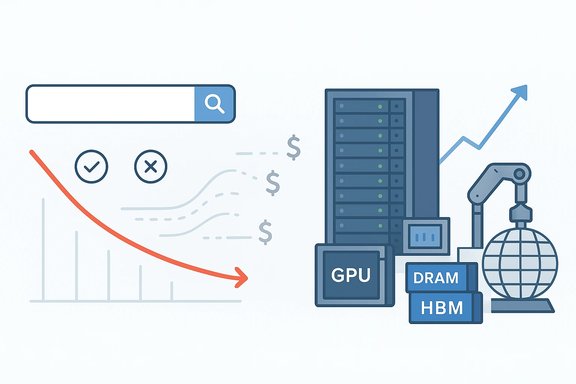
For years Google’s core monetization model has been simple and powerful: index the web, match user intent to relevant pages, and sell targeted ad impressions tied to those clicks. Search’s value proposition was tightly coupled to click‑through behavior — the more users clicked through to publisher pages, the more impressions advertisers received, and the healthier Google’s ad auction became.Generative AI shifts the user experience. When an LLM or an AI‑powered “answer box” returns a synthesized response that satisfies intent, users are less likely to click through to the source pages. This is the precise mechanism behind the zero‑click concern: answers in the interface reduce downstream traffic and, by extension, the pool of impressions available to advertisers. Multiple industry studies and controlled surveys have documented significant drops in click‑through rates for queries that surface AI summaries. The empirical signals show that users are often satisfied with in‑page AI responses and end their session there, producing a measurable decline in referral traffic.
How much is at stake?
Quantifying the dollar impact is hard because ad revenue depends on query mix, advertiser behavior, and how Google decides to embed monetization into its new AI responses. But the directional risk is clear: even partial displacement of high‑value commercial queries (product comparisons, transactional intent, travel, finance) could materially reduce search ad revenue if clicks evaporate faster than Google can implement new ad units or commerce integrations.Analysts who favor the “cannibalization” thesis point to early usage patterns and third‑party traffic studies showing CTR declines in categories where AI summaries are prevalent. These are early, but consistent, indicators that user behavior is changing — and user behavior drives ad economics.
Microsoft’s counter‑narrative: distribution, seats and Azure consumption
Why Microsoft looks differently exposed
Microsoft’s argument for resilience in the AI transition is structural. Its revenue streams are diversified across Productivity and Business Processes (Microsoft 365), Intelligent Cloud (Azure), and More Personal Computing (Windows). The AI monetization avenues for Microsoft are generally seat‑based upgrades (Copilot add‑ons), Azure AI consumption (GPU hours, managed inference), and enterprise services (deployment, tooling), rather than a pure ad auction. That mix reduces the probability of a single UI change wiping out a major revenue engine. Analysts highlighting Microsoft’s durability point to these seat economics and cross‑sell dynamics as the reason to prefer Microsoft as an AI play.The Azure growth story — what the numbers show
Microsoft’s public filings and investor slides confirm strong Azure growth: recent quarterly disclosures reported Azure‑and‑other cloud services growth in the mid‑30s percent range (33–35% year‑over‑year in recent quarters), and Microsoft management has repeatedly framed Azure as a core AI‑infrastructure play that is taking share and driving commercial bookings. Those growth rates are large enough to anchor the idea that Azure is the main commercial beneficiary of enterprise AI deployments today.The balance‑sheet advantage
Beyond current revenue, Microsoft’s balance sheet and multi‑year capital allocation allow it to fund large, lumpy data‑center investments and to tolerate multi‑quarter capacity ramps. That “capex optionality” matters because building GPU‑heavy AI datacenters requires striking a balance between bringing capacity online and achieving utilization that supports margins. Microsoft’s ability to underwrite those investments gives it optionality that smaller providers lack.The infrastructure opportunity: why the money is in chips, memory and fabs
Both bullish analysts and cautious strategists converge on one clear near‑term takeaway: the biggest investable opportunity in the current AI cycle is the infrastructure that powers models.- Data centers, racks, and networking to host models at scale.
- GPUs and accelerator silicon to train and serve models.
- DRAM and high‑bandwidth memory (HBM) that AI servers consume in huge quantities.
- Wafer fab equipment and process tools needed to produce next‑generation chips.
Verifying the key claims: what’s supported by public data
- Azure growth near mid‑30%: Microsoft’s investor relations materials and recent earnings slides show Azure (and related cloud) growth in the low‑to‑mid‑30% range across recent quarters. That rate aligns with management commentary that AI workloads materially contributed to Azure’s expansion.
- Analysts’ comments about cannibalization: multiple financial outlets and a Schwab Network segment quote analysts (Cory Johnson of Epistrophy Capital Research and John Freeman of Ravenswood Partners) who explicitly framed Google’s AI answers as cannibalizing clicks, and who favored Microsoft’s Azure as a safer play. These remarks have been published across Benzinga, Yahoo/AOL syndication, and social posts summarizing the Schwab Network conversation.
- Zero‑click evidence: independent studies and industry tracking reports — including controlled Pew‑style surveys and multiple SEO analytics firms — show substantial drops in CTR when AI summaries appear, with several analyses reporting CTR falls from mid‑teens to single digits in affected queries. While exact percentages vary by study and query type, the direction and magnitude are consistent: AI summaries reduce click rates in a material way.
- Memory and equipment winners: market data and analyst notes (including Reuters coverage of Micron’s pricing environment and Barron’s coverage of Lam Research’s upgrade) corroborate the surge in demand for DRAM/HBM and wafer‑fab equipment tied to AI. Public filings and management commentary from Micron and Lam likewise point to rising orders and tighter supply.
- Alphabet’s stock action: market pricing snapshots reported on major market data sites indicate Alphabet trades in the low‑to‑mid $300s and has experienced strong gains over recent months — a context illustrating investor divergence between enthusiasm for Google’s product execution and concern over its monetization model. For example, Benzinga’s market quote showed GOOGL near $316.54 at a recent close.
Counter‑arguments and Google’s potential responses
Google’s position is hardly helpless. The company has both technical advantages and a very large, monetizable audience:- Google can — and is — experimenting with in‑interface monetization: embedding commerce links, sponsored answers, and premium AI features inside generative responses offers potential paths to preserve or even expand revenue per user if executed well.
- Google’s data and ranking signals give it a product advantage in sourcing and verifying answers; building provenance and citation into AI outputs could preserve users’ trust and encourage click behavior for verification.
- Google Cloud remains a fast‑growing business and could diversify Alphabet’s revenue mix over time, reducing sole reliance on consumer search ads.
Risks and caveats — what to watch and what’s unverifiable
- Model roadmaps and performance claims: announcements about next‑generation models (e.g., hypothetical “GPT‑6”) are often speculative and should be treated with skepticism until supported by reproducible benchmarks or official releases.
- Short‑term attribution of stock moves: single‑day price movement is noisy and not a reliable indicator of long‑term fundamental impact from product changes.
- Exact dollar impact on Google ad revenue: while CTR and traffic studies show directional declines, turning those into company‑level revenue forecasts requires assumptions about ad rates, query mix, and Google’s counter‑measures; any headline dollar estimate without audited backing should be flagged as speculative.
- Google: changes in search click volumes, ad impression counts, and any disclosure of new AI‑native ad formats.
- Microsoft: Copilot seat conversion rates, Azure AI consumption growth, and gross margin trends for AI services.
- Infrastructure suppliers: order books and utilization metrics for GPU, DRAM, HBM, and wafer‑fab equipment.
- Regulatory moves that change how AI outputs must cite or compensate sources.
Practical implications for Windows users and IT leaders
- Treat AI deployments (Copilot or third‑party models) like any major software change: pilot extensively, validate, and gate wide rollouts.
- Prioritize portability: insist on multi‑cloud escape routes and containerized models where appropriate to avoid vendor lock‑in and negotiate meaningful SLAs for availability and data governance.
- Verify provenance and compliance: enterprises in regulated sectors must demand auditability, data residency guarantees, and clear lineage of AI outputs before production use.
- Cost modelling: when evaluating Copilot or managed AI services, compute the total cost per task (not just per‑token prices) to understand operational economics.
Investment takeaways
- The defensive-plus-growth case for Microsoft rests on seat economics and Azure consumption; the company’s current cloud growth rates and enterprise distribution make it a lower‑downside way to play enterprise AI risk — if Azure can convert pilot programs to paid seats at scale.
- For investors seeking leverage but wanting to avoid model‑owner idiosyncrasies, pick‑and‑shovel suppliers (memory, wafer‑fab equipment, data‑center integrators) often present clearer demand signals tied to capex cycles and contract flows. Micron and Lam are typical examples cited by market participants because they serve the constrained memory and equipment supply chains that AI consumption is stretching.
- Google remains a high‑stakes, high‑reward proposition: if it monetizes AI responses effectively (sponsored answers, commerce integrations, subscription tiers), it could preserve or increase lifetime revenue per user; if clicks decline faster than new monetization arrives, top‑line pressure is a real possibility. Investors must watch operational KPIs and management’s product rollout cadence rather than relying solely on model announcements.
Conclusion
The AI transition has created a paradox for one of the tech industry’s most successful business models: the very improvements in user experience that generative models promise may erode the click economics that funded those improvements. That tension explains why analysts warn of cannibalization for Google and why some prefer Microsoft — whose AI monetization paths are largely seat-based and cloud consumption driven — as the safer public play in the near term. The clearest, least speculative opportunity in this cycle remains the infrastructure buildout: memory, GPUs, and wafer‑fab equipment are seeing concrete demand signals that are already visible in orders, pricing, and company guidance.This is not a binary race with a guaranteed winner. Google has product depth, unrivalled reach, and multiple paths to re‑monetize AI inside search. Microsoft has enterprise distribution, seat economics, and the balance‑sheet firepower to underwrite large capex commitments. The prudent posture for technologists and investors alike is evidence‑driven: track the operational metrics (click volumes, Copilot ARPU, Azure AI consumption, DRAM/HBM pricing, wafer‑fab backlogs) and treat sensational product roadmaps as interesting background until corroborated by reproducible data. The coming quarters will show whether AI’s biggest winner is the company that controls user attention, the company that supplies the infrastructure, or the one that successfully translates AI utility into durable revenue without destroying the economics that paid for the innovation in the first place.
Source: Bitget Google Faces 'Cannibalization' Threat While Microsoft's Azure Expands: Specialist Discusses How AI Responses Might Significantly Reduce GOOG's Advertising Income | Bitget News
