

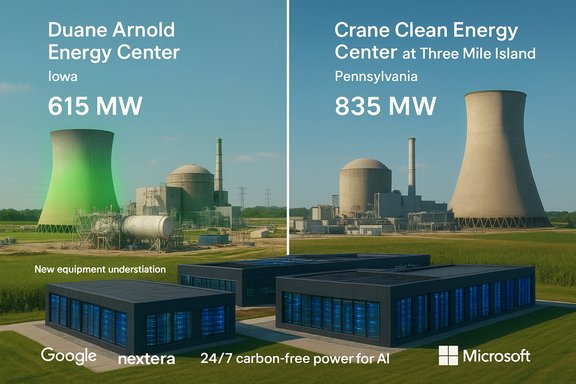
Tech giants are quietly rewiring the U.S. power landscape: Google and NextEra have announced a plan to restart Iowa’s Duane Arnold Energy Center to supply carbon‑free, round‑the‑clock electricity for Google’s expanding AI and cloud footprint, while Microsoft’s earlier deal with Constellation to revive Three Mile Island demonstrates a broader industry pivot toward reactivating idled nuclear reactors to anchor future data‑center growth.
Background
Why nuclear, and why now?
Data centers supporting modern cloud services — particularly large language models and generative AI — are driving unprecedented, continuous electricity demand. Electricity for training and inference workloads is not a seasonal or daytime load: it is constant and often requires predictable, low‑carbon baseload power. Tech companies are therefore shifting from conventional renewable PPAs and grid purchases toward securing dedicated, firm generation that can deliver 24/7 carbon‑free energy at scale.This strategic shift has produced headline deals: Google and NextEra unveiled an agreement to restart the Duane Arnold Energy Center (DAEC) in Iowa so that Google can buy most of the plant’s output under a long‑term arrangement. The plant’s proposed capacity is 615 megawatts and the restart is targeted for early 2029 with a 25‑year purchase agreement in place. Microsoft, in a separate but related move announced in 2024, agreed to buy essentially all output from Constellation Energy’s plan to restart Unit 1 at Three Mile Island — renamed the Crane Clean Energy Center — under a 20‑year contract. That plant is expected to produce roughly 835 megawatts when restored and has been cited as operational again in the 2028 timeframe, subject to regulatory approvals.
What’s changed since nuclear’s last chapter?
The U.S. nuclear fleet has largely been static or shrinking for economic reasons: cheap natural gas, the growth of wind and solar, and the long timelines and costs of new builds curtailed further investment. What has changed is the arrival of hyperscale compute loads that value continuous, carbon‑free power and can underwrite long-term energy contracts that make restarts or refurbishment financially viable. Regulators, utilities, and plant owners are reassessing whether previously uneconomic reactors can be revived under new market conditions.The Deals: Facts, timelines and the commercial logic
Duane Arnold Energy Center — Google + NextEra
- Plant: Duane Arnold Energy Center (DAEC), Palo, Iowa (near Cedar Rapids).
- Capacity: 615 MW (reactor historically commissioned 1975; shut in 2020).
- Deal: NextEra Energy and Google announced a restart collaboration; Google will purchase energy under a 25‑year agreement, with remaining output offered to the local cooperative. Restart target: first quarter of 2029, pending regulatory approvals and refurbishments.
Three Mile Island / Crane Clean Energy Center — Microsoft + Constellation
- Plant: Three Mile Island Unit 1 (adjacent to the 1979 Unit 2 accident site), Pennsylvania.
- Capacity: ~835 MW planned from the refurbished Unit 1.
- Deal: Constellation signed a 20‑year PPA with Microsoft to restart Unit 1, renaming it the Crane Clean Energy Center. Target operational date communicated in 2028, subject to NRC approvals and refurbishment. The project has been presented as an ~US$1.6 billion investment with sizable job and economic benefit estimates attached.
Technical and regulatory hurdles
Licensing and nuclear safety reviews
Restarting an idled nuclear plant is not a flip‑of‑a‑switch operation. Operators must restore the licensing basis for operation, upgrade components to meet current regulatory standards, repair or replace physically damaged systems (DAEC’s cooling towers were damaged in a derecho in 2020), and complete NRC inspections and approvals.Both NextEra and Constellation explicitly acknowledge the need to secure federal approvals and to meet regulatory requirements before commercial operation can resume. That process — encompassing engineering assessments, environmental reviews and NRC licensing work — is a gating path that commonly takes years and is subject to public hearings and technical scrutiny.
Equipment, grid reinforcements and timelines
Beyond licensing, the physical work is nontrivial: replacement of cooling towers, procurement of a large generator and transformers, refurbishment of steam turbines and safety systems, and testing to modern standards. NextEra reporting confirms orders for major hardware as an early sign of progress toward DAEC’s restart; Constellation likewise has presented a multi‑hundred‑million‑dollar refurbishment plan for TMI Unit 1. These procurement cycles, supply chain coordination, and construction timelines shape whether 2028–2029 targets are realistic.Grid interconnection and market integration
A restarted reactor must integrate cleanly with local transmission systems. Hyperscale data‑center loads are often sited with significant grid upgrades in mind. Power purchase agreements commonly include terms to ensure the project’s commercial viability without imposing extra costs on nonparticipating ratepayers; both the Duane Arnold and Three Mile Island announcements emphasize that local customers will not shoulder the cost of the contracted output. Nevertheless, upgrading substations and transmission corridors can create permitting and timing risks.Strategic analysis: opportunities and strengths
1) Firm, carbon‑free baseload for AI workloads
The single clearest strategic advantage is firmness. Nuclear fuel provides steady output around the clock, which is uniquely valuable for training large models that cannot easily tolerate intermittent supply or high spot prices.This capability enables hyperscalers to plan capacity expansion confidently and reduce exposure to volatile wholesale markets during peak grid stress. For companies that bill by compute cycles or run continuous background training, a reliable, price‑predictable baseload is a major benefit.
2) Long‑duration PPAs unlock stranded assets
Long PPAs — 20 to 25 years — provide the revenue certainty operators need to justify multi‑hundred‑million to billion‑dollar refurbishments. For plant owners, this is the difference between decommissioning as a sunk cost and reinvesting to extend reactor life.From a capital allocation perspective, these deals re‑animate assets that were turned off because they could not compete in merchant markets dominated by cheap gas or intermittent renewables. Corporate demand effectively creates a new economic class for legacy nuclear assets.
3) Jobs, local economic injection and faster deployment than new builds
Restarting an existing site avoids the decade‑plus development timeline typical of new nuclear builds and can deliver local jobs and infrastructure investment more quickly. Announcements highlight thousands of direct/indirect jobs during construction and hundreds once operational, plus substantial projected economic activity. For state and local governments facing job and tax revenue opportunities, these projects look attractive.Risks, open questions, and community impacts
Regulatory and schedule risk
Regulatory approvals are the single largest uncertainty. NRC reviews are rigorous and time consuming; public comments, state permitting, and potential legal challenges can extend timelines and inflate costs. Past decommissioning moves included equipment removal and other irreversible steps; reversing those decisions incurs technical and procedural overhead that will be scrutinized. Both the Duane Arnold and Three Mile Island restarts are explicitly conditioned on regulatory clearance.Safety perception and political sensitivity
Three Mile Island carries symbolic weight because of the 1979 partial meltdown at Unit 2. Even when Unit 1 was a separate, safely operated reactor, the site’s history invites disproportionate community and activist attention. Restart campaigns must manage public skepticism, environmental justice concerns, and the optics of reactivating a plant next to a decommissioned accident site. Transparency and exhaustive safety communication will be essential.Concentration of power and local grid effects
Large corporate PPAs that allocate a reactor’s output to a private buyer can alter local energy flows and pricing dynamics. While announcements stress that local customers won’t pay for contracted output, the net market effects — transmission upgrades, congestion, or changed dispatch patterns — require independent assessment. Concentrating major power supplies behind a few corporate consumers also raises governance questions about access and market power.Environmental justice and construction externalities
Rapid industrial refurbishment brings heavy construction activity, temporary emissions (from diesel generators during testing), and distributional impacts on nearby communities. Advocates warn that large industrial programs can produce “sacrifice zone” dynamics if not managed with environmental safeguards, workforce development, and community investment plans. Those concerns have emerged around prior large‑scale data‑center and power projects and deserve close attention here as well.Technical execution and supply‑chain risks
Ordering a generator and cooling towers is one thing; integrating nuclear‑grade systems, replacement parts for legacy equipment, modern instrumentation and control upgrades, and skilled nuclear staffing is another. The global supply chain for specialized nuclear components is limited and the pool of experienced technicians — operators, I&C engineers, nuclear welders — is constrained. Project execution risk is therefore material.Broader market and policy implications
1) A new model for corporate energy procurement
If these restarts succeed, they establish a precedent: corporate offtakers underwriting the restart or life‑extension of generation assets formerly deemed uneconomic. That model may extend to other fossil or nuclear plants and could reshape how regional generation portfolios evolve, making corporate demand an engine of supply‑side change.2) Potential acceleration of advanced nuclear and SMRs
Beyond legacy restarts, tech demand may accelerate investment into next‑generation technologies such as small modular reactors (SMRs) or advanced reactor designs. Those projects still face licensing and commercial scaling hurdles, but corporate backing could shorten their path from pilot to commercial operation.3) Regulatory and procurement frameworks will need updating
State utility commissions, FERC and the NRC may need to clarify frameworks for asset restarts, rate treatment, interconnection prioritization and decommissioning reversals. Policymakers will also face questions about permitting priorities and whether to incentivize corporate PPAs that deliver guaranteed jobs and clean power. Clear, consistent policy will be necessary to avoid ad‑hoc and uneven deployments.Practical takeaways for IT leaders, Windows administrators and local stakeholders
- Short‑term procurement certainty: Long PPAs backed by major tech firms can stabilize long‑term energy supply for data‑center roadmaps. IT planners should factor firm, contractual power into total cost of ownership models for future builds.
- Risk of concentration: Dependence on single large generation sources — whether nuclear or otherwise — increases systemic risk exposure for hosted workloads; architectural redundancy and multi‑region disaster recovery remain essential.
- Community engagement matters: Local acceptance is as critical as engineering execution. Successful projects will offer transparent safety plans, workforce commitments and environmental mitigations.
- Monitor regulatory milestones: Key verification points to watch are NRC filings, environmental review completions, major equipment deliveries, and grid interconnection agreements. These milestones convert announcements into deliverable schedules.
Verification and what remains uncertain
Multiple reputable outlets and the project owners have publicly announced these deals and timelines, but there are still verifiable checkpoints to watch:- NRC licensing and regulatory clearances for both Duane Arnold and Three Mile Island. These are non‑discretionary.
- Major equipment delivery and commissioning milestones — e.g., generator, cooling towers, and transformers — which will signal a move from planning to execution. NextEra has reported orders for key equipment at DAEC.
- Transmission and interconnection filings, which often appear in state or regional utility filings. These show how the plant’s output will be integrated with local grids and data‑center loads.
- Final PPA contract terms (price, firming provisions, curtailment language) — the public summaries omit granular commercial detail and those terms materially affect project economics.
Conclusion
The Google–NextEra and Microsoft–Constellation agreements mark a potentially transformative chapter in how hyperscalers secure the energy foundation for AI. Those deals convert long‑standing nuclear capacity into usable, contracted baseload for compute factories that require uninterrupted, low‑carbon electricity. Strategically, the logic is strong: long‑duration PPAs make refurbishment feasible and give tech firms predictable, firm supply for mission‑critical operations.But the path to restart is neither quick nor guaranteed. Regulatory gates, technical complexity, supply chains, and local stakeholder concerns all present material risks. If these projects deliver on their promises, they will not only power AI but also set a precedent: large corporate demand can reshape the power sector’s investment calculus, reviving assets once deemed uneconomic. If they falter, the industry will be reminded that energy commitments require as much engineering, permitting and community trust as they do corporate capital.
The coming 18–36 months will provide the clearest signals: NRC approvals, equipment installation milestones, and interconnection filings are the concrete checkpoints that will separate strategic intent from operational reality. Observers should watch those records closely as they are the real proof points that will determine whether this “new gold rush” for power will remake regional grids — and who ultimately pays the costs and reaps the benefits.
Source: Research Snipers The New Gold Rush: Tech Giants Race to Restart Old Nuclear Plants – Research Snipers
