
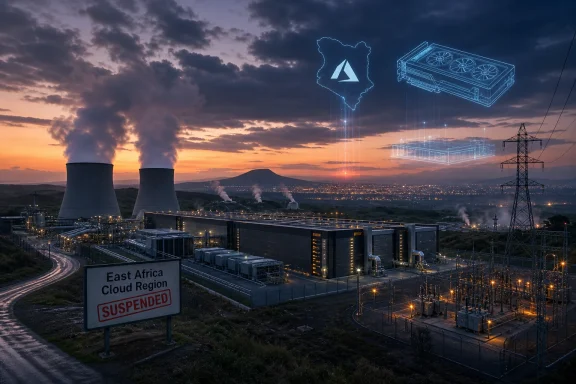
 The Cloud Region Ran Into the Grid
The original pitch was almost perfectly designed for the current technology moment: Microsoft, Abu Dhabi-based G42, Kenya’s government, renewable geothermal power, local AI development, connectivity investment, and a new Azure region for East Africa. In one package, it promised cloud sovereignty, regional digital modernization, climate-friendly infrastructure, and geopolitical alignment among the United States, Kenya, and the United Arab Emirates.
That made the Olkaria project more than a data center. It was meant to be proof that Africa could host hyperscale cloud infrastructure without simply importing the environmental and grid problems already visible in Northern Virginia, Ireland, the Netherlands, and parts of the American Midwest. Kenya’s geothermal resources gave the project a cleaner story than the usual scramble for gas turbines, diesel backup, and grid interconnection queues.
But the numbers have now punctured the story. If a single campus can credibly be described by Kenya’s president as capable of absorbing nearly one third of national generating capacity, then the issue is no longer whether the data center is “green” in marketing terms. The issue is whether the host power system is large, flexible, and resilient enough to absorb hyperscale computing at all.
That distinction matters. A data center can be powered by renewable electricity and still impose huge opportunity costs on a developing grid. Electrons dedicated to cloud and AI workloads are electrons not available to factories, households, electrified transport, water systems, or smaller local businesses unless the country adds capacity fast enough to prevent scarcity from becoming policy.
Microsoft’s East Africa Bet Was Always Bigger Than Microsoft
Microsoft’s 2024 announcement with G42 described a broad digital ecosystem initiative, not merely a server farm. The data center was to be built by G42 and partners, run Microsoft Azure, support a new East Africa Cloud Region, and operate from Olkaria using renewable geothermal energy. The package also included AI model work in Swahili and English, digital skills programs, connectivity investments, and government cloud collaboration.
That breadth was the point. Azure regions are not ordinary commercial real estate projects. They act as anchors for enterprise procurement, government digitization, latency-sensitive services, developer ecosystems, compliance regimes, and eventually AI workloads that prefer local or regional processing. A new cloud region can change where banks host workloads, where startups build products, and how public-sector agencies think about data residency.
For Kenya, the symbolism was obvious. Nairobi already has a strong reputation as a technology hub, with deep mobile-money history, a large developer community, and a government eager to present the country as East Africa’s digital gateway. A hyperscale Azure region would have strengthened that position against rivals on the continent and given multinational customers another reason to treat Kenya as a regional base.
For Microsoft and G42, the project was also strategically elegant. Microsoft could expand Azure’s geographic footprint and AI infrastructure story without presenting the move as a purely extractive land-and-power grab. G42, already tied to Microsoft through a broader AI partnership, could extend its infrastructure role into Africa while sitting inside a politically useful triangle connecting Washington, Abu Dhabi, and Nairobi.
That is why the suspension is so revealing. The deal did not fail because the concept was marginal. It stalled despite being politically favored, internationally visible, and wrapped in green-energy language. If that project cannot clear the power hurdle, less celebrated projects across the region will face an even harder path.
Geothermal Power Was the Selling Point, Not a Magic Wand
Kenya’s geothermal advantage is real. Olkaria is one of the country’s signature energy assets, and geothermal power has the qualities data center operators like: it is renewable, relatively steady, and not dependent on whether the sun is shining or the wind is blowing. In a world where hyperscalers are under pressure to decarbonize electricity use, geothermal is close to the ideal sales pitch.
But baseload renewable power does not remove the need for capacity planning. Data centers are not just large electricity customers; they are unusually unforgiving ones. They require high uptime, redundant power systems, cooling, transmission access, and contractual confidence that energy will be available not only today, but across years of expansion.
This is where green branding can blur the real constraint. Saying a facility will run on renewable geothermal energy answers one question: what kind of energy is being used? It does not answer the larger national question: how much spare firm capacity exists after ordinary consumers, industry, public services, and future demand are accounted for?
Kenya’s reported dilemma is that the data center’s demand looked too large relative to the present system. A facility that might be manageable in a 100,000-megawatt grid becomes a national planning event in a 3,000-megawatt system. Scale is not an adjective in this debate; it is the entire debate.
The same problem applies across much of the continent. Africa has abundant renewable resources, including solar, wind, hydro, and geothermal potential. But potential is not capacity, and capacity is not the same as dependable, connected, financed, dispatchable power delivered to the right place at the right time.
AI Has Turned the Data Center From Real Estate Into Energy Policy
For years, data center stories were written as property stories. The key questions were land, tax incentives, fiber routes, cooling, and proximity to customers. Power mattered, but it was often treated as one input among many.
AI has changed that hierarchy. Training and inference workloads require dense clusters of power-hungry accelerators, and the global race to deploy GPUs has made electricity the limiting reagent for cloud expansion. Microsoft, Google, Amazon, Meta, and the rest of the hyperscale economy now talk about power procurement with the urgency once reserved for chip supply.
That shift is visible everywhere. In the United States, data center growth has become a major driver of local grid debates. In Europe, regulators and utilities have wrestled with whether new facilities should be allowed to connect in constrained markets. In emerging markets, the issue is sharper because the same megawatts needed for AI infrastructure may also be needed for basic electrification, manufacturing growth, and grid reliability.
Kenya’s suspended project should be read in that global context. It is not an isolated embarrassment. It is a local version of a worldwide constraint: the cloud is becoming an energy-intensive industrial sector at precisely the moment governments are trying to electrify transport, decarbonize heating, expand manufacturing, and improve household access.
This is the uncomfortable reality behind the phrase AI infrastructure. It sounds weightless, as if intelligence is being summoned from software alone. In practice, it means land, substations, cooling systems, fiber, transformers, backup generation, and a colossal appetite for steady electricity.
The Political Sell Has Shifted From Digital Leapfrog to Power Build-Out
Ruto is now reportedly using the stalled project to argue for Kenya’s target of expanding national power capacity to 10,000 megawatts by 2030. That is a revealing pivot. The data center began as evidence that Kenya was ready for hyperscale digital infrastructure; it is now evidence that Kenya must build much more energy infrastructure before it can host that digital future at scale.
The target is ambitious. Moving from roughly 3,000 megawatts to 10,000 megawatts by 2030 would require not only generation projects, but also transmission, distribution, grid management, financing, regulatory execution, and bankable demand. The reported investment requirement of about $38 billion underscores the size of the task.
There is a persuasive development argument here. Countries do not become industrial powers by rationing electricity. If Kenya wants to host data centers, factories, electric mobility networks, irrigation systems, mineral processing, and modern public services, it needs a much larger grid. On that point, the Microsoft-G42 setback may be politically useful because it turns an abstract capacity target into a concrete lost opportunity.
But the politics are delicate. Governments can present hyperscale data centers as catalysts for national development, but citizens may ask why scarce power should be reserved for cloud infrastructure before households and local businesses have fully reliable service. The legitimacy of these projects depends on whether they expand the pie or simply reallocate electricity upward to global firms.
That is the line Kenya now has to walk. A data center that comes with new generation, transmission upgrades, local jobs, skills programs, and cheaper digital services is easier to defend. A data center that appears to crowd out ordinary power access is a political liability, no matter how many times the word “green” appears in the brochure.
The Africa Cloud Gap Is Really an Infrastructure Gap
Africa’s cloud market has long suffered from a geography problem. Many users rely on infrastructure hosted outside their country or even outside the continent, which can mean higher latency, data-governance complications, foreign exchange exposure, and fewer local platform capabilities. More African cloud regions would help governments, banks, telcos, health systems, universities, and startups build services closer to users.
The demand side is not the problem. Businesses are digitizing, governments are moving services online, AI tools are spreading, and local developers increasingly need compute that does not sit an ocean away. Kenya, Nigeria, South Africa, Egypt, Morocco, and other markets all have credible claims to regional cloud relevance.
The constraint is the stack underneath the stack. Cloud regions require power, water planning, cooling strategy, fiber redundancy, physical security, land-use approvals, import logistics, and stable policy. AI raises the bar further because compute density increases power demand and makes expansion planning less forgiving.
That is why the Kenya story should worry both African policymakers and hyperscalers. The continent does not lack digital ambition. It lacks enough reliable infrastructure built ahead of demand. If cloud and AI growth arrive faster than grids can scale, Africa risks becoming a market for imported AI services rather than a host for the infrastructure that creates economic leverage.
The consequences are practical. Latency-sensitive applications may remain harder to deploy. Data residency ambitions may be delayed. Local AI development may depend on expensive remote compute. And African governments may find that the rhetoric of digital sovereignty runs into a very old constraint: who controls the power supply?
Hyperscalers Cannot Procurement-Contract Their Way Out of National Scarcity
Large technology companies are very good at signing power purchase agreements, buying renewable energy certificates, and building sustainability narratives around specific projects. In mature markets, that machinery can work reasonably well, though even there it often masks complex grid realities. In smaller or more constrained markets, corporate procurement cannot substitute for national infrastructure planning.
A hyperscaler can promise to buy renewable power, but it cannot by itself create a national grid with enough spare firm capacity. It can fund a dedicated energy project, but that project still has to connect, operate, and coexist with public priorities. It can advertise a low-carbon campus, but if the surrounding system is short of power, the politics will not be solved by accounting.
This is especially true when a project’s demand is large enough to become nationally visible. A few megawatts can be handled as a private industrial load. Hundreds of megawatts, or a campus expected to scale toward that level, becomes part of energy policy. At that point, ministries of ICT, energy regulators, utilities, finance officials, and presidents all end up in the same room.
Microsoft has seen versions of this constraint elsewhere. The company’s AI ambitions depend on an enormous build-out of data center capacity, and the industry’s bottlenecks increasingly include not just chips but energized sites. The Kenyan case simply makes the bottleneck impossible to miss because the gap between project demand and national capacity is so stark.
For WindowsForum readers, the lesson is that the cloud is not an abstraction floating above infrastructure. Azure regions, Microsoft 365 reliability, AI copilots, developer platforms, and enterprise compliance offerings all depend on physical capacity. When that capacity is scarce, product roadmaps meet the grid.
The Geopolitics Made the Deal Shine, Then Made the Stall Louder
The Microsoft-G42-Kenya arrangement was also geopolitical theater. It was announced during Ruto’s 2024 Washington visit, with the Biden administration’s broader effort to deepen U.S. ties in Africa as a backdrop. G42 brought UAE capital and AI ambition. Microsoft brought cloud credibility and enterprise reach. Kenya brought location, geothermal assets, and a government eager to claim digital leadership.
That combination made the deal attractive but also made its stalling more conspicuous. A quiet data center delay is one thing. A suspended project that had been framed as the largest private-sector digital investment of its kind in Kenya is another. When a showcase project halts, it sends a signal far beyond the construction site.
It may also complicate the competitive map for cloud providers. Microsoft’s African cloud footprint already includes South Africa, and other hyperscalers have been selective about where they deploy full regions. East Africa remains strategically important, but the Kenya suspension suggests that the next cloud-region announcement will need a more detailed power story than “renewable energy will be used.”
The geopolitical dimension cuts both ways. If Kenya can use the setback to mobilize financing for a much larger power build-out, the project may eventually look less like a failure than a premature announcement. If the financing does not materialize, the suspension will be remembered as a moment when the AI era’s promises outran the state’s ability to supply electricity.
Either outcome will be watched by other governments. Countries courting hyperscalers will study Kenya’s experience and learn that cloud investment announcements are only as credible as their energy assumptions. The ribbon-cutting economy is giving way to the substation economy.
Kenya’s Hard Lesson for the AI Boom
The most important part of this story is not that one project has stalled. Large infrastructure projects stall all the time. The important part is that a project designed to embody the clean, inclusive, AI-enabled future ran into the oldest industrial constraint in the book.
That should sober up the industry. AI boosters often describe compute as the new oil, but the metaphor is too neat. Compute is not a single commodity that can be shipped anywhere and consumed on demand. It is an assembled condition: chips, power, cooling, land, water, networks, finance, and political permission.
Kenya’s experience also complicates the easy narrative that emerging markets can leapfrog directly into the AI age. Leapfrogging works best when the missing infrastructure can be bypassed, as mobile phones partly bypassed fixed-line networks. Hyperscale AI infrastructure does not bypass the grid. It intensifies the need for one.
That does not mean Kenya should abandon the project forever, nor does it mean African countries should reject data centers. Quite the opposite. Local compute capacity matters, and Africa should not be left dependent on distant cloud regions for the next era of digital infrastructure. But the sequencing has to be honest: power first, or at least power in parallel, not power as an appendix to a press release.
The data center industry likes to talk about “availability zones.” Kenya has just reminded everyone that the first availability zone is the power grid.
The Stall Leaves Five Lessons for Cloud Builders
The Kenya suspension is best understood as a planning failure exposed early enough to be useful. If governments and hyperscalers treat it as a warning rather than an embarrassment, it can improve the next generation of African cloud infrastructure deals.
- A hyperscale data center cannot be evaluated only by whether its contracted electricity is renewable; it must be evaluated by whether the national grid can spare and deliver that electricity without harming other users.
- Kenya’s proposed Azure-linked campus shows that even politically favored, climate-branded projects can stall when their power demand is too large relative to national capacity.
- The promise of African cloud regions remains strong, but the limiting factor is increasingly energy infrastructure rather than customer demand or developer ambition.
- Governments courting AI investment will need to publish credible generation, transmission, and interconnection plans alongside digital-economy announcements.
- Microsoft, G42, and other hyperscale players will have to bring more than capital and cloud branding; they will need to help solve the grid constraints that determine whether projects can exist.
- Kenya’s 10,000-megawatt target by 2030 is now tied to a visible technology prize, but reaching it will require execution at a scale far beyond a single data center deal.
The suspended Microsoft-G42 project does not end Kenya’s tech-hub ambitions, and it does not erase the logic for an East Africa cloud region. It does, however, force a more mature conversation about what the AI economy really requires. The next wave of cloud infrastructure in Africa will be won not by the country with the best launch ceremony, but by the country that can connect renewable power, financing, regulation, and public legitimacy into a grid strong enough to host the future without dimming the present.
